Zhenhai Tower: Guangzhou's Historic Tower Turned City Museum
Perched on Yuexiu Mountain and built in 1380, Zhenhai Tower is one of Guangzhou's most recognizable historic structures. Today it serves as the Guangzhou Museum, tracing the city's long history across five floors of exhibits. The admission price is low, the setting is striking, and the views from the upper floors give real context to how the city grew.
Quick Facts
- Location
- Yuexiu Mountain, Yuexiu District, Guangzhou
- Getting There
- Yuexiu Park Metro Station (Line 2), then a short walk through Yuexiu Park to the hilltop
- Time Needed
- 1.5 to 2.5 hours for the tower and immediate grounds
- Cost
- CNY 10 for the tower; Yuexiu Park entry is separate where applicable
- Best for
- History enthusiasts, architecture admirers, first-time visitors wanting city context
- Official website
- www.guangzhoumuseum.cn/en/main.asp
What Zhenhai Tower Is, and Why It Matters
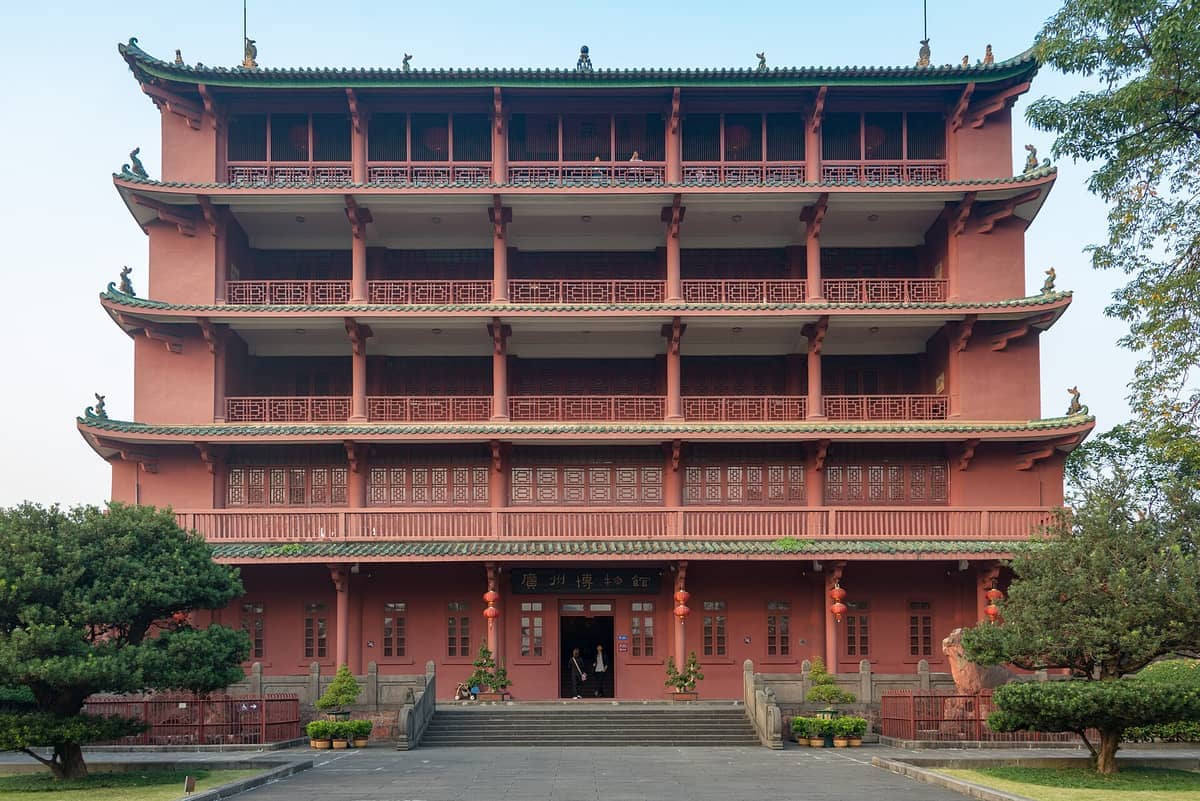
Zhenhai Tower, known in Chinese as 镇海楼 (literally 'Tower That Subdues the Sea'), is the main building of the Guangzhou Museum and one of the oldest surviving structures in the city. Built in 1380 during the early Ming Dynasty, the red sandstone tower rises five stories above Yuexiu Mountain, its distinctive crimson walls visible from well below. It has served as a military watchtower and a warehouse over the centuries. Since the late 1920s it has housed museum collections.
The building is not grand in the way that palace museums are grand. It is compact, precise, and layered with a specific kind of local authority. Guangzhou is one of China's oldest continuously trading cities, and this tower predates most of the urban fabric around it by several hundred years. Visiting it gives first-time arrivals an immediate sense of scale and continuity that no amount of walking through Tianhe's modern towers can provide.
ℹ️ Good to know
Opening hours: 09:00 to 17:30 daily, with last ticket sales at 17:00. The museum is closed on Mondays. Admission is CNY 10.
The Approach: Getting There Through Yuexiu Park
Zhenhai Tower sits inside Yuexiu Park, Guangzhou's largest public park in the central city. To reach the tower, visitors pass through the park entrance and climb a moderate hillside path. The route is shaded by large trees and takes roughly 10 to 15 minutes on foot at a relaxed pace. Yuexiu Park is free to enter separately from the tower ticket, so budget for both.
The walk itself is worthwhile. The path passes old banyan trees, stone tablets, and pockets of local park life: retirees practicing tai chi in the early morning, families with young children on weekends, and groups of older residents gathered for card games in shaded pavilions. By mid-morning the paths fill steadily, and school groups often arrive in organized batches on weekday mornings.
The nearest metro access is Yuexiu Park Station on Lines 2 and 5. From there it is a straightforward walk to the park gates. If you are combining the visit with other Yuexiu-area sites, the Five Rams Statue is also located within the park and can be seen on the same loop without adding significant time.
Inside the Tower: What the Museum Actually Contains
The Guangzhou Museum spreads across the floors of Zhenhai Tower. The exhibits trace the city's history through major periods, including early settlement, the Canton trade era, and modern history. Display cases hold bronze vessels, ceramics, coins, trade goods, maps, and documentary photographs. Labels are in Chinese with English translations, though the quality of English text varies by floor.
The interior spaces are modest in scale. Ceilings are low, corridors are narrow, and the wooden floors creak with age in the upper stories. This is not a complaint: the physical texture of the building is part of the experience. The lower floors tend to carry heavier thematic content about ancient Guangzhou, while the upper floors lean toward the city's role in China's modern history and foreign trade. Artifacts related to the Canton trade system, which made Guangzhou the principal legal port for foreign merchants during much of the 18th century, are particularly well represented.
💡 Local tip
Carry a portable fan or small water bottle. The interior can get warm, particularly in summer, and the narrow stairways between floors retain heat. Air conditioning is present but the building's historic structure limits its effectiveness at peak hours.
Visitors with a serious interest in Guangzhou's history may want to pair this visit with the Nanyue King Mausoleum Museum, which covers the Han Dynasty period in far greater depth and is located about two kilometers to the southwest. The two museums together provide a more complete picture of the city's pre-modern layers.
The View from the Upper Floors
The fifth floor offers an outdoor viewing platform with unobstructed sightlines across central Guangzhou. Looking north, the city's older residential areas fill the middle ground before giving way to more recent development. Looking south, the skyline is visible on clear days, with the Canton Tower rising distinctly on the far bank of the Pearl River.
This is one of the more quietly effective vantage points in the city precisely because it requires a small effort to reach. The view is not the highest in Guangzhou, but the historical grounding of the tower changes how the cityscape reads. You are looking at more than 600 years of city growth from a single fixed point. For a curated overview of Guangzhou's best elevated perspectives, the best views in Guangzhou guide covers the full range of options including rooftop bars, observation decks, and elevated parks.
Photography from the upper platform is relatively unobstructed. Morning light from the east catches the tower's red sandstone walls well in the first two hours after opening. Late afternoon, between 15:00 and 17:00, gives warmer light on the western-facing views. Midday light is flat and harsh in summer but workable in autumn and winter.
Time of Day and Crowd Patterns
Arriving at or shortly after opening at 09:00 on a weekday is the most comfortable option. The park paths are quiet, the tower interior is cool, and the upper viewing platform has space to stand without waiting. By 10:30 on weekends and public holidays, school groups and tour groups arrive in numbers that make the narrow interior floors genuinely crowded.
Midday in summer months should be avoided if heat is a concern. The path up the hill is exposed in sections and the tower's upper floors trap heat. Autumn, from October through November, is the most comfortable season for this visit. Spring visits, from March through May, are also good, though occasional rain should be expected. Carry a compact umbrella regardless of season.
⚠️ What to skip
The museum is closed every Monday. This is a firm closure, not just reduced hours. Plan accordingly, especially if your stay in Guangzhou is short.
Historical and Architectural Context
Zhenhai Tower was constructed in 1380 during the early years of the Ming Dynasty. The structure was built at the northern edge of the city walls that then defined Guangzhou's perimeter, positioned high enough on Yuexiu Mountain to serve as a watchtower over the Pearl River approaches from the south. The name reflects this defensive purpose: subduing maritime threats before they reached the city.
The building's five-story form with its stacked, progressively narrowing floors follows a classic southern Chinese tower typology. The use of red sandstone for the lower sections gives it a visual signature unlike the grey brick typical of northern Chinese historic buildings. Over the centuries the structure has undergone restoration work; the current form preserves the tower's historic appearance. For more context on Guangzhou's architectural heritage, the Guangzhou architecture guide covers both historic and contemporary examples across the city.
The conversion to a museum in the Republican era was part of a broader effort to preserve and reframe Chinese historical identity through civic institutions. The Guangzhou Municipal Museum was among the early public museums established in southern China.
Who Should Visit, and Who Might Want to Skip It
Zhenhai Tower rewards visitors who come with some curiosity about Guangzhou's past. The CNY 10 admission is one of the lowest prices for a historic attraction in any major Chinese city, making it a reasonable addition to a first-timer's itinerary without significant cost or time commitment. Combining it with a broader walk through Yuexiu District makes the most of the trip, since the area contains a high density of historic sites within a compact radius.
Visitors primarily interested in contemporary Guangzhou, shopping, food culture, or large-scale entertainment will likely find the tower underwhelming. The museum does not have the scale or spectacle of a national-level institution, and if your time in the city is very limited, other experiences may return more per hour. Travelers who strongly dislike steep walking paths or confined multi-story climbs should also consider whether the terrain and building layout suit them, as there is no elevator in the historic tower structure.
For travelers planning a broader Guangzhou itinerary, the Guangzhou museums guide provides a full comparison of the city's museum options by theme, collection quality, and practical accessibility.
Insider Tips
- Buy your Yuexiu Park entrance ticket and the Zhenhai Tower ticket separately at the relevant gates. Visitors sometimes queue at the wrong counter.
- The red sandstone walls photograph best in the first 90 minutes after opening, when the angle of morning light brings out the texture and color of the stonework. By midday the walls look significantly flatter.
- The museum's ground floor often receives the least attention from visitors eager to reach the top. Slow down here: the early Guangzhou artifacts, including Han Dynasty ceramics and bronze tools, are among the most significant objects in the collection.
- If you visit on a weekday morning, ask about audio guide availability at the ticket window.
- Combining Zhenhai Tower with the Five Rams Statue and a walk around Yuexiu Lake within the same park visit is an efficient use of time. Allow ample time for the full park circuit including the museum.
Who Is Zhenhai Tower (Guangzhou Museum) For?
- First-time visitors to Guangzhou wanting historical orientation before exploring other neighborhoods
- History and architecture enthusiasts interested in Ming Dynasty structures in southern China
- Travelers on a budget: CNY 10 is among the lowest admission prices for a significant heritage site in any major Chinese city
- Photographers looking for a viewpoint that combines historic foreground with the modern city skyline in a single frame
- Families with older children (roughly 10 and above) who have some interest in Chinese history
Nearby Attractions
Other things to see while in Yuexiu:
- Beijing Road Pedestrian Street
Beijing Road Pedestrian Street runs through the historic heart of Yuexiu District, layering modern retail over more than a thousand years of commercial history. Entry is free, the metro drops you right at the door, and the glass-covered archaeological ruins embedded in the pavement are an unexpected highlight worth stopping for.
- Canton Orchid Garden
Tucked inside Yuexiu District, the Canton Orchid Garden is a compact but carefully curated public garden dedicated entirely to orchid cultivation. At RMB 8 entry, it offers a rare pocket of calm in central Guangzhou, best appreciated in the cooler months when the flowers are at their peak.
- Ersha Island
Ersha Island sits in the Pearl River between Guangzhou Bridge and Haiyin Bridge, covering 1.26 square kilometers of parks, cultural venues, and tree-lined promenades. Free to enter and open around the clock, it offers a rare change of pace from the city's commercial core.
- Five Rams Statue
Carved from over 130 pieces of granite and completed in the late 1950s, the Five Rams Statue stands as one of Guangzhou's most recognizable landmarks. Located inside Yuexiu Park, it is free to visit and open daily, and is often best experienced in the early morning when the park is quiet and the light is soft.