Five Rams Statue: Guangzhou's Defining Symbol in Yuexiu Park
Carved from over 130 pieces of granite and completed in the late 1950s, the Five Rams Statue stands as one of Guangzhou's most recognizable landmarks. Located inside Yuexiu Park, it is free to visit and open daily, and is often best experienced in the early morning when the park is quiet and the light is soft.
Quick Facts
- Location
- Yuexiu Park, Jiefang North Road, Yuexiu District, Guangzhou
- Getting There
- Metro Line 2 – Yuexiu Park Station
- Time Needed
- 30–60 minutes for the statue; 2–3 hours if exploring the full park
- Cost
- Free (no ticket required)
- Best for
- History lovers, first-time visitors to Guangzhou, photography, morning walks
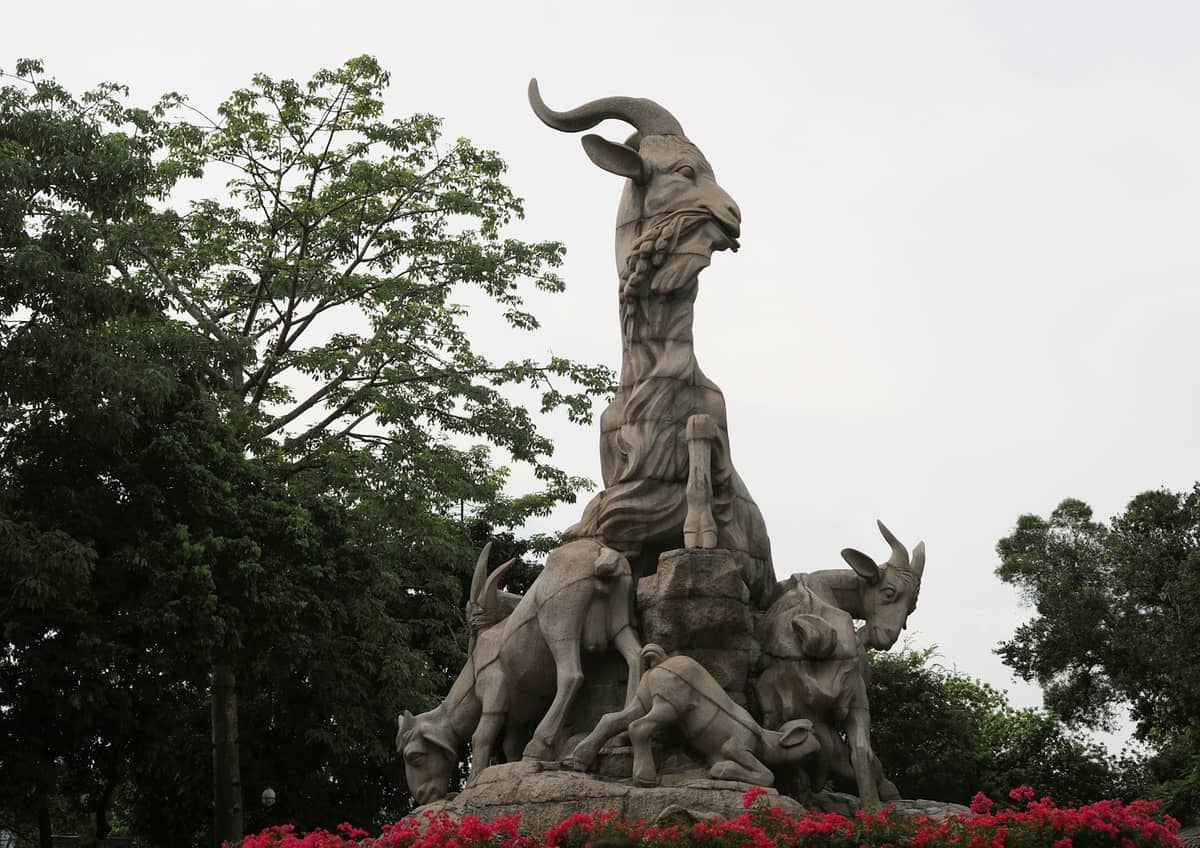
What Is the Five Rams Statue?
The Five Rams Statue, known in Chinese as 五羊石像, is the unofficial civic emblem of Guangzhou. Built in the late 1950s and assembled from more than 130 pieces of granite, the sculpture depicts five rams of descending size standing on a rocky base, with one of the rams holding a sheaf of rice in its mouth. The piece rises roughly 11 meters at its highest point and carries the kind of weight that comes not just from stone but from centuries of local mythology.
The statue is anchored in the founding legend of Guangzhou. According to the story, five celestial beings descended from the sky riding rams, each carrying a stalk of rice as a gift for the people of the region. The rams then turned to stone, and the city grew around that blessing. Whether you take the legend literally or not, it explains why Guangzhou is sometimes called the City of Rams or the City of Five Rams, and why this sculpture carries such genuine meaning for local residents.
ℹ️ Good to know
Opening hours: 06:00–22:00 daily. Admission is free. Verify current conditions before visiting, as hours or access details can change.
Inside Yuexiu Park: Getting to the Statue
The statue stands on a hillside inside Yuexiu Park, one of the largest urban parks in Guangzhou. The park covers over 860,000 square meters, and the statue is positioned on an elevated section that gives it presence without requiring a strenuous climb. Follow the main path from the Southwest Gate and look for signage pointing toward the sculpture area. The walk from the gate takes roughly 10 to 15 minutes at a relaxed pace.
The immediate setting is a tiered stone platform surrounded by trees and low shrubs. There is a viewing area in front that allows you to see the full group of rams from a distance. Up close, the texture of the granite is visible: the rough-hewn surface of the base contrasts with the more carefully finished bodies of the rams themselves. The largest ram faces outward and slightly upward, which is why the statue photographs well from below and slightly to the left.
💡 Local tip
Photography tip: The best angle is from the lower viewing platform, shooting upward to include the sky. Early morning light from the east falls directly on the front of the statue. Bring a wide-angle lens if possible, as the full composition is harder to capture from closer distances.
How the Experience Changes by Time of Day
Early morning, between 06:30 and 08:00, is when the statue belongs to Guangzhou residents rather than tourists. Older visitors practice tai chi on the surrounding paths. Families walk dogs. The air smells of damp stone and park vegetation. The low golden light from the east gives the granite a warm tone that disappears entirely by mid-morning. This is the window when you can stand in front of the statue without another visitor in the frame.
By 10:00, tour groups begin arriving, and the area in front of the statue becomes noticeably crowded. School groups are common on weekday mornings. Weekend afternoons see the heaviest foot traffic, with visitors queuing to take photos on the steps. The statue itself does not change, but the experience around it does: there is more noise, more jostling for position, and less time to simply look.
Late afternoon, around 16:00 to 17:30, offers another relatively quiet window before the evening crowd arrives. The light at this hour falls from the west and catches the rear portion of the rams, which is less photogenic but still pleasant for a calm visit. By 19:00, the park lights come on, illuminating the statue from below. The effect is dramatic and quite different from daytime visits, worth seeing if you are already in the neighborhood.
Cultural and Historical Context
The founding myth of Guangzhou traces the city's origins to the Chu state during the Zhou dynasty period, though the specific details vary across sources. The five rams legend has been part of local identity for centuries, predating the statue itself by more than a thousand years. When city planners commissioned sculptor Yin Jichang to create a permanent monument in the late 1950s, they were codifying something that already existed in civic memory. The use of granite, a durable local material, reinforced the sense of permanence. The Zhenhai Tower sits within the same park and reflects a similarly deliberate effort to anchor Guangzhou's identity in a physical place.
The statue was completed in the late 1950s according to most sources, though some references give 1960; the discrepancy likely reflects the gap between completion and public unveiling. Either way, it belongs to an era when Chinese cities were constructing new civic landmarks, and the Five Rams Statue has outlasted that period to become something genuinely loved rather than merely official.
For visitors who want more context on Guangzhou's history and the layered meaning of its civic symbols, the Nanyue King Mausoleum Museum and the Guangzhou Museum of Art are both worth adding to an itinerary built around understanding how this city sees itself.
Practical Details and Getting There
The most straightforward way to arrive is by Metro Line 2 to Yuexiu Park Station. From the station, the park entrance is a short walk, and signs in both Chinese and English point toward the main attractions. Taxis and ride-hailing apps such as DiDi are also reliable options if you prefer door-to-door transit, though traffic around Jiefang North Road can slow things down during peak hours.
Wear comfortable shoes. The path from the park entrance to the statue involves some gradual inclines and uneven paving stones, particularly around the viewing platform. The area is shaded for much of the morning, which matters in summer when Guangzhou's heat and humidity are at their most intense. From June to August, visiting before 09:00 or after 17:00 is strongly advisable. Bring water regardless of season.
⚠️ What to skip
Summer heat (June–August) in Guangzhou is serious: temperatures regularly exceed 33°C with high humidity. The area around the statue has limited shade at midday. Visiting during these months outside of early morning or late afternoon is uncomfortable and potentially hazardous for children and older travelers.
The statue is free to visit. Yuexiu Park as a whole is an excellent half-day destination that pairs naturally with the Guangzhou Martyrs Memorial Garden nearby. For a broader itinerary covering Yuexiu District's historic core, the Guangzhou walking tours guide offers structured routes that include the park.
Practical Assessment: Is It Worth the Visit?
The Five Rams Statue is worth visiting once, particularly on a first trip to Guangzhou. It is not a spectacle in the way that Canton Tower is, and it does not require significant time. What it offers is a moment of connection to the city's self-image: this is what Guangzhou chose to represent itself with. That has value, especially for travelers trying to understand a place rather than simply photograph it.
Visitors who come expecting an elaborate museum experience or a full afternoon of engagement may find it underwhelming. The statue is exactly what it appears to be from photographs. The surrounding park, however, is genuinely pleasant and easily justifies the trip on its own terms. If you are already in Yuexiu District for the Zhenhai Tower or the city museum, walking over to see the rams takes almost no additional effort.
Travelers who dislike crowds and cannot visit early in the morning may find the midday experience frustrating, with limited space to stand back from the statue without other visitors in view. Families with young children who are mobile and curious about the park tend to enjoy the overall setting more than adults focused solely on the statue itself.
Insider Tips
- Visit between 06:30 and 08:00 on a weekday for the quietest conditions. The park fills noticeably from 09:30 onward, especially on weekends and public holidays.
- The evening lighting rig illuminates the statue from below after dark. If you are in the area after 19:00, the effect is worth a look, particularly from the lower viewing platform where the granite picks up warmer tones.
- From the statue's elevated position, you can see across a large section of Yuexiu Park. Walk a short distance behind the statue for a different perspective on the park's tree canopy, which is dense and photogenic in its own right.
- The park's Southwest Gate entrance is closer to the statue than the main north or east gates. Check which entrance you approach from before entering to avoid an unnecessarily long walk.
- October and November offer the best combination of mild weather, lower humidity, and clear skies for outdoor photography at the statue. Avoid late May through early June when rain and overcast skies are common.
Who Is Five Rams Statue For?
- First-time visitors to Guangzhou wanting to see the city's defining landmark
- History and mythology enthusiasts interested in Cantonese civic identity
- Early morning walkers and photographers looking for golden-hour compositions
- Visitors combining the statue with a broader Yuexiu Park or Yuexiu District itinerary
- Travelers on a tight budget who want genuine cultural significance without admission costs
Nearby Attractions
Other things to see while in Yuexiu:
- Beijing Road Pedestrian Street
Beijing Road Pedestrian Street runs through the historic heart of Yuexiu District, layering modern retail over more than a thousand years of commercial history. Entry is free, the metro drops you right at the door, and the glass-covered archaeological ruins embedded in the pavement are an unexpected highlight worth stopping for.
- Canton Orchid Garden
Tucked inside Yuexiu District, the Canton Orchid Garden is a compact but carefully curated public garden dedicated entirely to orchid cultivation. At RMB 8 entry, it offers a rare pocket of calm in central Guangzhou, best appreciated in the cooler months when the flowers are at their peak.
- Ersha Island
Ersha Island sits in the Pearl River between Guangzhou Bridge and Haiyin Bridge, covering 1.26 square kilometers of parks, cultural venues, and tree-lined promenades. Free to enter and open around the clock, it offers a rare change of pace from the city's commercial core.
- Guangzhou Martyrs' Memorial Garden
Guangzhou Martyrs' Memorial Garden is a free public park and memorial cemetery in Yuexiu District, built to honor those killed in the Guangzhou Uprising of December 1927. It combines significant revolutionary history with shaded walkways, lotus ponds, and calm open spaces that feel worlds away from the surrounding city traffic.