Beijing Road Pedestrian Street: Guangzhou's Ancient Commercial Spine
Beijing Road Pedestrian Street runs through the historic heart of Yuexiu District, layering modern retail over more than a thousand years of commercial history. Entry is free, the metro drops you right at the door, and the glass-covered archaeological ruins embedded in the pavement are an unexpected highlight worth stopping for.
Quick Facts
- Location
- Beijing Road, Yuexiu District, Guangzhou, Guangdong
- Getting There
- Metro Line 6, Beijing Road Station (Exit B); or Line 1/2, Gongyuanqian Station (Exit D, about 800 m walk)
- Time Needed
- 1.5 to 3 hours depending on shopping and dining stops
- Cost
- Free entry; shops open roughly 10:00–22:00
- Best for
- Shopping, street food, evening crowds, urban history
What Beijing Road Pedestrian Street Actually Is
Beijing Road Pedestrian Street is Guangzhou's oldest and most visited commercial corridor, stretching roughly one kilometer through the center of Yuexiu District. The street has served as a trading artery since the Tang Dynasty, and the city has been layering infrastructure on top of itself ever since. What makes this street genuinely interesting for a curious traveler is not the flagship stores or the fast food chains, many of which you could find in any Chinese city, but the fact that the pavement literally reveals its own history.
Beneath a series of glass panels set into the walkway, archaeologists have exposed sections of road surface from multiple dynasties. You can look straight down through the glass at Song, Ming, and Qing-era road layers, each one slightly lower than the last, a cross-section of over a thousand years of urban life compressed into a few meters of depth. It is an unusual and low-key remarkable thing to encounter while standing in the middle of a modern shopping street.
💡 Local tip
The glass-covered road ruins are easy to walk past without noticing. They are located roughly in the middle section of the pedestrian zone. Look down near the larger information boards and slow down — the layered road surfaces from different dynasties are clearly labeled in both Chinese and English.
How the Street Changes Through the Day
In the morning, Beijing Road is almost unrecognizable compared to its evening self. Shop shutters are still coming up, delivery workers stack boxes near entrances, and the few people walking through are mostly commuters cutting across to nearby offices. The paving details, the scale of the buildings lining each side, and the exposed ruins are easiest to examine at this hour without weaving around other pedestrians.
By mid-afternoon the street fills steadily with a mix of local shoppers, school-age students, and domestic tourists. The temperature climbs noticeably in summer and the lack of shade on the main corridor becomes a real consideration. If you are visiting between June and August, either come in the morning before 10:00 or after 18:00 when the sun drops and the air cools slightly.
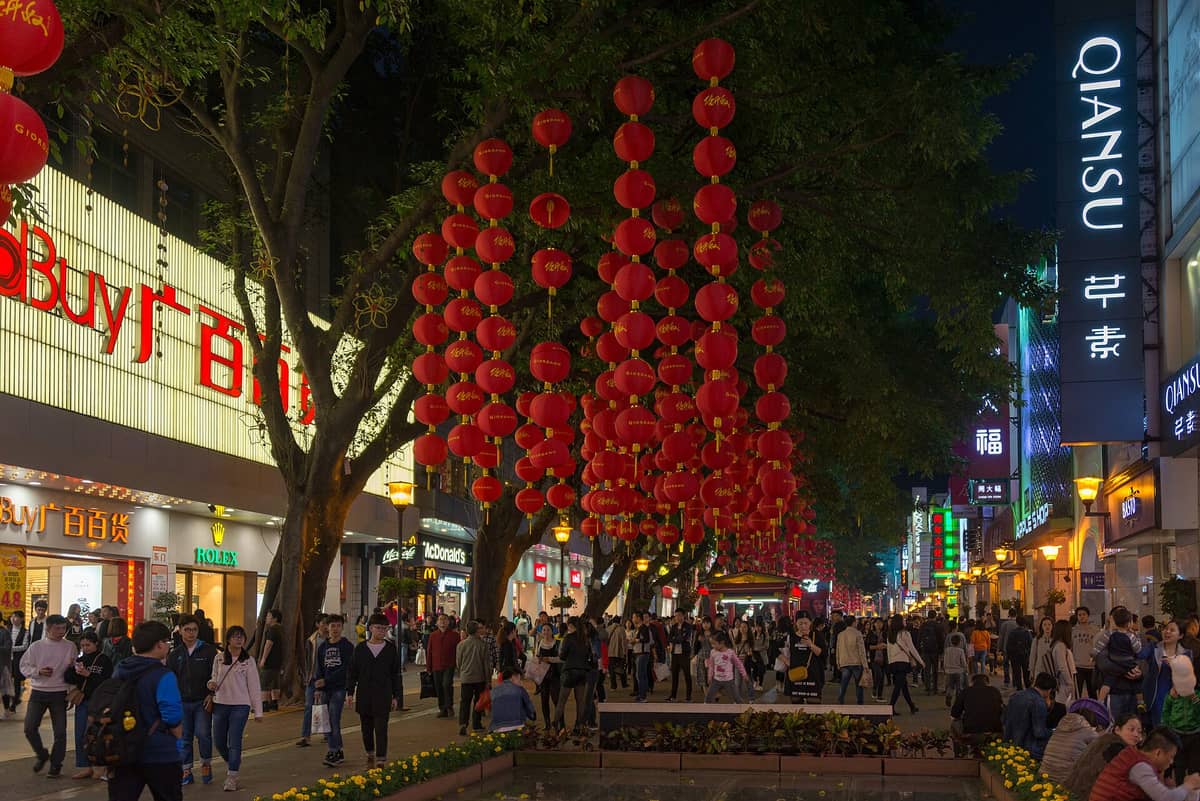
Evening is the street's best mode. After around 19:00, the neon and LED signage above the storefronts switches on in layers, the food stalls at the northern end push steam into the air, and the sound of multiple overlapping conversations, music from shop entrances, and the particular echo that pedestrianized streets produce when they are well populated gives the whole place an energy that daytime simply does not have. Weekend evenings in particular draw crowds large enough that moving at your own pace requires some patience.
⚠️ What to skip
Weekend evenings can get genuinely packed, especially near Golden Week holidays and Chinese New Year. If you have mobility issues or dislike dense crowds, a Tuesday or Wednesday evening is noticeably calmer while still offering the full atmosphere.
Historical Context: A Road Built on Older Roads
The name Beijing Road translates simply as Northern Capital Road, a directional reference from when Guangzhou was mapped using the compass points of the empire. The thoroughfare follows a route that was already established as the city's central commercial axis during the Tang Dynasty (618–907 CE), when the city served as the southern terminus of the maritime Silk Road. Merchants from Persia, Arabia, and Southeast Asia traded here long before the current street layout existed.
The modern pedestrian street designation and the managed commercial zone are governed under Guangzhou municipal regulations that came into effect in May 2022, but the street's transformation into a largely car-free zone had been underway for years before that. The archaeological excavation and preservation of the multi-dynasty road layers was a deliberate decision to retain evidence of the city's commercial continuity rather than simply pave over it, which is how many comparable sites elsewhere in China were treated during rapid urban development.
Beijing Road sits in Yuexiu District, which is the historic administrative core of Guangzhou. Within a short walk you can reach the Nanyue King Mausoleum Museum and the Temple of the Six Banyan Trees, two sites that provide deeper historical context for anyone interested in how old this city actually is.
What to Actually Do Here: A Practical Walkthrough
Exit the metro at Beijing Road Station, Exit B, and you emerge directly at the southern end of the pedestrian zone. The street runs roughly north-south from here, and the best approach is simply to walk the length of it without a fixed agenda. The southern section is dominated by mid-range fashion chains and cosmetics retailers. The middle section is where the archaeological ruins are displayed, and this is also where older commercial buildings with more interesting facades survive between the newer developments.
The northern end toward Zhongshan Road is denser with food options, including bubble tea shops, roasted skewer stalls, and a few Cantonese snack outlets serving items like stinky tofu and rice noodle rolls. The smell shifts noticeably as you move north, from the air-conditioned retail neutrality of the clothing stores to the charcoal and oil scent of street food preparation.
If you are planning a broader shopping day, Beijing Road pairs naturally with Shangxiajiu Pedestrian Street in nearby Liwan District, which has a more traditional Cantonese character and older shophouse architecture. The two streets offer a useful contrast: Beijing Road is more contemporary and commercially polished, while Shangxiajiu feels closer to what Guangzhou's urban shopping looked like before large-scale redevelopment.
Practical Assessment: What Works and What Doesn't
The street is frequently described in superlatives, but a realistic picture is more nuanced. If you are primarily looking for unique or locally distinctive retail, Beijing Road will mostly disappoint. The majority of stores carry national and international brands available throughout China. The food options at the northern end are more interesting but still oriented toward fast, inexpensive eating rather than anything particularly memorable.
What the street does well is atmosphere and accessibility. It is free, it is well-connected by metro, it operates at all hours, and the combination of historical layering beneath a living commercial street is genuinely something you do not encounter in most cities. For travelers who have an afternoon to fill before a dinner reservation, or who want to understand what everyday urban Guangzhou looks and sounds like rather than its showcase attractions, Beijing Road delivers that honestly.
Travelers with a focused interest in Guangzhou's architecture may find the nearby Chen Clan Ancestral Hall more rewarding for craftsmanship and visual detail. For a broader overview of what the city offers, the things to do in Guangzhou guide is a useful starting point.
ℹ️ Good to know
Accessibility: The street is fully pedestrianized at ground level with smooth paving, making it manageable for wheelchair users. However, the glass panels covering the road ruins have slight raised edges, and some sections of the street have temporary vendor setups that narrow the walkway during peak hours. Specific barrier-free facility details are not published by official sources, so verify locally if this is a concern.
Getting There and Practical Notes
Metro access is straightforward. Line 6 to Beijing Road Station, Exit B, brings you directly to the pedestrian zone. Alternatively, Line 1 or Line 2 to Gongyuanqian Station, Exit D, involves a short walk of a few minutes. Both options are reliable and the metro is generally the fastest way to reach this part of Yuexiu during the day.
The street itself is open at all hours, though there is little reason to visit before shops open around 10:00. Payment in shops is almost universally handled through WeChat Pay or Alipay. International visitors without a Chinese bank account linked to these apps should confirm their payment options in advance, as cash acceptance at smaller stalls varies and card terminals are less common than in comparable shopping areas in other countries.
Guangzhou's weather is a real planning factor for this kind of outdoor walk. Summer visits are hot and often humid. The best time to visit Guangzhou is generally October through November or March through April, when the temperature on an outdoor pedestrian street is significantly more comfortable.
Insider Tips
- The archaeological road ruins are lit from below at night, which actually makes them easier to examine after dark than in harsh afternoon sunlight. If you want a clear look, visit after 19:00 and use the lighting to your advantage.
- The cross street at Zhongshan 4th Road marks the northern boundary of the main pedestrian zone. Just beyond it, Beijing Road continues as a regular traffic street with a cluster of older tea and medicinal herb shops that attract far fewer tourists than the pedestrian section.
- WeChat Pay and Alipay dominate here. International visitors should set up a payment method before arriving or carry small denomination cash for street food vendors, some of whom do not accept cards at all.
- Photography of the full street length is best from the upper floors of Grandview Plaza (正佳广场) on the adjacent street, which offers an elevated view over the roofline of the retail blocks. This is not signposted anywhere on the street itself.
- If you are visiting around Chinese New Year, the street is decorated with red lantern installations and the crowd density reaches a peak that is either exhilarating or overwhelming depending on your tolerance. Arrive before 17:00 if you want any personal space.
Who Is Beijing Road Pedestrian Street For?
- First-time visitors to Guangzhou wanting a quick, free introduction to the city's commercial energy
- Travelers interested in urban archaeology and seeing historical layers preserved in a live street setting
- Evening walkers looking for a well-lit, active pedestrian area with street food options
- Shoppers seeking mid-range Chinese fashion and cosmetics brands in a concentrated area
- Anyone building a walking day through Yuexiu District between more specific sights
Nearby Attractions
Other things to see while in Yuexiu:
- Canton Orchid Garden
Tucked inside Yuexiu District, the Canton Orchid Garden is a compact but carefully curated public garden dedicated entirely to orchid cultivation. At RMB 8 entry, it offers a rare pocket of calm in central Guangzhou, best appreciated in the cooler months when the flowers are at their peak.
- Ersha Island
Ersha Island sits in the Pearl River between Guangzhou Bridge and Haiyin Bridge, covering 1.26 square kilometers of parks, cultural venues, and tree-lined promenades. Free to enter and open around the clock, it offers a rare change of pace from the city's commercial core.
- Five Rams Statue
Carved from over 130 pieces of granite and completed in the late 1950s, the Five Rams Statue stands as one of Guangzhou's most recognizable landmarks. Located inside Yuexiu Park, it is free to visit and open daily, and is often best experienced in the early morning when the park is quiet and the light is soft.
- Guangzhou Martyrs' Memorial Garden
Guangzhou Martyrs' Memorial Garden is a free public park and memorial cemetery in Yuexiu District, built to honor those killed in the Guangzhou Uprising of December 1927. It combines significant revolutionary history with shaded walkways, lotus ponds, and calm open spaces that feel worlds away from the surrounding city traffic.