Temple of the Six Banyan Trees: Guangzhou's Ancient Buddhist Landmark
Standing in the heart of Yuexiu District, the Temple of the Six Banyan Trees is one of Guangzhou's most significant Buddhist sites, with origins stretching back to AD 537. Its iconic Flower Pagoda rises above the surrounding streets, and the complex continues to function as an active place of worship — incense smoke, chanting, and all.
Quick Facts
- Location
- No. 87, Liurong Road, Yuexiu District, Guangzhou
- Getting There
- Gongyuanqian Station (Metro Lines 1 & 2), Exit B — approx. 5 min walk
- Time Needed
- 45 minutes to 1.5 hours
- Cost
- Temple entry reportedly free or CNY 5; Pagoda ascent CNY 10. Verify on arrival as pricing varies by source.
- Best for
- History, architecture, cultural immersion, photography
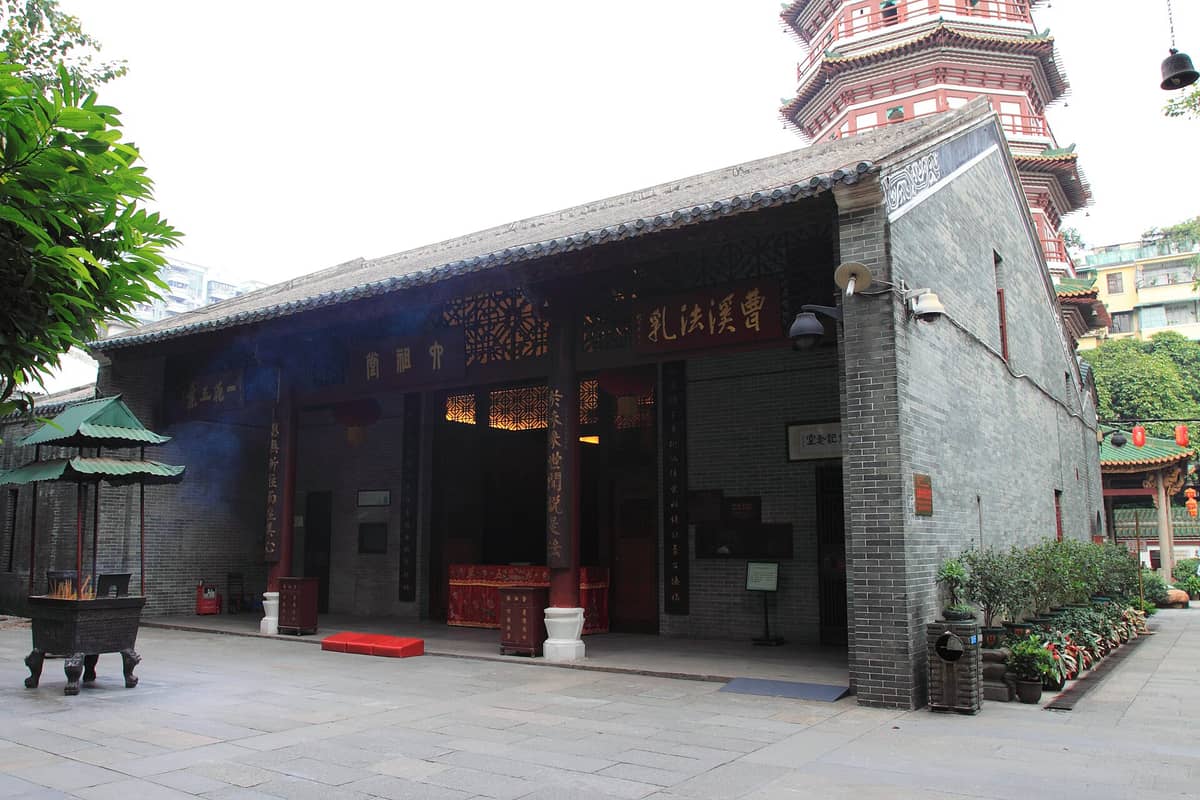
What Is the Temple of the Six Banyan Trees?
The Temple of the Six Banyan Trees, known in Chinese as 六榕寺 (Liurong Temple), is one of the oldest Buddhist temples in Guangzhou, originally constructed in AD 537 during the Liang Dynasty. That date puts it comfortably over 1,500 years old — older than the city's most-visited museums, older than most of its landmarks, and predating by centuries the European trading posts that would eventually define Guangzhou's modern identity. It sits on Liurong Road in Yuexiu District, the historic administrative core of the city, a short walk from some of Guangzhou's other major cultural sites.
The temple's unusual English name comes from the poet Su Dongpo, who visited during the Song Dynasty and was struck by six banyan trees growing in the courtyard. He inscribed the characters for 'six banyans' on a tablet, and the name endured long after the trees themselves were gone. That kind of layered literary history is typical of this complex: it has been destroyed, rebuilt, renamed, and reinterpreted multiple times across dynasties, yet it has remained a continuous center of Buddhist practice in the city.
ℹ️ Good to know
Opening hours are reported as 08:00–16:30 or 08:00–17:00 depending on the source.
The Flower Pagoda: The Reason Most Visitors Come
The Flower Pagoda (Hua Ta) is the visual centerpiece of the complex and the structure that makes this temple recognizable from a distance. Rising to approximately 57 meters, it has nine internal stories but appears from the outside to have seventeen tiers, thanks to the decorative external eaves that ring the structure at close intervals. The effect is unusually dense and ornate compared to pagodas at other Chinese temples, giving it an almost layered-cake silhouette that photography doesn't fully capture.
The current pagoda dates to the Song Dynasty, though it has been repaired and reinforced over the centuries. Ascending it reportedly costs approximately CNY 10 per person. The staircase is narrow and steep — not a casual climb, but manageable for most visitors. From the upper levels, you look out over the rooftops of central Yuexiu, and on a clear day the view extends toward the modern skyline to the southeast. The internal walls carry Buddhist carvings and decorative elements at each landing, making the climb itself worth slowing down for.
💡 Local tip
Photography inside the pagoda is easier with a wide-angle lens or phone camera. The windows are small and the light is low at ground level, so mid-morning visits when natural light filters through the upper openings give the best results.
The Temple Grounds: Active Worship, Not a Museum
Arrive expecting a living temple, not a heritage display case. On any given morning, particularly on weekends and Buddhist holidays, worshippers come to burn incense, make offerings, and pray before the various halls and statues throughout the complex. The main hall houses a large Buddha statue, and smaller shrines are scattered across the courtyards. The smell of incense is strong near the main altar area, particularly in the first two hours after opening.
The grounds are compact but layered — you move through a series of courtyards and covered walkways rather than across an open field. Stone carvings and inscribed tablets are embedded in walls and covered walkways throughout the complex. Some date back centuries; others are modern replacements. The difference in stone patina makes them fairly easy to distinguish if you look closely. Monks in saffron robes are a regular presence, particularly in the early morning.
Visitors who are uncomfortable around active religious practice or who want a purely sightseeing experience may find the atmosphere slightly challenging to navigate during peak worship hours. The temple does not operate as a tourist attraction first: ceremonies, chanting, and devotional activity take precedence, and visitors are expected to be respectful of that. Dress conservatively — covered shoulders and knees are appropriate. Loud conversation near the main halls is unwelcome.
How the Experience Changes by Time of Day
Early morning, between 08:00 and 09:30, is the most atmospheric time to visit. The incense smoke is fresh, worshippers are concentrated and purposeful, and the light in the courtyards is cool and soft. The Flower Pagoda glows differently in morning light than it does at midday, when the sun hits the whitewashed tiers directly and flattens the detail. If you want meditative quiet combined with genuine cultural activity, come early.
By late morning on weekends, tourist numbers increase noticeably. School groups and tour parties move through in clusters, and the ticketed pagoda queue can stretch to 15 or 20 minutes. Midday in summer brings genuine heat — Guangzhou's humid subtropical climate makes June through August outdoor sightseeing genuinely uncomfortable between 11:00 and 14:00. The temple's covered walkways provide some relief, but there is no air conditioning in the historical sections.
The calmest weekday visits tend to be Tuesday through Thursday, outside of public holidays. If you are planning a wider Yuexiu itinerary, the temple pairs naturally with the nearby Yuexiu Park and the Nanyue King Mausoleum Museum, both within comfortable walking or metro distance.
Historical and Cultural Context
The temple's founding in AD 537 places it in the early phase of Buddhism's spread through southern China, a period when the religion was still consolidating its presence in what was then a frontier region relative to the imperial capital. Guangzhou's role as a major maritime trade port meant it received religious and cultural influences from India and Southeast Asia earlier than many inland cities, and the temple reflects that longer southern exposure to Buddhist practice.
The complex survived, in varying forms, through the Tang, Song, Ming, and Qing dynasties, each of which left architectural or decorative contributions. The Song Dynasty renovation produced the current pagoda design. Later renovations during the Republican period and after 1949 preserved the structure while modifying some elements. For visitors interested in tracing Guangzhou's full religious and architectural history, the Guangzhou temples guide provides useful comparative context, including sites like the Huaisheng Mosque and the Temple of the Five Immortals that together illustrate the city's long history of religious coexistence.
Getting There and Practical Notes
The temple is easily reached by metro. Take Guangzhou Metro Line 1 or Line 2 to Gongyuanqian Station and exit via Exit B. The walk to the temple entrance on Liurong Road takes approximately five minutes on flat ground. The surrounding streets are commercial and busy, with small shops and food vendors, so the transition from metro exit to temple gate is quick but not serene.
Ticket pricing has been reported inconsistently across sources: some list free temple entry with a CNY 10 pagoda fee, while others list CNY 5 for temple entry and CNY 10 for the pagoda. Confirm on arrival rather than relying on any single published figure. For a wider look at Guangzhou's free and low-cost cultural options, the free things to do in Guangzhou guide covers which nearby sites cost nothing at all.
No verified accessibility statement for the temple complex was found. The pagoda's narrow internal staircase is not wheelchair accessible. The ground-level courtyards are paved and reasonably even, though some sections have low steps between levels. Visitors with mobility considerations should plan accordingly and may want to contact the temple directly before visiting.
⚠️ What to skip
The temple is an active place of worship. Photography is generally permitted in the grounds and pagoda, but use judgment near ongoing ceremonies and do not photograph worshippers without clear consent. Flash photography near altars is inappropriate.
Insider Tips
- Come on a weekday morning and walk Liurong Road before 09:00. The vendors setting up stalls and monks moving between buildings give you a rhythm that the midday crowd obscures entirely.
- The best exterior photographs of the Flower Pagoda are taken from the small plaza just inside the main gate, where you can include the foreground courtyard. The pagoda appears significantly smaller from street level outside.
- If you want to see the pagoda without climbing it, the upper-floor windows of the main hall offer a direct sightline to the middle tiers that is less photographed than the standard ground-level angle.
- The temple sits one block from Liurong Road's southern junction with Zhongshan Road, which is a major bus corridor. If the metro feels out of your way, several surface bus routes stop within two minutes of the entrance.
- Autumn, specifically October and November, is widely considered the best time to visit Guangzhou for outdoor and cultural sightseeing. The heat drops, the rain eases, and the temple's stone surfaces look particularly clean and cool in that softer light.
Who Is Temple of the Six Banyan Trees For?
- Travelers interested in Chinese Buddhist history and architecture who want a working temple rather than a museum replica
- Architecture enthusiasts drawn to pre-modern pagoda design and Lingnan religious building traditions
- Photographers looking for a photogenic historic structure that is less crowded than Guangzhou's headline attractions
- Cultural travelers building a Yuexiu District itinerary around historic sites within walking distance of each other
- Visitors with limited time who want a compact, meaningful stop that can be done in under 90 minutes
Nearby Attractions
Other things to see while in Yuexiu:
- Beijing Road Pedestrian Street
Beijing Road Pedestrian Street runs through the historic heart of Yuexiu District, layering modern retail over more than a thousand years of commercial history. Entry is free, the metro drops you right at the door, and the glass-covered archaeological ruins embedded in the pavement are an unexpected highlight worth stopping for.
- Canton Orchid Garden
Tucked inside Yuexiu District, the Canton Orchid Garden is a compact but carefully curated public garden dedicated entirely to orchid cultivation. At RMB 8 entry, it offers a rare pocket of calm in central Guangzhou, best appreciated in the cooler months when the flowers are at their peak.
- Ersha Island
Ersha Island sits in the Pearl River between Guangzhou Bridge and Haiyin Bridge, covering 1.26 square kilometers of parks, cultural venues, and tree-lined promenades. Free to enter and open around the clock, it offers a rare change of pace from the city's commercial core.
- Five Rams Statue
Carved from over 130 pieces of granite and completed in the late 1950s, the Five Rams Statue stands as one of Guangzhou's most recognizable landmarks. Located inside Yuexiu Park, it is free to visit and open daily, and is often best experienced in the early morning when the park is quiet and the light is soft.