Temple of the Five Immortals: Guangzhou's Ancient Taoist Heart
Rebuilt in 1377 during the Ming dynasty, the Temple of the Five Immortals stands in Yuexiu as one of Guangzhou's oldest Taoist shrines and the physical home of the city's founding legend. Admission is free, the crowds are thin, and the atmosphere is unlike anything in the city's more polished attractions.
Quick Facts
- Location
- No. 233 Huifu West Road, Yuexiu District, Guangzhou
- Getting There
- Ximenkou or Gongyuanqian (both approx. 9-min walk)
- Time Needed
- 45 to 90 minutes
- Cost
- Free (ID may be required to collect entrance ticket on site)
- Best for
- History seekers, Taoist culture, quiet sightseeing, photography
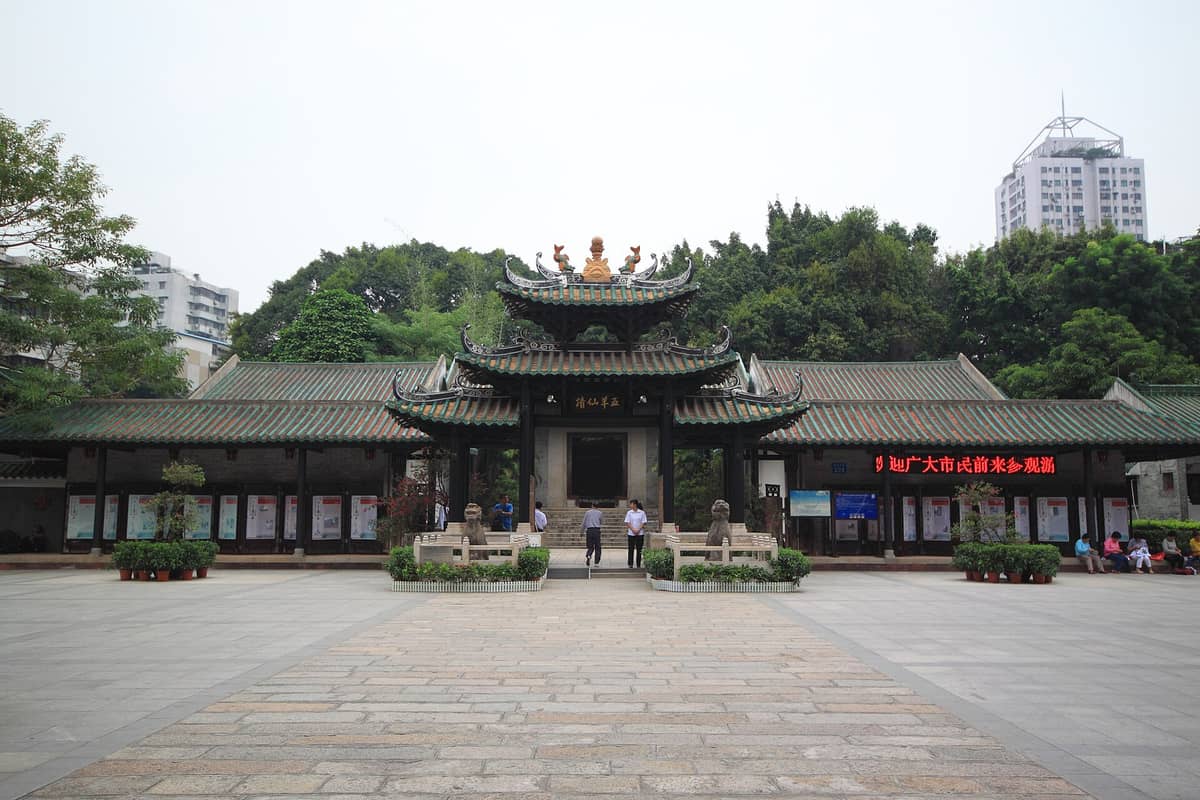
What Is the Temple of the Five Immortals?
The Temple of the Five Immortals, known in Chinese as 五仙观 (Wuxian Guan) and occasionally rendered in older English texts as the Temple of the Five Genii, is a Taoist temple complex on Huifu West Road in Yuexiu District, Guangzhou. It was rebuilt in 1377 during the early Ming dynasty on a site already associated with the city's founding mythology. Most travelers pass through Guangzhou without ever finding it, which makes it one of the most rewarding detours in the old city core.
The temple enshrines the legend of Guangzhou's origin: five immortals descended from the sky riding rams of five colors, each carrying a stalk of rice as a gift to the people of the south. The rams were turned to stone, the immortals vanished, and the city grew around that act of celestial generosity. That story is the reason Guangzhou is nicknamed the City of Rams or the City of Goats, and this temple is its ritual center.
ℹ️ Good to know
Opening hours are reported as 08:00–17:00 daily. Some sources list different hours, so verify locally before visiting, as hours may vary by season or public holiday. Verify locally before visiting, as hours may vary by season or public holiday.
The Founding Legend and Why It Still Matters
Guangzhou's founding myth is not just decorative folklore. The five rams appear on the city's official emblem, they stand in bronze at Yuexiu Park a short walk north, and they are the cultural backdrop that connects this temple to the city's civic identity across more than two thousand years of recorded history. The Ming-dynasty structure at 233 Huifu West Road is not the first temple on this site, only the best-preserved. Earlier structures associated with the five immortals date back centuries before the Ming, though the 1377 relocation is the accepted official site-history date.
For travelers spending serious time in Guangzhou, the temple pairs naturally with a walk to the Five Rams Statue in Yuexiu Park and a visit to the Zhenhai Tower, both nearby. Together, these three sites tell the story of Guangzhou's founding mythology more completely than any museum exhibit.
What You Actually See Inside
The temple compound is modest in scale compared to major religious complexes in China, which is part of its appeal. You enter through a gate on Huifu West Road and step almost immediately into a quieter register of the city. The main hall houses statues of the five immortals, each associated with one of the colored rams from the founding legend. The figures are painted and robed in ceremonial style, and the hall carries the low smell of incense that clings to every active Taoist space.
One of the genuinely unusual features of the complex is the Chumi Rock, a large indentation in the bedrock within the temple grounds that is traditionally identified as a giant footprint left by one of the immortals. Whether you take the mythology literally or not, the rock is a physical anomaly in the middle of an urban temple, and it has drawn pilgrims and curious visitors for centuries. Look for it in the courtyard area rather than the main hall.
The Lingying Bell Tower on the grounds The Lingying Bell Tower on the grounds holds a large iron bell. Local tradition holds that ringing it would bring disaster to the city, so it hangs in deliberate silence. It is one of those small, specific details that rewards travelers who read about a place before arriving.
💡 Local tip
Dress modestly. Shorts and sleeveless tops are not appropriate inside the active worship halls. The courtyard areas are more relaxed, but covering up shows respect and is straightforward to plan for.
How the Experience Changes by Time of Day
Morning visits, particularly on weekdays, offer the most contemplative experience. The incense smoke is freshest in the early hours, locals come to pray before work, and the surrounding streets have a slower rhythm before the commercial day starts properly. The light in the courtyard is soft and directional before midday, which is favorable for photography of the architectural details and the Chumi Rock.
By midday the temple remains relatively quiet by Guangzhou standards. This is not the kind of site that draws large tour groups or school parties in significant numbers. Afternoons bring occasional clusters of domestic tourists, but the overall visitor density stays low throughout the week. Weekend mornings see slightly more visitors, but nothing that disrupts the meditative quality of the space.
Avoid visiting on public holidays if you want the quietest experience. The temple sits in a neighborhood that fills up during festivals, and the surrounding streets can become genuinely crowded even if the temple itself stays manageable.
Getting There and Navigating the Neighborhood
The most practical approach is to take the Guangzhou Metro to either Ximenkou Station or Gongyuanqian Station. From either stop, the walk to the temple is short on foot through streets that are worth walking slowly. The neighborhood around Huifu West Road is part of old Yuexiu, and the street-level texture here, covered walkways, small hardware shops, tea sellers and the particular flatness of the old city grid, is itself a form of sightseeing.
If you are already exploring Yuexiu Park or the Nanyue King Mausoleum Museum, both of which are in the same district, the Temple of the Five Immortals fits naturally into the same half-day itinerary. The three sites together give a layered reading of Guangzhou from the mythological, through the imperial, to the civic.
💡 Local tip
Bring your passport or Chinese ID. Free entry may require collecting a ticket at the gate, and the gate staff sometimes check identification. This takes less than a minute but can catch unprepared visitors off-guard.
Photography and Practical Notes
The temple is genuinely photogenic in ways that reward patience. The courtyard geometry, the layered roof lines, the worn stone underfoot, and the contrast between the ochre-painted walls and the green of any plant growth inside the compound all photograph well. Morning light entering from the east hits the main gate facade directly before 10:00, which is the best window for exterior shots.
Photography inside the main worship halls requires sensitivity. Active worshippers should not be photographed without clear indication they are comfortable with it. In practice, most visitors find that staying in the courtyards and architectural spaces provides more than enough material without ever needing to photograph people in prayer.
No authoritative accessibility information is available for this site. The temple involves historic stone surfaces, which may be uneven, and there is no confirmed information about step-free routes, ramps, or wheelchair facilities. Visitors with limited mobility should verify conditions locally before planning a visit.
Is It Worth Your Time?
The honest answer is: yes, but with realistic expectations. The Temple of the Five Immortals is not a large or visually overwhelming site. You will not spend three hours here. What it offers is something rarer in a city that has modernized as aggressively as Guangzhou: a direct, quiet connection to the mythological foundation of the city, housed in a Ming-dynasty structure that has survived six and a half centuries of urban development around it.
Travelers who have already visited the Chen Clan Ancestral Hall in Liwan or the Temple of the Six Banyan Trees nearby will find this temple occupies a different register: less ornate, less well-known internationally, and in some ways more authentic for that reason.
Travelers who skip it: if ancient Chinese mythology and Taoist architecture are simply not areas of interest, the temple will not convert you. The site does not have a significant museum component, English-language interpretation is sparse, and there are no cafes or visitor amenities on-site. Travelers looking primarily for entertainment, food, or shopping should spend their limited time elsewhere in Yuexiu.
Insider Tips
- The Chumi Rock footprint is easy to miss if you go straight to the main hall. Ask at the gate or look in the eastern courtyard area before leaving.
- Weekday mornings before 10:00 give you the temple almost entirely to yourself, plus better light for photography.
- The area around Huifu West Road has several small Cantonese breakfast spots. Eat before entering rather than hunting for food after, as the immediate surroundings are light on tourist-friendly dining.
- Combine this visit with the Five Rams Statue and Zhenhai Tower in Yuexiu Park for a focused half-day on Guangzhou's founding mythology. All three are within a comfortable walking distance.
- The iron bell in the Lingying Bell Tower is one of the oldest surviving cast-iron objects in Guangzhou. Spend a moment reading any available signage about it rather than passing it as background scenery.
Who Is Temple of the Five Immortals For?
- History and mythology enthusiasts who want context for the city beyond its modern skyline
- Photographers looking for textured architectural subjects without large crowds
- Travelers following a Taoist or religious heritage itinerary through southern China
- First-timers in Guangzhou who want to understand why the city is called the City of Rams
- Independent travelers building a half-day walking itinerary through old Yuexiu
Nearby Attractions
Other things to see while in Yuexiu:
- Beijing Road Pedestrian Street
Beijing Road Pedestrian Street runs through the historic heart of Yuexiu District, layering modern retail over more than a thousand years of commercial history. Entry is free, the metro drops you right at the door, and the glass-covered archaeological ruins embedded in the pavement are an unexpected highlight worth stopping for.
- Canton Orchid Garden
Tucked inside Yuexiu District, the Canton Orchid Garden is a compact but carefully curated public garden dedicated entirely to orchid cultivation. At RMB 8 entry, it offers a rare pocket of calm in central Guangzhou, best appreciated in the cooler months when the flowers are at their peak.
- Ersha Island
Ersha Island sits in the Pearl River between Guangzhou Bridge and Haiyin Bridge, covering 1.26 square kilometers of parks, cultural venues, and tree-lined promenades. Free to enter and open around the clock, it offers a rare change of pace from the city's commercial core.
- Five Rams Statue
Carved from over 130 pieces of granite and completed in the late 1950s, the Five Rams Statue stands as one of Guangzhou's most recognizable landmarks. Located inside Yuexiu Park, it is free to visit and open daily, and is often best experienced in the early morning when the park is quiet and the light is soft.