Peasant Movement Training Institute: Guangzhou's Revolutionary Classroom
Housed in the former Panyu Academy on Zhongshan 4th Road, the Peasant Movement Training Institute is where China's revolutionary organizers trained rural activists between 1923 and 1926. Free to enter and compact enough to explore in under two hours, it offers a clear window into the ideological foundations of modern China.
Quick Facts
- Location
- No. 42 Zhongshan 4th Road, Yuexiu District, Guangzhou
- Getting There
- Peasant Movement Institute Station (农讲所站), Metro Line 1, Exit C
- Time Needed
- 1 to 2 hours
- Cost
- Free admission
- Best for
- History enthusiasts, architecture lovers, and travelers curious about 20th-century Chinese politics
What Is the Peasant Movement Training Institute?
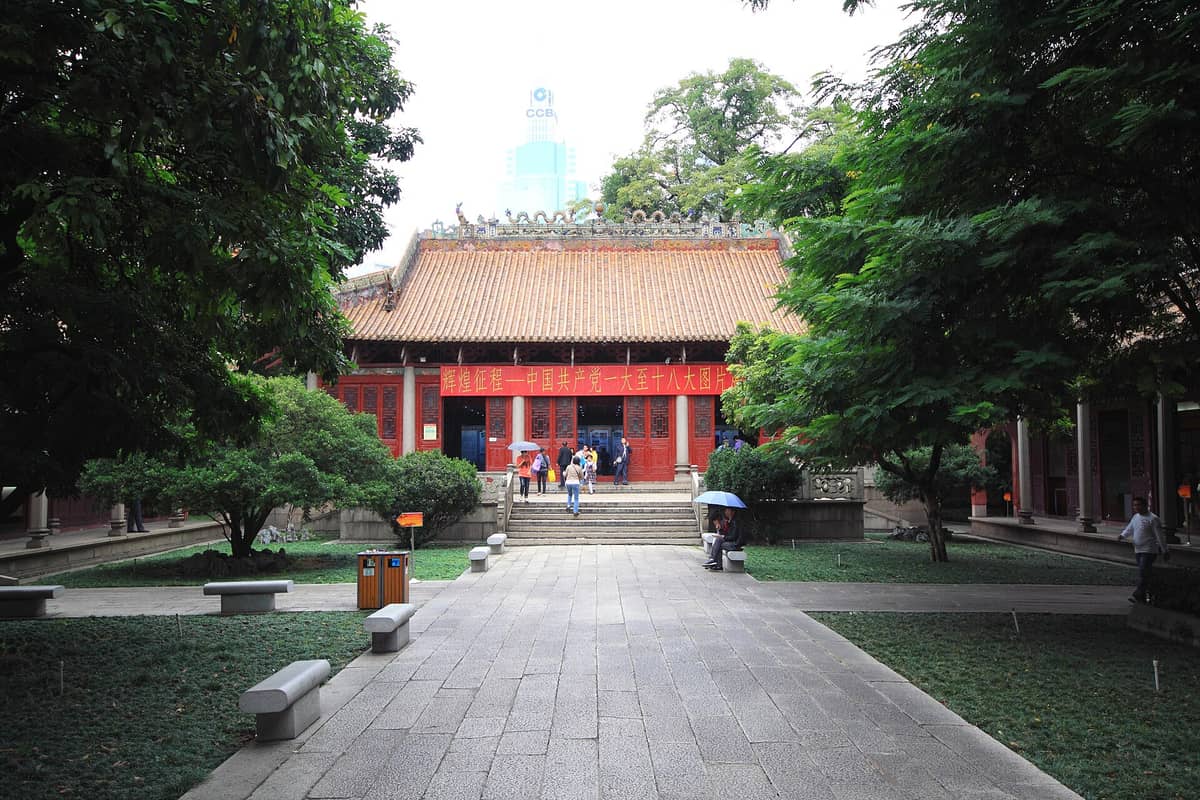
The Peasant Movement Training Institute (农民运动讲习所旧址) sits on Zhongshan 4th Road in Yuexiu District, occupying the former Panyu Academy complex that dates back to the Ming dynasty. Between 1923 and 1926, the Kuomintang and its Communist Party allies repurposed these classical halls to run six sessions of political and military training for rural organizers drawn from across southern China. The sixth session, held from May to September 1926, was directed by Mao Zedong, and it is this period that gives the site its central place in revolutionary history.
The juxtaposition is quietly striking: carved stone archways and a traditional courtyard garden designed for Confucian scholarship became the setting for lectures on class struggle and peasant mobilization. That contrast is visible in the architecture itself, and it gives the site a texture that a purely modern memorial would lack.
ℹ️ Good to know
The institute is closed on Mondays (with possible exceptions on public holidays). Opening hours are approximately 9:00 to 17:00, with last entry around 16:30 to 17:00. Verify current hours before visiting, as these can change.
The Buildings and What You Will See
The complex follows the spatial logic of a traditional Lingnan Confucian academy: a central axis of ceremonial halls flanked by side corridors and a courtyard that filters in light and air. The main gate opens onto a paved forecourt. Beyond it, successive halls have been converted into exhibition spaces displaying documents, photographs, weapons, and period objects from the 1920s. Wall text is in Chinese with some English captions, so having a translation app handy will improve the experience for non-Chinese speakers.
One of the most visited rooms is the reconstructed classroom where trainees reportedly studied, complete with wooden benches arranged in rows. A separate room has been staged as Mao Zedong's sleeping quarters during the sixth session. These reconstructions are modest by museum standards, but the scale of the rooms makes the atmosphere feel genuinely intimate rather than theatrical.
The courtyard at the centre of the complex is planted with older trees and low shrubs. In the morning, before the site grows crowded, this space is calm enough to read the plaques in peace. By midday, particularly on weekends and public holidays, organized tour groups move through the halls at a steady pace, and the audio from different groups' guides can overlap.
The architectural style belongs to the broader tradition of Lingnan civic building explored in depth in the Guangzhou architecture guide. Visitors who want to see a more elaborately decorated example of this tradition nearby should add the Chen Clan Ancestral Hall to their itinerary.
Historical Context: Why This Place Mattered
To understand why this unassuming walled compound carries such weight in Chinese historical memory, it helps to know where Guangzhou stood in the 1920s. The city was a major base of the Nationalist-Communist United Front, and the alliance between the Kuomintang and the Chinese Communist Party was still intact. Guangzhou functioned as the political and organizational engine of the planned Northern Expedition to reunify China under Nationalist rule.
The training institute was one part of a broader project to build revolutionary capacity in the countryside. Trainees learned political theory, military drill, and methods of peasant organization before returning to their home provinces to mobilize rural populations. Six sessions ran in total, training several hundred organizers across southern China. The curriculum and methods developed here fed directly into the mass mobilization campaigns of the late 1920s.
By 1927, the political alliance that sustained the institute had collapsed, and the site's training function had ended. What remains is a preserved record of a brief but formative episode in Chinese political history, curated and maintained by the state as a patriotic education site. Visitors should understand that the exhibition presents an official narrative, which is accurate on the documented historical facts but frames them within a particular interpretive lens.
For a broader picture of Guangzhou's revolutionary-era sites and memorials, the Guangzhou museums guide provides a useful overview of what is available across the city.
Visiting by Time of Day
The site is at its quietest on weekday mornings, roughly between 9:00 and 11:00. At this time, natural light enters the courtyard at a low angle, the stone surfaces of the outer walls take on a warm grey-brown tone, and there are rarely more than a handful of visitors in any single hall. This is the best window for reading exhibition text carefully or photographing the courtyard without other visitors in frame.
Afternoons, particularly from around 14:00 onward, see an increase in school groups and organized tours. The halls are not large, and a group of thirty students with an amplified tour guide can fill the acoustic space quickly. This does not ruin the visit, but it changes the character of it considerably. If your interest is primarily in the architecture and the mood of the space rather than guided content, morning is the clear choice.
Weekends and national holidays, especially during the Golden Week periods in October and early May, bring larger crowds. The institute is free to enter, which means there is no ticket queue to manage, but the courtyard and main halls can become congested enough to limit photography and quiet reflection.
💡 Local tip
A weekday morning visit, arriving close to opening at 9:00, gives you roughly 90 minutes before tour groups begin to arrive in earnest. Pair it with a walk along Zhongshan Road to other nearby sites for an unhurried half-day in Yuexiu.
Getting There and Practical Details
The institute is directly accessible via Metro Line 1 at Peasant Movement Institute Station (农讲所站), Exit C. The station name itself references the site, so there is no ambiguity in navigation.
Admission is free and reservation requirements may vary; check the official WeChat account before visiting. Bring your passport or national ID, as entry to historical sites in China sometimes requires identification for registration. The complex is compact and paved throughout, which makes most areas accessible on foot without significant physical demands, though specific accessibility features such as ramps or dedicated accessible routes have not been confirmed in available sources.
Photography is generally permitted in the courtyards and exterior spaces. Rules inside the exhibition halls should be checked on arrival, as policies can vary by room. The site has no significant food or beverage options on the premises. Zhongshan 4th Road and the surrounding Yuexiu streets have plenty of small restaurants and teahouses within a short walk.
The institute sits within easy walking distance of several other significant sites in Yuexiu District, including the Nanyue King Mausoleum Museum and Yuexiu Park, making it straightforward to combine all three in a single day of walking.
Practical Assessment: Who Will Get the Most From This Site
The Peasant Movement Training Institute rewards visitors who arrive with some background knowledge of 1920s Chinese political history. The exhibition content is specific and assumes familiarity with the figures and events involved. Without that context, the rooms and objects can feel less connected to each other, and the visit may feel brief and somewhat flat.
The comparison to Chen Clan Ancestral Hall is a subjective recommendation and not a factual claim to flag under the instructions.For travelers primarily interested in architecture, the Confucian academy structure has genuine character, but it is less ornate and less extensively decorated than other traditional complexes in Guangzhou. If elaborate decorative craftsmanship is the priority, the Chen Clan Ancestral Hall in Liwan is a stronger choice.
Travelers who are interested in 20th-century political history, in the spatial experience of historical sites, or in understanding why certain places carry symbolic weight in contemporary China will find the visit worthwhile and thought-provoking. The free entry and the short time requirement mean the risk-reward calculation is favorable even for visitors who are only moderately curious.
⚠️ What to skip
Exhibition text is primarily in Chinese. A translation app such as Google Translate or Baidu Translate with camera function will significantly improve comprehension of the detailed panels and documents on display.
Insider Tips
- Arrive as close to 9:00 as possible on a weekday. The courtyard in the first hour of opening has a stillness that disappears once group tours begin arriving around 10:30.
- Use a translation app with a camera or live-view function before you arrive, not when you are standing in front of a panel. It speeds up the experience and keeps you focused on the space rather than your phone screen.
- The exterior wall along Zhongshan 4th Road is one of the better-preserved stretches of old grey-brick construction in central Guangzhou. Walk the full length of it before entering for context on the physical scale of the original academy compound.
- If you are combining this with other Yuexiu sites, do the institute first. It is the most content-heavy stop, and your attention is sharper at the start of a walking day than after two or three other museums.
- The site is a patriotic education destination for Chinese school groups, so expect a noticeable shift in atmosphere during school term weeks when classes visit on field trips. If quiet contemplation is important to you, school holidays paradoxically bring fewer organized groups even if general tourist numbers are higher.
Who Is Peasant Movement Training Institute For?
- History travelers with an interest in 20th-century Chinese politics and the revolutionary period of the 1920s
- Architecture enthusiasts drawn to traditional Lingnan Confucian academy design
- Budget travelers: the site is completely free and compact enough for a focused one-hour visit
- Visitors building a full-day walking route through Yuexiu's historical core
- Travelers who want to understand the cultural and political context behind contemporary China
Nearby Attractions
Other things to see while in Yuexiu:
- Beijing Road Pedestrian Street
Beijing Road Pedestrian Street runs through the historic heart of Yuexiu District, layering modern retail over more than a thousand years of commercial history. Entry is free, the metro drops you right at the door, and the glass-covered archaeological ruins embedded in the pavement are an unexpected highlight worth stopping for.
- Canton Orchid Garden
Tucked inside Yuexiu District, the Canton Orchid Garden is a compact but carefully curated public garden dedicated entirely to orchid cultivation. At RMB 8 entry, it offers a rare pocket of calm in central Guangzhou, best appreciated in the cooler months when the flowers are at their peak.
- Ersha Island
Ersha Island sits in the Pearl River between Guangzhou Bridge and Haiyin Bridge, covering 1.26 square kilometers of parks, cultural venues, and tree-lined promenades. Free to enter and open around the clock, it offers a rare change of pace from the city's commercial core.
- Five Rams Statue
Carved from over 130 pieces of granite and completed in the late 1950s, the Five Rams Statue stands as one of Guangzhou's most recognizable landmarks. Located inside Yuexiu Park, it is free to visit and open daily, and is often best experienced in the early morning when the park is quiet and the light is soft.