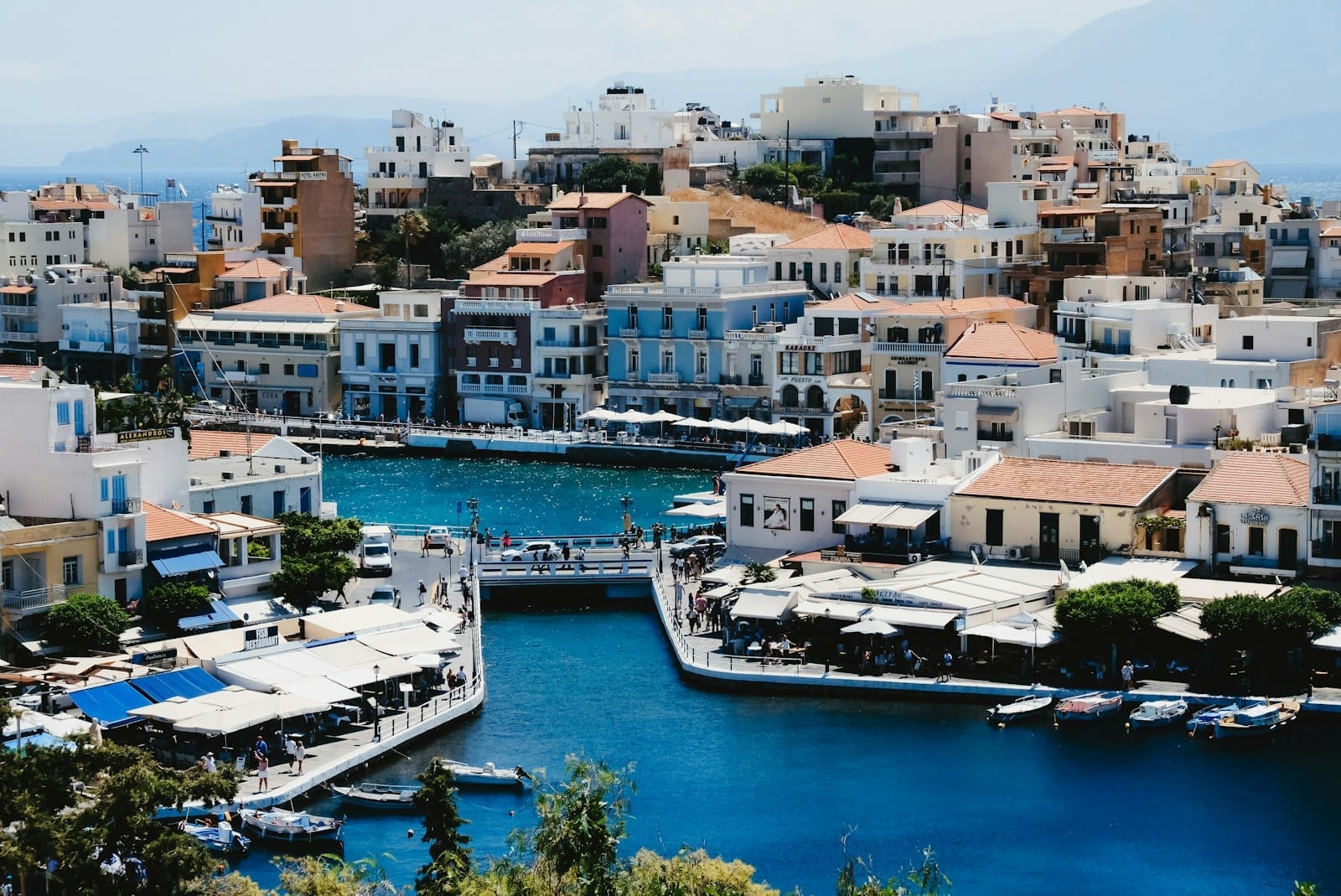
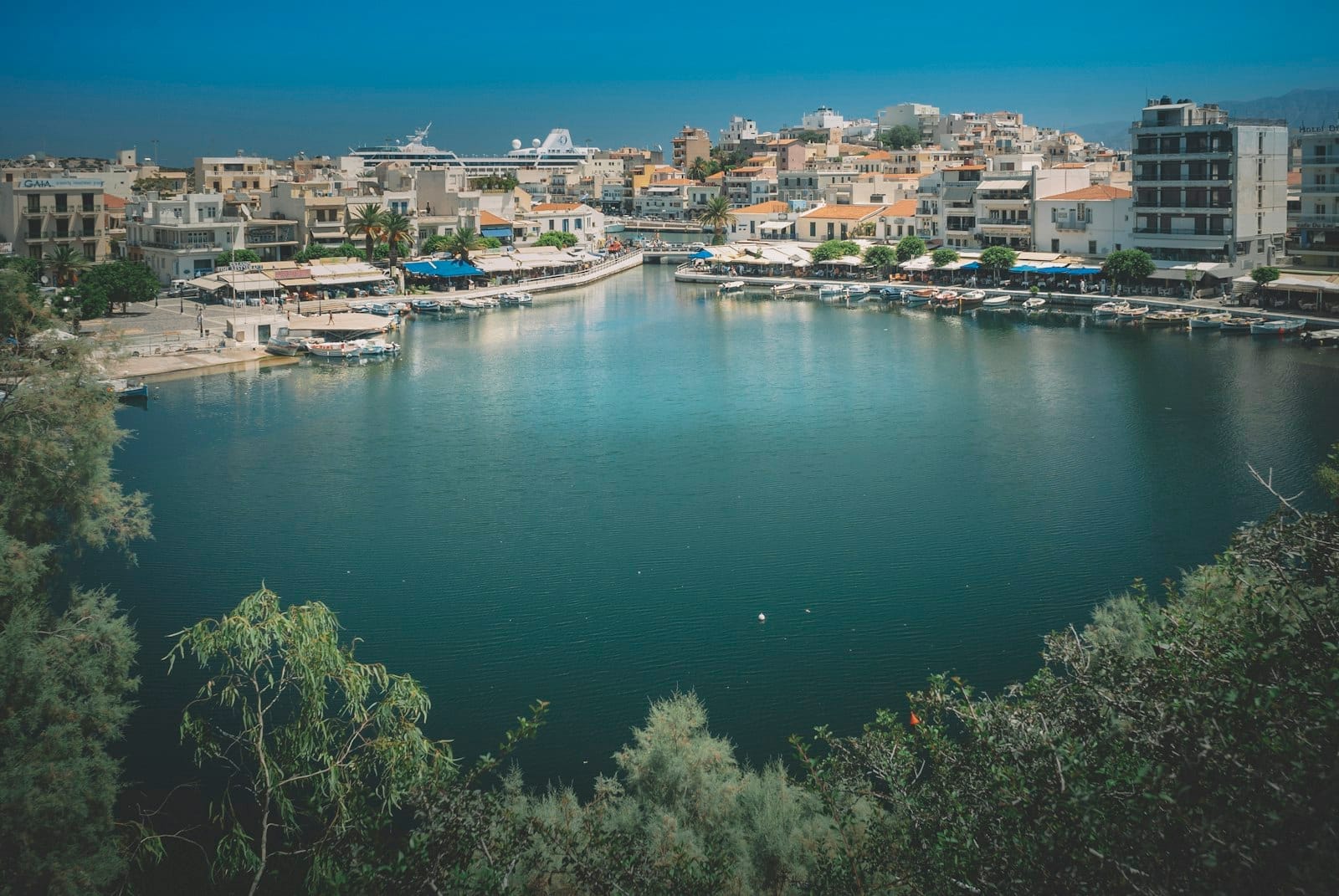
Agios Nikolaos is the capital of Crete's Lasithi regional unit, a coastal town built around a small saltwater lake connected to the sea. Compact, walkable, and less frenetic than Heraklion or Chania, it works well as both a destination and a base for exploring the eastern half of the island.
Agios Nikolaos sits on Crete's northeast coast around the extraordinary Lake Voulismeni, a small circular lagoon that anchors the town's social and physical life. It is the administrative capital of the Lasithi region, with a population of roughly 13,600, and carries a certain quiet confidence that sets it apart from the island's more heavily visited resort strips. The town has a long history of attracting visitors who want access to eastern Crete without the full resort machinery.
Orientation
Agios Nikolaos occupies a compact peninsula on the Gulf of Mirabello, on Crete's northeast coast. Heraklion lies about 64 km to the west, about a 45-to-60-minute drive by road. Sitia is roughly 67 km to the east, and Ierapetra sits to the south across the narrowest part of the island. The town serves as the administrative center of the Lasithi regional unit, which stretches from the central highlands to the eastern tip of Crete.
The town's layout is easier to grasp on foot than on a map. Lake Voulismeni occupies the southwestern edge of the center, connected to the sea by a short canal. The main waterfront promenade curves north from the lake along the harbor. Moving inland, streets climb gently uphill through a grid of shops, cafes, and residential blocks. The northern end of town opens onto a headland with the beach at Kitroplatia, while Almyros Beach extends south of the center along the bay.
Agios Nikolaos is not a neighborhood within a larger city but a self-contained town, though visitors use it as a launchpad for the wider Lasithi area. Day trips to Spinalonga Island, the Lassithi Plateau, and the beaches of the east are all feasible from here. It also has direct bus connections west toward Heraklion and Knossos.
Character & Atmosphere
Agios Nikolaos has a slower rhythm than Crete's larger cities. Mornings around Lake Voulismeni feel genuinely local: fishing boats rock at the canal mouth, older residents walk the lakeside trail, and the first cafes open with the light falling flat and silver across the water. The lake is about 64 metres deep, far deeper than its modest diameter suggests, and local legend long held it to be bottomless. That unusual depth gives the water an almost inky colour in morning light.
By midday in July and August, the lakeside cafes fill with tourists and the harbor promenade gets busy. The peak comes around mid-August, when Greek vacationers join the West European and Russian visitors who have favored this town since the 1960s, when filmmakers and international media attention put it on the map. Despite this history, Agios Nikolaos never became the sprawling resort that parts of the north coast did. The scale stays human.
Evenings are the town's best hour. The harbor lights come on, the temperature drops to something comfortable, and the outdoor tables around the lake fill for dinner that stretches well past 10 pm in the Greek tradition. The amphitheatre area near Lake Voulismeni sometimes hosts live events in summer. The side streets away from the main waterfront stay quieter, with local tavernas that see fewer tourist menus and more honest pricing.
ℹ️ Good to know
Agios Nikolaos sits on or near the ruins of the ancient city of Lato pros Kamara, a port settlement that dates back to antiquity. The region's archaeology extends far deeper than the Venetian-era structures visible in Heraklion or Chania.
What to See & Do
Lake Voulismeni is the obvious starting point. The circular lagoon is ringed by a walking path, park benches, ducks, and a cluster of cafes. A short canal connects it to the sea, crossed by a bridge that becomes a social hinge point in the evenings. The lake's presence right at the town center gives Agios Nikolaos a spatial quality you do not find in most Cretan coastal towns, which typically organize around harbors or squares.
The Archaeological Museum of Agios Nikolaos holds artifacts from across the Lasithi region, including finds from Minoan sites, cemeteries, and the ancient ruins of Lato and Olous. It is a manageable, uncrowded alternative to the larger collections in Heraklion, and provides useful context before visiting the wider region. Nearby Priniatikos Pyrgos, an archaeological site on the coast settled around 3000 BC, is accessible for those with an interest in the Bronze Age layers beneath eastern Crete.
The Agioi Pantes islet sits just offshore and is visible from the harbor promenade. Almyros Beach, one of the longest sandy stretches near town, is about a 20-minute walk south of the center or a short taxi ride. The beach is backed by a protected wetland area fed by the Almyros river.
The most important excursion from Agios Nikolaos is the boat trip to Spinalonga Island, the former Venetian fortress and, later, one of Europe's last active leper colonies. Boats leave from the harbor and from Elounda, 11 km north. The island gained wider international recognition through Victoria Hislop's novel 'The Island.' Combine it with a stop in Elounda, the upscale resort village that has become one of the most exclusive addresses on the island.
Lake Voulismeni lakeside circuit and park
Archaeological Museum of Agios Nikolaos
Almyros Beach, south of town
Kitroplatia Beach, walkable from the center
Boat excursions to Spinalonga Island
Day trip to Lato archaeological ruins, 12 km inland
Drive or tour to the Lassithi Plateau windmills and Dikteon Cave
For travelers interested in the broader context of Minoan civilization, Agios Nikolaos makes a practical base for reaching sites to the west, including the Palace of Knossos via the direct bus to Heraklion, or to the east toward the Minoan palace at Zakros. Both require a half-day or full day.
Eating & Drinking
The lakeside and harbor promenade carry the town's most visible dining, but visible does not always mean best value. Cafes with direct lake views charge a premium for the location, and the menus at some harbor restaurants lean toward international dishes aimed at tourists. That said, the quality of ingredients in Crete's eastern region is excellent, and even the more tourist-facing kitchens tend to work with decent local produce.
For more honest Cretan cooking, walk a block or two inland from the water. Lasithi's food culture emphasizes olive oil, legumes, fresh fish from the Gulf of Mirabello, and dakos, the twice-baked barley rusk topped with tomato and cheese that functions as a Cretan institution. The region also produces good local wine. For broader context on what to eat across the island, the Cretan food guide covers the key dishes and regional variations worth knowing before you sit down anywhere.
The town has a decent cafe culture outside peak tourist season. Coffee is taken seriously in Greek style: freddo espresso or freddo cappuccino in summer, Greek filter coffee at the older spots around the lake. Bars cluster near the harbor and around the main pedestrian shopping street. Nightlife is present but not loud by Mediterranean resort standards, which suits the town's general character.
💡 Local tip
For seafood, look for tavernas with handwritten menus on chalkboards rather than laminated picture menus. The Gulf of Mirabello supplies fresh catch, and restaurants that change their offerings daily are working with what arrived that morning.
Getting There & Around
The main arrival point for most visitors is Heraklion International Airport (IATA: HER), 64 km to the west. The drive takes between 45 and 60 minutes on the E75 highway, depending on traffic. Sitia Airport, to the east, handles some domestic and seasonal European flights and sits roughly 67 km away. Neither airport is serviced by a direct train, as Crete does not have a rail network.
KTEL buses connect Agios Nikolaos to Heraklion several times daily, with journey times around 90 minutes. Services run east to Sitia and north to Elounda, and there are connections to inland villages including Kritsa. Check current KTEL Lasithi schedules at the local bus station. For a broader overview of moving around the island by bus, car, and ferry, the guide to getting around Crete covers the practical logistics clearly.
Within Agios Nikolaos, the town center is easily walkable. From the lake to the harbor takes about five minutes on foot, and Kitroplatia Beach is within ten minutes. Almyros Beach to the south is a longer walk of around 20 minutes or a taxi fare of approximately 8 euros. Scooter and car rentals are available locally and are the most practical way to explore the surrounding coastline and villages independently.
⚠️ What to skip
Crash helmets are compulsory for scooter riders in Greece and are enforced in Crete. Rental operators are required to provide them; riding without one risks a fine, not just personal risk.
Ferries serving Crete typically operate through Heraklion's main harbor rather than Agios Nikolaos directly. If you are combining eastern Crete with island hopping, plan for the transfer west. For the route to Santorini specifically, the Crete to Santorini guide explains ferry and flight options in detail.
Where to Stay
Agios Nikolaos offers accommodation across a wider range than its modest scale might suggest, from simple rooms above the commercial streets to boutique hotels on the waterfront. The lake area and harbor promenade are the most in-demand locations, combining convenience with the social life of the town. Expect to pay more for a lake-facing room, and expect some noise from cafe terraces below in peak season.
Travelers who prioritize a quieter stay should look at the residential streets running inland and uphill from the center, where smaller guesthouses offer a more local feel. The northern headland area near Kitroplatia Beach has hotels with sea views and less foot traffic past midnight. Budget options exist but are not as plentiful as in Heraklion or Rethymno. Agios Nikolaos attracts a mix of independent travelers, older European couples, and Greek families on summer holidays.
For high-end accommodation, the immediate surroundings offer something Agios Nikolaos itself cannot match at volume: the coast around Elounda, 11 km north, has several internationally ranked luxury resorts. If that tier is a priority, the luxury Crete guide outlines the best areas and properties. Agios Nikolaos itself suits mid-range travelers who want a town with real daily life, not just a resort facility.
Day Trips from Agios Nikolaos
Eastern Crete is the least densely visited part of the island, and Agios Nikolaos positions you well for it. The Lassithi Plateau is roughly 50 km by road, climbing through mountain villages to a high fertile plain associated with the Dikteon Cave, mythological birthplace of Zeus. The drive alone is worth doing, passing through the kind of agricultural Crete that the north coast resorts obscure.
To the east, Sitia is an undervisited town with a good waterfront, a Venetian fortress, and its own regional character. Further east still, Vai Palm Beach is the only natural palm forest in Europe, and the beach itself is impressive despite its fame. The Minoan palace at Zakros sits near the island's eastern tip and sees a fraction of the visitors that Knossos receives. These destinations make a logical chain for a full-day drive east.
For those interested in a broader overview of eastern and central Crete by road, the Crete road trip guide covers the key routes and stops worth planning around.
TL;DR
Agios Nikolaos is a compact, walkable coastal town organized around the unique Lake Voulismeni, with genuine daily life alongside its tourist infrastructure.
It works best as a base for exploring eastern Crete, including Spinalonga Island, the Lassithi Plateau, Elounda, and the Minoan sites of the east.
The town suits independent travelers and couples who want a Greek coastal atmosphere without the full resort strip experience.
Peak season runs mid-July through August; shoulder months of May, June, and September offer the same access with smaller crowds and lower prices.
Not the right choice for travelers who prioritize nightlife, large beach facilities, or a wide budget accommodation scene: Heraklion or Malia serve those needs better.
Crete has over 1,000 beaches, ranging from famous pink-sand lagoons to wild river-mouth coves. This guide ranks the best by region so you can plan your base and your days on the water without the guesswork.
Crete is large enough that each of its main towns sits within reach of completely different landscapes, ruins, and coastlines. This guide organizes the best day trips by base town, so whether you're staying in Chania, Heraklion, Rethymno, or Agios Nikolaos, you'll know exactly where to go and how to get there.
Crete holds one of the richest concentrations of museums in the Mediterranean, from world-class Minoan collections to maritime heritage and Byzantine icons. This guide covers the essential museums and historically significant sites across the island, organized by theme and region.
Crete rewards visitors year-round, but the right time depends entirely on what you want. This guide breaks down every month by weather, crowds, prices, and activities so you can plan with confidence.
Choosing between Chania and Heraklion shapes your entire Crete experience. This guide breaks down both cities honestly, covering location, culture, beaches, day trips, and who each one actually suits.
Cretan cuisine is one of the most distinctive and well-studied food traditions in the world, rooted in 4,000 years of agricultural practice and the foundational principles of the Mediterranean diet. This guide covers the essential dishes, local ingredients, seasonal patterns, and practical tips for eating well across the island.
Crete's coastline is best explored from the water. From the tidal lagoon at Balos to the haunting island of Spinalonga, these are the boat trips worth planning your days around.
Crete delivers more romance than most Greek islands dare to promise. From the pink-sand shores of Elafonissi to candlelit dinners in Chania's Venetian harbour and private yacht trips around hidden sea caves, this guide covers every romantic experience worth planning, plus honest advice on where the crowds go and where couples actually find peace.
October is one of the most underrated months to visit Crete. The summer crowds have thinned, sea temperatures stay around 23°C, and the island shifts into a slower, more authentic rhythm. This guide covers what the weather actually looks like, which attractions stay open, where crowds still linger, and how to plan a genuinely rewarding trip.
July and August are Crete's most popular months, and for good reason. The sea hits 26°C, the days stretch to 12 hours of sunshine, and almost every beach, taverna, and archaeological site is fully operational. But peak season on Greece's largest island comes with real trade-offs. This guide breaks down exactly what to expect and how to handle it.
Crete's interior is a world apart from its famous coastline. This guide covers the island's most compelling mountain villages, the gorges and caves surrounding them, and the ancient sites tucked into its high plateaus and rugged massifs.
Crete after dark ranges from cocktails beside a Venetian harbour to all-night club marathons in Malia. This guide breaks down the best nightlife in Crete by city, venue type, and season, so you know exactly where to go and what to expect before you arrive.
Crete produces some of the world's finest olive oil and a range of wines from indigenous grapes found nowhere else on earth. This guide covers where to taste, what to look for, how to book tours, and what's actually worth bringing home.
Crete is one of the Mediterranean's most rewarding destinations, and it doesn't have to be expensive. This guide breaks down real daily costs, the cheapest ways to get around, where to eat well for under €10, and which experiences are completely free — so you can spend more time enjoying the island and less time worrying about your wallet.
Crete rewards self-drivers like few Mediterranean islands can. From the white-pebble coves of the south coast to the gorge-carved mountains of the interior, this guide covers every route, practical detail, and honest warning you need to drive Crete with confidence.
The ferry from Crete to Santorini is faster, cheaper, and more scenic than flying via Athens. This guide covers every option: high-speed ferries, slow overnight boats, the flight reality, day trip logistics, and what to book first in summer.
Two of Greece's most iconic islands, but they deliver very different experiences. This guide breaks down beaches, budget, activities, and logistics so you can decide which island actually suits your trip.
From pink-sand beaches with toddler-safe shallows to underwater aquariums and myth-soaked caves, Crete delivers a remarkable range of family experiences. This guide breaks down the best activities by age group, the seasonal realities parents need to know, and the honest warnings that travel brochures skip.
Crete rewards travelers who know where to look, and the best experiences here rarely require a ticket. From pink-sand beaches and mythological caves to Venetian harbors and ancient ruins, here are 20 genuinely free things to do across the island.
Crete is 260 km long and divided into four distinct regions. Getting around efficiently requires planning. This guide breaks down every transport option — from KTEL buses to car rental pricing — so you can move around Greece's largest island without wasting a day.
Crete rewards travelers who look beyond Knossos and Elafonissi. This guide uncovers the island's lesser-known beaches, gorges, ancient sites, and villages that most visitors drive straight past.
Crete is one of Europe's finest hiking destinations, with towering gorges, mountain plateaus, coastal paths, and ancient landscapes to explore. This guide covers the best trails across the island, from iconic gorge walks to quieter routes that reward those willing to go further.
Crete delivers a caliber of luxury that rivals anywhere in the Mediterranean. This guide cuts through the noise to identify the best high-end hotels, private villas, and exclusive experiences across the island's four regions, with honest advice on where to splurge and where to save.
The Matala Beach Festival is one of Europe's largest free-entry music events, held annually on the south coast of Crete. Running across four stages for three days each July, it draws thousands of visitors to a beach that has its own remarkable counterculture history. Here is everything you need to plan your visit.
The Minoans built Europe's first advanced civilization on Crete over 4,000 years ago, leaving behind palaces, frescoes, and artifacts that still astonish. This guide covers the essential sites, museums, and landscapes connected to their remarkable world.
Seven days is enough to cover Crete's four regional units, its best beaches, and its most significant ancient sites — if you plan it right. This guide gives you a day-by-day route built around a rental car, honest crowd warnings, and practical details on costs and timing.
Crete is Greece's largest island and one of its most rewarding destinations, with Minoan ruins, dramatic gorges, world-class beaches, and a food culture that puts most of Europe to shame. This guide covers the best things to do in Crete across every category, with honest advice on what's worth your time and what to skip.
Crete is 260 km long, and choosing the wrong base can cost you hours of driving each day. This guide breaks down the best areas to stay in Crete by location, travel style, and budget, with honest advice on which towns to avoid and which hotels are worth booking early.