Vai Palm Beach: The Ancient Palm Forest on Crete's Remote Eastern Edge
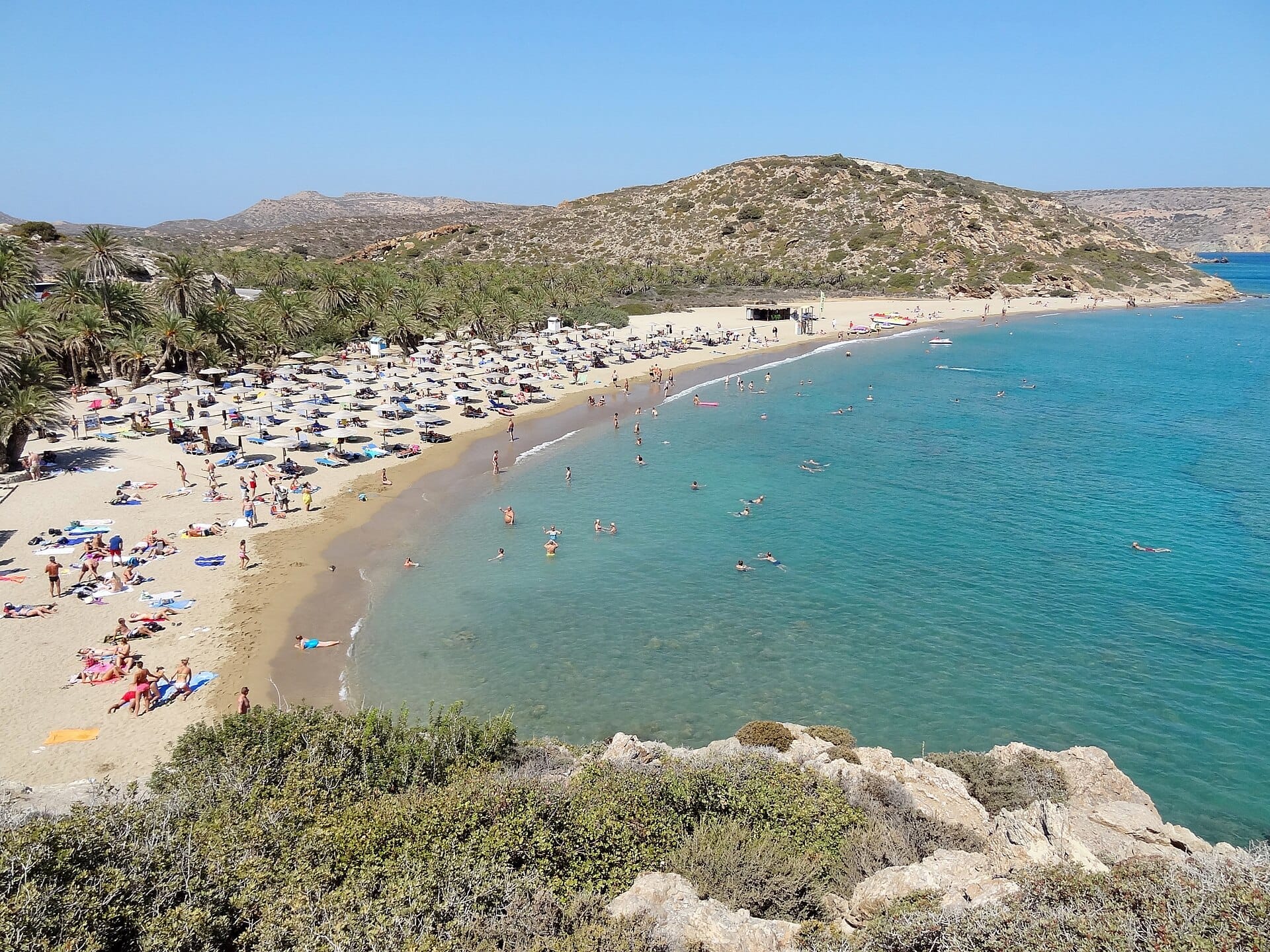
Vai Palm Beach is unlike any other beach in Europe. Backed by roughly 5,000 wild Phoenix theophrasti palms estimated to be around 2,000 years old, this Blue Flag-certified stretch of fine sand sits on Crete's northeastern coast in the Lassithi region. The combination of the protected palm forest, shallow turquoise water, and sheer remoteness makes it one of the island's most singular natural attractions.
Quick Facts
- Location
- Northeastern Crete, Lassithi region, near Cape Sideros — 25 km from Sitia, 94 km from Agios Nikolaos
- Getting There
- By car from Sitia (approx. 45 min) or Palekastro (approx. 15 min); seasonal bus connections from Sitia available. Large on-site parking, fees apply.
- Time Needed
- 2 to 4 hours for beach and forest walk; allow a full day if combining with Palekastro or Sitia
- Cost
- Beach access free; sunbed and umbrella hire available. Note: parking and on-site services run pricier than most Cretan beaches.
- Best for
- Families, nature lovers, photographers, road-trippers exploring eastern Crete
What Makes Vai Palm Beach Different
Most Greek beaches deliver blue water and pale sand. Vai Palm Beach delivers something fundamentally stranger: the sensation of stepping into a North African oasis that happens to have a Greek flag planted nearby. The Phoenix theophrasti palms, a species endemic to Crete and a few Aegean islands, rise in dense, rustling columns directly behind the shoreline. There are an estimated 4,500 to 5,000 of them here, making this the largest natural palm grove in Europe, protected as a national park and aesthetic forest under Greek government jurisdiction.
The palms are not ornamental. These are ancient wild trees, some thought to be around 2,000 years old, with rough, scaly trunks and fronds that click and hiss in the sea breeze. Walking beneath them produces a sound quite unlike any other Mediterranean forest. The dappled light through the canopy is unusually warm and golden, even on overcast days.
ℹ️ Good to know
The palm forest is protected and fenced off. Access is restricted to designated paths during daytime hours only. Do not enter the grove off-trail: this is enforced to protect the root systems of these ancient trees.
The Beach Itself: What to Expect at Water Level
The main beach at Vai is a compact arc of fine, light-coloured sand with shallow, calm water that shades from pale green to deep turquoise as you wade out. The seabed is sandy underfoot, which makes entry comfortable for young children. The beach holds Blue Flag certification, meaning water quality is monitored and facilities are maintained to a defined standard.
A smaller secondary beach sits to the north of the main bay, accessible by a short path through the fringes of the forest. It receives fewer visitors and has less infrastructure, which makes it worth knowing about if the main beach fills up. Sunbeds and umbrellas are available for hire on the main beach, alongside a canteen and a taverna serving food and cold drinks. Toilets and outdoor showers are on-site.
Water sports equipment is available for rental. The water's calmer character makes kayaking and paddleboarding more practical here than at exposed Atlantic-style beaches. Snorkelling along the rocky edges of the bay reveals sea urchins, small fish, and patches of posidonia seagrass.
Tickets & tours
Hand-picked options from our booking partner. Prices are indicative; availability and final rates are confirmed when you complete your booking.
Visit a Family-Run Olive Mill with Food Tasting in Heraklion
From 19 €Instant confirmationFree cancellationSnorkeling experience in Crete
From 45 €Instant confirmationFree cancellationSpinalonga self-guided audio tour on your phone
From 12 €Instant confirmationFree cancellationMalia to Sissi private tuk-tuk journey with tastings
From 45 €Instant confirmationFree cancellation
Crowds, Timing, and How the Beach Changes Through the Day
Vai is the most-visited beach in eastern Crete and that distinction comes with predictable consequences. Tour buses from Agios Nikolaos and Heraklion typically arrive between 10:30 and 11:00 in the morning, and the beach fills quickly through midday. By early afternoon in July and August, sunbeds on the main beach are occupied, the canteen queue stretches, and the forest paths are dotted with visitors reading signs in five languages.
The most productive approach is to arrive early, before 9:00 if possible. In the first hour or two of the morning, the light through the palm fronds is at its most dramatic, the water is glassy, and the beach is quiet enough to hear the fronds overhead. The parking area is also free of the midday congestion that can make leaving frustrating. Arriving after 16:00 is a reasonable second option: tour groups depart, the light turns amber, and the beach settles into a calmer rhythm for the final hours before close.
💡 Local tip
Visit in May, June, or September rather than July and August. The water is fully swimmable, the forest is lush, and the crowds are manageable. October visits are quieter still, though some facilities may be reduced.
If your trip falls in summer, Vai pairs naturally with a broader eastern Crete road trip. The nearby Minoan Palace of Zakros is roughly 30 km to the south, and the town of Sitia makes a logical base for exploring this corner of the island without the long daily drive from Heraklion.
The Phoenix theophrasti: A Forest Worth Understanding
Phoenix theophrasti, named after the ancient Greek philosopher and botanist Theophrastus, is one of only two wild date palm species native to Europe. It grows naturally in Crete and on a handful of Aegean and Turkish coastal sites, but nowhere in Europe does it appear in anything approaching the density found at Vai. The species produces small, marble-sized dates that are edible but astringent, quite unlike the cultivated Medjool variety. You may see fallen fruit on the forest floor in late summer.
The grove's protected status reflects both its ecological rarity and its vulnerability. The trees' root systems are easily compacted by foot traffic, which is why the fenced path network matters. Human disturbance, along with the pressures of a warming Mediterranean climate, makes the long-term health of the forest a genuine conservation concern. Signs throughout the site explain this context in Greek and English.
For context on Crete's wider natural environments, the Natural History Museum of Crete in Heraklion has exhibits specifically covering endemic Cretan flora, including Phoenix theophrasti, that are worth seeing before or after a visit to Vai.
Getting There and Practical Logistics
Vai sits at the end of a well-signposted road on Crete's northeastern tip, approximately 23 km from Sitia and 8 km from the village of Palekastro. From Heraklion, the drive is roughly 150 km, about two and a half hours along the north coast road via Agios Nikolaos and Sitia. The road through Palekastro is narrow in places, but manageable in a standard rental car. A large paid parking area sits directly above the beach.
Seasonal bus service connects Sitia to Vai, making it viable without a car if you are basing yourself in eastern Crete. That said, a car opens up the surrounding area considerably: the road between Sitia and Vai passes through agricultural land, olive groves, and sparsely populated coastline that rewards stopping.
⚠️ What to skip
Parking and on-site food and drink prices at Vai are noticeably higher than at comparable Cretan beaches. Bring water and snacks from Palekastro or Sitia if you want to manage costs, and budget for the parking charge.
If you are planning a wider eastern Crete loop, the Crete road trip guide covers the practical route options for combining Vai with Zakros, Sitia, and the Lassithi Plateau in a logical sequence.
Photography, Accessibility, and What to Bring
The golden morning light through the palm canopy makes the forest paths some of the most photogenic walking in Crete. A wide-angle lens captures the vertical density of the trunks; a longer focal length isolates individual fronds against the sky or compresses the layered depth of the grove. The contrast between the pale sand, turquoise water, and dark green palms is visually striking in afternoon light as well, particularly from the small elevated viewpoint at the northern end of the main beach.
The beach and main facilities are reasonably accessible on flat ground. The forest paths are compacted earth and gravel, with some uneven sections; they are walkable in sandals but are better in closed shoes. Pushchairs can reach the beach from the parking area. The secondary northern beach requires navigating a short, rougher path and is not suitable for pushchairs or visitors with limited mobility.
Bring: reef-safe sunscreen (particularly important in a protected marine area), a hat (shade on the beach is limited outside the palm zone), adequate water, and cash for parking and any on-site purchases, as card payment availability at smaller on-site kiosks varies.
Who This Suits and Who Might Want to Skip It
Vai is genuinely worthwhile for families with young children, given the shallow water and sand underfoot, and for anyone with an interest in Crete's natural ecology. Photographers will find strong material here at any time of day. Travellers combining Vai with a broader eastern Crete circuit — taking in Zakros or the dramatic landscape around the Lassithi Plateau — will find the detour well-justified.
Travellers primarily seeking a quiet, undiscovered beach should weigh their expectations carefully. In high summer, Vai is one of the busiest beaches in eastern Crete. Its reputation means it draws day-trippers from resorts over two hours away. If solitude is your priority, the beaches around Palekastro or further south toward Xerokambos will serve you better. The palm forest itself remains the attraction that no other beach in Europe can replicate; the beach, while attractive, is not exceptional by Cretan standards. The combination of the two is what makes Vai worth the drive.
For a broader comparison of Crete's beaches before committing to an eastern itinerary, the best beaches in Crete guide sets Vai in context alongside Elafonissi, Balos, and the island's other standout stretches of coastline.
Insider Tips
- The secondary beach north of the main bay, reached by a short forest-edge path, tends to be significantly less crowded through most of the day. It has minimal facilities but far more space.
- The parking area fills and creates exit queues in peak season. If you arrive at midday, plan to stay until mid-afternoon when a wave of day-trippers departs, rather than trying to leave at the same time as everyone else.
- Palekastro village, 8 km away, has several family-run tavernas serving lunch at standard Cretan prices — worth stopping here before or after Vai rather than eating at the beach's on-site canteen.
- The forest paths are best appreciated as a walk in their own right, separate from beach time. Walk the full marked circuit through the grove rather than treating the palms as a backdrop for the beach.
- In late summer, look for the small, round fruits of the Phoenix theophrasti on the forest floor — a tangible reminder that this is a functioning wild ecosystem, not a landscaped feature.
Who Is Vai Palm Beach For?
- Families with young children, thanks to shallow, calm water and sandy seabed
- Nature enthusiasts and botanists interested in endemic Mediterranean flora
- Photographers seeking the distinctive morning light through the palm canopy
- Road-trippers building an eastern Crete itinerary around Sitia, Zakros, and Lassithi
- Travellers wanting a beach that offers something ecologically and visually distinct from the rest of the island
Nearby Attractions
Combine your visit with:
- Ancient Gortyna
Ancient Gortyna, set across the sun-baked Mesara plain in south-central Crete, was once the Roman capital of an entire Mediterranean province. From the world's longest surviving ancient Greek inscription to a Byzantine basilica built over a Greek temple, Gortyna rewards patient visitors with layers of history that few other sites on the island can match.
- Palace of Phaistos
The Palace of Phaistos sits on a low hill above the Mesara plain in south-central Crete, offering a rare chance to walk through a Minoan palace complex without the crowds that overwhelm Knossos. Dating to around 2000 BCE, it is the second-largest Minoan palace on the island and the site where the famous, still-undeciphered Phaistos Disc was found. The views alone justify the drive.
- Palace of Zakros
The Palace of Zakros sits at the far eastern edge of Crete, half a kilometer from the sea, where a Minoan trade empire once operated 3,500 years ago. It is one of Crete's four largest Minoan palace complexes, and the one fewest visitors bother to reach — which is precisely what makes it worth the effort.
- Richtis Gorge
Richtis Gorge cuts through Lasithi Prefecture in eastern Crete, following a 4 km trail from Exo Mouliana village down to a 20-metre waterfall and the Aegean coast. With ancient bridges, lush riparian forest, and relatively manageable terrain, it ranks among the island's most rewarding gorge hikes outside of the famous Samaria route.