Richtis Gorge: Eastern Crete's Best Waterfall Hike
Richtis Gorge cuts through Lasithi Prefecture in eastern Crete, following a 4 km trail from Exo Mouliana village down to a 20-metre waterfall and the Aegean coast. With ancient bridges, lush riparian forest, and relatively manageable terrain, it ranks among the island's most rewarding gorge hikes outside of the famous Samaria route.
Quick Facts
- Location
- Lasithi Prefecture, eastern Crete — 115 km from Heraklion, 55 km from Agios Nikolaos
- Getting There
- By car via the E75 coastal road toward Sitia; park at the lot roughly 100 m before Exo Mouliana village. No direct public bus service to the trailhead.
- Time Needed
- 3–4 hours for the full 4 km trail (one-way); allow 2 hours for the shorter beach-to-waterfall approach
- Cost
- €3 entrance fee for visitors over 16; under 16 free
- Best for
- Hikers, nature lovers, photographers, and families with older children
What Richtis Gorge Actually Is
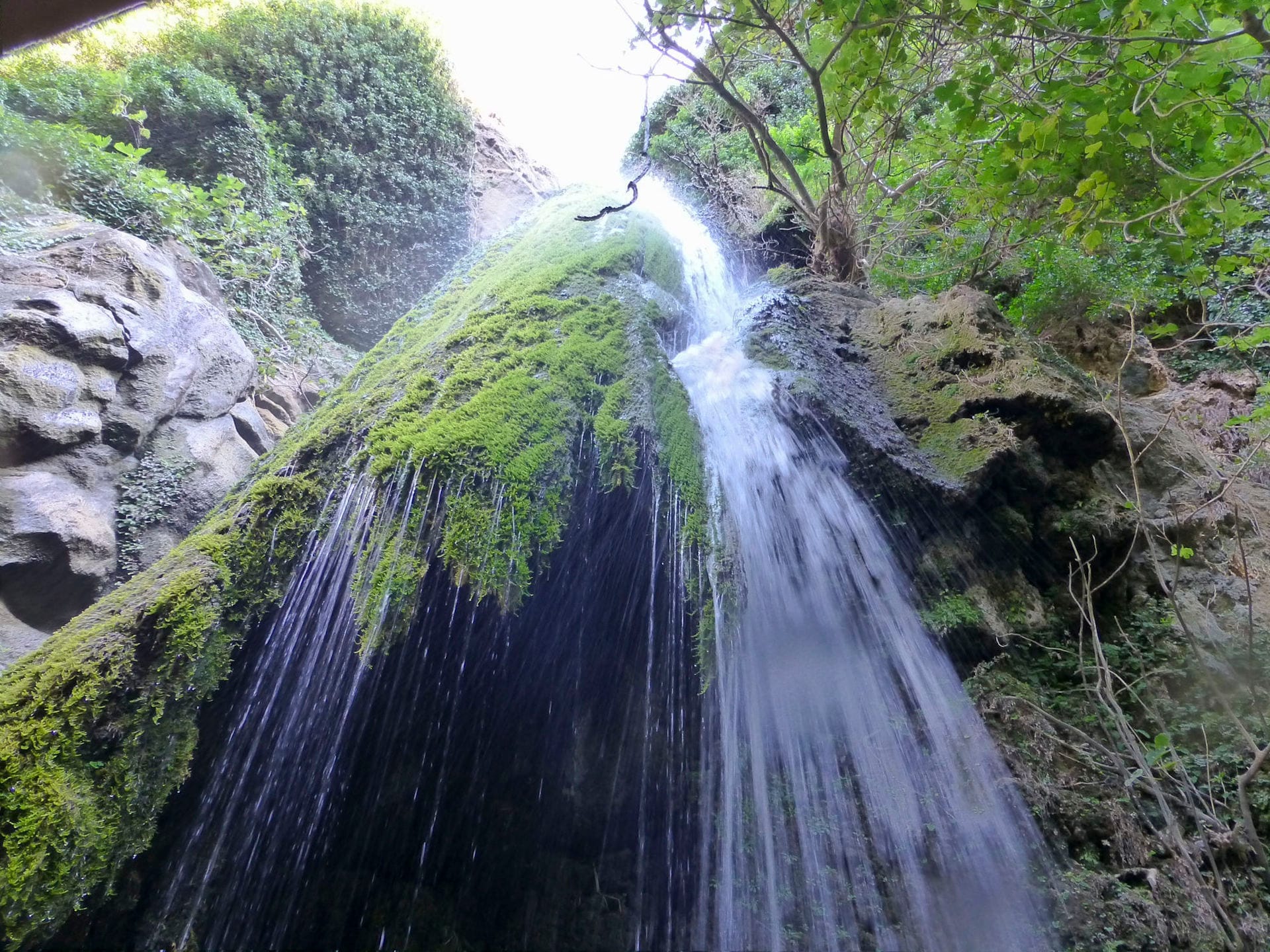
Richtis Gorge (Φαράγγι του Ρίχτη) is a 4-kilometre limestone canyon in the Lasithi regional unit of eastern Crete, carved over millennia by tectonic uplift and water erosion. The trail descends roughly 350 metres in elevation from the plateau village of Exo Mouliana all the way to Richtis Beach on the north coast, passing through dense oleander, plane trees, wild fig, and prickly kermes oak the entire way. The centrepiece is a 20-metre waterfall that feeds a natural plunge pool — cold, clear, and deep enough to swim in during spring and early summer.
Unlike the well-paved, heavily managed Samaria Gorge to the west, Richtis remains largely unscaffolded. The path crosses the stream multiple times, scrambles over polished boulders, and requires you to read the terrain. That rawness is exactly what draws those who know about it, and it is why the experience feels genuinely wild even in August.
Eastern Crete's gorges are generally less trafficked than those near Chania or Rethymno. If you are building an itinerary around the region, pairing Richtis with a visit to the Minoan palace at Zakros — which has its own gorge approach called the Valley of the Dead — makes for an exceptional two-day loop through Lasithi's most dramatic landscapes.
💡 Local tip
Arrive at the trailhead parking area by 8:00 AM in summer. The lower canyon sections get direct sun from mid-morning onward, and the lack of shade near the stream crossings makes midday hiking genuinely draining.
The Trail: What You Will Encounter
The standard route begins at the parking lot approximately 100 metres before Exo Mouliana village. A short access path of around 20 minutes leads you to the official gorge entrance, where a small information hut is located. From that point, the trail narrows immediately and the temperature drops noticeably — the forest canopy overhead closes in, and the sound of water replaces road noise within the first five minutes.
The first kilometre is the most forested and feels almost subtropical. Enormous plane trees grow horizontally over the stream, their roots gripping exposed rock like claws. The path crosses the water several times on stepping stones and, in one section, over the Lachanas Bridge, a single-arch stone structure dating from around the turn of the 20th century that has survived both floods and earthquakes. Its construction is vernacular Ottoman-era Cretan: rough-hewn limestone blocks mortared with lime and pebble, functional and completely unadorned.
The gorge widens in the middle section, revealing carved rock walls stained orange, ochre, and grey. Archaeological surveys have identified evidence of Minoan settlement in this area dating to roughly 2000–1450 BCE, suggesting the gorge and its reliable water source attracted permanent habitation for at least three and a half millennia. You will also pass the remains of old water mills, their stone wheels still visible at the base of small drops in the streambed.
The waterfall appears near the end of the trail, audible before it is visible. It drops 20 metres in a single curtain into a pool roughly ten metres across. In April and May, the flow is full and the mist reaches several metres out; by late July, the volume drops considerably, but the pool remains swimmable. After the waterfall, the trail continues another short distance to Richtis Beach, a pebbly cove where the canyon stream meets the sea.
Tickets & tours
Hand-picked options from our booking partner. Prices are indicative; availability and final rates are confirmed when you complete your booking.
Excursion to Richtis Gorge from Agios Nikolaos
From 539 €Instant confirmationFree cancellationVisit a Family-Run Olive Mill with Food Tasting in Heraklion
From 19 €Instant confirmationFree cancellationSnorkeling experience in Crete
From 45 €Instant confirmationFree cancellationSpinalonga self-guided audio tour on your phone
From 12 €Instant confirmationFree cancellation
How the Experience Changes by Season and Time of Day
Spring, particularly April through early June, is the definitive season for Richtis. The stream runs strong, the vegetation is fluorescent green from winter rains, wildflowers grow in cracks along the cliff face, and the air in the lower canyon smells of wet limestone and wild herbs. Temperatures in the gorge itself stay cool well into the morning even when the coast is already warm.
October is nearly as good. The summer crowds — modest compared to Samaria, but noticeable in August — have thinned, the light is lower and more golden, and the plane trees start turning yellow along the upper section. The stream begins to recover after the dry summer, and the hike back up feels considerably less punishing than it does in July heat.
Summer visits are possible but require planning. Start before 8:00 AM, carry at least 1.5 litres of water per person, and accept that the waterfall pool will likely have other visitors by the time you arrive. If you are visiting Crete specifically in the peak months, the summer in Crete guide has broader advice on managing heat and crowds across the island.
⚠️ What to skip
Avoid the gorge entirely after heavy rain or during winter storms. The stream can rise quickly and the boulder crossings become genuinely dangerous when water levels are high. The trail is not equipped with emergency infrastructure.
Two Ways to Experience the Gorge
The full linear hike from Exo Mouliana to Richtis Beach covers 4 kilometres and descends 350 metres. It is rated moderate: there is no serious climbing, but the river crossings and uneven rock surfaces require balance and appropriate footwear. Plan for 3–4 hours one-way. Most hikers either arrange a car shuttle between the two endpoints — parking one vehicle at the beach, another at the village — or walk back up after reaching the waterfall, which adds another 2 hours.
The shorter alternative, favoured by families with younger children, begins from Richtis Beach and walks upstream to the waterfall. This section covers roughly 2 kilometres and gains elevation gradually. It is still not a stroller path — the terrain is rocky and uneven throughout — but it is accessible to older children comfortable on rough ground and to adults who want the visual payoff without the full descent.
If you are combining the gorge with broader exploration of eastern Crete, the town of Sitia is about 30 kilometres east and makes a logical base. It has a relaxed pace, good tavernas, and far fewer tourists than Agios Nikolaos to the west.
Practical Logistics
A car is effectively required. There is no regular KTEL bus service to Exo Mouliana or Richtis Beach on a schedule suited to day hikes. The drive from Heraklion takes roughly 2 hours via the northern coastal road; from Agios Nikolaos alone, allow just over 1 hour depending on the route.
Footwear matters more than most sources admit. Trail runners or approach shoes with grippy soles are the minimum. Flip-flops and smooth-soled sandals are unsuitable; the wet rock sections near the stream crossings are polished smooth by water and genuinely slippery. Long trousers protect against the scratchy vegetation on the upper section of the trail, though most people hike in shorts during summer.
There are no food or water facilities along the trail. The information hut at the entrance can answer basic questions; the beach at the end has no permanent services. Carry food if you plan to linger at the waterfall or beach, and bring more water than you think you need, particularly from June through September.
Photography is excellent in the lower canyon during morning light, when the sun angles into the gorge from the east and illuminates the waterfall directly. A wide-angle lens captures the scale of the pool and surrounding walls. For anyone building a broader hiking itinerary in Crete's eastern reaches, the hiking in Crete guide covers trail grades, seasonal conditions, and equipment recommendations across the island.
Who Should Consider Skipping This
Richtis Gorge is not suitable for wheelchair users or those with significant mobility limitations. The terrain is genuinely uneven from start to finish, and the stream crossings have no bridges in most places. Visitors expecting a manicured nature walk will find it more demanding than anticipated.
It also requires a full half-day commitment at minimum, including drive time from the main tourist centres. Travellers with only one or two days in eastern Crete may find that the time investment competes with major sites like Knossos or Spinalonga. That said, for anyone who enjoys being in a landscape rather than simply looking at it, the gorge consistently delivers something the archaeological sites cannot.
If the drive to the far east of the island is not practical, the Imbros Gorge near Chania is a shorter and more accessible alternative, though the landscape there is considerably drier and less dramatic in terms of water features.
Insider Tips
- Park one car at Richtis Beach before driving up to Exo Mouliana — a linear point-to-point hike is significantly easier and more enjoyable than doubling back uphill in afternoon heat.
- The plunge pool beneath the waterfall is deep enough to swim in from April through June. Bring a dry bag for your phone and a quick-dry towel if you want to use it.
- The Lachanas Bridge in the middle section makes for one of the best photographs in the gorge, especially in morning light when it is in partial shadow. Most walkers pass it quickly; stop and look downstream from the top of the arch.
- Water shoes or sandals with ankle straps (packed in your bag) are worth bringing for the stream crossings near the waterfall. The wet boulders are polished smooth and even grippy trail shoes lose traction in spots.
- The information hut at the entrance is not always staffed outside peak season — if you arrive and find it unstaffed, the trail is still accessible and the fee collection system is on the honour system according to local practice.
Who Is Richtis Gorge For?
- Hikers looking for a greener, quieter alternative to Samaria Gorge
- Photographers drawn to waterfalls, old bridges, and canyon light
- Families with children aged 8 and up who are comfortable on rough terrain
- Travellers spending time in Lasithi or Sitia who want an active half-day
- Anyone visiting Crete in spring or autumn when the water flow is at its best
Nearby Attractions
Combine your visit with:
- Ancient Gortyna
Ancient Gortyna, set across the sun-baked Mesara plain in south-central Crete, was once the Roman capital of an entire Mediterranean province. From the world's longest surviving ancient Greek inscription to a Byzantine basilica built over a Greek temple, Gortyna rewards patient visitors with layers of history that few other sites on the island can match.
- Palace of Phaistos
The Palace of Phaistos sits on a low hill above the Mesara plain in south-central Crete, offering a rare chance to walk through a Minoan palace complex without the crowds that overwhelm Knossos. Dating to around 2000 BCE, it is the second-largest Minoan palace on the island and the site where the famous, still-undeciphered Phaistos Disc was found. The views alone justify the drive.
- Palace of Zakros
The Palace of Zakros sits at the far eastern edge of Crete, half a kilometer from the sea, where a Minoan trade empire once operated 3,500 years ago. It is one of Crete's four largest Minoan palace complexes, and the one fewest visitors bother to reach — which is precisely what makes it worth the effort.
- Sitia
Sitia sits at the far eastern edge of Crete, where the tourist trail quietly fades and daily Greek life takes over. With Minoan origins, a hilltop Venetian fortress, a serious archaeological museum, and easy access to Vai Beach and the Minoan palace at Zakros, this unhurried port town rewards travelers who make the journey.