Ancient Gortyna: Crete's Forgotten Capital and the Stone That Wrote the Law
Ancient Gortyna, set across the sun-baked Mesara plain in south-central Crete, was once the Roman capital of an entire Mediterranean province. From the world's longest surviving ancient Greek inscription to a Byzantine basilica built over a Greek temple, Gortyna rewards patient visitors with layers of history that few other sites on the island can match.
Quick Facts
- Location
- Mesara plain, near Agioi Deka village, south-central Crete (45 km from Heraklion)
- Getting There
- By car via the E75/E90 toward Mires; buses from Heraklion toward Mires stop near the site. A rental car is strongly recommended.
- Time Needed
- 1.5 to 3 hours, depending on how thoroughly you explore the acropolis
- Cost
- Paid admission (verify current price with local tourism authorities before visiting, as fees change seasonally)
- Best for
- History enthusiasts, archaeology fans, and travelers combining with Phaistos or Matala
What Is Ancient Gortyna?
The Gortyna archaeological site sits on the broad, heat-shimmering Mesara plain, roughly 45 kilometres south of Heraklion. It is not a single tidy ruin but an enormous, mostly unenclosed spread of ancient remains that straddles both sides of a provincial road. Olive trees, dense scrub, and the sound of cicadas fill the gaps between stone walls, column drums, and mosaic fragments. At first glance it can feel chaotic. Within twenty minutes, it becomes one of the most compelling archaeological landscapes on the island.
Gortyna's history begins at the end of the Neolithic period, around 3000 BC, making it one of the longest-continuously-settled sites in all of Crete. Its known ancient names were Larissa and Kremnia before it became Gortyn in the Greek period. The city reached its absolute peak under Roman rule, when it served as the capital of the combined Roman province of Creta et Cyrenaica, which encompassed Crete and the coast of North Africa. That imperial status explains the scale of what you still see today: a theatre, an Odeion, temples, a praetorium, public baths, and a nymphaion, all spread across a landscape that was, in the 1st through 5th centuries AD, one of the Mediterranean world's important administrative centers.
ℹ️ Good to know
Opening hours and ticket prices at Gortyna change seasonally and are subject to revision. Check with the Greek Ministry of Culture or the 23rd Ephorate of Prehistoric and Classical Antiquities before your visit. Arriving early in summer is strongly advised; the Mesara plain offers almost no shade and midday temperatures regularly exceed 35°C.
The Law Code: A Stone That Changed Civilization
The single most important object at Gortyna is not a temple or a palace. It is a series of inscribed limestone blocks housed in a small protective building at the north circular wall of the Odeion. These blocks carry the Gortyn Law Code, dated to the 5th century BC, and they represent the longest extant ancient Greek stone inscription anywhere in Greece. The code runs to twelve columns and covers civil law with striking specificity: inheritance rights, property disputes, the status of free persons versus serfs, conditions for divorce, and the rights of women in ways that were surprisingly progressive for the ancient world.
The inscription was discovered in 1884 by Italian archaeologist Federico Halbherr, who recognized immediately that he had found something of enormous legal and linguistic significance. The text is written in boustrophedon style, meaning the lines alternate direction like an ox plowing a field: one line reads left to right, the next right to left. Standing in front of it, you can trace the tight, archaic lettering with your eyes even without reading ancient Greek. The precision of the carving, over two and a half millennia old and still largely legible, is remarkable.
This building and the Law Code form the enclosed, ticketed section at the road-level part of the site. Even visitors who move quickly through the rest of Gortyna should spend at least fifteen minutes here. It is a direct physical connection to one of the foundational moments in Western legal history.
Tickets & tours
Hand-picked options from our booking partner. Prices are indicative; availability and final rates are confirmed when you complete your booking.
Knossos Archaeological Site Entrance Tickets and Heraklion Audio Guide
From 10 €Instant confirmationArchaeological Museum of Chania entrance ticket with audio tour
From 24 €Instant confirmationArchaeological Museum of Chania self-guided audio tour
From 12 €Instant confirmationFree cancellationVisit a Family-Run Olive Mill with Food Tasting in Heraklion
From 19 €Instant confirmationFree cancellation
Walking the Roman City
On the south side of the road, the ruins of Roman Gortyna spread across a wide area. The Odeion itself, the small covered theatre where the Law Code is displayed, dates in its current form to Roman construction, though it was built over much earlier Greek structures. Nearby are the remains of the Temple of Apollo Pythios, one of the most significant cult sites in Cretan antiquity. Column stumps, inscribed bases, and architectural fragments are scattered across the ground around it, many still in situ where they fell.
Further into the site you will find the ruins of the Praetorium, the administrative headquarters of the Roman governor, and the remains of a large Nymphaion. The scale of these structures clarifies why Rome chose Gortyna as its provincial capital rather than the more famous Knossos: Gortyna had a commanding position over the fertile Mesara plain, reliable water sources, and an existing Cretan urban tradition dating back centuries.
The vegetation within the Roman zone is thick in spring and early summer. Paths become narrow, and some ruins are partially obscured by wild fennel and fig trees. This is not a manicured open-air museum. It has the slightly overgrown feel of a site that is genuinely very large and only partially excavated, which, depending on your temperament, is either atmospheric or frustrating. Wear closed shoes.
If you are combining Gortyna with other sites in the south of the island, the Minoan Palace of Phaistos is just 16 kilometres to the west and offers a striking contrast: where Gortyna is Roman and Greek, Phaistos is pure Bronze Age Minoan, and the hilltop setting at Phaistos is spectacular. Many visitors pair the two into a single full day.
The Acropolis and the Byzantine Layer
The acropolis of Gortyna rises above the road-level ruins on a low hill. This section requires a separate walk, some uphill effort, and is often skipped by visitors who have already spent their energy on the main zone. That is a mistake, at least for those with a serious interest in the site's full span of history.
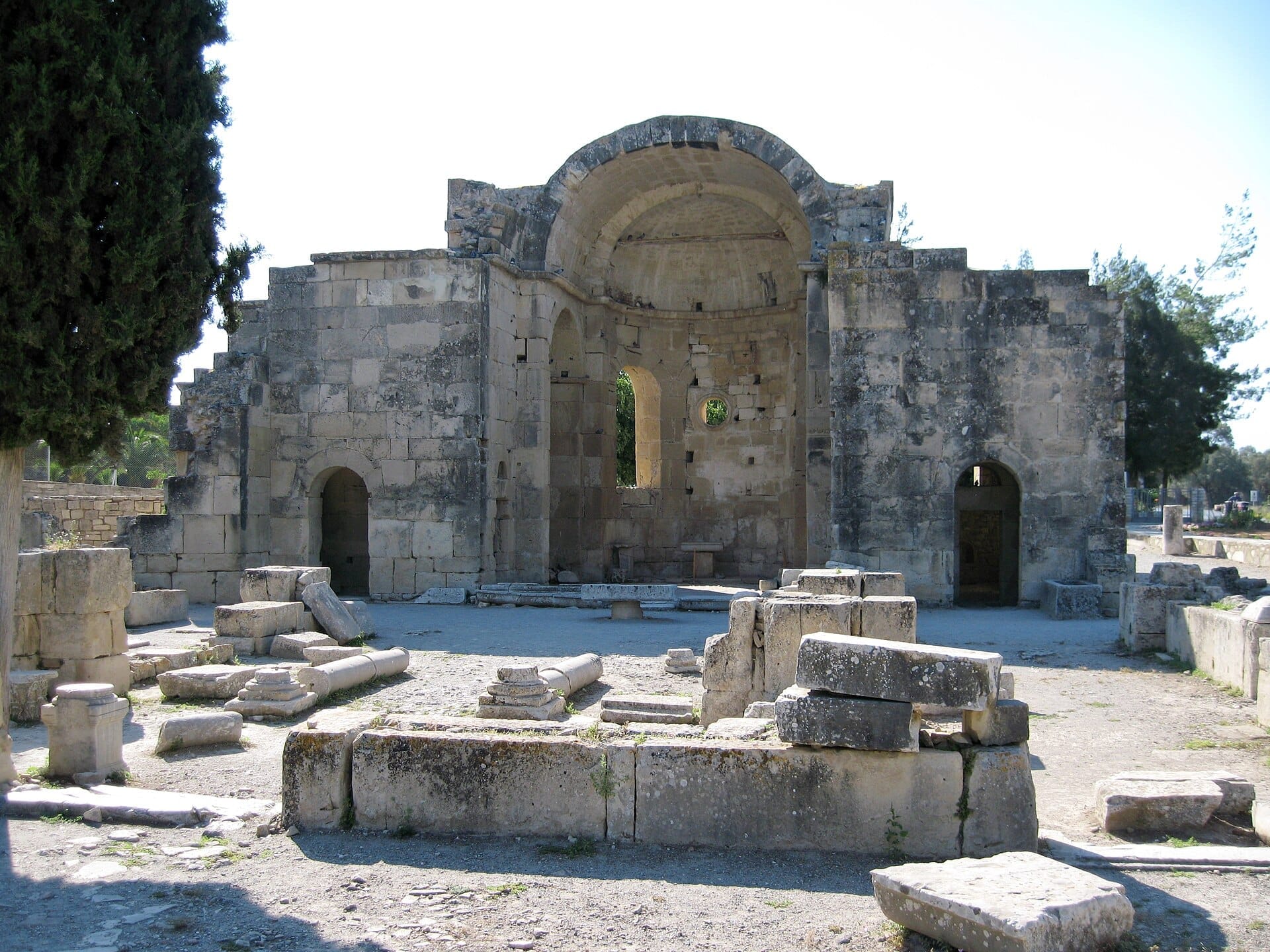
The acropolis was originally a Minoan-era settlement and was later fortified by the Dorians after approximately 1100 BC, with polygonal stone walls and towers that you can still partially trace. At its summit stand the ruins of a 6th-century AD Byzantine basilica, built directly over a Greek temple to Athena that dates to the 7th century BC. The layering here is extraordinary: Greek sacred architecture buried beneath early Christian architecture, both of them standing on a site that humans have occupied continuously for roughly four thousand years.
From the acropolis you also get the clearest sense of Gortyna's geographic logic. The Mesara plain stretches in all directions, flat and vast, with the Asterousia Mountains closing the horizon to the south. It is easy to understand from up here why this location controlled the agricultural wealth of Crete for so many centuries.
💡 Local tip
The path to the acropolis is unmarked and can be muddy after rain. In summer, the hillside is completely exposed. Bring water. The climb takes roughly 15-20 minutes from the road-level site. The view and the Byzantine ruins justify the effort.
When to Visit and How Light Changes the Site
Gortyna is at its best in the early morning between April and June, or in the late afternoon in September and October. At those hours, the light is angled enough to throw the inscribed grooves of the Law Code into sharp relief and to give the column drums and wall sections a warm, honey-colored tone. Midday in July and August is genuinely punishing on this exposed plain. The site provides almost no shade outside the Law Code building, and the white limestone reflects heat intensely.
Spring visitors will find the ruins surrounded by wildflowers, including poppies growing between ancient stones, and the air carries the scent of wild herbs. Autumn strips back the vegetation somewhat, making it easier to see structural details that summer growth obscures. Winter visits are possible but the site can be muddy and some paths become impassable.
For travelers planning a wider southern Crete itinerary, Gortyna fits naturally into a day that also includes Matala Beach to the southwest. The two sites are roughly 22 kilometres apart, and combining ancient history with an afternoon at the sea makes for a well-balanced day.
⚠️ What to skip
There is no on-site café or food vendor at Gortyna. The village of Agioi Deka, immediately adjacent, has basic tavernas. Stock water and snacks before entering, particularly in summer.
Getting There and Practical Details
Gortyna is located on the provincial road that connects the villages of Moires and Agioi Deka in south-central Crete. By car from Heraklion, the drive takes approximately 45 to 55 minutes via the E75 heading southwest. Parking is available at the roadside near the main entrance. A rental car is the most practical option by a significant margin: the site is not within walking distance of any major town, and bus connections from Heraklion toward Mires do run along this corridor but require onward walking from the nearest stop.
Travelers using a car have the advantage of linking Gortyna into a broader circuit of the island's southern and central sites. The Crete road trip guide covers several routes that include Gortyna as a natural stop between the Heraklion region and the southwest coast.
Accessibility at the site is limited. The road-level section with the Law Code is relatively flat, but the paths between Roman ruins are uneven, with loose stone and no paving. The acropolis involves an unpaved uphill climb. Visitors with mobility limitations should be aware that the enclosed Odeion building and Law Code display are the most accessible portion.
Gortyna is one of several major archaeological sites across the island. For context on how it fits into Crete's ancient history, the guide to Minoan and ancient history in Crete provides useful background on the different civilizations that shaped the island across four millennia.
Who Will Get the Most From Gortyna
Gortyna rewards visitors who approach it with some prior knowledge or a genuine interest in ancient history. Without context, the ruins can seem like scattered stones in a field. With context, that same landscape becomes one of the most significant archaeological sites in the eastern Mediterranean. Reading a brief history of the Gortyn Law Code before arrival will transform your experience of the inscribed blocks from curiosity to genuine wonder.
Travelers who prefer neatly presented, well-signposted archaeological parks may find Gortyna underwhelming. Signage at the site is inconsistent. Some areas have explanatory panels; others have nothing. The Italian Archaeological School, which has conducted excavations here since Halbherr's first dig in 1884, continues to work the site, and portions are periodically inaccessible due to active fieldwork.
For families with younger children, the Crete with kids guide has honest advice on which archaeological sites hold a child's attention and which do not. Gortyna's scale and partial obscurement by vegetation make it better suited to older children and teenagers with some interest in history than to very young visitors.
Insider Tips
- The Law Code blocks are best photographed in the early morning when side-lighting picks out the carved letters. The enclosed building's interior is dim, so let your eyes adjust for a minute before trying to read the inscription.
- Look for the large carved stone blocks reused in later Byzantine and medieval constructions throughout the site. Spolia (reused ancient stone) is everywhere at Gortyna, and spotting the inscriptions and decorative details on repurposed blocks is a game within the visit.
- The road divides the site into two sections. Most visitors only see the enclosed Odeion section on one side and miss the larger Roman zone across the road. Cross over and explore: the Praetorium ruins are impressive and almost always empty.
- Agioi Deka, the village right next to the site, is named after the Ten Saints martyred here during Roman rule. The small village church preserves Roman blocks with inscriptions in its construction, making it a five-minute extension of the historical experience.
- If you are visiting in spring (April to May), the wildflowers growing between the ruins are extraordinary. Poppies, chamomile, and wild sage fill the gaps between Roman masonry. Early May is particularly good for this.
Who Is Ancient Gortyna For?
- History and archaeology enthusiasts who want depth, not just highlights
- Travelers on a southern Crete day trip combining ruins, Minoan palaces, and coastal swimming
- Photographers interested in ancient inscriptions, architectural texture, and landscape
- Anyone studying classical antiquity, Roman provincial governance, or early Western legal history
- Visitors who have already seen Knossos and want to experience a very different kind of ancient site
Nearby Attractions
Combine your visit with:
- Palace of Phaistos
The Palace of Phaistos sits on a low hill above the Mesara plain in south-central Crete, offering a rare chance to walk through a Minoan palace complex without the crowds that overwhelm Knossos. Dating to around 2000 BCE, it is the second-largest Minoan palace on the island and the site where the famous, still-undeciphered Phaistos Disc was found. The views alone justify the drive.
- Palace of Zakros
The Palace of Zakros sits at the far eastern edge of Crete, half a kilometer from the sea, where a Minoan trade empire once operated 3,500 years ago. It is one of Crete's four largest Minoan palace complexes, and the one fewest visitors bother to reach — which is precisely what makes it worth the effort.
- Richtis Gorge
Richtis Gorge cuts through Lasithi Prefecture in eastern Crete, following a 4 km trail from Exo Mouliana village down to a 20-metre waterfall and the Aegean coast. With ancient bridges, lush riparian forest, and relatively manageable terrain, it ranks among the island's most rewarding gorge hikes outside of the famous Samaria route.
- Sitia
Sitia sits at the far eastern edge of Crete, where the tourist trail quietly fades and daily Greek life takes over. With Minoan origins, a hilltop Venetian fortress, a serious archaeological museum, and easy access to Vai Beach and the Minoan palace at Zakros, this unhurried port town rewards travelers who make the journey.