Matala Beach: Ancient Caves, Hippie History, and One of Crete's Most Unusual Shores
Matala Beach on Crete's south coast is unlike any other stretch of sand on the island. A 250-metre Blue Flag bay backed by cliff caves that served as Roman tombs, then 1960s hippie dens, it rewards curious travelers who want history and a good swim in the same afternoon.
Quick Facts
- Location
- Matala village, south coast of Crete, ~70 km southwest of Heraklion
- Getting There
- KTEL buses from Heraklion via Mires; by car via the E75/Tympaki road. Beach is walkable from village center.
- Time Needed
- 2–4 hours for beach and caves; full day if combining with Red Beach or Phaistos
- Cost
- Free entry to beach; sunbed hire extra; cave area has a small access fee in peak season
- Best for
- History lovers, relaxed beach days, counterculture curiosity, photography
What Makes Matala Different
Most beaches in Crete sell themselves on the colour of their water or the drama of their cliffs. Matala Beach does both, and then adds something no other beach on the island can match: a sandstone cliff riddled with hand-carved caves that have served, across different centuries, as Roman burial chambers, early Christian sanctuaries, and the improvised bedrooms of a generation of free-spirited travellers in the 1960s and early 1970s.
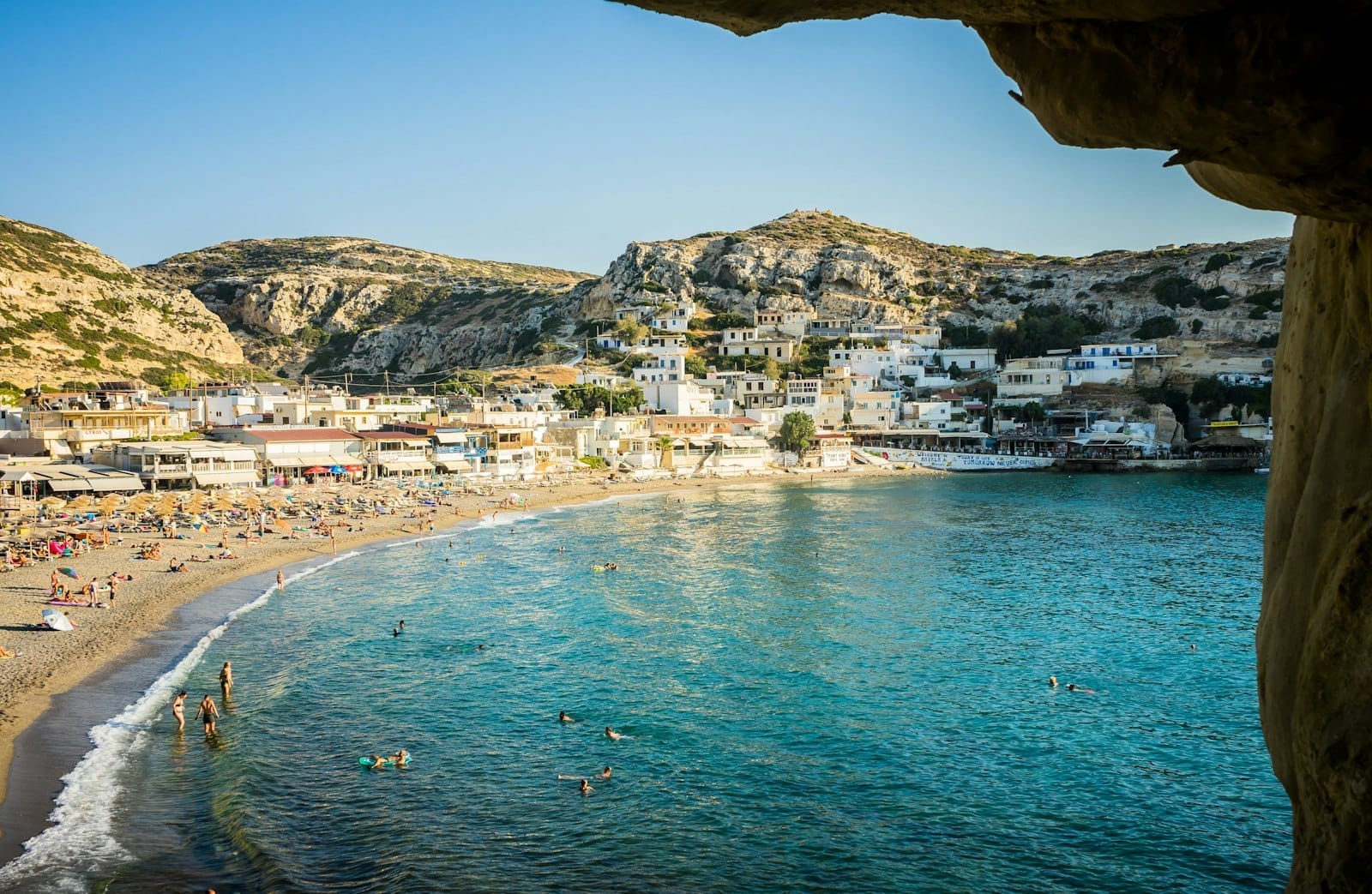
The beach itself sits inside a compact, semi-circular bay on Crete's south coast, facing the Libyan Sea. It runs roughly 250 to 300 metres in length and about 40 to 45 metres wide, with a mix of coarse sand and fine pebble underfoot. The water is sheltered enough to be calm most days, clear enough to see your feet at chest depth, and warm enough from June through October to make extended swimming easy. It holds Blue Flag status, which means annual checks on water quality, safety infrastructure, and cleanliness.
But none of that explains why people who have visited remember it years later. That comes down to the cliffs. And the story layered into them. If you want context before you arrive, the Minoan Palace of Phaistos is just 11 km away, and the two sites share ancient history as Matala served as Phaistos's sea outlet.
The Caves: Thousands of Years of Use
The caves carved into the northwest cliff face are not a natural formation. They were cut by human hands, most likely beginning in the Roman era, and expanded through early Christian centuries as tomb chambers. The sandstone at Matala is soft enough to work with basic tools, which is why the cells feel both deliberate and rough-edged: rectangular doorways, niched interiors, the occasional carved shelf that once held a burial. There are dozens of them stacked across the cliff face in irregular rows, some barely more than shoulder height, others spacious enough for a person to stand upright.
By the time the 1960s arrived, the graves were long abandoned and the caves became something altogether different. Word spread among the overland travellers passing through Greece and North Africa that Matala offered free shelter, warm nights, and a beach. By the early 1970s, a small international community had established itself in the caves. Joni Mitchell is among the names most often connected to this period, and she later drew on her time here for the lyrics to 'Carey'. The Greek military junta eventually evicted the cave dwellers, but the story stuck.
Today the caves are fenced off from the beach itself and accessed via a small path near the northern end of the bay. During the summer months a modest entry fee is collected at the gate. Inside, you can walk along the cliff-face paths, peer into the chambers, and read the informal multilingual graffiti that covers some walls, a palimpsest of everyone who has passed through. The atmosphere is surprisingly quiet compared to the beach below, especially in the morning before the day-trippers arrive.
💡 Local tip
Visit the caves early, ideally before 10am. The light falls directly on the cliff face in the morning, making it the best time for photographs. The paths are also significantly less crowded before the tour buses from Heraklion arrive mid-morning.
Tickets & tours
Hand-picked options from our booking partner. Prices are indicative; availability and final rates are confirmed when you complete your booking.
Agiofarago and Matala beach private tour
From 88 €Free cancellationVisit a Family-Run Olive Mill with Food Tasting in Heraklion
From 19 €Instant confirmationFree cancellationSnorkeling experience in Crete
From 45 €Instant confirmationFree cancellationSpinalonga self-guided audio tour on your phone
From 12 €Instant confirmationFree cancellation
The Beach: Layout, Facilities, and Water
The bay at Matala is compact and organized, which is both a strength and a limitation depending on what you're looking for. Rows of sunbeds and umbrellas cover most of the central stretch of sand in high season. Showers, toilets, a first aid post, and a lifeguard are all present during the summer months. Beach volleyball poles are set up toward the southern end. Water sports including jet ski hire and snorkeling equipment rental are available from operators along the shoreline.
The northern end of the beach, closest to the cave cliff, is the most atmospheric stretch. Here, the cliff provides some natural shade in the afternoon, and the sunbeds thin out. The water just off this section has a rocky bottom, so water shoes are worth having if you want to snorkel close to the cliff base. The central and southern sections are sandier underfoot and more suitable for young children.
In July and August the beach fills up completely by mid-morning. Arriving before 9am means you can choose your spot. Outside of peak summer, particularly in May, June, and September, the beach is noticeably quieter and the village feels more like a lived-in place than a resort. The water remains warm well into October.
ℹ️ Good to know
Matala Beach has a wheelchair-accessible lift to assist visitors with mobility limitations. Shaded areas are available under trees at the edges of the bay if you prefer to avoid full sun.
Red Beach: The Walk Worth Taking
About 1.5 km south of Matala, accessible by a 20 to 25 minute walk over a rocky headland path, is Red Beach. The name is literal: iron-rich red sandstone cliffs shed sediment onto the shore, giving the sand a warm terracotta tone unlike anything you'll find elsewhere on Crete's coast. The walk requires reasonable footwear and some scrambling over rocks, but it's not technical. The reward is a smaller, less organized beach with no sunbed hire, far fewer people, and a strong sense of being somewhere genuinely remote despite being minutes from a village.
Red Beach also has its own small nudist tradition and draws a more independent crowd. There are no facilities, so bring water. The path back can feel steep in the afternoon heat, so timing your return for late afternoon, when the rocks are cooler, makes the round trip more comfortable.
Historical and Mythological Context
Matala sits within one of the most historically layered parts of Crete. In ancient times, the bay functioned as the sea outlet and port for both Phaistos and, later, Gortyn, two of the most significant settlements on the island across different eras. Ships carrying goods from the Minoan Palace of Phaistos likely loaded and unloaded here. The Romans, who made Gortyn the capital of their Cretan province, continued to use the harbour and began cutting the tomb caves into the cliffs.
Greek mythology also attaches itself to the bay. According to one version of the story of Zeus and Europa, it was at Matala that Zeus came ashore in the form of a white bull after carrying Europa across the sea from Phoenicia. Whether you find mythology persuasive or decorative, it is one more reason the location has drawn people across thousands of years. The nearby Gortyna archaeological site is roughly 17 km northeast and makes a logical pairing with a Matala trip for anyone interested in Roman-era Crete.
Practical Information: Getting There and Getting Around
Matala is approximately 70 km southwest of Heraklion and about 45 km south of Rethymno by road. The most comfortable way to reach it is by rental car. The drive from Heraklion takes roughly 75 to 90 minutes depending on traffic and passes through the agricultural plains of the Mesara valley. Parking is available in the village, though spaces fill up fast in August.
KTEL public buses connect Heraklion to Matala via Mires, the regional town. Check current schedules directly with KTEL Heraklion as timings change seasonally. For those planning a broader south coast loop, Matala pairs well with the Preveli Beach and Agia Galini, both reachable within 30 to 45 minutes by car along the scenic coastal road.
If you are building a broader Crete itinerary, the Crete road trip guide covers the south coast route in detail and explains how to combine Matala with the island's other major sites without backtracking unnecessarily.
⚠️ What to skip
Matala gets genuinely crowded in peak summer. If you are visiting in July or August and value space and quiet, consider arriving before 9am or switching your beach day to a shoulder-month trip. The Matala Beach Festival, held in June, draws large crowds for several days around its dates.
Photography and Atmosphere by Time of Day
The bay faces roughly southwest, which means the morning light falls on the cliff face while the beach is still in partial shade. This is the best window for cave photography. By midday the light is high and flat, and the beach is at its fullest. Late afternoon brings the most atmospheric conditions: the sun drops behind the cliffs, the shadows lengthen across the sand, and the remaining light turns the water from pale blue to deep green. Sunsets at Matala, seen from the cliff path or from a table at one of the tavernas lining the bay, are worth staying for.
The village itself is compact enough to walk entirely in 20 minutes. There are several tavernas and cafes directly along the beach road, most serving straightforward Greek seafood and salads. Prices are slightly elevated for a village of this size, reflecting the tourist traffic. For a broader sense of how Matala fits into Crete's south coast, the best beaches in Crete guide compares it honestly with alternatives across the island.
Insider Tips
- The cave gate typically opens around 8am in summer. Being there at opening means near-empty paths, ideal light on the cliff face, and no tour groups. By 10:30am the paths can feel congested.
- The small rocky cove just north of the main beach, accessible by scrambling a few meters past the cave entrance path, is largely unknown to day-trippers and offers clear water over flat rock for snorkeling.
- The Matala Beach Festival usually takes place in June and draws music fans from across Crete and mainland Greece. Book accommodation months in advance if your visit coincides with it, or avoid it if crowds are not your thing.
- Bring water shoes if you plan to snorkel near the northern cliff base. The sand gives way to sharp rock quickly, and the marine life is noticeably richer closer to the cliff than on the open sandy bottom.
- Red Beach has no shade whatsoever. If you plan to spend more than an hour there, go in the morning or late afternoon and carry more water than you think you need.
Who Is Matala Beach For?
- Travelers who want history and a beach in the same stop, without a museum entrance fee
- Photography enthusiasts drawn to unusual cliff formations and layered human stories
- Couples and solo travelers looking for a south coast base with character beyond a typical resort
- Anyone building a south-central Crete day combining Phaistos, Gortyna, and a coastal swim
- Shoulder-season visitors in May, June, or September who want warm water and genuine quiet
Nearby Attractions
Other things to see while in Plakias & South Coast:
- Agia Galini
Perched amphitheatrically above Messara Bay on Crete's southern coast, Agia Galini is a small fishing village with steep lanes, a sheltered harbor, and a beach within 100 meters of the center. Its name means 'Holy Peace' in Greek, and for most of the year, that description holds.
- Kourtaliotiko Gorge
Kourtaliotiko Gorge cuts through the Rethymno highlands for roughly 3 kilometres, its limestone walls rising up to 600 metres above a river that eventually spills into Preveli Beach. The gorge takes its name from the Cretan word for applause, a reference to the wind-carried echo that rings through the canyon walls. This is one of southern Crete's most rewarding short excursions, combining geology, legend, rare wildlife, and river scenery in a compact, accessible package.
- Matala Caves
Cut into sandstone cliffs above one of southern Crete's most atmospheric beaches, the Matala Caves are an open-air archaeological site with a layered past: Roman burial chambers, a Minoan port connection, and a 1960s countercultural chapter that gave this quiet village an unlikely legendary status. The views from the cliff face alone justify the small entrance fee.
- Plakias Beach
Plakias Beach stretches 1.3 kilometres along the south coast of Crete's Rethymno Prefecture, backed by mountains and facing the Libyan Sea. Free to enter, Blue Flag certified, and far quieter than the north coast resorts, it rewards travellers who make the drive south.