Plakias Beach: South Crete's Most Rewarding Sandy Crescent
Plakias Beach stretches 1.3 kilometres along the south coast of Crete's Rethymno Prefecture, backed by mountains and facing the Libyan Sea. Free to enter, Blue Flag certified, and far quieter than the north coast resorts, it rewards travellers who make the drive south.
Quick Facts
- Location
- Plakias, Agios Vasileios Municipality, Rethymno Prefecture, Crete — 32–36 km south of Rethymno city
- Getting There
- By car: ~2 hrs from Chania Airport, ~1.5 hrs from Heraklion Airport. KTEL buses run from Rethymno to Plakias; free parking on-site
- Time Needed
- Half day minimum; most visitors stay 3–5 hours or base themselves here overnight
- Cost
- Free entry. Sunbed and umbrella hire approximately €10 per set
- Best for
- Families, independent travellers, sun-seekers who want space without a resort price tag
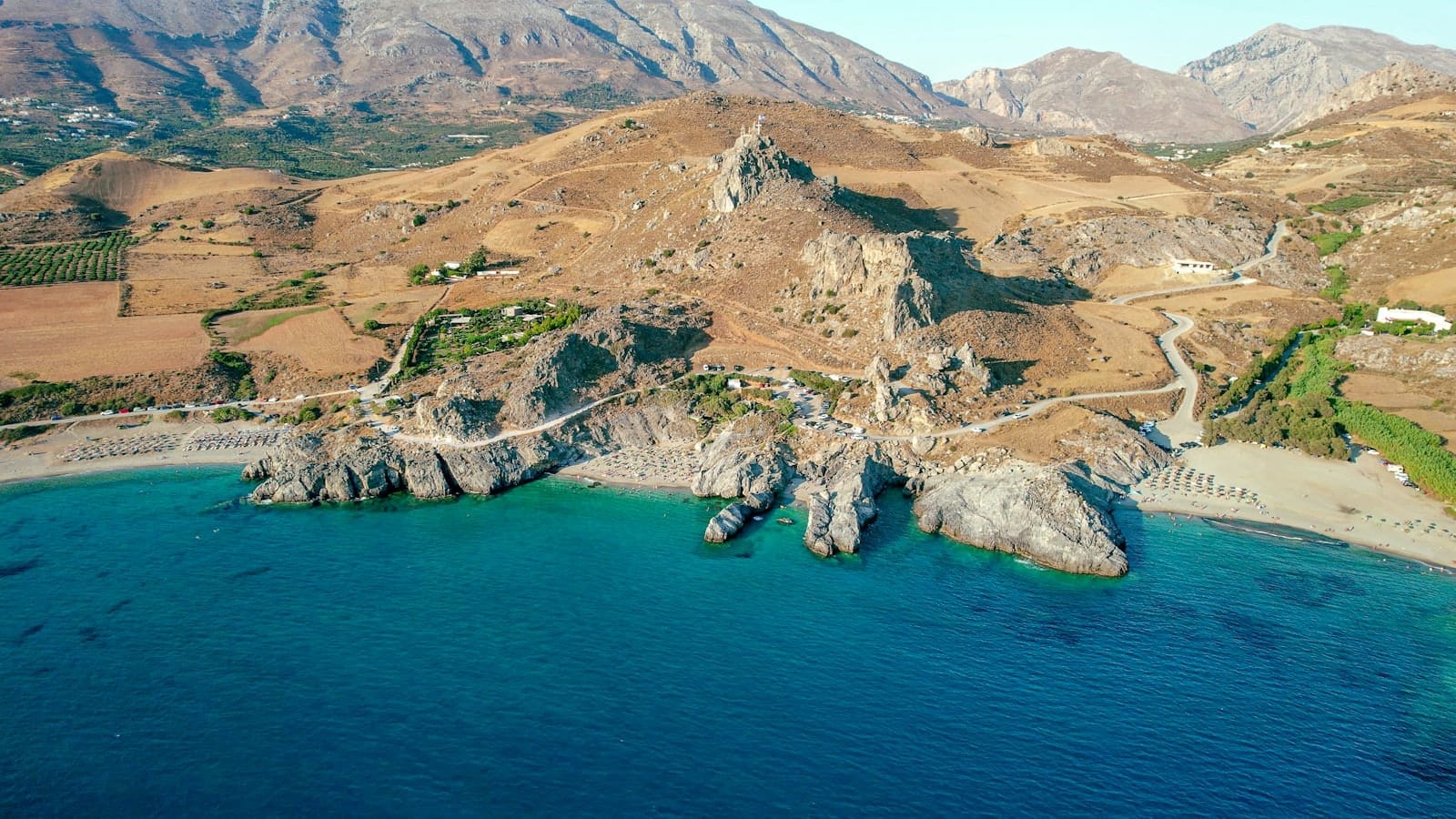
What Plakias Beach Actually Looks Like
Plakias Beach is a broad crescent of coarse golden sand running roughly 1.3 to 1.5 kilometres along the southern shore of the Rethymno regional unit. The beach faces the Libyan Sea, which means the horizon is wide open — no islands interrupting the view, just blue water deepening steadily from turquoise at the shoreline to darker indigo offshore. The mountains of the White Mountains foothills crowd in on the western side, giving the bay a sheltered, almost enclosed feeling that contrasts sharply with the open expanse of water ahead.
The sand itself is not the fine powder of a postcard beach. It is coarser, slightly grey-gold, and firm underfoot, which actually makes it easier to walk and to set up for a long day. The water is clear enough to see the bottom at chest depth on calm days, and the entry is gradual, making it safe and comfortable for children. There are no dramatic rock formations breaking the beach line, just a consistent, wide strip that stays spacious even on busy summer afternoons.
💡 Local tip
The eastern end of the beach is less developed and informally used as a nudist section. If that is not what you are looking for, set up in the central or western portion near the tavernas.
How the Beach Changes Through the Day
Early morning at Plakias — before 9am — is genuinely quiet. The light comes in low from the east, turning the water a pale mint colour and the mountains behind the village a warm ochre. A handful of local fishermen and early-rising campers have the sand to themselves. There is no music, no bar hum, just the sound of small waves and the occasional motorbike passing through the village. This is the hour to walk the full length of the beach from west to east without weaving around sunbeds.
By mid-morning the sunbed operators are set up and the first arrivals from Rethymno are parking up. The beach handles the crowd better than most: it is wide enough that even in July and August the western stretch feels uncrowded. The water temperature in peak season typically sits between 24 and 26 degrees Celsius, warm enough that nobody hurries out. Afternoons bring a reliable westerly breeze off the Libyan Sea — refreshing for swimmers but worth knowing if you are not good with wind-blown sand in your food.
Sunset at Plakias is understated rather than spectacular. The beach faces roughly south, so the sun sets slightly behind the western hills rather than over the water. What you do get is a long golden-hour glow across the mountains and the village rooftops, and water that shifts from blue to bronze. Many visitors combine a late swim with dinner at one of the seafront tavernas, timing arrival back in Rethymno for after dark.
Tickets & tours
Hand-picked options from our booking partner. Prices are indicative; availability and final rates are confirmed when you complete your booking.
Visit a Family-Run Olive Mill with Food Tasting in Heraklion
From 19 €Instant confirmationFree cancellationSnorkeling experience in Crete
From 45 €Instant confirmationFree cancellationSpinalonga self-guided audio tour on your phone
From 12 €Instant confirmationFree cancellationMalia to Sissi private tuk-tuk journey with tastings
From 45 €Instant confirmationFree cancellation
The Village Behind the Beach
Plakias village sits directly behind the beach and began as a small fishing settlement in the 1960s. It was never a grand resort and has never fully become one, which is precisely what draws the travellers who come here. The seafront strip has tavernas, a few small hotels, a supermarket, a pharmacy, and a scattering of rental rooms. There is no casino, no water park, no strip of nightclubs. The atmosphere in the evening is closer to a working Cretan village than a package holiday destination.
The tavernas along the beach road serve standard Greek-Cretan menus: fresh fish, grilled lamb, dakos (barley rusk with tomato and cheese), and local olive oil that is noticeably better than what you find in tourist-heavy spots. Prices are fair. The kafeneion at the village square is where older Cretan men play backgammon in the evenings, mostly unbothered by tourists passing through.
For travellers interested in understanding Cretan food culture beyond the beach, the Cretan food guide provides a useful primer on what to order and what to avoid.
Practical Information: Getting There and Getting Around
Plakias is on Crete's south coast, which means there is no fast highway connecting it to the north. The drive from Rethymno city takes roughly 45 minutes via the inland mountain road, which winds through olive groves and small villages before descending to the coast. The road is well-maintained but narrow in sections — overtaking a truck on a hairpin bend is an experience you will only want once. A rental car is by far the most practical option. The drive is genuinely scenic.
From Heraklion Airport, budget around 1.5 hours by car. From Chania Airport, allow around 2 hours. KTEL buses run between Rethymno and Plakias, though the schedule is limited and not suited to a day trip unless you plan around it carefully. Taxis from Heraklion run to approximately €105. Free parking is available near the beach and is generally easy to find outside of August.
ℹ️ Good to know
Plakias is a useful base for exploring nearby gorges and beaches. Preveli Beach and the Kourtaliotiko Gorge are both within 20–25 minutes by car, making this village a logical overnight stop rather than just a day trip destination.
If you are planning a broader circuit of the south coast, the Crete road trip guide covers the best routes and how to link Plakias with other stops on the island.
Facilities, Accessibility, and Blue Flag Standards
Plakias Beach holds Blue Flag certification, which requires verified water quality, environmental management, lifeguard presence in season, and clean facilities. In practice this means you will find supervised swimming during summer months, showers at several points along the beach, changing rooms, and public toilets. The beach also has a designated wheelchair-accessible section with adapted sunbeds and parasols, provided via the taverna operators.
The shallow, gently shelving entry and calm conditions on most days make Plakias one of the more family-friendly beaches on the south coast. Young children can wade safely and the lack of boat traffic in the swimming area reduces risk. On windier days — which can arrive without much warning in September and October — the surface chop increases but the water remains manageable for confident swimmers.
⚠️ What to skip
The afternoon westerly wind can build quickly in summer. If you are bringing an umbrella or canopy, stake it down properly. Lightweight sun shelters have been known to take flight without warning.
Nearby Excursions Worth Building In
The area around Plakias contains some of the most dramatic terrain on the island. The Kourtaliotiko Gorge is a short drive northeast, a deep limestone canyon where you can hear the river before you see it and where griffon vultures occasionally circle above the cliff faces. Preveli Beach lies a further 20 minutes east, where the Megalopotamos river meets the sea through a palm grove — one of the more unusual coastal environments in Greece.
Preveli is worth its own half-day: see the full breakdown in our guide to Preveli Beach and the nearby Preveli Monastery, which sits on a ridge above the gorge with panoramic views over the Libyan Sea.
If you are based in Plakias for more than one night, the small resort of Agia Galini lies about 35 kilometres east along the coast road and makes a worthwhile half-day excursion, particularly for its harbour-side fish restaurants and boat trip options.
For a broader view of what the south coast offers, the best beaches in Crete guide compares Plakias against the island's other major coastal options and helps you decide how it fits into your itinerary.
Who Should Consider Skipping Plakias
Plakias is not the right choice for every traveller. If you are looking for an all-inclusive resort experience with water sports, organised entertainment, and a beach bar pumping music until sunset, this is the wrong address. The village is quiet, the evening options are limited to dinner and a slow walk, and the nearest town of any size is 45 minutes away. Travellers who feel uncomfortable without urban infrastructure nearby may find it isolating rather than peaceful.
The beach itself, while large, is not visually dramatic. It lacks the jagged coves and photogenic rock formations that make places like Seitan Limani or Elafonissi instantly recognisable. If Instagram aesthetics are driving your beach choices, there are more photogenic options. What Plakias offers instead is uncrowded space, clean water, and a functioning village that has not been entirely remade for tourists.
Insider Tips
- Arrive before 9am in July and August to claim a spot in the central section without paying for a sunbed. By 10am the hired sets fill in, but the eastern end stays open and free throughout the day.
- The supermarket in the village sells decent local wine and olive oil at normal Greek prices. Stock up here rather than at the airport on your way home — the quality is noticeably better than tourist-shop bottles.
- Wind direction matters on this beach. The afternoon westerly comes from the right (west), so set up facing south-southeast if you want to avoid having your towel used as a sail.
- If you have a car, drive the 7 km to Damnoni Beach in the late afternoon. It is smaller, pebblier, and significantly quieter, with two tavernas that serve food until evening. Locals from Plakias village tend to go there when their own beach gets busy.
- The road from Rethymno to Plakias passes through the village of Mixorrouma, where there is a small kafeneion that serves mountain tea and homemade pastries. It is easy to miss but worth a 15-minute stop on the way down.
Who Is Plakias Beach For?
- Families with young children who need calm, shallow water and proper beach facilities
- Independent travellers who want a south-coast base for exploring gorges and monasteries
- Visitors to Rethymno looking for a full-day beach excursion away from the north coast crowds
- Couples wanting a quieter alternative to the main resort areas, particularly in May, June, or September
- Budget travellers: free beach, affordable tavernas, and cheaper accommodation than comparable beaches on the north coast
Nearby Attractions
Other things to see while in Plakias & South Coast:
- Agia Galini
Perched amphitheatrically above Messara Bay on Crete's southern coast, Agia Galini is a small fishing village with steep lanes, a sheltered harbor, and a beach within 100 meters of the center. Its name means 'Holy Peace' in Greek, and for most of the year, that description holds.
- Kourtaliotiko Gorge
Kourtaliotiko Gorge cuts through the Rethymno highlands for roughly 3 kilometres, its limestone walls rising up to 600 metres above a river that eventually spills into Preveli Beach. The gorge takes its name from the Cretan word for applause, a reference to the wind-carried echo that rings through the canyon walls. This is one of southern Crete's most rewarding short excursions, combining geology, legend, rare wildlife, and river scenery in a compact, accessible package.
- Matala Beach
Matala Beach on Crete's south coast is unlike any other stretch of sand on the island. A 250-metre Blue Flag bay backed by cliff caves that served as Roman tombs, then 1960s hippie dens, it rewards curious travelers who want history and a good swim in the same afternoon.
- Matala Caves
Cut into sandstone cliffs above one of southern Crete's most atmospheric beaches, the Matala Caves are an open-air archaeological site with a layered past: Roman burial chambers, a Minoan port connection, and a 1960s countercultural chapter that gave this quiet village an unlikely legendary status. The views from the cliff face alone justify the small entrance fee.