Moni Preveli Monastery: History, Views, and Practical Guide
Perched at 170 metres above the Libyan Sea in the Rethymno region, Moni Preveli is one of Crete's most historically layered monasteries. From its role in 19th-century resistance to sheltering Allied soldiers in World War II, it carries real weight. The views, the church, and the ruined lower monastery along the road make this far more than a scenic detour.
Quick Facts
- Location
- Preveli, Rethymno 74060, Crete — 37 km south of Rethymno city
- Getting There
- By car via Spili and Kourtaliotiko Gorge road; no regular bus service to the monastery gate
- Time Needed
- 1 to 1.5 hours at the monastery; add 30 min if stopping at Kato Preveli ruins en route
- Cost
- Entry fee charged in peak season (verify current amount on arrival); free in winter
- Best for
- History seekers, WWII buffs, architecture lovers, and anyone combining the visit with Preveli Beach below
- Official website
- preveli.org/files/moni/en10.htm
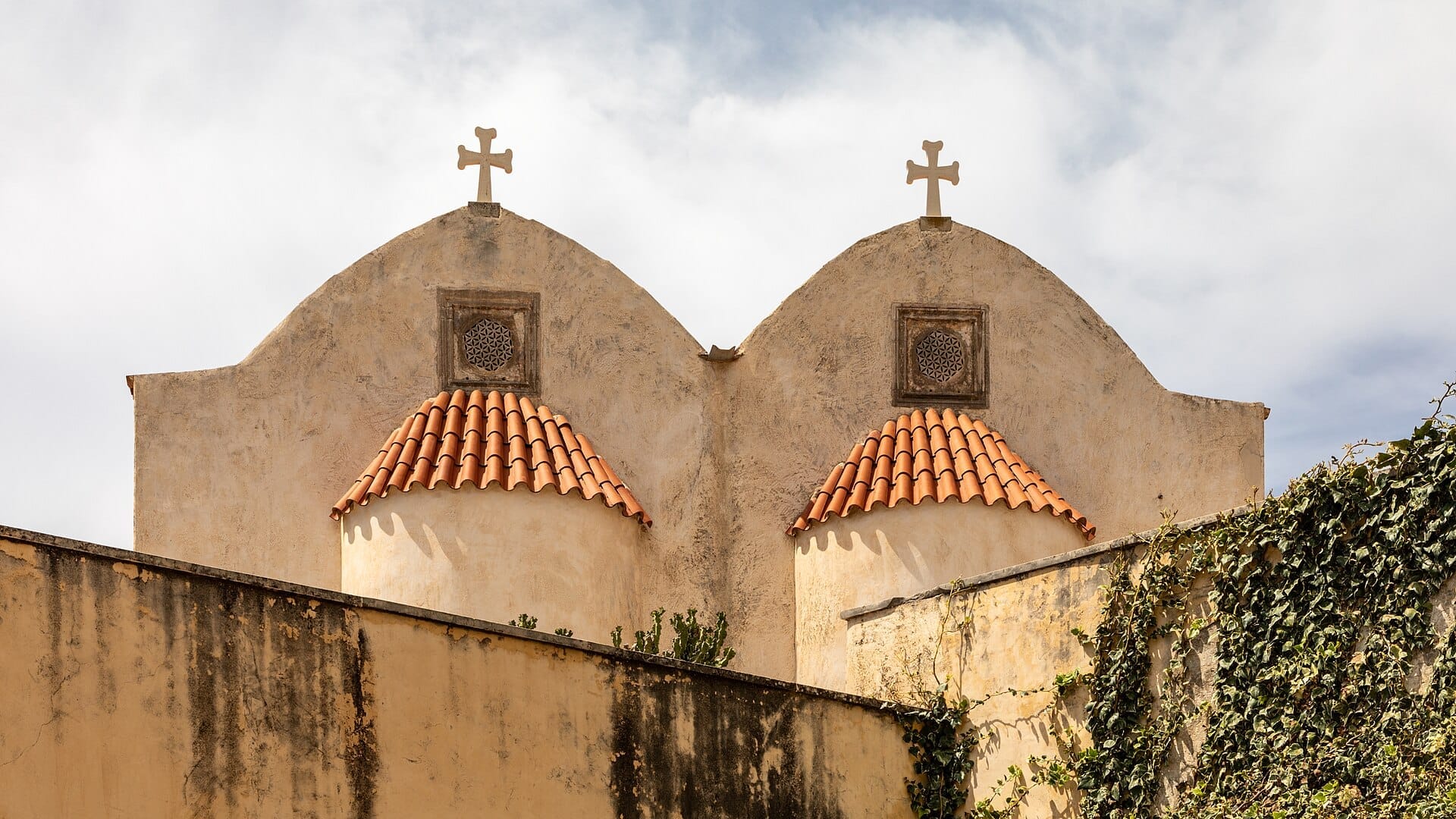
What Moni Preveli Actually Is
The Holy Monastery of Preveli, known in Greek as Ιερά Μονή Προβελή, sits on a broad plateau at 170 metres elevation on Crete's southern coast, with an unobstructed panorama of the Libyan Sea stretching toward North Africa. The complex you visit today, formally called Piso Moni Preveli (Upper Monastery of St. John the Evangelist), is an active Orthodox monastery with a working church, a small ecclesiastical museum, and terraced gardens. It is not a ruin. It is not a reconstruction. It is a living religious site that has been continuously rebuilt and defended across four centuries.
The distinction between the upper and lower monasteries matters for first-time visitors. About two kilometres before you reach Piso Moni, the road passes the roofless shell of Kato Moni Preveli, the Lower Monastery of St. John the Baptist. This earlier foundation dates from roughly the same period but was abandoned and is now a picturesque ruin set beside the Megalopotamos River and a well-preserved Ottoman stone bridge from around 1850. Many visitors drive past without stopping, which is a mistake. The lower monastery gives the upper one its full context.
💡 Local tip
Stop at Kato Moni Preveli and the Turkish bridge before heading up the road to Piso Moni. It adds 20 minutes and substantially deepens the visit.
The History Behind the Walls
The oldest confirmed artifact at Preveli is a bell dated 1594, pointing to a Venetian-era foundation, likely established by a feudal lord known as Prevelis. The Ottoman invasion of 1649 destroyed the complex, but it was rebuilt and became a significant seat of Cretan Orthodox identity during the long occupation. By the 19th century it was active enough to contribute to the 1866 revolutionary uprising, one of several failed but formative attempts to unite Crete with Greece before union was finally achieved in 1913.
The episode that draws most international visitors is the monastery's role in World War II. After the Battle of Crete in 1941, the monks of Preveli sheltered hundreds of Allied soldiers, mostly Australian and New Zealand troops who had been cut off during the evacuation. The monastery fed them, hid them from German patrols, and helped coordinate their escape by submarine from Preveli Beach below. Abbot Agathangelos Lagouvardos led this effort at enormous personal risk. The monastery was eventually raided and punished by German forces, but the abbot's actions are now commemorated by a monument on the grounds and recognized by the governments of Australia and New Zealand.
For deeper context on this period, the history of Crete guide covers the island's longer arc from Minoan civilization through Ottoman rule and 20th-century occupation.
Tickets & tours
Hand-picked options from our booking partner. Prices are indicative; availability and final rates are confirmed when you complete your booking.
Preveli guided tour from Chania
From 46 €Instant confirmationFree cancellationVisit a Family-Run Olive Mill with Food Tasting in Heraklion
From 19 €Instant confirmationFree cancellationSnorkeling experience in Crete
From 45 €Instant confirmationFree cancellationSpinalonga self-guided audio tour on your phone
From 12 €Instant confirmationFree cancellation
The Church, the Museum, and the Grounds
The church of Saint John the Theologian, built in 1837 in a clean neoclassical style, anchors the upper courtyard. Inside, the iconostasis holds several significant icons, including a jewel-encrusted silver cross that is one of the monastery's most venerated relics. Natural light enters from high windows, and on summer mornings, the interior is cool and dim with a faint smell of incense from earlier liturgy. Dress code is strictly enforced: shoulders and knees must be covered. The monastery provides wraps at the entrance for those who arrive underprepared, but bringing your own is faster.
The museum, housed in the former stables, is modest in size but specific in content. It displays ecclesiastical silverware, embroideries, manuscripts, and artifacts tied to the monastery's history, including items from the WWII period. Labels are in Greek and English. Budget 15 to 20 minutes here, more if the monastic history genuinely interests you.
The grounds themselves reward slow walking. Terraced gardens with olive trees and flowering shrubs descend toward the cliff edge, and a stone terrace near the southern wall offers the best unobstructed view of the Libyan Sea. On a clear day, the horizon feels very far south. In summer, the salt breeze off the water keeps the terrace several degrees cooler than the road.
When to Visit and How It Changes by Hour
Summer opening hours are generally 8:00 to 13:30 in the morning session and 16:00 to 19:00 in the afternoon, though these are subject to change without notice. The monastery is most peaceful in the first hour after it opens in the morning. By mid-morning in July and August, tour buses arrive from Rethymno and Plakias, and the courtyard can feel crowded for a place that calls for quiet. The afternoon session, reopening around 16:00, is often calmer, with softer light and the worst of the midday heat past.
⚠️ What to skip
Always verify hours before visiting. The monastery operates on Greek Orthodox religious schedule and may close for feast days or during liturgies. The phone number is +30 28320 41444.
Winter visits are a different experience entirely. The monastery may be free of charge and largely free of other visitors, but parts of the complex may be closed or unstaffed. The road through Kourtaliotiko Gorge is occasionally affected by rockfalls in winter, so check local conditions before driving. The reward in cooler months is the landscape: the gorge runs with more water, the light is lower and less harsh, and the sea view from the monastery terrace has a particular clarity.
October visits work especially well here, with warm but manageable temperatures and thinning crowds. The guide on visiting Crete in October covers the broader picture for planning around this season.
Getting There and What the Drive Is Like
There is no regular bus service that reaches the monastery gate. A car or scooter is the practical choice. From Rethymno, the drive south takes roughly 45 minutes under normal conditions. The route passes through the market town of Spili, then drops into the Kourtaliotiko Gorge, a dramatic limestone canyon where the road narrows and the walls rise close on both sides. The gorge is worth slowing down for. After the gorge, the road follows the Megalopotamos River to the Ottoman bridge and the lower monastery ruins, then climbs to the plateau and the upper monastery entrance.
Travellers staying in Plakias are well placed: the monastery is under 20 kilometres away and can be combined in a day with Preveli Beach below the monastery, reached by a 15-minute walk from a separate car park lower on the road. The beach sits where the Megalopotamos River meets the sea, flanked by palm trees, and it is a striking contrast to the religious solemnity above it.
For those planning a wider loop through Rethymno, the Crete road trip guide has routing suggestions that connect the south coast with the Rethymno town stop.
Photography and Practical Notes
Photography is generally permitted in the courtyard and on the grounds, but inside the church it is customary to ask and often restricted during services. The best exterior shots of the monastery come from the terrace facing south, with the Libyan Sea as a backdrop. Early morning light hits the facade directly and the stone takes on a warm tone. Afternoon light is more diffuse but works better for the sea view.
The site is multi-level with stone steps and some uneven paths. For visitors with limited mobility, the main courtyard and church entrance are reachable, but several sections of the grounds involve steps without handrails. There is no café or water point inside the monastery, so bring your own water, especially in summer when temperatures on the exposed terrace can be significant. The nearest facilities are in Plakias town or at stops along the Kourtaliotiko road.
ℹ️ Good to know
Covered shoulders and knees are required to enter the monastery and church. A light scarf or thin trousers take care of this. The monastery provides wraps but having your own is more comfortable.
Who This Suits and Who Should Think Twice
Preveli works well for travellers who want cultural and historical substance alongside Crete's coastal scenery. The combination of the gorge drive, the lower monastery ruins, the upper complex with its museum, and Preveli Beach below makes for a full and genuinely varied half-day. Families with children over eight or so tend to manage it well, particularly if the beach is included as the final reward.
Travellers who are primarily beach-focused and feel indifferent to religious or historical sites may find the monastery portion thin, especially if the museum is closed. In that case, the beach and the gorge drive alone might be enough reason to make the journey. Anyone expecting the visual grandeur of a major medieval fortress or a richly decorated Byzantine complex should calibrate expectations: Preveli is dignified and historically significant, but architecturally restrained. Its 19th-century church is clean and well-kept rather than ornate.
If your primary interest is Cretan monastic history and architecture, Arkadi Monastery near Rethymno is a larger and more dramatically presented site, famous for the 1866 siege, and makes a useful comparison point.
Insider Tips
- The ruined Kato Moni Preveli and the Ottoman bridge below it are not signed prominently from the main road. Slow down after the gorge and look for the turnoff left toward the river. The detour is short and adds real depth to the visit.
- The afternoon session (around 16:00 to 19:00 in summer) is consistently quieter than the morning. If you can time your arrival for the first 30 minutes of the afternoon reopening, you will likely have the terrace and courtyard largely to yourself.
- The monument commemorating Allied soldiers evacuated during WWII is on the grounds but not prominently labelled in tour group itineraries. Take a few minutes to find it and read the inscription. It puts the whole site in a different register.
- Combine the monastery with Preveli Beach on the same day but drive separately: the beach car park is below the monastery on a different spur of road, and the path down from the monastery is steep and not suitable for all footwear.
- In summer, the sea breeze on the south-facing terrace is the coolest spot in the entire complex. If the heat is significant, spend more time there than inside.
Who Is Moni Preveli Monastery For?
- History and WWII enthusiasts wanting sites with documented resistance significance
- Travellers combining the Kourtaliotiko Gorge drive with a south coast beach day
- Photographers looking for monastery architecture framed against the Libyan Sea
- Visitors based in Plakias or Rethymno looking for a substantive half-day inland and coastal loop
- Travellers interested in Greek Orthodox monastic culture and ecclesiastical art
Nearby Attractions
Other things to see while in Plakias & South Coast:
- Agia Galini
Perched amphitheatrically above Messara Bay on Crete's southern coast, Agia Galini is a small fishing village with steep lanes, a sheltered harbor, and a beach within 100 meters of the center. Its name means 'Holy Peace' in Greek, and for most of the year, that description holds.
- Kourtaliotiko Gorge
Kourtaliotiko Gorge cuts through the Rethymno highlands for roughly 3 kilometres, its limestone walls rising up to 600 metres above a river that eventually spills into Preveli Beach. The gorge takes its name from the Cretan word for applause, a reference to the wind-carried echo that rings through the canyon walls. This is one of southern Crete's most rewarding short excursions, combining geology, legend, rare wildlife, and river scenery in a compact, accessible package.
- Matala Beach
Matala Beach on Crete's south coast is unlike any other stretch of sand on the island. A 250-metre Blue Flag bay backed by cliff caves that served as Roman tombs, then 1960s hippie dens, it rewards curious travelers who want history and a good swim in the same afternoon.
- Matala Caves
Cut into sandstone cliffs above one of southern Crete's most atmospheric beaches, the Matala Caves are an open-air archaeological site with a layered past: Roman burial chambers, a Minoan port connection, and a 1960s countercultural chapter that gave this quiet village an unlikely legendary status. The views from the cliff face alone justify the small entrance fee.