Agia Galini: South Crete's Most Atmospheric Fishing Village
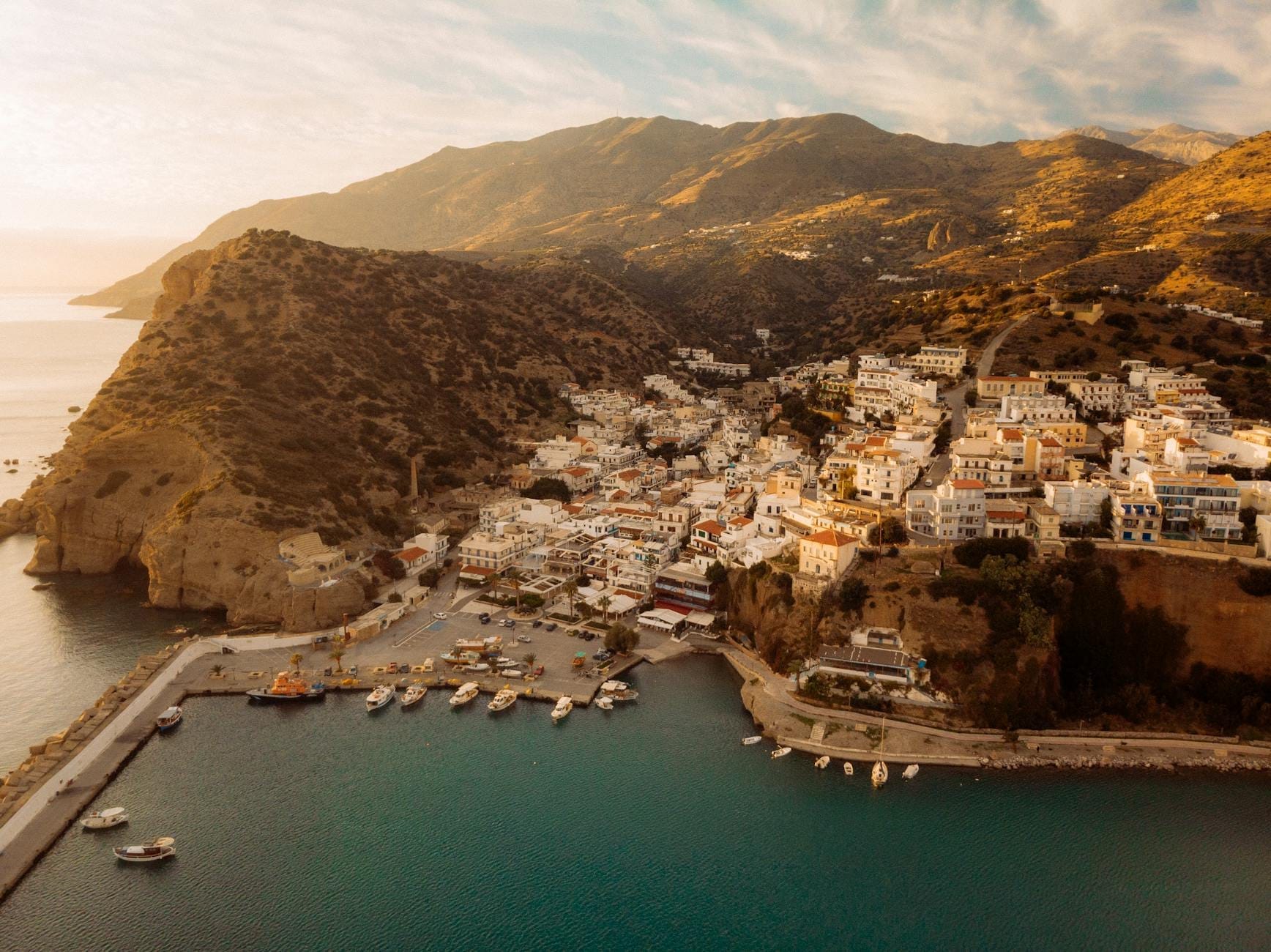
Perched amphitheatrically above Messara Bay on Crete's southern coast, Agia Galini is a small fishing village with steep lanes, a sheltered harbor, and a beach within 100 meters of the center. Its name means 'Holy Peace' in Greek, and for most of the year, that description holds.
Quick Facts
- Location
- Rethymno regional unit, south Crete — 53 km southeast of Rethymno, 78 km southwest of Heraklion
- Getting There
- Car recommended via coastal roads; buses connect from Rethymno and Heraklion. Approx. 78 km from Heraklion.
- Time Needed
- Half day to full day; overnight recommended to catch the village at its quietest
- Cost
- Free to enter. Beach umbrella and sunbed hire applies on the main beach.
- Best for
- Slow travel, waterfront dining, mythology-minded visitors, and beach days without large resort crowds
What Agia Galini Actually Is
Agia Galini is a working fishing village turned low-key resort on the southern coast of Crete, looking out over Messara Bay and the Libyan Sea. With a permanent population of around 650 people, it is small enough to walk end to end in ten minutes, yet complete enough to spend several days without feeling like you are missing something. There are no gates, no admission charges, and no single monument that demands your time. The attraction is the village itself: layered on a hillside above a compact harbor, threaded with narrow lanes, and edged by a sandy-gravel beach that begins just 100 meters from the center.
What sets Agia Galini apart from similarly sized Cretan villages is the topography. The settlement rises steeply from the waterfront, so even a short walk uphill opens up broad views across the bay toward the open sea. The amphitheater shape is not a metaphor — the village genuinely wraps around its hillside like tiers of seating, with whitewashed buildings stacked one above the other. At street level, the mood is of restaurants, small shops, and the low noise of boat engines. One floor up, it gets noticeably quieter.
💡 Local tip
A rental car is effectively essential for Agia Galini. Bus connections exist but are infrequent, and some of the best nearby beaches and gorges require your own transport. The roads from Rethymno via the Amari Valley are among the most scenic drives in Crete.
The History Beneath the Whitewash
The site Agia Galini occupies has a much longer story than the current village suggests. This was the ancient harbor of Soulia, the port of the inland city of Syvritos, which served Crete through the Minoan period and into the early medieval era. The harbor functioned until around the 7th century AD, when pirate raids made it untenable. Traces of that earlier occupation remain: a temple to Artemis once stood here, and granite columns from that structure were incorporated into the walls of the village church, where they can still be seen today. Tombs and column fragments have also been recorded in and around the settlement.
The modern village dates to the late 19th century, initially to support the olive oil trade moving through the southern coast. For most of the 20th century it remained a minor fishing community. Tourism arrived gradually, and unlike several other southern Cretan resorts, large-scale hotel development never quite took hold, which is why the village retains a texture that feels lived-in rather than constructed for visitors.
Agia Galini also carries mythological weight. Local tradition and several ancient sources associate this stretch of coast with the escape of Daedalus and Icarus from the labyrinth of King Minos. A small park near the village features statues and a modest amphitheater commemorating that story. It is a quiet spot rather than a major site, but the connection adds a layer worth knowing — particularly if you are already interested in Minoan history across Crete.
Tickets & tours
Hand-picked options from our booking partner. Prices are indicative; availability and final rates are confirmed when you complete your booking.
Quad tour from Agia Pelagia to discover the authentic Crete
From 80 €Instant confirmationFree cancellationTry Mermaid diving course in Agia Pelagia
From 60 €Instant confirmationFree cancellationVisit a Family-Run Olive Mill with Food Tasting in Heraklion
From 19 €Instant confirmationFree cancellationSnorkeling experience in Crete
From 45 €Instant confirmationFree cancellation
The Waterfront and the Beach
The harbor front is the social engine of Agia Galini. A promenade runs along the water's edge, lined with tavernas and cafes that face the fishing boats. In the mornings, the boats are usually still in the harbor; by mid-morning, the tables fill with people ordering coffee while watching the water. The light at this hour is clean and angled, making it one of the better times to photograph the harbor before the sun climbs directly overhead.
The main beach is sandy-gravel, relatively short, and well-equipped with umbrellas and sunbeds available for hire. It sits at the base of the village cliffs and is backed by the waterfront strip of restaurants and small hotels. The water in Messara Bay is calm by southern Crete standards, sheltered enough for children and relaxed swimming. In peak July and August, the beach fills up quickly by mid-morning, and the combination of sun and pale stone reflects considerable heat. If you want space, arrive early or aim for late afternoon when day-trippers start to leave.
For more secluded beaches, the coast both east and west of the village has smaller coves accessible by boat trips from the harbor or, in some cases, by car. The nearby Plakias beach to the west is longer and less enclosed, with a different character entirely — worth the drive if you want more space.
How the Village Changes Through the Day
Early morning in Agia Galini is unusually pleasant. By 7am, the harbor smells of diesel and salt water. Fishermen are sorting nets or preparing to head out; a few bakeries are open; and the steep lanes above the waterfront are cool and almost empty. This is the window to walk the upper village without the afternoon heat pressing down. The views from the higher terraces, looking out over terracotta rooftops toward the sea, are at their best in this light.
By 10am the dynamic shifts. Day-trippers with cars begin arriving, taverna chairs fill with breakfast orders, and the beach starts to populate. The midday heat in summer is sharp — the south-facing slopes trap warmth, and there is limited shade in the central lanes. Most experienced visitors retreat to a taverna, a sunbed, or air conditioning between roughly noon and 4pm.
Evenings are the social high point. The waterfront comes alive after 7pm as the temperature drops. Restaurants serve until late, and the harbor lights reflecting on the water give the village a different atmosphere from the daytime. The pace is slow, conversations are unhurried, and the tourist demographic skews older and more deliberate than the party crowds further east. Agia Galini does not have a nightlife scene to speak of, and that is by design.
ℹ️ Good to know
Agia Galini is open year-round as a public village. Many businesses close or reduce hours from November through March, when the permanent population quietly reclaims the space. The shoulder months of May, June, September, and October offer the best balance of good weather, open facilities, and manageable crowds.
Using Agia Galini as a Base
One of the strongest arguments for Agia Galini is its position. Sitting near the mouth of the Messara Plain, it places you within reach of some of the most significant archaeological and natural sites on the island. The Minoan Palace of Phaistos is a short drive northeast, set on a ridge with views of the plain that give context to the scale of Minoan civilization in a way that photographs cannot. The Gortyna archaeological site is equally accessible, and the Kourtaliotiko Gorge to the northwest offers a serious natural spectacle.
Boat trips run from the harbor to nearby sea caves and isolated beaches along the coast. These are informal excursions rather than large-scale tourism operations, typically offered by local operators with small vessels. Ask at the harbor in the morning for what is running that day. For a full overview of boat excursion options across the island, the Crete boat trips guide covers the main routes and what to expect.
The Amari Valley road connecting Agia Galini to Rethymno is one of Crete's less-discussed scenic routes, passing through traditional mountain villages with almost no tourist infrastructure. If you are building a south-coast itinerary, this corridor deserves attention. A good starting point for planning is the Crete road trip guide.
Practical Notes: What to Know Before You Go
Accessibility is genuinely limited in Agia Galini. The village is built on steep terrain, and the lanes connecting the upper and lower sections involve steps, irregular paving, and significant gradient changes. The waterfront promenade itself is relatively flat, but reaching accommodation above the harbor level requires negotiating slopes that are challenging for anyone with mobility difficulties. Check the specific access route to your accommodation before booking.
Parking is tight in summer. The main car park sits above the village center, and a short downhill walk brings you to the waterfront. Arriving before 9am in July or August means a straightforward park; arriving at noon means circling. Scooter and quad rentals are available locally if you want to explore the coast without dealing with car logistics.
For photography, a wide-angle lens captures the amphitheater arrangement of the village most effectively from the beach looking back toward the hillside. The hour after sunrise and the half-hour before sunset offer the most textured light on the whitewashed facades. The harbor long-exposure at night, with fishing boats lit by dock lights, is a worthwhile late-evening exercise.
⚠️ What to skip
If you are visiting primarily for a beach experience and want a long, wide stretch of sand, Agia Galini's main beach may feel small and confined. The beach is short, enclosed by cliffs, and can feel crowded in peak season. Consider combining it with boat trips to quieter coves, or base yourself at Plakias for more shoreline.
Who Should Think Twice
Agia Galini is not the right choice for every traveler. If you are after large organized beach clubs, a varied nightlife scene, or the kind of polished resort infrastructure found in northern Crete, this village will feel too quiet and too small. The accommodation stock runs to family-run guesthouses and small hotels rather than full-service resorts. The dining options, while good for fresh fish and standard Greek taverna food, are limited in range. Travelers arriving mid-July expecting a secluded, private experience will find the beach unexpectedly busy. And for anyone with significant mobility issues, the terrain is a real obstacle.
For visitors who want something genuinely different from the northern coast package tourism experience, Agia Galini delivers. It works best for slow travelers, couples, and anyone using south Crete as an archaeological base. For context on how the southern coast compares overall, see Crete's lesser-known destinations.
Insider Tips
- The granite columns from the ancient temple to Artemis are incorporated into the wall of the village church. They are easy to miss if you do not know to look, but their scale and age relative to the building around them is quietly striking.
- Boat trips to the sea caves east of the village often depart between 9 and 10am. Go directly to the harbor, not to an agency — the fishermen running the boats will quote you a better price in person.
- The upper lanes of the village see almost no foot traffic before 8am. Walking them at that hour, with the harbor visible below through gaps between buildings, is one of the better free experiences the south coast offers.
- The Amari Valley road from Agia Galini to Rethymno adds roughly 30 minutes compared to the highway route but passes through traditional villages where tourism has barely arrived. At least one stop for coffee in the valley is worth building in.
- In October, Agia Galini reverts almost entirely to local life. Most tourist businesses remain open but half-empty, prices drop, and the pace slows further. For anyone who finds summer Crete too loud, October here is worth timing for.
Who Is Agia Galini For?
- Couples and slow travelers who prefer atmosphere over resort amenities
- Archaeology enthusiasts using south Crete as a base for Phaistos, Gortyna, and Matala
- Visitors wanting a southern Cretan fishing village that has not been fully absorbed by resort tourism
- Photographers drawn to hillside harbor compositions and early-morning harbor light
- Travelers building a road trip through the Amari Valley and southern Rethymno
Nearby Attractions
Other things to see while in Plakias & South Coast:
- Kourtaliotiko Gorge
Kourtaliotiko Gorge cuts through the Rethymno highlands for roughly 3 kilometres, its limestone walls rising up to 600 metres above a river that eventually spills into Preveli Beach. The gorge takes its name from the Cretan word for applause, a reference to the wind-carried echo that rings through the canyon walls. This is one of southern Crete's most rewarding short excursions, combining geology, legend, rare wildlife, and river scenery in a compact, accessible package.
- Matala Beach
Matala Beach on Crete's south coast is unlike any other stretch of sand on the island. A 250-metre Blue Flag bay backed by cliff caves that served as Roman tombs, then 1960s hippie dens, it rewards curious travelers who want history and a good swim in the same afternoon.
- Matala Caves
Cut into sandstone cliffs above one of southern Crete's most atmospheric beaches, the Matala Caves are an open-air archaeological site with a layered past: Roman burial chambers, a Minoan port connection, and a 1960s countercultural chapter that gave this quiet village an unlikely legendary status. The views from the cliff face alone justify the small entrance fee.
- Plakias Beach
Plakias Beach stretches 1.3 kilometres along the south coast of Crete's Rethymno Prefecture, backed by mountains and facing the Libyan Sea. Free to enter, Blue Flag certified, and far quieter than the north coast resorts, it rewards travellers who make the drive south.