Matala Caves: Ancient Tombs, Hippie History, and a Beach Below
Cut into sandstone cliffs above one of southern Crete's most atmospheric beaches, the Matala Caves are an open-air archaeological site with a layered past: Roman burial chambers, a Minoan port connection, and a 1960s countercultural chapter that gave this quiet village an unlikely legendary status. The views from the cliff face alone justify the small entrance fee.
Quick Facts
- Location
- Matala village, Phaistos municipality, southern Crete — approx. 68 km southwest of Heraklion
- Getting There
- By car from Heraklion: ~1 hr 15 min via E75 and regional roads. KTEL buses run from Heraklion to Matala (check current schedule locally). No direct service from Rethymno; allow ~1.5 hrs by car.
- Time Needed
- 1 to 2 hours for the caves; add beach time separately
- Cost
- Small entrance fee (specific fee varies by season); confirm current price at the gate
- Best for
- History enthusiasts, culture travelers, photographers, and anyone combining a beach day with something more substantial
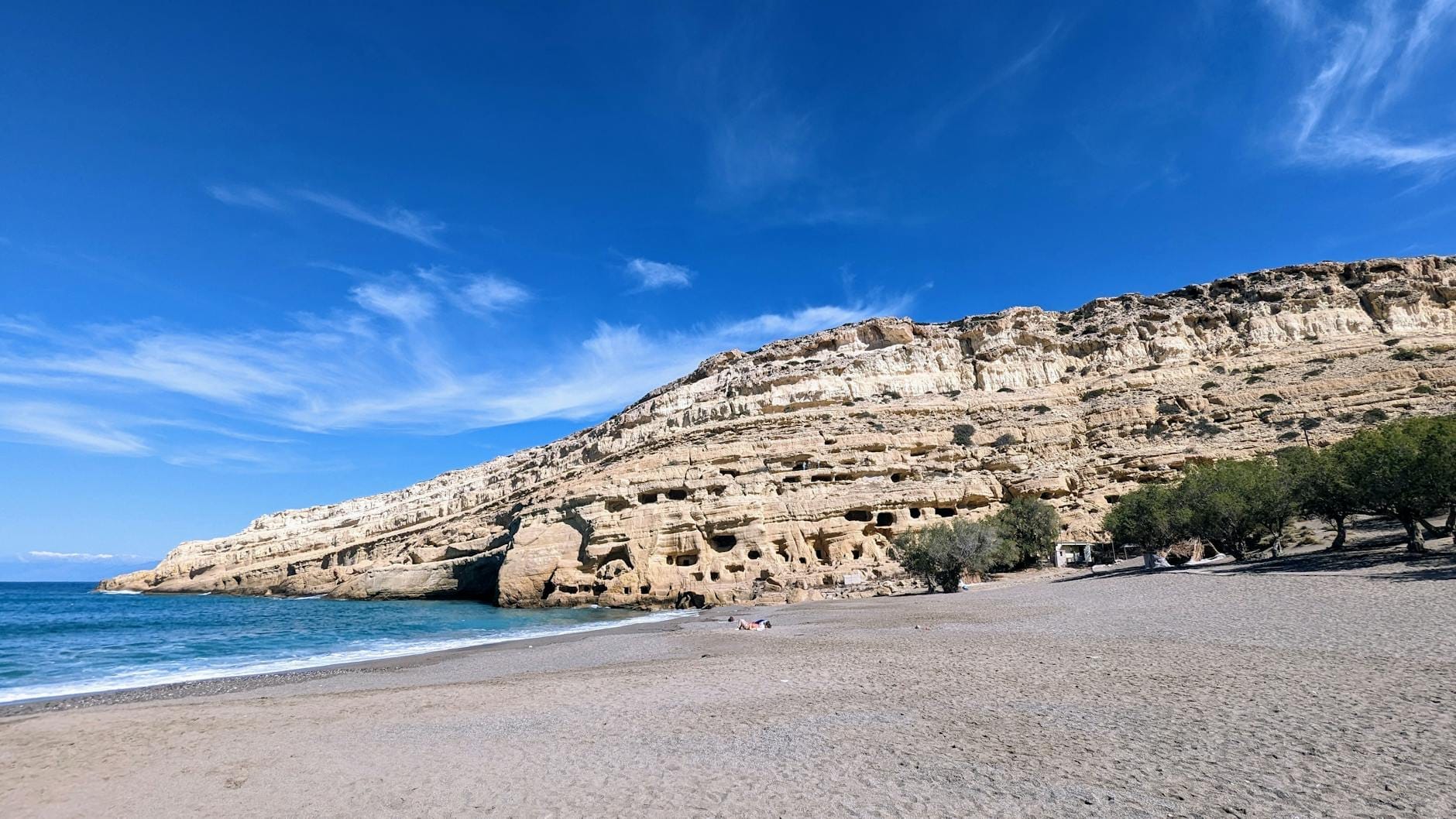
What the Matala Caves Actually Are
The Matala Caves are a series of artificial chambers carved directly into a sandstone cliff that rises sharply from the northern edge of Matala Beach on Crete's southern coast. The site is fenced and ticketed, managed as an archaeological area. From ground level, the cliff face looks almost like a cross-section of a honeycomb: dozens of dark rectangular openings stacked in uneven rows, some accessible by carved staircases, others visible only from below.
What you find inside varies by chamber. Some are shallow niches barely large enough to stand in. Others are genuinely room-sized spaces with carved benches, shelves cut into the walls, and small window openings that frame views of the sea below. The sandstone itself has a warm, amber tone in afternoon light, porous and slightly rough to the touch, eroded in places to a smoothed, almost sculptural finish.
💡 Local tip
Wear closed-toe shoes with grip. The carved steps and ledges are smooth from decades of foot traffic and can be unexpectedly slippery, especially on shaded sections of the cliff.
Layers of History: From Roman Tombs to Hippie Refuge
The oldest layers of the caves' story are still debated by scholars. Some scholars believe the earliest caves may date to the Neolithic period, though the majority of what visitors see today is attributed to Roman and early Christian funerary use. Matala served as the port for Phaistos during the Minoan period and later as the port for Gortys under Roman rule. Many caves were used as burial chambers during the Roman and early Christian periods. The carved alcoves and recesses visible in several caves are consistent with funerary use: arched openings (arcosolia) and semicircular or rectangular niches cut in the side walls to receive offerings.
The connection to Phaistos, one of Crete's most significant Minoan palace sites, gives Matala a deeper archaeological context. If you're interested in tracing Minoan civilization across the island, the Minoan Palace of Phaistos is roughly 11 km northeast and makes a natural pairing with a Matala visit.
The chapter that lodged Matala in modern consciousness came nearly two millennia later. In the 1960s, the caves became a gathering point for a transient community of international travelers, artists, and counterculture figures who made the chambers their informal homes. Joni Mitchell spent time in Matala during this period (and wrote the song "Carey" about a local), and the village's identity absorbed something of that era permanently. Authorities eventually cleared the caves of residents, but the mythology has outlasted the occupation. Local cafes still trade on the association, and a small annual festival, the Matala Beach Festival, keeps the memory alive each summer.
Tickets & tours
Hand-picked options from our booking partner. Prices are indicative; availability and final rates are confirmed when you complete your booking.
Agiofarago and Matala beach private tour
From 88 €Free cancellationMelidoni Cave, Margarites, and more guided tour in Crete
From 116 €Instant confirmationFree cancellationCrete highlights day-tour with Cave of Zeus
From 540 €Instant confirmationCave of Zeus & mountainous East Crete adventure private tour
From 590 €Instant confirmationFree cancellation
How the Experience Changes Through the Day
Morning arrivals, particularly before 10 am in peak summer, find the site relatively quiet. The light comes in low and warm from the east, catching the texture of the sandstone and making the cave openings easier to photograph without harsh shadows. The path up through the lower tier of chambers is cooler at this hour, the cliff still holding the night's chill in its shadowed sections.
By midday in July and August, both the beach below and the caves themselves become crowded. The site is compact enough that fifty visitors can make it feel busy. The sandstone radiates heat absorbed over the morning, and the upper ledges offer almost no shade. Late afternoon, from around 4 pm onward, is arguably the best photographic window: the sun moves to the west and begins to light the cliff face directly, and the crowd thins as people drift back toward the village or to the beach. The sea beyond the beach turns a deep blue-green in this light.
Off-season visitors, particularly in April, May, or October, encounter a completely different atmosphere. The site stays open but the village is quiet, the beach nearly empty, and the caves have a contemplative quality that summer obscures. Autumn especially suits the place: the air is still warm, the light is lower and softer, and the surrounding landscape has dried to the tawny, bleached palette of a Cretan late summer.
ℹ️ Good to know
The caves face west and southwest. For the best light on the cliff face and on the sea view from the upper chambers, visit in the late afternoon rather than at midday.
Walking Through the Site: What to Expect
The entrance is at the base of the cliff, where a ticket booth operates during opening hours. Once inside, a rough path leads upward along carved and natural ledges to the various tiers of chambers. The lowest level is the most accessible and gives you the clearest sense of the scale of the cliff. Higher tiers require some careful scrambling and confidence on narrow ledges. There are no guardrails on the upper sections.
Inside individual chambers, the carvings are genuinely striking up close: you can see tool marks in the stone, the deliberate shaping of sleeping or resting surfaces, and in some cases inscriptions or graffiti from multiple eras layered on top of each other. The hippie-era additions sit alongside much older markings, a strange compression of time. The smell inside the caves is cool and slightly mineral, the kind of damp stone smell that persists even in dry summer.
Visitors with limited mobility should be aware that much of the upper cave area is not accessible without climbing. The lower chambers can be viewed from the path, but the fuller experience requires navigating uneven carved steps. There are no lifts or adapted routes. Families with young children generally manage the lower sections fine; the upper ledges require close supervision.
Matala Beach and the Village Below
The beach directly below the caves is the main reason many visitors come here at all, and the two elements are best experienced together. Matala Beach is a compact arc of coarse sand backed by tamarisk trees, with a scattering of sunbeds and a few tavernas on the promenade. The water is clear and sheltered by the headlands. Swimming here and then looking back up at the cave-pocked cliff above is the defining image of the place.
The village itself is small and seasonally oriented, with the usual mix of tourist shops, fish tavernas, and a few accommodation options. It is not Heraklion or Chania in terms of infrastructure; plan accordingly. For the wider context of beaches along this coastline, the Plakias Beach area to the west is worth comparing, and for those traveling the south coast more broadly, the Preveli Beach near the Kourtaliotiko gorge is within a reasonable drive.
Practical Considerations and Honest Assessment
The Matala Caves site is relatively compact. Most visitors who are reasonably mobile will cover it in 45 minutes to an hour. It does not rival the scale or complexity of major archaeological sites like Knossos or Phaistos, and the interpretation on-site is minimal: there are few information boards, and what exists may not be translated into multiple languages. If you arrive expecting a fully interpreted museum-quality experience, you will be disappointed.
What it offers instead is something more atmospheric: direct contact with spaces people lived, died, and slept in across multiple centuries, with the sea framed in the window openings and the smell of salt air drifting in. For travelers following the broader arc of Cretan history, pairing this with a visit to the Gortyna archaeological site, Matala's one-time administrative center, adds significant depth. Gortyna is roughly 17 km northeast.
Who should skip it: travelers with very limited time who are prioritizing Crete's tier-one archaeological sites, those who have mobility challenges and cannot manage uneven terrain, or visitors who are purely beach-focused and not interested in the historical layer. The beach at Matala is good but not exceptional; you are not coming here for the swimming alone.
⚠️ What to skip
Opening hours and ticket prices are not fixed year-round. The site typically operates seasonally with reduced availability outside summer. Verify current hours and fees at the local tourist office or on arrival, as no official website publishes this in real time.
Getting There and Getting Around
The most practical way to reach Matala from Heraklion is by car, a drive of approximately 68 km that takes around 1 hour and 15 minutes via the E75 motorway toward Mires, then south on regional roads through Pitsidia. The approach through the Messara plain, with its olive groves and vineyard strips, is worth noting as scenery in itself.
KTEL buses connect Heraklion to Matala, but services are infrequent and schedules change seasonally — check directly with the Heraklion KTEL terminal before planning around bus times. For those self-driving along the south coast, Matala fits naturally into a broader loop. The Crete road trip guide covers route options that incorporate the south coast from Rethymno to Ierapetra.
Parking in the village is free but limited in peak season. Arrive before 9 am in July and August to secure a space near the beach. The caves entrance is a short walk from the main village square.
Insider Tips
- The upper tier of caves, which requires a bit more scrambling, gives you a sea view through carved window openings that is far more striking than anything you get at ground level. Most casual visitors stop at the lower chambers. Push a little higher and you will have it largely to yourself.
- The Matala Beach Festival typically runs in June and draws crowds to this otherwise quiet village. If you are not interested in the festival itself, avoid that weekend entirely — accommodation books up and the caves are packed.
- The village's small supermarket and the tavernas on the beach promenade are fine for a meal, but they are priced for tourists. Drive up to Pitsidia, about 3 km inland, for a simpler, cheaper lunch at a local kafeneio.
- Bring water. There is no drinking water point inside the cave site, shade is limited on the cliff path, and the sandstone radiates heat in summer. A hat and 1.5 liters of water per person are not excessive.
- If you want a photograph of the entire cliff face with caves visible, walk to the southern end of Matala Beach and shoot back toward the north. From the beach itself, directly below the cliff, you lose the perspective that makes the site visually dramatic.
Who Is Matala Caves For?
- History travelers who want to combine archaeological interest with a beach day
- Photographers looking for a visually distinctive subject on Crete's south coast
- Travelers interested in the counterculture chapter of Mediterranean history
- Families with older children who can manage uneven terrain and short climbs
- Road-trippers routing through the Messara plain who want a substantive stop
Nearby Attractions
Other things to see while in Plakias & South Coast:
- Agia Galini
Perched amphitheatrically above Messara Bay on Crete's southern coast, Agia Galini is a small fishing village with steep lanes, a sheltered harbor, and a beach within 100 meters of the center. Its name means 'Holy Peace' in Greek, and for most of the year, that description holds.
- Kourtaliotiko Gorge
Kourtaliotiko Gorge cuts through the Rethymno highlands for roughly 3 kilometres, its limestone walls rising up to 600 metres above a river that eventually spills into Preveli Beach. The gorge takes its name from the Cretan word for applause, a reference to the wind-carried echo that rings through the canyon walls. This is one of southern Crete's most rewarding short excursions, combining geology, legend, rare wildlife, and river scenery in a compact, accessible package.
- Matala Beach
Matala Beach on Crete's south coast is unlike any other stretch of sand on the island. A 250-metre Blue Flag bay backed by cliff caves that served as Roman tombs, then 1960s hippie dens, it rewards curious travelers who want history and a good swim in the same afternoon.
- Plakias Beach
Plakias Beach stretches 1.3 kilometres along the south coast of Crete's Rethymno Prefecture, backed by mountains and facing the Libyan Sea. Free to enter, Blue Flag certified, and far quieter than the north coast resorts, it rewards travellers who make the drive south.