Preveli Beach & Palm Grove: Crete's Most Dramatic Coastal Landscape
Where the Megalopotamos river meets the Libyan Sea, a grove of endemic Phoenix theophrasti palms lines a crescent of sand and pebble unlike anything else in Greece. Preveli Beach is genuinely remarkable, but it demands effort to reach and rewards those who plan carefully.
Quick Facts
- Location
- Agios Vasileios, Rethymno Regional Unit, south coast of Crete near the Kourtaliotiko Gorge
- Getting There
- By car via the Kourtaliotiko Gorge road; seasonal boat service from Plakias harbour; no direct public bus to the beach itself
- Time Needed
- Half day minimum (3–5 hours including travel from Plakias)
- Cost
- No admission fee for the beach; parking fees apply at the monastery car parks; boat trips from Plakias charged separately
- Best for
- Nature lovers, swimmers, photographers, couples, anyone wanting a beach that genuinely looks different from the norm
What Makes Preveli Beach Unique
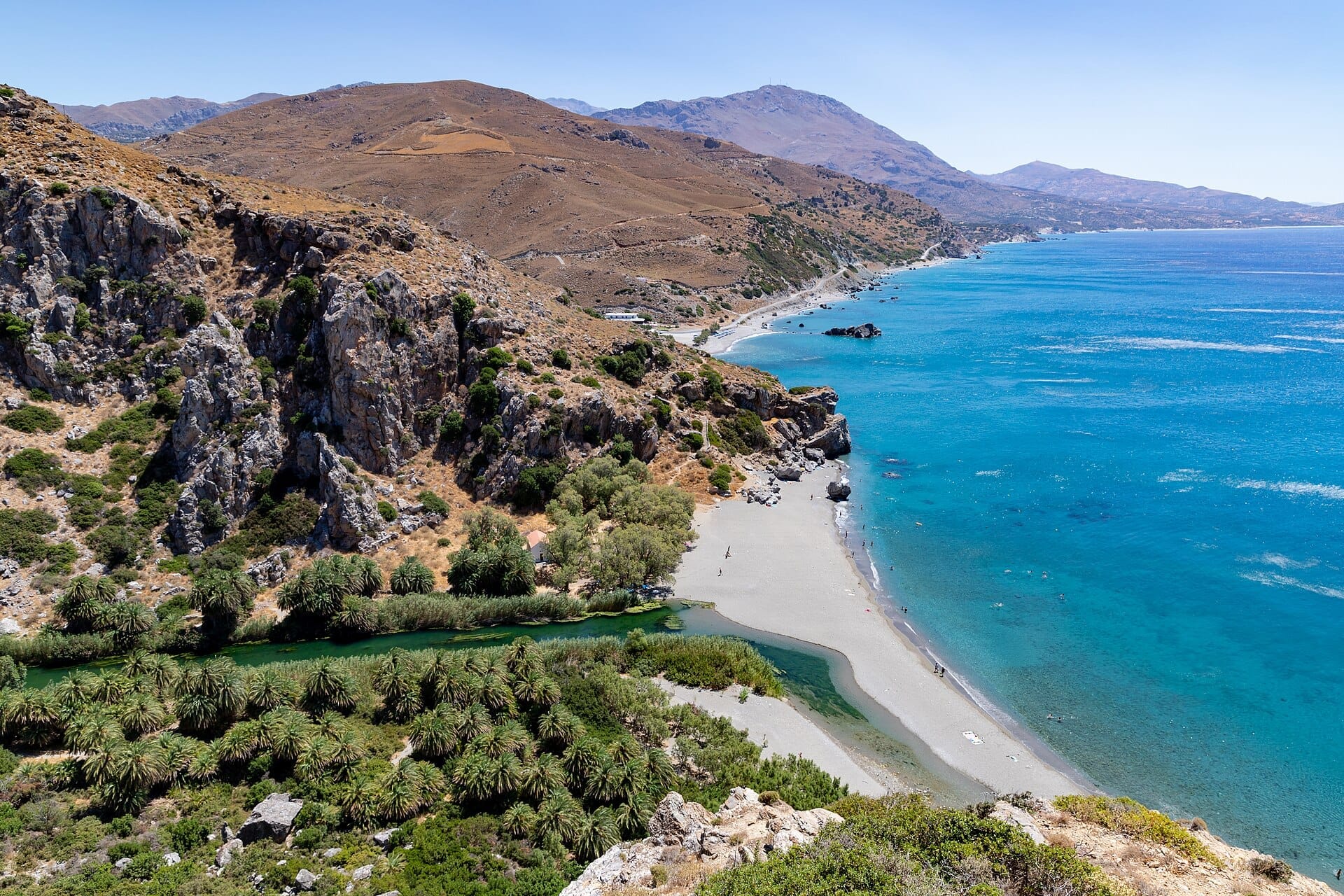
Preveli Beach, known in Greek as the Finikodasos tis Prevelis (Φοινικόδασος της Πρέβελης), is one of the most ecologically and visually distinctive beaches in the Mediterranean. The Megalopotamos river, which drains the length of Kourtaliotikos Gorge, does not stop at the coast. It flows all the way to the beach, forming a freshwater lagoon just behind the shoreline before finally merging with the Libyan Sea. The result is a layered landscape: clear turquoise saltwater on one side, cool fresh river water on the other, and a grove of Phoenix theophrasti palms arching overhead in between.
Phoenix theophrasti is a palm species endemic to Crete and a handful of Aegean islands. The grove at Preveli is the second-largest collection of this endemic species in Crete. These are not ornamental imports. They are wild, slow-growing trees that have colonised the riverbank over centuries, their trunks leaning at angles shaped by seasonal floods and Aegean winds. On a hot August afternoon, sitting in their shade while cold river water runs over your feet is one of those simple experiences that travel writers consistently fail to adequately describe.
ℹ️ Good to know
The Megalopotamos River carries water all year round, which means the lagoon is always present. However, its size and depth vary significantly by season. Spring visitors (April–May) will find the highest water levels after winter rains. By September, the lagoon is shallower and warmer.
How to Get There: Your Three Options
The beach has a reputation as one of the hardest to reach in Crete, and that reputation is partly earned. There is no road that descends directly to the sand. From the western approach, most visitors park near the monastery car parks and walk a steep, rocky path down to the beach. The descent takes roughly 10–15 minutes but requires sure footing. In summer heat, the return climb up is noticeably harder than the way down — factor that into your energy reserves.
The eastern approach from Drimiskiano Amoudi is longer and less crowded. This trail follows the river through the gorge and delivers you to the beach from the inland side, passing through the palm grove itself rather than arriving above it. It takes considerably more time but the route through the canyon is worth it in its own right.
The third option is the boat. Seasonal boat trips run from Plakias harbour directly to Preveli Beach, a journey of roughly 30–40 minutes along the southern coast. This is the easiest way to arrive and avoids the car park queues entirely. It also gives you a memorable approach from the sea, watching the palm grove materialise against the cliff face. Check locally for current departure times and prices as these vary by operator and season.
💡 Local tip
If you're driving, arrive before 9:30am in July and August. The monastery car parks fill quickly, and vehicles end up parked along the access road in a line stretching back several hundred metres, adding to your walk in full sun.
Tickets & tours
Hand-picked options from our booking partner. Prices are indicative; availability and final rates are confirmed when you complete your booking.
Preveli guided tour from Chania
From 46 €Instant confirmationFree cancellationVisit a Family-Run Olive Mill with Food Tasting in Heraklion
From 19 €Instant confirmationFree cancellationSnorkeling experience in Crete
From 45 €Instant confirmationFree cancellationSpinalonga self-guided audio tour on your phone
From 12 €Instant confirmationFree cancellation
The Visit: What You Actually See and Do
The beach itself is a crescent of coarse sand and smooth pebbles. The water is remarkably clear, with the shallow entry giving way quickly to deeper, cooler depths. On calm days, the colour shift from turquoise to deep blue happens abruptly, which makes for compelling photographs from the hillside path above.
The river lagoon is the heart of the experience. Wading upstream from the beach, the palms close in on both sides within about fifty metres, and the sounds of the sea fade. The water is colder here, fed by the gorge. There are smooth boulders to sit on, patches of reeds, and a quality of light in the mid-morning hours that filters through the palm fronds at a low angle. A stone bridge, associated with the nearby Moni Preveli monastery, is visible on the approach from the western path and provides the most photographed angle of the grove.
Local legend connects the wider Preveli area to Odysseus, said to have rested here after the Trojan War. More concretely, archaeological evidence points to human habitation in the region dating back more than 130,000 years. The monastery above the beach, Moni Preveli, is a religious center from the 16th century and is a functioning religious community. It is not on the beach itself but sits on the clifftop road and is worth a brief visit en route.
A small taverna operates at the base of the cliff near the palm grove path during the main season, selling cold drinks, snacks, and basic food. It is not a full restaurant. If you are planning a long day, bring your own water and food. For a broader context on what the southern Rethymno coast offers, the Kourtaliotiko Gorge immediately north of Preveli is a rewarding stop on any drive to the beach.
When to Go: Time of Day and Season
Early morning arrivals before 9am get the beach almost to themselves and catch the best light for photography, when the sun sits low over the eastern hills and casts long shadows through the palms. The water in summer is warmest by mid-afternoon but the beach by then is at peak capacity, with towels covering most of the pebbles and the path through the grove becoming a slow procession of visitors.
May, June, and September are the best months for a relaxed visit. In May the river runs fuller and the vegetation is intensely green. September thins the crowds noticeably while the sea temperature remains high from the summer's accumulated warmth. July and August are not unpleasant but require earlier starts and lower expectations for solitude.
October visits are possible and can be genuinely beautiful — the autumn light on the Libyan Sea is soft, the palms are undisturbed, and the beach is largely empty. However, the taverna and boat services may have closed for the season. See our guide to visiting Crete in October for broader seasonal context.
⚠️ What to skip
Strong south winds (from the Libyan Sea direction) can make the water rough and stir up sand and pebbles. On windy days the beach loses much of its appeal. Check wind forecasts before making the drive, especially in spring and autumn.
Photography, Accessibility, and Practical Details
The most effective photography positions are from the western descent path, where you shoot down into the lagoon with palms in the foreground and the open sea beyond. A wide-angle lens captures the full grove. For underwater shots, the clarity of both the sea and the lagoon is unusually high. A heart-shaped rock known locally as the Stone of Lovers sits near the beach and appears in many visitor photos.
Accessibility is limited. Neither approach path is suitable for wheelchairs or pushchairs. The western descent involves uneven rocky steps with no handrail sections. The boat from Plakias offers a more accessible arrival but the beach itself is pebbled and uneven. Visitors with significant mobility limitations should consider whether the experience is achievable given the terrain.
- Wear closed shoes or robust sandals for the descent path — flip flops are a poor choice on loose rock
- Bring more water than you think you need, especially in summer
- A dry bag or waterproof pouch for valuables is practical when crossing the lagoon
- The pebble beach is hard on bare feet without water shoes
- There are no changing facilities or showers at the beach itself
Is Preveli Beach Overhyped?
Honestly, no. Most beaches in Crete are beautiful but they follow a familiar template: clear water, white or reddish sand, tavernas, sunbeds. Preveli genuinely looks different. The palm grove is not a gimmick and the river-meets-sea dynamic makes it ecologically interesting as well as photogenic. It earns its reputation.
That said, if you visit in mid-August expecting a quiet natural sanctuary, you will be disappointed. On peak summer days the beach is crowded and the path through the grove has a queue-like quality. Visitors who want a remote southern coast experience with fewer people should also consider Plakias Beach or explore the less-visited coves along the Rethymno coast. And if dramatic natural landscapes are your primary interest, Samaria Gorge offers a more immersive and less crowded natural experience, though it requires a full day.
Visitors who will not enjoy Preveli: those with significant mobility challenges, anyone unwilling to walk a steep path in heat, people who want flat sandy beaches with sunbed rental and umbrella service, and travellers who find crowds deeply frustrating in summer months.
Insider Tips
- Take the eastern approach from Drimiskiano Amoudi at least one way — the gorge walk through the palms from the inland side is a completely different experience from the western clifftop descent, and far less travelled.
- The lagoon is coldest and deepest closest to the gorge mouth, warmest near where it meets the sea. On very hot days, sitting in the cool gorge-side water with your back to the sea is one of the more restorative things you can do on a Cretan summer afternoon.
- Moni Preveli monastery, on the clifftop road above the beach, is open to visitors during certain hours and has a small museum. It is well worth 20 minutes even if monasteries are not normally your priority — the historical context it provides for the landscape below is genuinely interesting.
- The boat from Plakias does not run to a fixed timetable in the same way a ferry does. Confirm current departure times with your accommodation in Plakias the day before, as services can change or be cancelled due to sea conditions.
- If you park at the western car park and descend to the beach, note that the final section of path and the stone bridge area can be slippery when wet. Even in summer, the morning spray from the lagoon keeps certain rocks damp.
Who Is Preveli Beach & Palm Grove For?
- Nature and ecology enthusiasts drawn to endemic plant species and river-meets-sea landscapes
- Photographers wanting images that look genuinely different from standard Greek beach shots
- Couples looking for a scenic and slightly adventurous day out from Plakias or Rethymno
- Swimmers who want unusually clear water with the option of both fresh and saltwater swimming in the same spot
- Travellers with a half-day to spare who want something more memorable than another beach sunbed day
Nearby Attractions
Other things to see while in Plakias & South Coast:
- Agia Galini
Perched amphitheatrically above Messara Bay on Crete's southern coast, Agia Galini is a small fishing village with steep lanes, a sheltered harbor, and a beach within 100 meters of the center. Its name means 'Holy Peace' in Greek, and for most of the year, that description holds.
- Kourtaliotiko Gorge
Kourtaliotiko Gorge cuts through the Rethymno highlands for roughly 3 kilometres, its limestone walls rising up to 600 metres above a river that eventually spills into Preveli Beach. The gorge takes its name from the Cretan word for applause, a reference to the wind-carried echo that rings through the canyon walls. This is one of southern Crete's most rewarding short excursions, combining geology, legend, rare wildlife, and river scenery in a compact, accessible package.
- Matala Beach
Matala Beach on Crete's south coast is unlike any other stretch of sand on the island. A 250-metre Blue Flag bay backed by cliff caves that served as Roman tombs, then 1960s hippie dens, it rewards curious travelers who want history and a good swim in the same afternoon.
- Matala Caves
Cut into sandstone cliffs above one of southern Crete's most atmospheric beaches, the Matala Caves are an open-air archaeological site with a layered past: Roman burial chambers, a Minoan port connection, and a 1960s countercultural chapter that gave this quiet village an unlikely legendary status. The views from the cliff face alone justify the small entrance fee.