Samaria Gorge: The Complete Hiking Guide to Crete's Greatest Walk
Samaria Gorge cuts 16 kilometres through the White Mountains of southwest Crete, from the 1,230-metre Omalos plateau down to the Libyan Sea. It is one of Europe's longest gorges and the centrepiece of Crete's only national park. This guide tells you what the hike actually involves, when to go, and how to plan the full-day logistics.
Quick Facts
- Location
- White Mountains National Park, Chania, southwest Crete
- Getting There
- KTEL bus from Chania to Omalos/Xyloskalo; ferry from Agia Roumeli to Chora Sfakion on return
- Time Needed
- Full day: 4–7 hours hiking plus ferry and bus back
- Cost
- Entrance fee required; book tickets at samaria-tickets.necca.gov.gr. Ferry and bus fares additional.
- Best for
- Fit walkers, nature lovers, geology enthusiasts, early risers
- Official website
- samaria-gorge.gr
What Is Samaria Gorge?
Samaria Gorge, known in Greek as Φαράγγι Σαμαριάς, is a 16-kilometre ravine slicing through the White Mountains of southwest Crete. It stretches from the high plateau of Omalos, where the trailhead at Xyloskalo sits at roughly 1,230 metres above sea level, all the way down to the coastal hamlet of Agia Roumeli on the Libyan Sea. The total walking distance, including the approach path, is approximately 18 kilometres. The gorge is the longest in Europe by some measures, and it forms the core of the White Mountains National Park, the only national park on the island.
The gorge's most dramatic feature is the section called Portes, known to most visitors as the Iron Gates: a passage barely 3 to 4 metres wide where limestone walls tower between 300 and 500 metres overhead. Sunlight reaches the floor here only briefly in midsummer. The narrowing forces the trail to cross the streambed multiple times through shallow fords, and the scale of the rock faces is genuinely hard to absorb while you're standing in it.
Samaria became a national park in 1962, primarily to protect the kri-kri, the Cretan wild goat, a shy ibex-like creature that survives in meaningful numbers only in this park and on a few offshore islands. The gorge is also a UNESCO Biosphere Reserve and sits on the UNESCO World Heritage tentative list. During the Ottoman period and the later Cretan struggle for union with Greece, the remote villages of the gorge served as refuges for fighters and civilians alike. A small ruined settlement, also called Samaria, still stands inside the park and gives the gorge its name. For more on the island's layered past, see our guide to Minoan history and Crete's ancient sites.
The Hike: What to Expect at Every Stage
The route is entirely one-directional and almost entirely downhill. You begin by descending a steep, wooden-railed switchback path called Xyloskalo, which drops roughly 1,000 metres in the first three kilometres. Knees feel this section immediately. The path is rocky and uneven throughout, with loose stones on steeper stretches. This is not a paved promenade: sturdy, ankle-supporting footwear is non-negotiable.
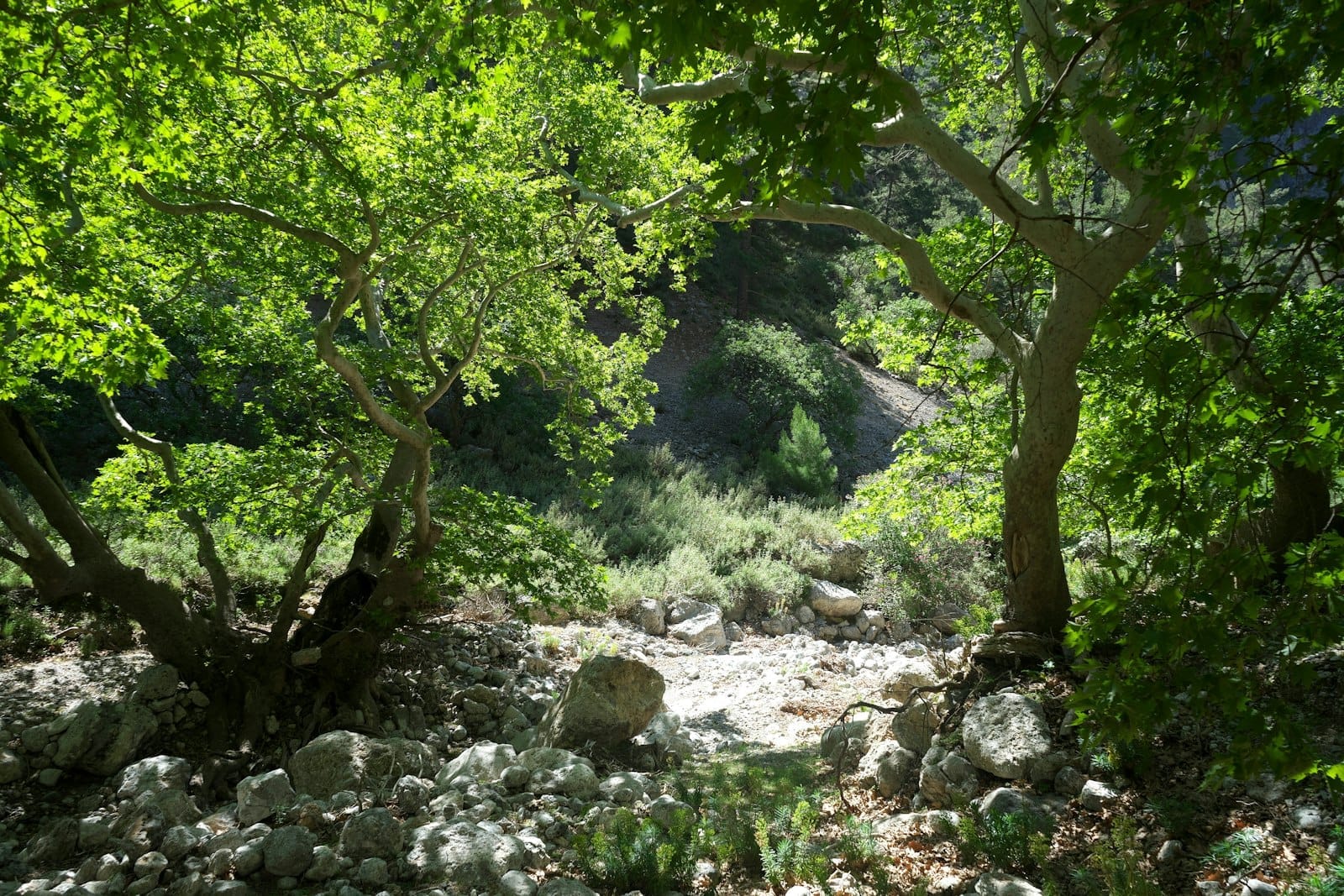
After the initial descent, the valley floor opens into a pine and cypress forest that provides welcome shade. The gradient eases, and the trail weaves between the dry riverbed and low scrub for several kilometres. You pass the abandoned village of Samaria around the midway point, where a small church dedicated to Osia Maria (from which the gorge takes its name) still stands. Rest stations with water and basic toilets are spaced along the route.
The walls close in as you approach the Iron Gates, roughly 12 kilometres into the walk. This is the photographic and physical climax. Beyond it, the gorge widens again into a broader delta plain before reaching the settlement of Agia Roumeli and the coast. Many hikers underestimate those final three kilometres: the surface changes to loose pebble and the sun comes fully into view. Pace yourself. Total hiking time ranges from four hours for very fit, lightly packed walkers to seven or more hours for those moving steadily with stops.
💡 Local tip
Bring at least 2 litres of water per person. The springs along the gorge are generally clean and well-marked, but in high summer the heat in the lower sections is intense. Electrolyte tablets or salty snacks help prevent cramping on the final stretch.
Tickets & tours
Hand-picked options from our booking partner. Prices are indicative; availability and final rates are confirmed when you complete your booking.
Excursion to Richtis Gorge from Agios Nikolaos
From 539 €Instant confirmationFree cancellationVisit a Family-Run Olive Mill with Food Tasting in Heraklion
From 19 €Instant confirmationFree cancellationSnorkeling experience in Crete
From 45 €Instant confirmationFree cancellationSpinalonga self-guided audio tour on your phone
From 12 €Instant confirmationFree cancellation
The Gorge at Different Times of Day
The park opens daily at approximately 7:00 to 7:30 AM between May 1 and October 31. Arriving at the trailhead for the first entry is the clearest advantage available to any visitor. The air at Omalos is cool and often misty in early morning, and the upper forest is filled with birdsong and the smell of damp limestone and pine resin. By 9 AM, the organised tour groups from Chania and the resort areas begin arriving, and the trail becomes noticeably more crowded. By midday in July and August, the Iron Gates section can feel like a slow-moving queue rather than a wilderness walk.
Late arrivals should be aware that entry after approximately 3 PM is restricted to a 2-kilometre out-and-back walk from the top, which offers the upper forest but does not reach the gorge itself. This is worth knowing if you plan to drive up independently in the afternoon.
The lower section, approaching Agia Roumeli, gets full sun from late morning onwards and the reflective pale rock amplifies the heat. In July and August, temperatures in the lower gorge regularly exceed 35 degrees Celsius. May, early June, and late September are when the hike is at its most comfortable. In October the light is lower and golden, crowds are thinner, and the streambed carries the first trickle of autumn water.
⚠️ What to skip
The gorge closes entirely from November through April. Flash floods caused by winter rainfall make the ravine genuinely dangerous, and closures are enforced. On rare occasions in spring or after heavy rain, day-of closures occur even within the open season. Check samaria.gr before travelling.
Getting There and Getting Back
The logistics of this hike require more planning than most day trips. The trail is point-to-point: you start at Omalos and finish at Agia Roumeli, which is only reachable by sea. From Agia Roumeli, a ferry runs to Chora Sfakion on the south coast, and from Chora Sfakion, a KTEL bus returns to Chania. This means the return journey involves at least two connecting legs, and ferry schedules must be checked in advance as they operate on a fixed timetable and do not wait for slow hikers.
KTEL buses from Chania to Omalos run early in the morning specifically to serve gorge hikers. Departures are typically from the main bus station in Chania. If you are based in Chania's old town, the walk to the bus station takes around 15 minutes. For more on getting around the Chania region, see getting around Crete by bus, car, and ferry.
Many visitors book an organised day-trip package from their resort, which bundles bus transport, gorge entry, ferry, and return bus into a single cost. This is the most straightforward option for those unfamiliar with the south coast ferry timetables, though it comes at a higher price than arranging each leg independently. Independent travel is entirely feasible and cheaper; it simply requires booking the gorge entrance ticket online in advance and confirming the ferry schedule before you leave.
Ecology, Wildlife, and Landscape
The White Mountains National Park surrounding the gorge is one of the ecologically richest areas in the eastern Mediterranean. The limestone geology creates dramatic vertical relief and numerous micro-habitats. The kri-kri, the Cretan wild goat, is the park's flagship species, though sightings on the main trail are rare during busy hours. Dawn and dusk, when visitors are absent, are when kri-kri come down toward the valley floor. The park also supports golden eagles, Bonelli's eagles, and Lammergeiers, all of which can be spotted soaring above the high walls. For a broader picture of Crete's mountain landscapes, the White Mountains deserve their own dedicated visit.
The gorge floor supports a distinct riparian woodland of plane trees, oleanders, and Cretan maple. In late spring, the streambed runs with clear snowmelt water that becomes a series of shallow crossings. By August the water recedes to isolated pools. The rock walls themselves are veined with fossils and show the horizontal banding typical of Cretaceous-era marine limestone, a reminder that these mountains were once ocean floor.
Hikers with a serious interest in Crete's mountain interior should also consider the hiking in Crete guide for alternative gorges and trails across the island, including routes that see far fewer visitors.
Practical Walkthrough: What to Wear, Carry, and Know
Footwear is the single most important decision. Trail running shoes with grip work well; lightweight hiking boots with ankle support are better for those with weaker ankles given the uneven, rocky surface. Flip-flops, sandals, and fashion trainers have all caused injuries here and are widely flagged by park authorities as unsuitable.
- Carry at minimum 2 litres of water; 3 litres in summer.
- Pack a high-calorie snack for the midway section where the village ruins are.
- Wear sun protection from the waist up: the upper forest offers shade, but the lower third of the gorge is exposed.
- Trekking poles significantly reduce knee strain on the Xyloskalo descent.
- A light layer for the early morning is worth it at Omalos even in July.
- Keep your gorge ticket: it is checked at the exit as well as the entrance.
The hike is not wheelchair accessible and is not appropriate for young children who cannot walk 16 to 18 kilometres on uneven terrain. Older children who are regular walkers can manage it, but be realistic: the final few kilometres along the pebble delta are where tired legs make poor decisions on slippery stones. People with significant knee problems should consider the condition carefully before committing, given the sustained downhill gradient at the start.
ℹ️ Good to know
Photography in the gorge is excellent in morning light, particularly in the first 4 km where shafts of light come through the cypress canopy. The Iron Gates require a wide-angle lens to capture any sense of scale. The walls are so tall and close that standard smartphone portraits look flat; step back as far as the passage allows and shoot upward.
Honest Assessment: Is It Worth the Effort?
Samaria is legitimately impressive. The Iron Gates alone justify the trip for anyone who responds to geological drama, and the upper forest and plateau views at dawn are some of the most striking mountain scenery in Greece. The scale of the place, the smell of hot limestone and wild thyme in the lower section, the sound of the gorge narrowing around you: these are real, not manufactured for tourism.
That said, the hike in peak season (late June through August) is genuinely crowded. If you imagined a solitary wilderness walk, you will be disappointed unless you arrive at first light. The logistics also carry a real time commitment: from Chania and back via the ferry, expect to lose the best part of 12 hours. This is a full-day, high-effort commitment. Travellers with limited mobility, very young children, or only a day in Chania should be honest about whether this is the right use of their time. There are other gorges on the island that are shorter, less visited, and nearly as dramatic. The Imbros Gorge nearby is a fraction of the length and effort, and is often suggested as an alternative for those who want the landscape without the full-day commitment.
For context on how Samaria fits into a broader Crete itinerary, see the one-week Crete itinerary, which helps balance the major hikes against beach days and archaeological sites.
Insider Tips
- Entrance tickets are available online at samaria-tickets.necca.gov.gr before you travel. Tickets can sell out during peak weeks in July and August, and arriving without one means you will be turned away at the gate.
- The KTEL bus to Omalos fills quickly on summer mornings. Arrive at Chania bus station at least 20 minutes before departure. Standing for an hour on a mountain road is not comfortable.
- Download an offline map before you go. Mobile signal is absent for most of the gorge interior. The path itself is well-marked, but having a map for the Agia Roumeli end is useful for locating the ferry ticket office.
- Check the ferry schedule from Agia Roumeli to Chora Sfakion the evening before your hike, not the morning of. Knowing the last ferry departure keeps you from rushing the final kilometres in a way that causes ankle injuries.
- The ruins of the abandoned Samaria village at the midway point are worth a 10-minute detour. Most hikers walk past the small church of Osia Maria without stopping, but it is one of the few surviving pre-20th-century structures inside the national park.
Who Is Samaria Gorge For?
- Fit walkers and trekkers looking for a full-day mountain challenge with a logical end point at the sea
- Nature and geology enthusiasts drawn to the limestone canyon landscape and endemic wildlife of the White Mountains
- Photographers seeking dramatic light, narrow gorge passages, and high-contrast mountain scenery
- Travellers with more than three days in Chania who want to experience the island's interior beyond the coast
- Anyone visiting Crete in May, early June, or late September when the heat is manageable and the spring flowers or autumn colours are present
Nearby Attractions
Other things to see while in Chania:
- Archaeological Museum of Chania
Opened in 2022 in a purpose-built 6,000 m² building in the Chalepa suburb, the Archaeological Museum of Chania traces western Crete's story from the Palaeolithic era through the 4th century AD. With over 4,100 finds, tactile exhibits, and a location just outside the Old Town, it rewards anyone who wants more than a beach holiday.
- Balos Lagoon
Balos Lagoon sits at the northwestern tip of Crete, where a shallow, turquoise-green pool forms between the Gramvousa Peninsula and the rocky spur of Cape Tigani. The sand is faintly pink from crushed shells and coral. The crowds in July and August are real. Here is what the experience actually involves.
- Chania Old Town
Chania Old Town is a living archive of civilizations stacked on top of one another, from Neolithic Kydonia to Venetian merchant palaces to Ottoman minarets. Free to enter and open at all hours, it rewards slow exploration more than rushed sightseeing.
- Elafonissi Beach
Elafonissi Beach sits on Crete's remote southwestern tip, where crushed shells from microscopic foraminifera tint the sand pink and a shallow lagoon connects the shore to a small protected island. Free to enter and genuinely striking, it draws large summer crowds that reward early arrivals and discourage afternoon visits.