Balos Lagoon: Crete's Most Photographed Shoreline, Honestly Reviewed
Balos Lagoon sits at the northwestern tip of Crete, where a shallow, turquoise-green pool forms between the Gramvousa Peninsula and the rocky spur of Cape Tigani. The sand is faintly pink from crushed shells and coral. The crowds in July and August are real. Here is what the experience actually involves.
Quick Facts
- Location
- Gramvousa Peninsula, Kissamos, Chania Prefecture — 56 km northwest of Chania city (approx. 1 hr 15 min by car)
- Getting There
- By car via rough gravel road from Kaliviani (4WD strongly recommended) + 20-min walk and 100m descent to beach; or by ferry from Kissamos port
- Time Needed
- 3–5 hours for beach only; full day if combining with Gramvousa Island boat tour
- Cost
- Free entry to the natural site; parking fee applies at the hilltop lot; ferry tickets and jeep tours cost extra (verify current prices on-site or with tour operators)
- Best for
- Scenic photography, shallow-water swimming, snorkeling, nature lovers, boat-day itineraries
What Balos Actually Looks Like
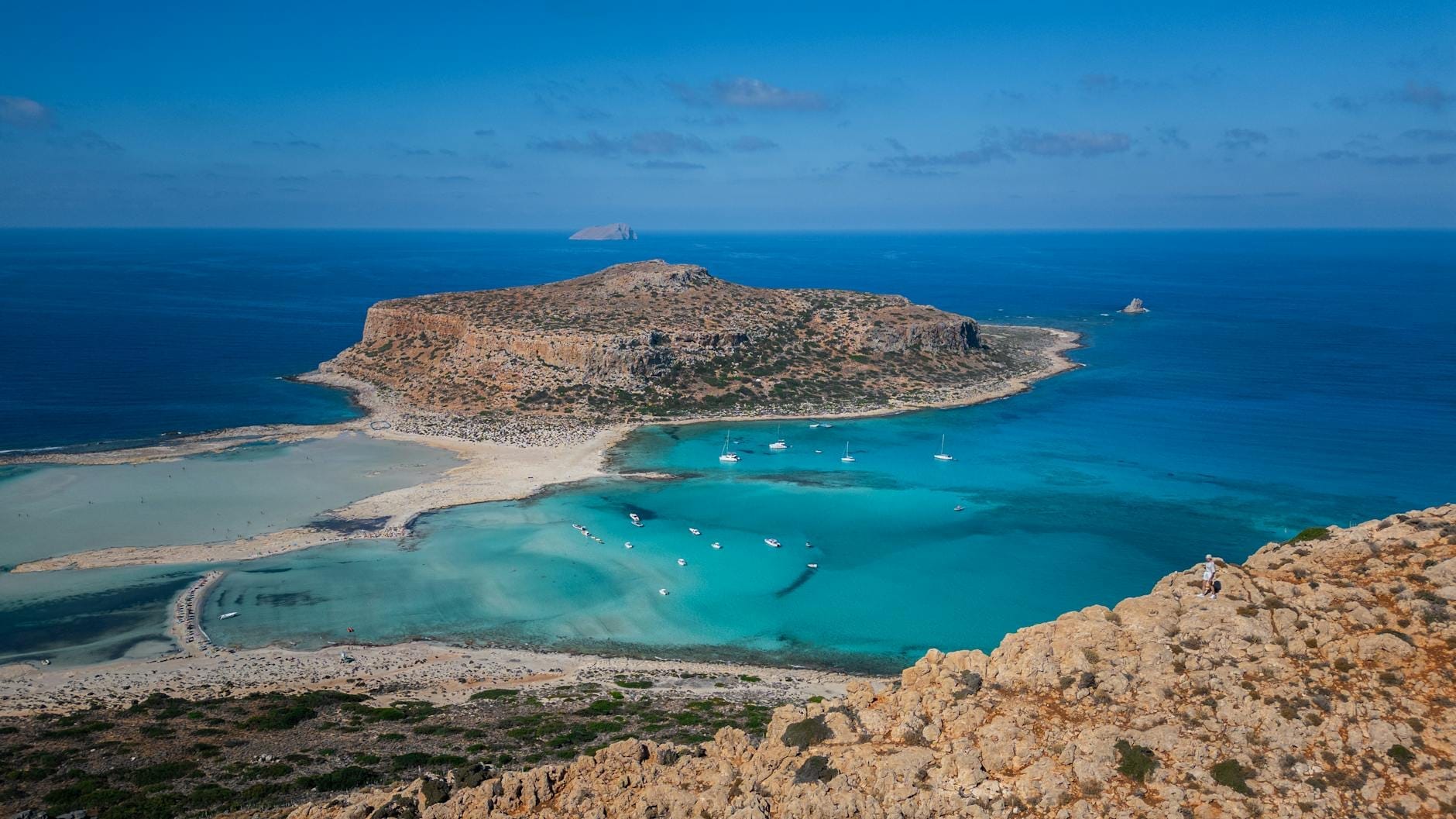
Balos Lagoon is one of those places that genuinely resembles its photographs, which is rarer than it sounds. The shallow lagoon stretches roughly 500 metres between two landmasses: the barren limestone ridge of the Gramvousa Peninsula to the west and the low, narrow spit of Cape Tigani to the east. The water is almost impossibly clear, shifting from pale aquamarine at the edges to a deeper teal toward the open sea. The sand underfoot has a faint pinkish tone, the result of centuries of pulverised shells and coral fragments mixing with the white silica. Wading in, you will feel the texture beneath your feet change from soft powder to small shell fragments. The water temperature is warm and the depth rarely exceeds knee height in the central lagoon area, though it deepens quickly at the outer edges.
From the hilltop viewpoint above the parking area, before you begin your descent, the full geometry of the place becomes clear. The lagoon looks like a brushstroke of pale colour set against the dark, scrubby hills of the peninsula. This is the shot that fills travel feeds, and it is taken from here, not from the beach itself. Spend a few minutes at this vantage point before walking down.
💡 Local tip
The hilltop viewpoint above the car park offers the iconic overhead perspective of the lagoon. Arrive before 9am or after 5pm for the best light and fewest people in your frame.
How to Get There: Car Road vs. Boat
There are two routes to Balos, and they offer very different experiences. The overland approach follows a gravel track that leaves the main road near the village of Kaliviani, roughly 15 km east of Kissamos town. The road is unpaved, rocky, and corrugated for most of its length. Small rental cars with low clearance struggle on this route, and tyre damage on sharp stones is a real risk. A standard SUV or jeep handles it without difficulty. The drive takes around 20 minutes from the junction, ends at a hilltop car park where a fee applies, and is followed by a 20-minute walk down a well-marked but steep and sun-exposed path to the beach. There is no shade on this descent.
The boat option departs from Kissamos port and takes around 45 minutes each way, passing along dramatic coastal cliffs. Many operators offer combined tickets that include a stop at Gramvousa Island, where a Venetian castle sits at the summit. This is the easier and more scenic introduction to the area, and a good choice if you are not travelling with a suitable vehicle. Organised jeep tours and boat excursions can be booked through agencies in Chania and Kissamos. If you are planning a wider road trip across the island, the drive itself is worth the effort.
For context on planning your route across western Crete, the Crete road trip guide covers the northwestern routes in useful detail.
⚠️ What to skip
Do not attempt the gravel road in a small city car or low-clearance rental vehicle. Tyre punctures are common, and roadside assistance does not reach this area quickly. Check your rental agreement for gravel-road coverage before you go.
Tickets & tours
Hand-picked options from our booking partner. Prices are indicative; availability and final rates are confirmed when you complete your booking.
Balos Lagoon and Falassarna beach jeep tour with lunch
From 150 €Instant confirmationFree cancellationVisit a Family-Run Olive Mill with Food Tasting in Heraklion
From 19 €Instant confirmationFree cancellationSnorkeling experience in Crete
From 45 €Instant confirmationFree cancellationSpinalonga self-guided audio tour on your phone
From 12 €Instant confirmationFree cancellation
The Ecology and History Behind the Scenery
Balos Lagoon sits within a protected Natura 2000 zone, which means the landscape you are visiting is legally recognised as ecologically significant. The area supports endemic plant species adapted to the arid, wind-blasted peninsula, and the waters are occasionally visited by loggerhead sea turtles (Caretta caretta) and Mediterranean monk seals, one of the rarest marine mammals in the world. Migratory birds use the lagoon as a resting point during seasonal passages. Camping, fires, and off-track driving are prohibited, and for once, these restrictions are actively enforced.
The cape and its surroundings have a longer human history than most visitors realise. Near Korykon Cape, just to the north, ruins associated with the ancient settlement of Agnion include remnants linked to a sanctuary of Apollo. Roman activity in the area left traces connected to the extraction of murex shellfish, which were processed for their purple dye, a commodity as valuable in antiquity as precious metals. The Venetian castle visible on Gramvousa Island was built in 1579 and later served as a base for Cretan rebels during the Greek War of Independence in the 1820s.
If the history of the Venetian presence in Crete interests you, Gramvousa Island is well worth the extra hour on a combined boat excursion.
Timing Your Visit: Crowds, Light, and Seasons
July and August turn Balos into one of the most crowded beaches in Crete. By 11am on a clear summer day, the small beach and lagoon can hold hundreds of people. The ferry boats arrive in waves and the effect is immediate. If you are driving yourself, the solution is simple: leave Chania or Kissamos before 8am. You will have at least 90 minutes on the beach in near-solitude before the boats and cars arrive. The afternoon light after 4pm also thins the crowd considerably as day-trippers return to their boats and cars.
The lagoon's sandbar can be partially submerged depending on seasonal wind and water conditions, which changes the visual impact. Late spring (May to early June) and early autumn (September to mid-October) are generally the best periods to visit: the water is warm, the light is sharp, and the footfall is significantly lower. In winter and early spring, the gravel access road may be impassable after heavy rain, and the boat services typically do not operate.
If you are visiting in the shoulder season, the guide to Crete in October has practical notes on what remains open and what the weather looks like.
ℹ️ Good to know
There is minimal shade on the beach itself. The limestone hills provide none, and umbrellas or natural cover are scarce. Bring sun protection, a hat, and more water than you think you will need, particularly if walking down from the car park.
The Beach Experience in Practice
The lagoon is shallow enough to walk across at its shallowest point, and the warm, still water makes it ideal for children and nervous swimmers. Snorkelling is possible at the lagoon's outer margins where the depth increases, and the clarity of the water rewards it. There is no permanent snorkelling gear rental on the beach, so bring your own if you want it. Basic refreshments, including drinks and simple food, are sometimes available from a small seasonal kiosk near the beach, but do not rely on this being open or stocked. Treat it as a bonus, not a plan.
There are no toilet facilities on the beach itself. Facilities are located near the car park at the top of the hill, which means a 20-minute climb if needed. Factor this into your planning, especially with young children. The path down to the beach is rocky and uneven. Sandals with grip or light trainers are better than flip-flops for the descent and ascent.
The beach is not wheelchair accessible. The gravel road, steep descent, and rocky terrain make independent access impossible without significant physical assistance. This is an important limitation to flag for travellers with mobility considerations.
Photography: Getting the Shots Worth Keeping
The viewpoint from the hilltop car park is where the defining image of Balos is taken. A wide-angle lens captures the full geometry of the lagoon against the dark peninsula. The best light falls in the early morning when the sun is low and coming from the east, casting long shadows across the hills and turning the water golden rather than flat white. By midday, the overhead sun bleaches the scene and the colour contrast in photographs diminishes.
From the beach level, the photography becomes more intimate: close-up details of the pink sand, water clarity shots with the sea floor visible, or portraits with the turquoise water as background. A polarising filter cuts glare from the surface and dramatically improves underwater clarity shots taken from above. Drone use in Natura 2000 protected zones requires a permit; do not assume it is permitted and check current Greek aviation regulations before bringing equipment.
For comparison with Crete's other standout coastal landscapes, Elafonissi Beach offers a similar shallow lagoon character but is slightly easier to access and often just as crowded in peak season.
Who Should Think Twice Before Going
Balos is genuinely spectacular, but it comes with real friction. Travellers who dislike rough roads, steep walks in full sun, minimal facilities, and peak-season crowds may find the experience disappointing relative to the effort involved. If you are travelling in July or August without an early start, arriving to find hundreds of people on a small beach after 40 minutes on a rocky road is a predictable outcome. Travellers with limited mobility should note that the entire approach is inaccessible. Those looking for shade, sunbeds, or a taverna meal should know that Balos offers none of these consistently.
If you want a beautiful Chania-area beach with easier access and more amenities, the options around Falassarna Beach are worth serious consideration as an alternative or addition to your itinerary.
Insider Tips
- If you are driving, start no later than 7:30am from Chania to reach the car park before 9am. The beach is a different place before the boat tours arrive.
- The gravel road surface changes year to year depending on winter rains and maintenance. Ask at your accommodation or a local car rental office in Kissamos about current road conditions before setting out.
- Bring at least two litres of water per person. The descent and ascent in summer heat are more demanding than they look on a map, and there is no reliable water source on the beach.
- The hilltop viewpoint is freely accessible even if you choose not to descend to the beach. For travellers with mobility limitations, this elevated perspective still delivers the visual payoff without the rough terrain below.
- If combining with a boat trip to Gramvousa Island, book ferry tickets in advance during July and August. Demand is high and morning departures sell out faster than afternoon ones.
Who Is Balos Lagoon For?
- Photographers and landscape enthusiasts willing to start early for the iconic hilltop view
- Families with older children who can manage the rocky descent and enjoy shallow, safe swimming
- Snorkellers who want clear, warm water with good visibility at the lagoon's outer edges
- Travellers on a Crete road trip through the Chania region combining multiple western beaches
- Nature-focused visitors interested in Natura 2000 protected habitats and potential monk seal sightings
Nearby Attractions
Other things to see while in Chania:
- Archaeological Museum of Chania
Opened in 2022 in a purpose-built 6,000 m² building in the Chalepa suburb, the Archaeological Museum of Chania traces western Crete's story from the Palaeolithic era through the 4th century AD. With over 4,100 finds, tactile exhibits, and a location just outside the Old Town, it rewards anyone who wants more than a beach holiday.
- Chania Old Town
Chania Old Town is a living archive of civilizations stacked on top of one another, from Neolithic Kydonia to Venetian merchant palaces to Ottoman minarets. Free to enter and open at all hours, it rewards slow exploration more than rushed sightseeing.
- Elafonissi Beach
Elafonissi Beach sits on Crete's remote southwestern tip, where crushed shells from microscopic foraminifera tint the sand pink and a shallow lagoon connects the shore to a small protected island. Free to enter and genuinely striking, it draws large summer crowds that reward early arrivals and discourage afternoon visits.
- Falassarna Beach
Falassarna stretches for three kilometres along Crete's remote northwestern tip, offering pink-gold sand, clear turquoise water, and the atmospheric ruins of an ancient Hellenistic port. It is one of the island's most consistently celebrated beaches, and on a calm morning, the praise feels entirely justified.