Gramvousa Island: The Pirate Fortress at the Edge of Crete
Gramvousa Island (Imeri Gramvousa) rises from the sea off northwestern Crete like a natural fortification, its 16th-century Venetian castle crowning a 137-metre peak above some of the clearest water in the Aegean. Reached by boat from Kissamos, it combines raw coastal drama with layers of Venetian and Greek Revolutionary history.
Quick Facts
- Location
- Off Gramvousa Peninsula, northwestern Crete, Chania regional unit
- Getting There
- Seasonal boat trips from Kissamos port (approx. 40 km from Chania); some day-trip cruises depart from Chania
- Time Needed
- Half day minimum; full day if combined with Balos Lagoon
- Cost
- No island entry fee; boat tickets approx. €20–€50 per person depending on operator and inclusions
- Best for
- History enthusiasts, coastal hikers, photographers, boat-trip lovers
What Gramvousa Island Actually Is
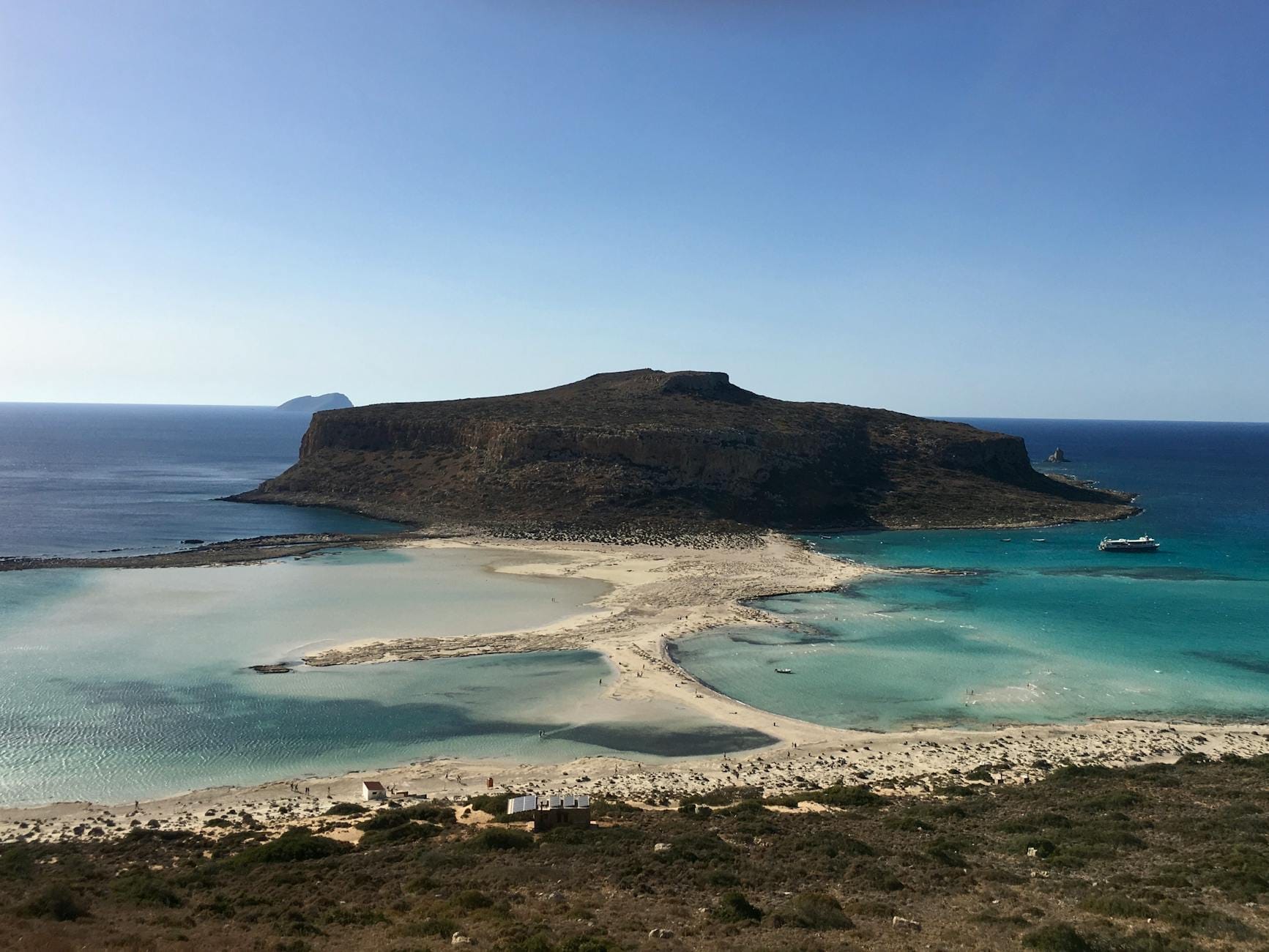
Imeri Gramvousa, which translates from Greek as 'Tame Gramvousa', is a small uninhabited island at the northwestern tip of Crete, sitting roughly one kilometre off the Gramvousa Peninsula. It is administered by Kissamos municipality within the Chania regional unit. The island has no permanent residents, no hotels, and no cars. What it does have is a remarkably well-preserved Venetian fortress perched at 137 metres above sea level, a sheltered sandy beach at its base, and water so clear and shallow that the seabed shifts from white to aquamarine depending on the angle of the sun.
Most visitors arrive as part of an organised day-trip boat cruise that combines Gramvousa with nearby Balos Lagoon. The two sites are geographically close but feel completely different: Balos is wide, open, and photogenic in a panoramic way, while Gramvousa is more intimate, with steep rock faces, the smell of wild herbs on the hillside path, and the particular silence of a place where only day-trippers come and go.
ℹ️ Good to know
Gramvousa Island is sometimes confused with Agria Gramvousa ('Wild Gramvousa'), a separate, smaller island to the northwest that is off-limits to visitors. All boat services go to Imeri (Tame) Gramvousa.
A Brief History Worth Knowing Before You Climb
The Venetian fortress on Gramvousa was constructed between 1579 and 1584 as part of Venice's defensive network against Ottoman expansion in the eastern Mediterranean. When the Ottomans captured the rest of Crete in 1669 after a 21-year siege, Venice managed to retain three island outposts under the subsequent treaty: Spinalonga, Souda, and Gramvousa. The fortress held out until 1692, making it one of the last Venetian strongholds in the Aegean.
Its second chapter is more colourful. During the Greek War of Independence (1821–1829), the island became a base for Greek rebels who captured it from the Ottomans in 1825. The harsh conditions and lack of resources pushed many of its occupants toward piracy, and Gramvousa earned a reputation as a pirate refuge, with its inhabitants raiding merchant ships passing through the strait. The situation became diplomatically uncomfortable enough that a combined British and French naval squadron cleared the pirates from the island in 1828. If you want the full context of this era, the history of Crete spans millennia and makes this island's role in the independence struggle even more striking.
Fragments of the fortress walls, cisterns, a small church dedicated to the Transfiguration of Christ, and the ruins of buildings used during the independence period all survive on the hilltop. The stonework blends Venetian construction with later additions, and you can trace the different historical phases if you look carefully at the masonry.
Tickets & tours
Hand-picked options from our booking partner. Prices are indicative; availability and final rates are confirmed when you complete your booking.
Visit a Family-Run Olive Mill with Food Tasting in Heraklion
From 19 €Instant confirmationFree cancellationSnorkeling experience in Crete
From 45 €Instant confirmationFree cancellationSpinalonga self-guided audio tour on your phone
From 12 €Instant confirmationFree cancellationMalia to Sissi private tuk-tuk journey with tastings
From 45 €Instant confirmationFree cancellation
Getting There: Boats, Timing, and What to Expect on the Water
Boat services to Gramvousa run seasonally, typically from May through October, with the peak frequency between June and September. The main departure point is Kissamos port (also called Kastelli), which lies approximately 40 kilometres west of Chania. The crossing takes around 45 minutes to an hour depending on the vessel. Some operators depart directly from Chania harbour, adding travel time on the water but removing the need to drive to Kissamos.
Boat tickets generally range from approximately €20 to €50 per person, with the price depending on whether the trip includes Balos Lagoon, onboard food and drinks, and the quality of the vessel. Tickets are available directly at Kissamos port or through local tour operators in Chania. Booking a day or two ahead is sensible in July and August when boats fill up early. The island itself has no entry fee.
⚠️ What to skip
The sea between the Gramvousa Peninsula and the island can be rough, particularly in the afternoon when the Meltemi wind picks up. If you're prone to seasickness, take medication before departure and aim for morning sailings when conditions tend to be calmer.
The Island on Foot: What You'll See from Shore to Summit
Boats moor at the small beach on the island's eastern side, a crescent of coarse white sand and fine gravel with water ranging from pale jade in the shallows to deep blue further out. The beach is narrow and fills quickly once two or three boats arrive, so swimming is best done within the first hour of reaching the island, before the midday crowds settle in. The water is cold by Mediterranean standards in May and early June but warms significantly by late July.
From the beach, a rocky path leads up to the fortress in about 20 minutes. The ascent is uneven and steep in places, with loose stone underfoot and no shade until you reach the walls. Wear shoes with grip. The climb rewards quickly: within a few minutes of the beach, the view opens up across the Gramvousa Peninsula and south toward the Kissamos Gulf. At the top, you step through the main gate into the fort and immediately understand why this location was considered strategically critical. You can see ships approaching from multiple directions.
Inside the walls, the small whitewashed church of the Transfiguration of Christ is well maintained and often unlocked. The cisterns that once supplied fresh water to the garrison are clearly visible. The highest point of the fortress gives a 360-degree view taking in the open Aegean to the north, the White Mountains on the Cretan mainland to the south, and Balos Lagoon visible in the distance to the east. In the late afternoon, when most boats are preparing to leave, this summit can be almost quiet.
💡 Local tip
Photography tip: The best light for shooting the fortress walls and the sea below is in the morning, when the sun comes from the east and illuminates the stonework. By midday the light is flat and the heat is intense. For shots of Balos Lagoon in the distance, a longer lens or zoom is useful from the fortress viewpoint.
Combining Gramvousa with Balos: Is the Full-Day Trip Worth It?
Most day-trip boats stop at Gramvousa Island first, then continue to Balos Lagoon, the shallow tidal lagoon formed between Cape Tigani and the mainland that appears in virtually every Crete travel photograph. The combined trip is the most popular excursion in the Chania region, and for good reason: the two locations complement each other well and the boat journey between them passes through striking coastal scenery.
The trade-off is time. A combined trip typically allows about 90 minutes at Gramvousa and 2 to 3 hours at Balos, which is enough to swim, eat, and explore both without feeling rushed, but not enough to linger. If your priority is the fortress and its history rather than the lagoon, consider checking whether any operators offer Gramvousa-only trips, which allow more time on the island. Alternatively, arriving at Balos overland via the rough track from Kaliviani gives you the lagoon experience independently.
For those planning a broader tour of the Chania region, it helps to read a dedicated guide to Crete boat trips to understand the full range of day-trip options from various ports.
Practical Considerations: What to Bring and Who Should Think Twice
The island has a small seasonal snack bar near the beach that operates in peak summer, but you should not rely on it for a full meal or for drinking water. Bring at least 1.5 litres of water per person, sun protection, and food if you plan a full day. There is no shade on the hillside path, and the midday temperature at the fortress in July and August regularly exceeds 35°C. A hat and sunscreen are not optional.
The fortress hike is not suitable for wheelchairs or for visitors with limited mobility. The path from the beach is unpaved, rocky, and steeply graded in sections. Guests with young children should assess carefully: the path is manageable for children over about 8 who are comfortable on uneven terrain, but not appropriate for toddlers or those in strollers. The beach itself is accessible from the boat landing without significant effort.
Visitors who prefer organised amenities, flat walking surfaces, or destinations with extensive infrastructure will likely find Gramvousa frustrating. This is a raw, undeveloped site. Its appeal lies precisely in what is absent: no beach bars, no sun lounger rentals, no paved walkways. If that sounds unappealing, the Venetian Harbour in Chania offers Venetian history in a far more comfortable, serviced setting.
Weather matters more here than at most Crete attractions. If the Meltemi wind is strong, boat trips are cancelled or delayed, sometimes with little advance notice. October visits are possible and often beautiful for the fortress, but boat service frequency drops significantly. Check the best time to visit Crete if you're planning around the shoulder season.
Insider Tips
- Board early at Kissamos port to secure a shaded seat on the boat's upper deck. The crossing can take up to an hour in each direction, and the sun on the open water is relentless by mid-morning.
- The small church of the Transfiguration inside the fortress is easy to overlook. Step inside even briefly: it is one of the best-preserved structures on the island and gives a tangible sense of life during the independence period.
- Spend your first 30 minutes swimming before the majority of boats arrive. The beach empties out again in the final hour before departure, so a second swim then is equally worthwhile.
- The ruins inside the fortress walls extend further than they appear from the gate. Follow the perimeter wall to the far side for the best elevated view toward Balos, which most visitors miss because they stop at the first good viewpoint.
- If you're travelling outside July and August, call operators in Kissamos directly rather than booking through large online platforms. Local operators sometimes run smaller boats on request in May, June, and September that aren't listed online.
Who Is Gramvousa Island For?
- Travellers who want history and coastal scenery combined in a single excursion
- Photographers after dramatic fortress-and-sea compositions with minimal crowds in early morning
- Hikers and walkers comfortable on uneven rocky terrain who want a short but rewarding climb
- Couples or small groups looking for a full-day boat excursion that combines two very different landscapes
- Anyone curious about the Greek War of Independence and its lesser-known Cretan dimension
Nearby Attractions
Other things to see while in Chania:
- Archaeological Museum of Chania
Opened in 2022 in a purpose-built 6,000 m² building in the Chalepa suburb, the Archaeological Museum of Chania traces western Crete's story from the Palaeolithic era through the 4th century AD. With over 4,100 finds, tactile exhibits, and a location just outside the Old Town, it rewards anyone who wants more than a beach holiday.
- Balos Lagoon
Balos Lagoon sits at the northwestern tip of Crete, where a shallow, turquoise-green pool forms between the Gramvousa Peninsula and the rocky spur of Cape Tigani. The sand is faintly pink from crushed shells and coral. The crowds in July and August are real. Here is what the experience actually involves.
- Chania Old Town
Chania Old Town is a living archive of civilizations stacked on top of one another, from Neolithic Kydonia to Venetian merchant palaces to Ottoman minarets. Free to enter and open at all hours, it rewards slow exploration more than rushed sightseeing.
- Elafonissi Beach
Elafonissi Beach sits on Crete's remote southwestern tip, where crushed shells from microscopic foraminifera tint the sand pink and a shallow lagoon connects the shore to a small protected island. Free to enter and genuinely striking, it draws large summer crowds that reward early arrivals and discourage afternoon visits.