Chania Venetian Harbor & Lighthouse: What to Expect Before You Go
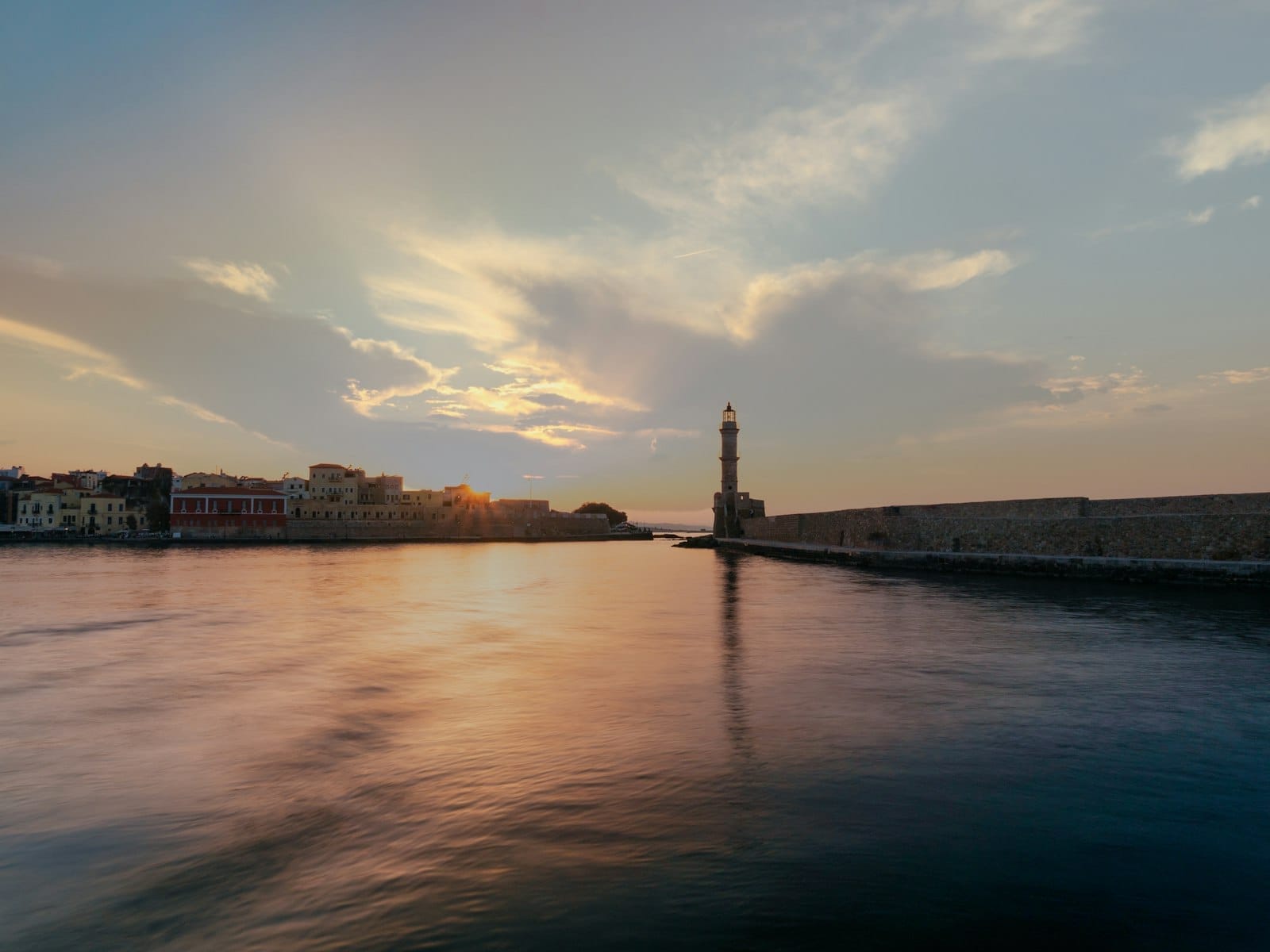
The Old Venetian Harbor is the heart of Chania, a crescent of water framed by Venetian-era architecture and anchored by a centuries-old lighthouse at the end of a long stone breakwater. Entry is free, it never closes, and the light changes everything depending on when you arrive.
Quick Facts
- Location
- Old Venetian Harbor, Chania, Crete — lighthouse at the eastern breakwater tip
- Getting There
- 5–10 minute walk from Chania Old Town center; limited paid parking nearby on Akti Kountourioti
- Time Needed
- 45 minutes to 2 hours depending on pace; allow extra time for sunset
- Cost
- Free, open 24/7 year-round — no ticket, no interior access to lighthouse
- Best for
- Sunset photography, evening walks, architecture lovers, history seekers
- Official website
- www.chaniatourism.gr/neighborhood/venetian-harbor
What the Venetian Harbor Actually Is
The Chania Old Venetian Harbor (Λιμάνι Χανίων) is a working harbor, a promenade, and an open-air monument compressed into one compact crescent. Construction began in 1320 under Venetian rule, primarily to support commerce and provide defense against piracy in the eastern Mediterranean. The result was one of the finest natural harbors in the Aegean, shaped and reinforced by stone quays that are, in places, still the same ones Venetian merchants walked across.
At the eastern end of the outer breakwater stands the Chania Lighthouse (Φάρος Χανίων), roughly 21 meters tall, its current form the product of an Egyptian-era reconstruction between 1830 and 1864 following the destruction of the original Venetian lighthouse after the Ottoman capture of the city in 1645. The Egyptian influence shows in the minaret-like silhouette, an architectural detail that catches most visitors by surprise. The lighthouse was registered as a protected archaeological site in 1962 and underwent a full refurbishment in 2006. It remains operational, with a fixed light visible for approximately 7 nautical miles.
💡 Local tip
The walk along the breakwater to the lighthouse base takes about 10 minutes each way. The path is paved but narrow, with low stone walls on either side. If you visit in strong wind conditions, sea spray can reach the walkway — wear appropriate shoes and hold onto bags and camera equipment.
How the Experience Changes by Time of Day
The harbor in the morning, before 9am, is a different place entirely. Fishing boats are still tied up along the inner quay, and the smell of salt water and diesel is stronger than at any other hour. The restaurant chairs are still stacked. Locals walk dogs along the waterfront. The water reflects the Venetian facades in near-perfect stillness, and you can photograph the lighthouse without a single other visitor in the frame.
By midday in summer, the promenade fills with foot traffic and the heat radiating from the stone quay becomes real. Restaurants along Akti Enoseos open for lunch, and the harbor's character shifts toward the tourist-facing. This is not the worst time to visit — the colors are saturated and the boats are active — but it is the least atmospheric, and the least comfortable for anyone sensitive to heat.
The hour before and after sunset is when the harbor earns its reputation. The limestone facades on the southern quay turn amber, and the lighthouse, backlit against a darkening sky, looks exactly like the photograph you have already seen. This is peak crowd time in July and August, particularly on the breakwater. Arrive 30 minutes before sunset to claim a position on the outer pier. After dark, the harbor lights reflect in the water and the restaurant strips along the waterfront come to life, with ambient noise replacing the daytime photo-clicking.
Tickets & tours
Hand-picked options from our booking partner. Prices are indicative; availability and final rates are confirmed when you complete your booking.
Private tour of western Crete's highlights from Chania
From 560 €Instant confirmationFree cancellationFrom Argiroupolis to Kournas Lake and Chania tour from Heraklion
From 630 €Instant confirmationFree cancellationPreveli guided tour from Chania
From 46 €Instant confirmationFree cancellationChania's old town food and wine walking tour with lunch
From 145 €Instant confirmationFree cancellation
Walking the Harbor: A Practical Route
Most visitors approach from the Chania Old Town side, entering the harbor area at the western end near the Firkas Fortress. This puts you immediately in front of the broad inner quay, with fishing boats on your left and the restaurant-lined promenade on your right. The full harbor crescent is roughly 500 meters from the Firkas end to the outer breakwater entrance.
From the Firkas end, walk east along the waterfront. You will pass the Maritime Museum of Crete, housed inside the fortress itself — worth a stop if you have an interest in naval history. Continue past the inner quay, where the waterfront transitions from working harbor to tourist promenade. At the far eastern end, the breakwater begins. The entrance is easy to miss: look for the narrow stone pier extending north toward the lighthouse.
The breakwater walk takes roughly 10 minutes at a relaxed pace. The surface is even enough for most visitors, though the narrow width and absence of guardrails on portions of the outer section make it less suitable for small children without close supervision. Wheelchair users will find the early section of the breakwater accessible, but the surface becomes more uneven nearer the lighthouse base. You cannot enter the lighthouse — the exterior and the views from the pier are the destination.
Historical and Architectural Context
Chania's identity as a port city predates the Venetians by centuries. The site of the harbor sits near ancient Kydonia, one of the most important Minoan settlements on the island. By the time Venice acquired Crete in 1204 following the Fourth Crusade and formally established control, the harbor already had centuries of use behind it. The Venetians transformed it into one of their key eastern Mediterranean trading posts, reinforcing the quays and building the arsenals — the vaulted stone boathouses visible at the harbor's eastern edge — that were used to repair and shelter their war galleys.
The harbor sat at the center of Cretan commerce and defense for over 300 years before the Ottomans captured Chania in 1645, ending Venetian rule. The architecture along the waterfront reflects these layered ownerships: Venetian stonework, Ottoman additions, and later modifications that followed Greek unification in 1913. For a deeper understanding of Crete's layered history, the Minoan and ancient history of Crete provides useful context before you visit.
The lighthouse's architectural curiosity, that minaret profile, directly reflects the period of Egyptian administration under Mohammed Ali Pasha, who governed Crete on behalf of the Ottoman Empire. The lighthouse rebuilt during this period (1830–1864) was designed in a style consistent with the architectural vocabulary of the time, giving it a silhouette that reads as distinctly different from any other Greek lighthouse. Its operational light was fixed in 1915 and the structure suffered damage in World War II before the 2006 restoration stabilized and refurbished it.
Photography: What Works and What Doesn't
The classic shot — lighthouse in the background, colorful fishing boats in the foreground — is taken from the inner harbor quay, roughly level with the start of the breakwater. A wide-angle lens captures both the boats and the full lighthouse in one frame. In summer, the light from roughly 6pm to 8pm is warm enough to add color to the stone without harsh shadows.
For a less-seen angle, walk to the far end of the breakwater and turn back toward the city. The view south from the lighthouse base puts the full sweep of Venetian facades against the backdrop of the White Mountains, which often carry snow from November through April. This is one of the most visually striking and least photographed compositions at the harbor. A standard zoom or short telephoto compresses the distance well.
ℹ️ Good to know
Drone use over the harbor area is subject to Greek Civil Aviation Authority regulations. The harbor's protected archaeological status and the operational nature of the lighthouse create no-fly restrictions in certain conditions. Check current HCAA rules before flying any unmanned aircraft here.
Practical Details and What to Know Before You Go
The harbor and lighthouse exterior are open 24 hours a day, 365 days a year. There is no ticket, no queue, and no infrastructure to navigate. The restaurants along Akti Enoseos and Akti Kountourioti are privately operated and vary considerably in quality and price. As a general rule, the restaurants directly on the inner quay charge a premium for the view — the food itself is rarely exceptional. If you are eating in the harbor area, look for places on the side streets that run south from the waterfront.
Getting to the harbor is straightforward from anywhere in Chania's Old Town. If you are arriving by car, parking near the harbor in high season requires patience — the streets narrow quickly and the closest spots fill early. Public buses serve central Chania, with stops within a 10-minute walk of the harbor entrance. Most visitors staying in the Old Town or Splantzia neighborhoods are within 5 minutes on foot.
The harbor is genuinely accessible to almost all visitors in terms of physical access to the main promenade. The breakwater walk has a mostly even surface but no formal accessibility infrastructure. In strong winds from the north (common in winter and spring), the outer pier can receive wave splash and becomes inadvisable for anyone not wearing waterproof footwear.
If this is your first time in Chania, combining the harbor with a broader walk through the city makes sense. The Archaeological Museum of Chania is a short walk inland and gives historical context that enriches what you see at the harbor. If you are planning a longer stay on the island, the comparison between Chania and Heraklion is worth reading to understand how each city's harbor experience differs.
Who This Attraction Suits — and Who Might Be Disappointed
The Venetian Harbor delivers most for people who engage with it on its own terms: a slow walk, a coffee at the right hour, time spent looking at the water and the architecture. If you arrive expecting a polished visitor experience with interpretation panels and guided structures, you will find mostly restaurants and stone. The harbor is a place to be in, not a place to be guided through.
Visitors seeking active beach days or adventure activities will find the harbor a pleasant interlude but not the point of the trip. For beaches near Chania, Balos Lagoon and Elafonissi Beach are the area's standout options, both accessible as day trips.
Travelers who are very sensitive to crowds should adjust their visit accordingly. In July and August, the breakwater at sunset is genuinely congested. The same walk at 7am is almost entirely private. The harbor's appeal does not diminish at off-peak hours — in many ways it improves.
Insider Tips
- The arsenals (arzenali) — the vaulted Venetian boathouses on the eastern inner harbor — are structurally impressive and easy to miss. Look for the series of stone arches along the waterfront before you reach the breakwater. Some are used as exhibition or event spaces during summer.
- The view from the lighthouse base looking back toward the city includes the White Mountains in the background. Bring a longer lens or zoom in on your phone — the combination of lighthouse foreground, harbor middle ground, and mountain backdrop is the most complete visual summary of Chania in a single frame.
- If you want a coffee or drink with a harbor view without the waterfront restaurant markup, the streets immediately south of the harbor (Zambeliou and Theotokopoulou) have independent cafes with outdoor tables just one block from the water at considerably lower prices.
- The harbor has almost no street lighting on the outer breakwater — bring a flashlight or use your phone torch if you plan to walk out to the lighthouse base after dark. The uneven sections are harder to navigate without it.
- October and November offer some of the best light and the emptiest breakwater. The harbor is fully operational year-round, the restaurants thin out, and the autumn afternoon light on the Venetian facades is warmer than anything summer produces.
Who Is Venetian Harbor & Lighthouse For?
- Photographers and anyone prioritizing visual composition, particularly at golden hour
- History and architecture enthusiasts with an interest in Venetian and Ottoman layers of Cretan identity
- Couples and slow travelers who want an evening walk with atmosphere rather than a ticketed attraction
- Families with older children who can manage the breakwater walk safely
- First-time visitors to Chania who need a central landmark to orient their exploration of the Old Town
Nearby Attractions
Other things to see while in Chania:
- Archaeological Museum of Chania
Opened in 2022 in a purpose-built 6,000 m² building in the Chalepa suburb, the Archaeological Museum of Chania traces western Crete's story from the Palaeolithic era through the 4th century AD. With over 4,100 finds, tactile exhibits, and a location just outside the Old Town, it rewards anyone who wants more than a beach holiday.
- Balos Lagoon
Balos Lagoon sits at the northwestern tip of Crete, where a shallow, turquoise-green pool forms between the Gramvousa Peninsula and the rocky spur of Cape Tigani. The sand is faintly pink from crushed shells and coral. The crowds in July and August are real. Here is what the experience actually involves.
- Chania Old Town
Chania Old Town is a living archive of civilizations stacked on top of one another, from Neolithic Kydonia to Venetian merchant palaces to Ottoman minarets. Free to enter and open at all hours, it rewards slow exploration more than rushed sightseeing.
- Elafonissi Beach
Elafonissi Beach sits on Crete's remote southwestern tip, where crushed shells from microscopic foraminifera tint the sand pink and a shallow lagoon connects the shore to a small protected island. Free to enter and genuinely striking, it draws large summer crowds that reward early arrivals and discourage afternoon visits.