Maritime Museum of Crete: Chania's Seafaring Story in a Venetian Fortress
Housed inside the Firka Fortress at the entrance to Chania's Venetian harbour, the Maritime Museum of Crete covers over three millennia of Cretan seafaring history. From a full-scale replica of a Minoan ship to exhibits on the pivotal Battle of Crete, this is one of the most historically layered small museums in the Aegean.
Quick Facts
- Location
- Firka Fortress, Akti Kountourioti, Chania Harbour, Chania 73136
- Getting There
- 10-15 min walk from Chania city centre; near the Venetian Lighthouse on the western arm of the harbour
- Time Needed
- 1 to 1.5 hours for the main collection;
- Cost
- Approx. €5 adult admission (verify before visiting; prices may change seasonally)
- Best for
- History enthusiasts, families with older children, WWII and naval history buffs
- Official website
- http://mar-mus-crete.gr/en/the-museum
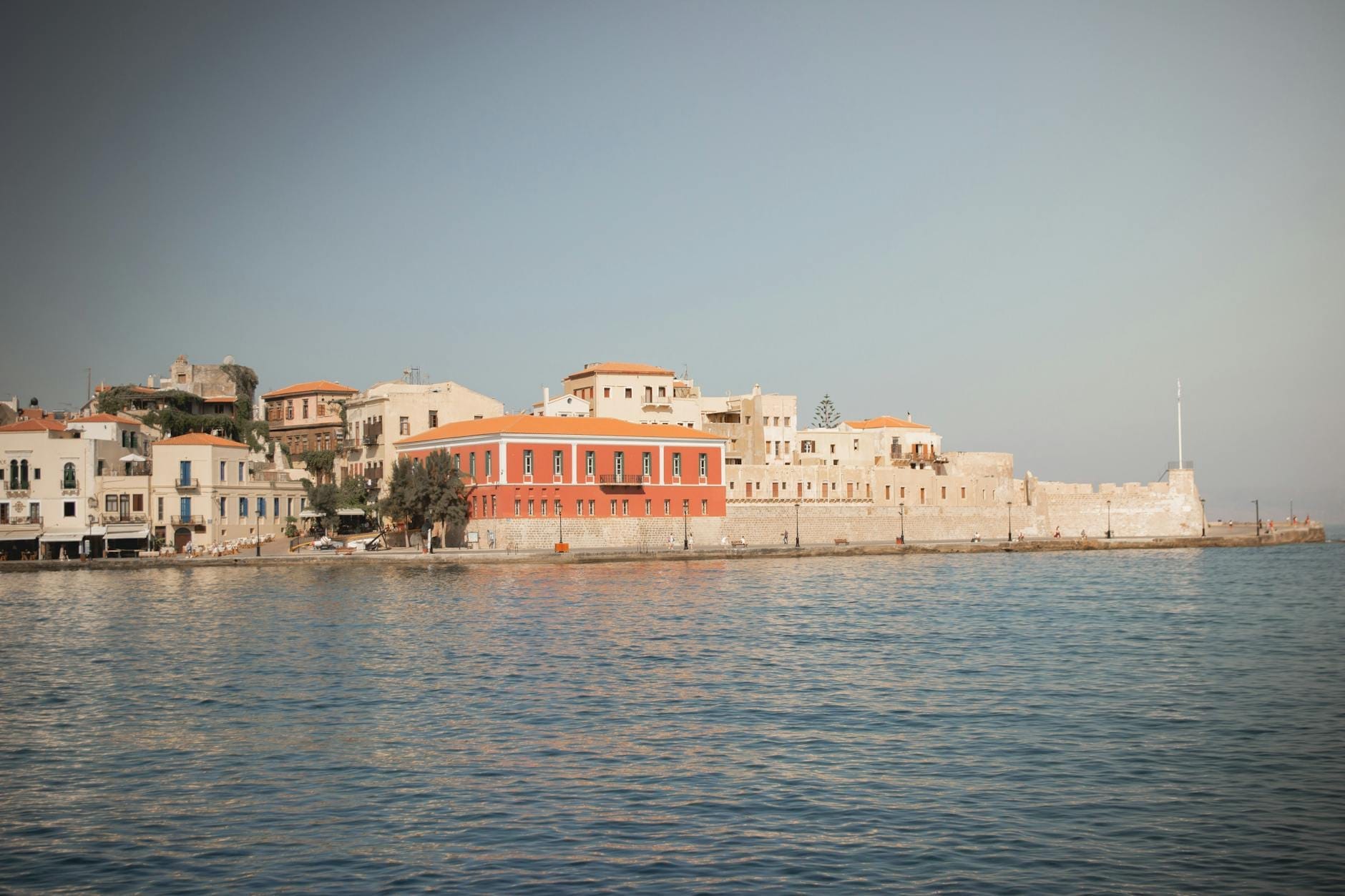
What the Maritime Museum of Crete Actually Is
The Maritime Museum of Crete occupies two sites along Chania's celebrated old harbour. The main collection sits inside the Firka Fortress on the western tip of the harbour mouth, a structure the Venetians built following their conquest of Crete in 1204 and substantially reinforced through the early 17th century. A smaller annex occupies the Moro Shipyards at the harbour's eastern end, dating to 1607. Together, the two spaces form a continuous narrative: the buildings themselves are as much part of the exhibit as anything displayed inside them.
The museum was founded on 27 May 1973 by Vice Admiral Giannopolous, deliberately timed to mark the 32nd anniversary of the Battle of Crete. That founding impulse, part military commemoration, part cultural institution, still shapes the experience. You feel it in the balance of the collection: ancient seafaring sits alongside detailed documentation of 20th-century naval warfare, and neither side of that timeline is shortchanged.
💡 Local tip
Opening hours vary significantly between summer (16 April to 31 October) and winter (1 November to 15 April). Always confirm current hours on the official website or by calling (+30) 28210 91875 or (+30) 28210 97484 before making it the centrepiece of your day.
The Collection: Two Floors, Three Millennia
The centrepiece of the main building is a 17-metre replica of a Minoan vessel, reconstructed between 2001 and 2004 using ancient shipbuilding techniques. The ship is not simply a display piece. After its completion it sailed from Crete to Piraeus on the Greek mainland, demonstrating that Minoan seafarers were navigating the Aegean not just on papyrus representations but in seaworthy, ocean-ready hulls. Standing next to it inside the fortress hall gives you a physical sense of scale that no photograph can replicate: these were not small coastal boats.
The exhibits move chronologically through Cretan maritime history. Early rooms cover Minoan trade networks and Bronze Age navigation. Middle floors address Byzantine, Arab, and Venetian control of Cretan waters, periods that often get compressed or skipped entirely in broader Greek history courses but which shaped the island's architecture and culture more than almost anything else. The Venetian section is particularly strong, with maps, navigational instruments, and detailed scale models of galleys and galleons.
The Battle of Crete section, covering the German airborne invasion of May 1941, is the most emotionally charged part of the museum. Photographs, weapons, uniforms, and documents are arranged without sensationalism. There is a particular focus on the Allied naval effort to evacuate troops from Sfakia on the island's south coast, a story often overshadowed by Dunkirk but every bit as desperate. For visitors with family connections to the Commonwealth forces who fought here, this room frequently becomes a long stop.
Tickets & tours
Hand-picked options from our booking partner. Prices are indicative; availability and final rates are confirmed when you complete your booking.
Snorkeling experience in Crete
From 45 €Instant confirmationFree cancellationPrivate guided tour of Crete with Knossos Palace and Lassithi Plateau
From 650 €Instant confirmationFree cancellationFarm to Fork 4-Hour Cooking Class in Crete
From 200 €Instant confirmationFree cancellationEastern Crete and Mirabello Bay guided small group tour
From 116 €Instant confirmationFree cancellation
The Firka Fortress: The Building as Exhibit
Even visitors with limited interest in naval history tend to find the Firka Fortress itself worth the admission price. The stone walls are thick enough to muffle the harbour traffic outside, and the interior chambers still carry the feel of a working military structure rather than a renovated shell. The fortress played a specific, documented role in Cretan history: it was here, on 1 December 1913, that the Greek flag was raised over Crete for the first time, marking the island's formal union with Greece after centuries of Venetian and Ottoman rule. A small commemoration marks the spot.
The relationship between the fortress and the surrounding harbour is best appreciated from the upper ramparts, which offer a clean sightline across the water toward the Egyptian Lighthouse and back across the rooftops of Chania's Old Town. This viewpoint is less crowded than the lighthouse itself and gives you the full sweep of the Venetian harbour without the selfie-stick congestion of the more photographed spots.
Timing Your Visit: How the Experience Changes by Hour
The museum is at its best in the morning, when the light off the harbour filters into the fortress's narrow windows and the crowds are thinner. By mid-morning in summer, tour groups begin arriving, and the Minoan ship room in particular can feel compressed. If you arrive when the museum opens, you can spend time with the ship in near-silence, which is a different experience entirely.
Midday visits in July and August are a practical option regardless of crowds, since the thick Venetian stone keeps the interior noticeably cooler than the streets outside. The museum functions well as a two-hour refuge from the peak afternoon heat. Late afternoon light through the upper windows of the fortress is pleasant but not dramatically different from morning.
ℹ️ Good to know
at the eastern end of the harbour has separate opening arrangements. If it is a priority for you, confirm it is open on the same ticket before crossing the harbour.
Practical Walkthrough: Getting There and Around
The museum is easily reached on foot from anywhere in central Chania. Follow the harbour promenade west past the restaurants and cafes that line Akti Kountourioti; the fortress announces itself at the end of the arc, its stone mass distinguishable from the surrounding buildings. There is no dedicated parking on the harbour front, so driving is not recommended. The walk from the covered market area takes roughly 12 minutes.
Chania is well suited to a day structured around the museum and the harbour. Combine it with a walk through the Archaeological Museum of Chania for a full survey of the city's history, or use it as a starting point before heading east along the waterfront. If you are planning a longer stay on the island, the one-week Crete itinerary offers a framework for fitting Chania's attractions into a broader trip.
The museum is operated jointly by the Municipality of Chania and the Naval Base of Crete. Staff are generally knowledgeable and, in peak season, some English-language assistance is available. Signage is in Greek and English throughout the main collection.
⚠️ What to skip
The Firka Fortress is a multi-floor historic building. There are stairs between exhibition levels and no lifts have been noted in available information. Visitors with significant mobility restrictions should check accessibility conditions directly with the museum before visiting.
Photography and What to Bring
Photography is generally permitted inside the museum for personal use. The Minoan ship is the obvious centrepiece shot, but the rooms covering Venetian cartography, with their aged maps and brass instruments under low light, reward patience more than the obvious angles. A wide-angle lens or the widest setting on a phone camera helps in the confined fortress chambers. Flash is typically discouraged around older documents.
Bring a light layer even in summer. The stone walls hold cool air, and the drop in temperature from the harbour promenade can be more pronounced than expected. Comfortable shoes matter more than any specific footwear, as the stone floors and uneven fortress staircases can be slick in certain light.
Is the Maritime Museum Worth Your Time?
For travellers drawn to the layered history of the Mediterranean, this museum punches well above its size. It covers a timeline, from Minoan trade to 20th-century naval warfare, that very few institutions manage to hold together coherently, and the setting inside the Firka Fortress prevents it from feeling like a generic display space. The €5 admission is reasonable for what is on offer.
That said, visitors expecting extensive interactive technology or child-oriented programming will find the format traditional. The exhibits are largely object-based with printed labels. Families with young children who found the Heraklion Archaeological Museum too text-heavy are likely to have the same experience here. The museum rewards curiosity and a willingness to read, not passive observation.
If the Minoan seafaring angle interests you, it pairs logically with a visit to the Palace of Knossos for a fuller picture of the Bronze Age civilisation that these ships served. Those focused specifically on Crete's WWII history will find the Battle of Crete section here a useful primer before exploring further into the island's wartime sites. The Minoan history guide for Crete provides additional context for understanding the seafaring exhibits.
Insider Tips
- Walk the upper ramparts of the Firka Fortress after finishing the interior collection. The view across the harbour mouth is one of the better vantage points in Chania and is rarely crowded because most visitors head straight for the exit.
- The spot where the Greek flag was first raised over Crete on 1 December 1913 is marked inside the fortress. It is easy to walk past it. Ask staff to point it out if you cannot locate it.
- The harbour-side restaurants immediately adjacent to the fortress inflate their prices considerably. Walk two or three streets back into the Old Town before stopping for coffee or lunch.
- If you are visiting with an interest specifically in the Battle of Crete, come on a weekday morning. Tour groups focusing on WWII history sometimes fill the exhibition in peak season, particularly on weekends.
- Explore the full Firka Fortress site on the eastern side of the harbour if it is open. The two sites together give a more complete picture, and the walk between them along the harbour front is pleasant in itself.
Who Is Maritime Museum of Crete For?
- History and archaeology enthusiasts who want Mediterranean naval context beyond the standard ancient Greece narrative
- WWII history travellers with a specific interest in the Battle of Crete and Allied evacuation operations
- Architecture lovers interested in Venetian military construction in the Eastern Mediterranean
- Travellers looking for a substantive indoor activity during peak summer heat
- Older children and teenagers with an interest in ships, exploration, or wartime history
Nearby Attractions
Other things to see while in Chania:
- Archaeological Museum of Chania
Opened in 2022 in a purpose-built 6,000 m² building in the Chalepa suburb, the Archaeological Museum of Chania traces western Crete's story from the Palaeolithic era through the 4th century AD. With over 4,100 finds, tactile exhibits, and a location just outside the Old Town, it rewards anyone who wants more than a beach holiday.
- Balos Lagoon
Balos Lagoon sits at the northwestern tip of Crete, where a shallow, turquoise-green pool forms between the Gramvousa Peninsula and the rocky spur of Cape Tigani. The sand is faintly pink from crushed shells and coral. The crowds in July and August are real. Here is what the experience actually involves.
- Chania Old Town
Chania Old Town is a living archive of civilizations stacked on top of one another, from Neolithic Kydonia to Venetian merchant palaces to Ottoman minarets. Free to enter and open at all hours, it rewards slow exploration more than rushed sightseeing.
- Elafonissi Beach
Elafonissi Beach sits on Crete's remote southwestern tip, where crushed shells from microscopic foraminifera tint the sand pink and a shallow lagoon connects the shore to a small protected island. Free to enter and genuinely striking, it draws large summer crowds that reward early arrivals and discourage afternoon visits.