Archaeological Museum of Chania: What to See, Know, and Expect
Opened in 2022 in a purpose-built 6,000 m² building in the Chalepa suburb, the Archaeological Museum of Chania traces western Crete's story from the Palaeolithic era through the 4th century AD. With over 4,100 finds, tactile exhibits, and a location just outside the Old Town, it rewards anyone who wants more than a beach holiday.
Quick Facts
- Location
- 15 Skra Str., Chalepa, Chania 73133 — about 2 km east of Chania Old Town
- Getting There
- Local bus from central Chania, taxi (5–10 min), or a 25-minute waterfront walk from the Old Town
- Time Needed
- 1.5 to 2.5 hours for a thorough visit; 45 minutes if you focus on highlights
- Cost
- €15 full price / €8 reduced; e-tickets available at hhticket.gr
- Best for
- History enthusiasts, families with older children, architecture lovers, rainy-day plans
- Official website
- amch.gr/en
What Is the Archaeological Museum of Chania?
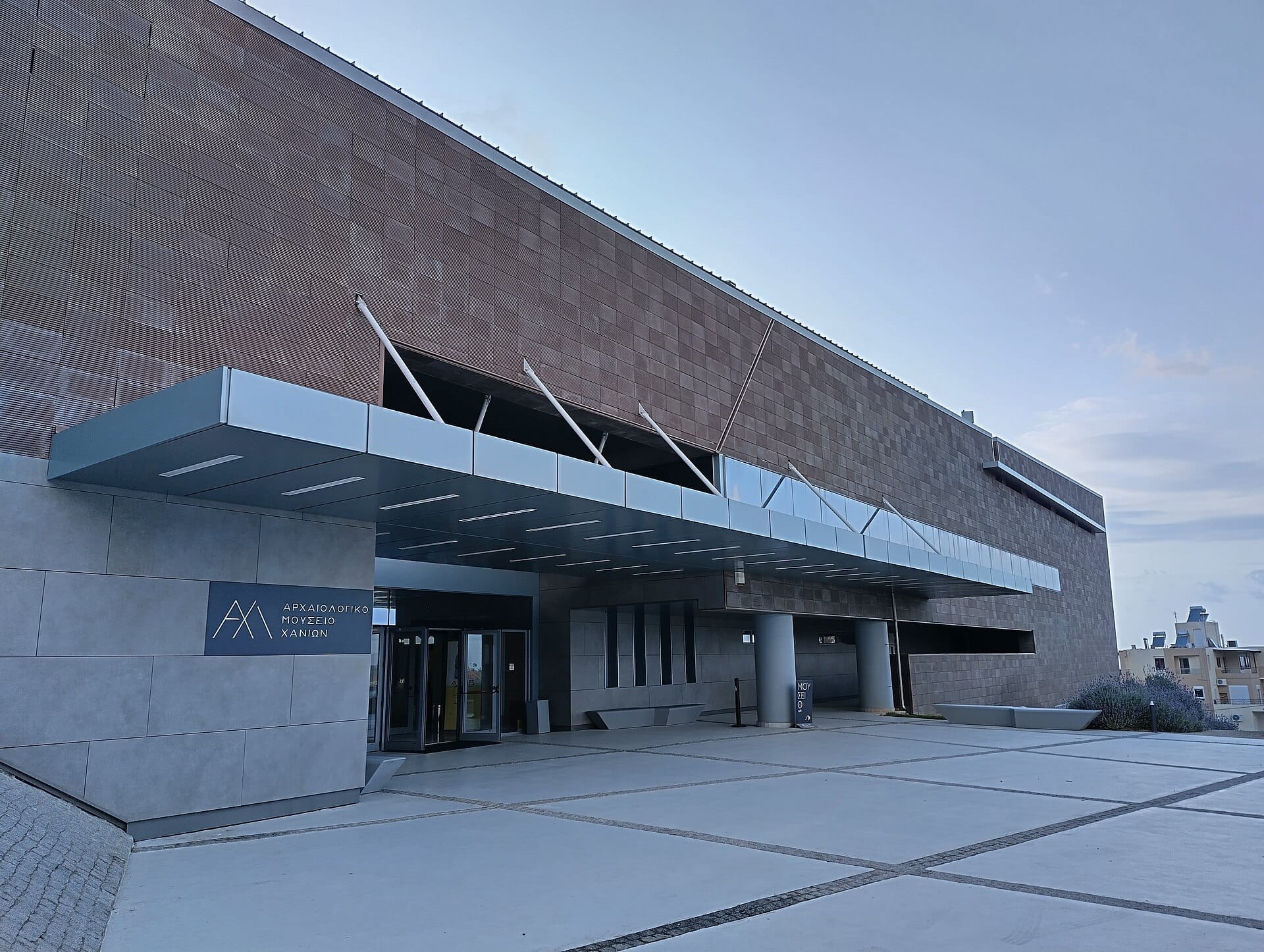
The Archaeological Museum of Chania (Αρχαιολογικό Μουσείο Χανίων) is the principal archaeological museum serving western Crete. It opened on 16 April 2022 in a purpose-built facility in the Chalepa suburb, ending decades of the collection being cramped into a converted Venetian church in the Old Town. The new building covers roughly 6,000 m² of floor space on a plot of over 11,500 m², designed by architect Theofanis Bobotis to give the collection the breathing room it always deserved.
The permanent collection spans an extraordinary sweep of time: from Palaeolithic stone tools to Roman-era sculptures and glass, with particular depth in the Minoan, Geometric, and Hellenistic periods. In total, around 4,100 objects are on display, supplemented by the Mitsotakis Collection. For anyone visiting Crete with serious curiosity about the island's deep past, this museum is one of the most substantive stops outside of Heraklion.
Western Crete is often thought of as a scenery-first destination, but it has one of the island's richest archaeological records. The ancient city of Kydonia, which sat beneath modern Chania, was one of the three great Minoan cities of Crete — along with Knossos and Phaistos. In 2024, Kydonia was inscribed on the UNESCO World Heritage List as part of the Minoan Palatial Centres nomination. Many of the objects in this museum were recovered from Kydonia's excavation, giving the collection a direct link to the city under your feet. You can read more about the Minoan world in our Minoan history guide for Crete.
The Building and Its Setting
Chalepa is not the tourist quarter. It is a quiet residential suburb east of the Old Town, historically associated with diplomats, merchants, and Cretan political figures — Eleftherios Venizelos, the statesman who shaped modern Greece, was born nearby. Arriving in Chalepa, you notice the pace slows. The building sits at roughly 98 metres above sea level, and on clear days the upper-floor windows open onto views of the sea.
The architecture is deliberate and spare: clean lines, large internal volumes, and natural light managed carefully to protect the objects. It does not perform the way some new museums do. It simply makes the collection easy to see. The entrance plaza is shaded in the morning hours, which matters in July and August when Chania bakes. Plan to arrive before 10:00 if you want comfortable outdoor conditions for the short walk from the bus stop.
💡 Local tip
The museum is about 2 km from the Venetian Harbour. You can walk along the coastal road in around 25 minutes, or take a local bus from central Chania. A taxi from the Old Town costs only a few euros and takes 5–10 minutes.
Tickets & tours
Hand-picked options from our booking partner. Prices are indicative; availability and final rates are confirmed when you complete your booking.
Archaeological Museum of Chania entrance ticket with audio tour
From 24 €Instant confirmationArchaeological Museum of Chania self-guided audio tour
From 12 €Instant confirmationFree cancellationPrivate tour of western Crete's highlights from Chania
From 560 €Instant confirmationFree cancellationFrom Argiroupolis to Kournas Lake and Chania tour from Heraklion
From 630 €Instant confirmationFree cancellation
What You Will See Inside
The collection is arranged broadly in chronological order, which helps even casual visitors follow the arc of western Crete's history without needing a guide. You move from Palaeolithic fragments through Neolithic settlements, into the Bronze Age Minoan material that forms the emotional core of the museum, then through the Geometric, Archaic, Classical, and Hellenistic periods, and finally into the Roman era.
The Minoan rooms are the highlight for most visitors. Look for the seals and seal impressions: small in size, extraordinary in detail, they record Minoan iconography with animals, ritual scenes, and patterns that remain only partly understood. Clay tablets with Linear A script, the undeciphered writing system of the Minoans, are among the most intellectually charged objects in the entire building. You are looking at a language no one has cracked.
The Hellenistic and Roman galleries tend to get less attention from visitors who are rushing through, but they reward slowness. Fine glassware, jewellery, terracotta figurines, and coins trace how western Crete connected to the wider Mediterranean world after Minoan civilization collapsed. The Mitsotakis Collection, donated to the museum, adds depth to this later material.
ℹ️ Good to know
The museum provides tactile exhibits and braille captions, making it one of the more accessible archaeological museums in Crete for visitors with visual impairments.
Opening Hours and Tickets
The museum operates two seasonal schedules. From 1 April to 31 October, it opens at 08:00 and closes at 20:00. From November through March, hours are 08:30 to 15:30. In both seasons, the museum is closed on Tuesdays. Last entry is 20 minutes before closing time, so do not arrive at 19:50 in summer expecting a full visit.
Admission is €15 for a full-price ticket, €8 reduced. Reduced rates apply to students, EU citizens over 65, and other qualifying categories — check current terms on the official site or hhticket.gr before visiting. E-tickets can be purchased in advance, which is useful during the busy summer months when queues can form at the desk, particularly mid-morning when tour groups arrive.
⚠️ What to skip
The museum is closed every Tuesday year-round. Many visitors arriving on a Tuesday are caught off-guard — plan your Chania itinerary accordingly.
Best Time to Visit and Crowd Patterns
Opening time (08:00 in summer) is the single best moment to visit. The light is still clean, the building has not yet absorbed the midday heat, and tour groups have not arrived. The museum typically stays quiet until around 10:00 to 10:30, when organised day-trip groups begin to filter through.
Midday on weekdays in July and August is the most crowded window. If you cannot make opening time, late afternoon, from around 17:00 onward, is the next best option. The light shifts inside the building, the temperature drops slightly, and the tour groups have usually moved on. You will have more space around the larger display cases.
The museum makes an excellent anchor for a day in Chania that also includes the Old Town and waterfront. If you are planning a broader Chania itinerary, consider pairing this visit with a walk through Chania's Old Town and an evening at the Venetian Harbour, where the pace is completely different.
For those planning a full cultural tour of Crete, note that the Heraklion Archaeological Museum holds the largest Minoan collection in the world and covers different sites entirely. The two museums are complementary, not repetitive. If you are visiting both, Heraklion's collection is broader; Chania's is more focused on the western region and benefits from the clarity of its new building.
Who Should Visit — and Who Might Not
The museum works well for adults with genuine curiosity about history, for families with children aged 10 and above who can engage with objects behind glass, and for anyone who finds it useful to have historical context before visiting archaeological sites. The Minoan material here gains significantly more meaning if you subsequently visit sites across Crete.
Travelers whose priority is beaches, nightlife, or outdoor activity may feel the €15 entry is steep for 90 minutes inside. If you are on a tight budget, note that Crete has several free things to do that may better suit your priorities. The museum is not interactive in the way modern children's museums are — it is a serious archaeological collection, and the pace it demands is reflective rather than active.
Very young children (under 7) often find the visit long, particularly as there is no dedicated children's play space or interactive digital layer. The accessible design helps visitors with mobility challenges — the building is modern and level — but the 2 km distance from the Old Town means it requires deliberate planning rather than a spontaneous drop-in.
Insider Tips
- Arrive at 08:00 when the doors open. The first 90 minutes are the quietest of the day, and you will have the Minoan rooms essentially to yourself before tour groups reach the building.
- Buy e-tickets in advance via hhticket.gr. The desk queue mid-morning in summer can absorb 15 to 20 minutes of your visit time unnecessarily.
- The museum is in Chalepa, not the Old Town — many visitors assume it is near the Venetian Harbour. Add an extra 10 minutes to your journey and confirm directions before leaving your accommodation.
- Spend time with the seal impressions and Linear A tablets in the Minoan rooms. They are small and easy to walk past, but they represent some of the most significant unresolved puzzles in Mediterranean archaeology.
- Tuesday closures catch many visitors off-guard. If your Chania stay includes a Tuesday, reschedule the museum and use that day for the Old Town, the Maritime Museum, or a day trip instead.
Who Is Archaeological Museum of Chania For?
- History and archaeology enthusiasts visiting western Crete
- Travelers wanting context before visiting Minoan sites like Knossos or Phaistos
- Families with older children (10+) interested in ancient civilizations
- Rainy or very hot days when outdoor activities are uncomfortable
- Anyone staying in Chania for more than two nights who wants depth beyond the waterfront
Nearby Attractions
Other things to see while in Chania:
- Balos Lagoon
Balos Lagoon sits at the northwestern tip of Crete, where a shallow, turquoise-green pool forms between the Gramvousa Peninsula and the rocky spur of Cape Tigani. The sand is faintly pink from crushed shells and coral. The crowds in July and August are real. Here is what the experience actually involves.
- Chania Old Town
Chania Old Town is a living archive of civilizations stacked on top of one another, from Neolithic Kydonia to Venetian merchant palaces to Ottoman minarets. Free to enter and open at all hours, it rewards slow exploration more than rushed sightseeing.
- Elafonissi Beach
Elafonissi Beach sits on Crete's remote southwestern tip, where crushed shells from microscopic foraminifera tint the sand pink and a shallow lagoon connects the shore to a small protected island. Free to enter and genuinely striking, it draws large summer crowds that reward early arrivals and discourage afternoon visits.
- Falassarna Beach
Falassarna stretches for three kilometres along Crete's remote northwestern tip, offering pink-gold sand, clear turquoise water, and the atmospheric ruins of an ancient Hellenistic port. It is one of the island's most consistently celebrated beaches, and on a calm morning, the praise feels entirely justified.