Chania Old Town: Venetian Lanes, Ottoman Layers, and One of Crete's Great Harbors
Chania Old Town is a living archive of civilizations stacked on top of one another, from Neolithic Kydonia to Venetian merchant palaces to Ottoman minarets. Free to enter and open at all hours, it rewards slow exploration more than rushed sightseeing.
Quick Facts
- Location
- Northwest Crete, Chania regional unit (35°31′N 24°01′E)
- Getting There
- Walk 2 blocks from Chania City Market via Halidon Street to Venizelos Square; regional KTEL buses serve central Chania
- Time Needed
- 2–4 hours for a thorough walk; a full day if you add museums and the harbor
- Cost
- Free entry to all streets, alleys, and public spaces
- Best for
- History, photography, evening walks, slow travel
- Official website
- www.visitgreece.gr/islands/crete/chania
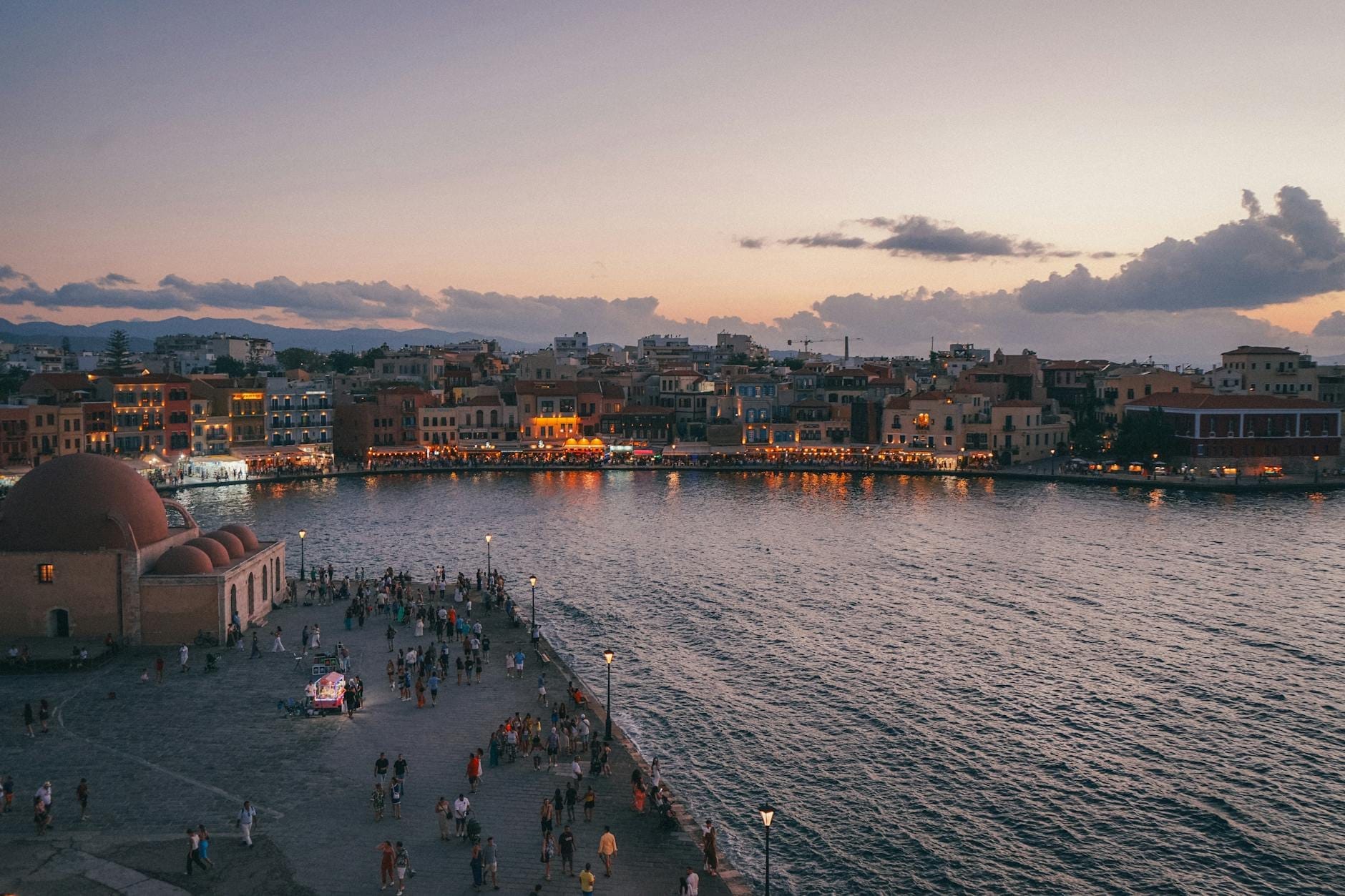
What Chania Old Town Actually Is
Chania Old Town is not a museum district cordoned off from everyday life. It is a functioning neighborhood where residents hang laundry above 15th-century stone arches, where cats sleep in doorways of buildings that have cycled through Venetian, Ottoman, and Greek ownership. The area is bounded by the surviving fragments of Venetian fortification walls and stretches down to one of the most photographed harbors in the Aegean. Its center of gravity is the Venetian harbor lighthouse and the crescent of Venetian-era warehouses facing the water.
The hill at the heart of the old town, Kasteli, has been continuously inhabited since at least the Neolithic period. It was the site of ancient Kydonia, a significant Minoan center whose name echoes in the modern Greek word for quince. Layers of Minoan, Greek, Roman, Byzantine, Venetian, and Ottoman occupation sit compressed beneath the current streetscape, which is part of why the alleys feel so irregular: they follow topographies shaped by cultures separated by millennia.
ℹ️ Good to know
Chania Old Town is open 24 hours a day as a public historic district. There are no gates, no entry tickets, and no closing times for the streets themselves. Individual museums and monuments have their own schedules.
The Venetian Harbor: Anchor Point of the Old Town
The harbor is where most visitors begin, and for good reason. The Egyptian lighthouse at the end of the western breakwater, originally built by the Venetians in the 16th century and substantially rebuilt in 1830, is the visual anchor of Chania. Early morning, before 8am, the light is low and golden, the fishing boats are returning or being rigged, and the long row of Venetian arsenals (shipyards) along the waterfront casts clean geometric shadows. By 10am the tour groups arrive and the atmosphere shifts entirely.
The arsenals themselves are worth close attention. These vaulted stone structures, built by the Venetians in the 16th century to house and repair war galleys, are some of the best-preserved examples of Venetian naval architecture in the Eastern Mediterranean. Several have been converted into exhibition spaces and shops, though from the outside the scale and workmanship of the masonry remains legible.
The harbor walk continues east to the area around the Firka fortress, which houses the Maritime Museum of Crete. This is worth an hour if you have any interest in how Crete's relationship with the sea shaped its history, from Byzantine trade routes to the Battle of Crete in 1941.
💡 Local tip
Come to the harbor at sunrise if you want photographs without crowds or restaurant signage blocking your sightlines. Come at dusk if you want the social atmosphere: locals walk here in the evening regardless of tourist season.
Tickets & tours
Hand-picked options from our booking partner. Prices are indicative; availability and final rates are confirmed when you complete your booking.
Chania's old town food and wine walking tour with lunch
From 145 €Instant confirmationFree cancellationPrivate tour of western Crete's highlights from Chania
From 560 €Instant confirmationFree cancellationFrom Argiroupolis to Kournas Lake and Chania tour from Heraklion
From 630 €Instant confirmationFree cancellationPreveli guided tour from Chania
From 46 €Instant confirmationFree cancellation
Topanas, Evraiki, and the Quarters Beyond the Harbor
Most visitors stick to the harbor promenade and miss the two historic quarters that give Chania Old Town its real depth. Topanas, the former Christian quarter, sits west of the harbor and contains some of the finest Venetian mansions in Crete. The streets here are narrow enough that neighbors could theoretically shake hands from opposite windows. Many of the buildings retain their original stone door frames, carved lintels, and interior courtyard configurations, even when the ground floor has become a boutique or a pension.
Evraiki, the former Jewish quarter, occupies the area to the east of Kasteli hill. The Etz Hayyim Synagogue, the only functioning synagogue in Crete, is the spiritual center of this quarter. The Jewish community of Chania, which had roots stretching back to the Byzantine period, was almost entirely deported and killed during World War II. The synagogue operates as a place of worship and a site of memory, and visits are welcomed with appropriate respect for the solemnity of what it represents.
Walking between these quarters requires crossing the slope of Kasteli, where active archaeological excavations have at various times exposed Minoan and Mycenaean remains. The uneven cobblestone underfoot is not a design affectation; it reflects the genuine difficulty of paving over centuries of settlement.
How the Old Town Changes Through the Day
The transformation across a 24-hour cycle is dramatic enough to justify planning your visit in deliberate phases. At 7am the neighborhood belongs to residents: a bakery near the Halidon Street end of the old town opens early, the smell of koulouri and fresh bread carries down the lane, and the only sounds are delivery scooters and the occasional early-rising cat dislodged from a warm step.
By 11am the main arteries, particularly Halidon Street and the harbor front, are dense with visitors. Restaurants on the waterfront are calling customers in. The quieter alleys of Topanas and Evraiki remain relatively calm, but the harbor itself can feel overwhelming in high summer. This is not the time to appreciate the architecture; save the architectural wandering for morning or after 6pm.
Evening is arguably the best time to be here. Chania's residents treat the harbor walk as a social institution, particularly on warm evenings between May and October. The lighthouse turns on, the restaurants fill, the water reflects the lit facades of the arsenals, and the atmosphere is genuinely pleasant rather than performative. The acoustic environment changes too: the daytime traffic noise drops away and you begin to hear water against stone.
⚠️ What to skip
In July and August, waterfront restaurants can be aggressive about pulling in passing tourists. Prices on the harbor front are significantly higher than one or two streets back into the old town. The food quality gap does not always justify the premium.
Historical Context: From Kydonia to the Cretan Capital
Understanding what you are walking through changes the experience. Chania's hill, Kasteli, sits above a Neolithic settlement and, later, a Minoan town called Kydonia that traded with mainland Greece and Egypt. Roman occupation followed, then Byzantine, then Arab raids in the 9th century. The Venetians, who acquired Crete in 1204 after the Fourth Crusade, built their walls and arsenals and gave the city much of the stone infrastructure visible today. The outer Venetian walls date from 1538, a response to Ottoman expansion; the inner Kasteli walls are older, with four original gates of which two survive.
The Ottomans took Chania in 1645 after a two-month siege, and the city served as the capital of Crete under Ottoman administration until the late 19th century. Mosques replaced or supplemented churches, including the Yiali Tzami mosque at the harbor entrance, which now functions as an exhibition space. After Cretan autonomy in 1898 and union with Greece in 1913, Chania remained the island's capital until 1971, when administrative functions transferred to Heraklion. That history explains both the quality of the old buildings and a certain civic pride among locals that Heraklion sometimes finds irritating.
For a deeper understanding of the Minoan origins underlying the entire region, the Heraklion Archaeological Museum holds the most significant collection. The Archaeological Museum of Chania covers the local Kydonia finds specifically and is housed in a former Venetian church.
Practical Walkthrough: How to Navigate the Old Town
Enter from Eleftherios Venizelos Square (known locally as Syntrivani, meaning fountain square) near the harbor, or approach via Halidon Street from the Chania City Market, which is roughly two blocks away. Halidon runs straight to the harbor and passes the Archaeological Museum, making it a logical first-pass route.
A complete circuit of the main areas, including the harbor front, the arsenals, Topanas, Evraiki, and Kasteli hill, takes about two hours at a moderate pace with occasional stops. Add another hour if you go into the Maritime Museum or the Archaeological Museum. For photographers, allocate more time in the early morning when light angles are favorable and space is clear.
Wear flat-soled shoes. The cobblestones are genuinely uneven, particularly on Kasteli hill and in Topanas, and sandals with no grip become uncomfortable quickly in the heat. Accessibility for wheelchairs is limited through most of the historic alleys; the harbor promenade itself is more manageable but not smooth.
Chania Old Town sits at the center of a broader regional network worth considering for a longer stay. Day trips to Balos Lagoon or Samaria Gorge are both feasible from the city, and the old town makes a natural base for the Venetian harbor explorations on foot.
Who Will Not Enjoy This
Travelers who need clear objectives and a defined endpoint may find the old town unsatisfying. It is a place for wandering rather than checking off. The harbor restaurants are overpriced relative to quality, and in peak summer the main alleys are genuinely crowded to the point of being uncomfortable. If your visit falls in July or August and you are hoping for a quiet atmospheric experience, the reality of high season will disappoint.
Visitors with significant mobility limitations should be aware that the most historically interesting parts of the old town, the Kasteli hill area and Topanas in particular, involve steep uneven surfaces with no ramps. The harbor promenade is the most accessible section.
Insider Tips
- The lighthouse walk is only possible via the western breakwater, not from the arsenals side. Walk to the end of the breakwater early morning before the heat builds: the view back toward the old town shows the full arc of the harbor and the Venetian walls above.
- Streets one block back from the harbor have the same architectural character as the waterfront but at roughly half the restaurant prices. Specifically, the parallel street behind the arsenals has tavernas where local workers eat.
- The Yiali Tzami mosque at the harbor entrance functions as a changing exhibition space. Check what is showing: the building interior, with its domed ceiling and original proportions, is worth seeing regardless of the exhibit.
- Kasteli hill has active archaeological dig sites that are occasionally visible through fencing. If you walk up in the morning when archaeologists are working, the exposed stratigraphy shows Minoan, Venetian, and later layers simultaneously.
- If you are visiting in October or shoulder season, the light in the late afternoon hits the lighthouse and arsenal facades at a low angle that transforms the ochre stone. High summer light is harsh for photography from around 10am to 5pm.
Who Is Chania Old Town For?
- Architecture and history enthusiasts who want to read a city through its buildings rather than a guidebook
- Photographers, especially those willing to come at dawn or after sunset
- Slow travelers spending multiple days in Chania who want to peel back layers gradually
- Couples looking for an atmospheric evening walk with dinner options at multiple price points
- Travelers using Chania as a base for day trips who want a low-effort, high-reward activity on arrival or departure day
Nearby Attractions
Other things to see while in Chania:
- Archaeological Museum of Chania
Opened in 2022 in a purpose-built 6,000 m² building in the Chalepa suburb, the Archaeological Museum of Chania traces western Crete's story from the Palaeolithic era through the 4th century AD. With over 4,100 finds, tactile exhibits, and a location just outside the Old Town, it rewards anyone who wants more than a beach holiday.
- Balos Lagoon
Balos Lagoon sits at the northwestern tip of Crete, where a shallow, turquoise-green pool forms between the Gramvousa Peninsula and the rocky spur of Cape Tigani. The sand is faintly pink from crushed shells and coral. The crowds in July and August are real. Here is what the experience actually involves.
- Elafonissi Beach
Elafonissi Beach sits on Crete's remote southwestern tip, where crushed shells from microscopic foraminifera tint the sand pink and a shallow lagoon connects the shore to a small protected island. Free to enter and genuinely striking, it draws large summer crowds that reward early arrivals and discourage afternoon visits.
- Falassarna Beach
Falassarna stretches for three kilometres along Crete's remote northwestern tip, offering pink-gold sand, clear turquoise water, and the atmospheric ruins of an ancient Hellenistic port. It is one of the island's most consistently celebrated beaches, and on a calm morning, the praise feels entirely justified.