Falassarna Beach: Crete's West-Coast Showstopper
Falassarna stretches for three kilometres along Crete's remote northwestern tip, offering pink-gold sand, clear turquoise water, and the atmospheric ruins of an ancient Hellenistic port. It is one of the island's most consistently celebrated beaches, and on a calm morning, the praise feels entirely justified.
Quick Facts
- Location
- 59 km west of Chania, Crete's northwestern tip
- Getting There
- Seasonal buses from Chania and Kissamos; car recommended. Large free parking on-site.
- Time Needed
- Half day minimum; full day if exploring all five beach sections and the ruins
- Cost
- Beach: free. Ancient ruins: free. Sunbeds and umbrellas available for hire on the main beach.
- Best for
- Sunset seekers, beach lovers, history enthusiasts, photographers
What Falassarna Actually Is
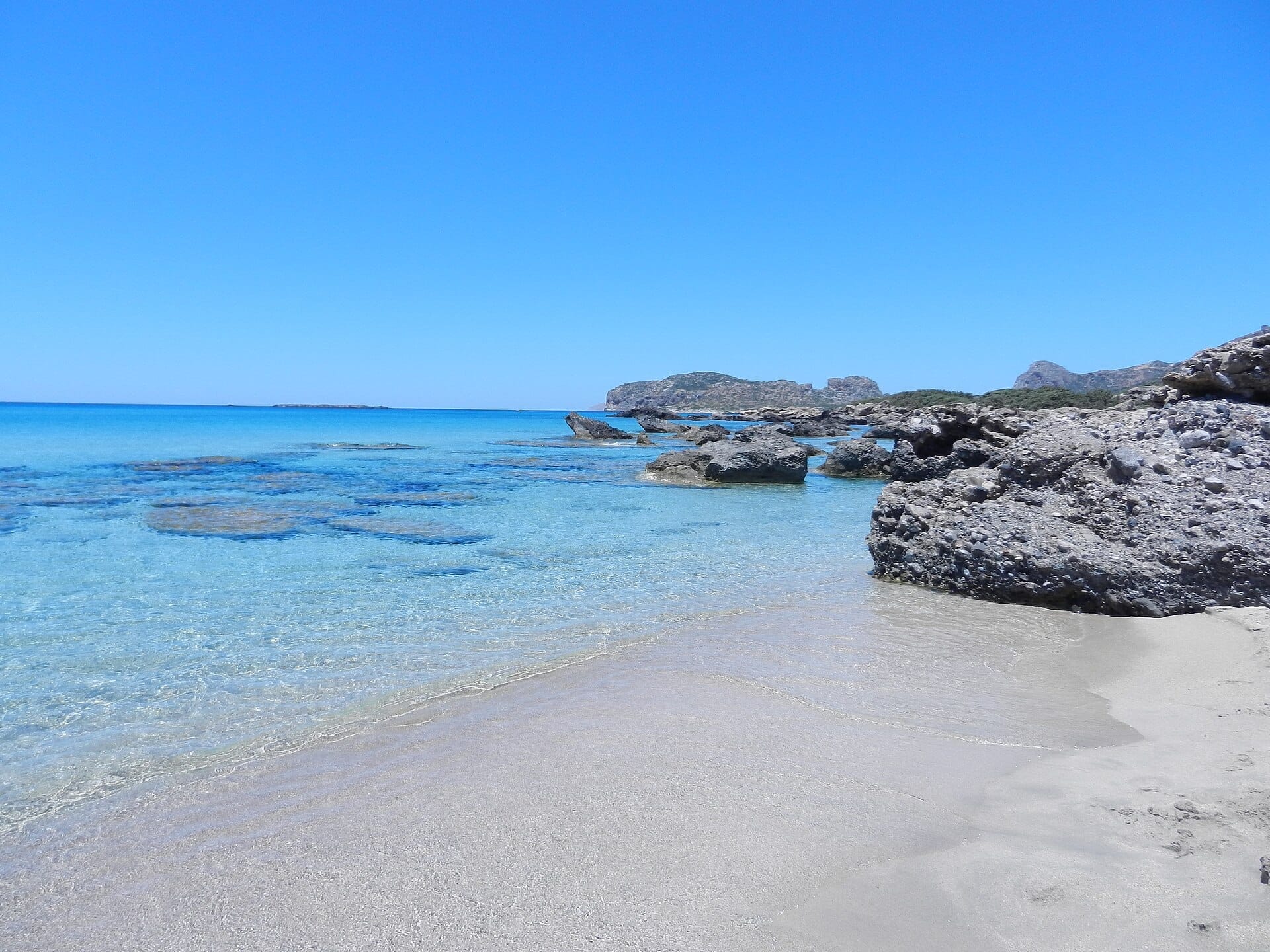
Falassarna Beach is not a single beach but a chain of five connected coves running along roughly three kilometres of Crete's far northwestern coastline. The most developed section, Pachia Ammos, stretches for about one kilometre and is the one most visitors picture: wide, flat, sandy, equipped with sunbeds, beach bars, showers, and watersports. The remaining four sections thin out gradually as you move north, becoming wilder, more stony in places, and considerably quieter.
The sand itself is the beach's most discussed feature. It carries a faint pink or rose-gold tint caused by crushed shells mixed through the sediment, most visible in low morning or evening light. The water is a layered spectrum of colour, ranging from pale turquoise in the shallows to deep cobalt further out, and it stays unusually clear thanks to limited development upstream. Falassarna holds a Blue Flag designation, reflecting consistent water quality and beach management standards.
ℹ️ Good to know
The beach faces due west, which makes it one of the best positions in all of Crete for watching the sun set directly over the sea. Plan to still be there at dusk if the sky is clear.
Getting There and the Drive In
From Chania, Falassarna is roughly 59 kilometres and about one hour by car. You take the E75 national road west toward Kissamos, then follow signs south through the village of Platanos. The final three kilometres descend steeply on a narrow road before opening onto the coast and the large free car park. It is a straightforward drive on a good road for most of the distance, but the final descent requires a little care, particularly when meeting vehicles coming up.
Buses run seasonally from Chania and from Kissamos (Kastelli), making the beach reachable without a car if you are based nearby. That said, a rental car gives you the freedom to arrive early and explore the quieter northern coves on your own timetable. If you are planning a longer loop around western Crete, Falassarna pairs well with Balos Lagoon and Gramvousa Island to the north, though those require a boat transfer or a different trailhead. See the Crete road trip guide for a logical route that combines these western highlights.
Tickets & tours
Hand-picked options from our booking partner. Prices are indicative; availability and final rates are confirmed when you complete your booking.
Balos Lagoon and Falassarna beach jeep tour with lunch
From 150 €Instant confirmationFree cancellationFalassarna full-day tour from Rethymno
From 23 €Instant confirmationFree cancellationVisit a Family-Run Olive Mill with Food Tasting in Heraklion
From 19 €Instant confirmationFree cancellationSnorkeling experience in Crete
From 45 €Instant confirmationFree cancellation
Morning, Midday, and Evening: How the Beach Changes
Arrive before 9am and you will find the sand almost entirely empty. The light at that hour is soft and directional, hitting the water at an angle that brings out the full colour range of the sea. The beach bars are setting up, chairs are being arranged, and the only sounds are waves and the occasional car pulling into the car park. This window, roughly 8am to 10am in high summer, is the best time to photograph and the most pleasant time to swim.
By late morning in July and August, the main section fills steadily. The sunbed rows pack in, the bars begin serving, and the watersports area gets busy. Families with children tend to cluster toward the southern end of Pachia Ammos where the water is shallower and the ground more protected. The open northern sections remain considerably less crowded throughout the day, but they are more exposed to wind and the seabed becomes rockier.
Afternoons at Falassarna can be windy. This part of Crete's western coast catches the prevailing northwesterly winds, and by 2pm or 3pm in summer, conditions can shift from glassy to choppy with little warning. This makes it excellent for windsurfers and kite boarders, but it can make open-water swimming uncomfortable and stirs up sand on the beach itself. If you are sensitive to wind, scheduling your main swim for the morning and treating the afternoon as sunbathing and sightseeing time is a practical approach.
⚠️ What to skip
The afternoon meltemi wind can make the sea rough for children and weak swimmers. Always check conditions before letting kids swim unattended, particularly in the northern coves where there is no lifeguard presence.
The Ancient City at the Northern End
Most visitors come for the beach and leave without walking the fifteen minutes north to the archaeological site. This is a genuine oversight. Ancient Falasarna was a Hellenistic-era city-state and naval harbour that flourished from around the 4th century BC. It commanded the western sea routes and was significant enough to mint its own coins, one of which depicted the sea god Poseidon, whose ceremonial throne still sits within the ruins today.
The site includes the remains of city walls, towers, a partially excavated acropolis, rock-cut tombs, and the unusually well-preserved stone quays of the ancient harbour. The quays are now several metres inland and above the current shoreline, a result of tectonic uplift following a major earthquake in 365 AD that raised this part of Crete by as much as nine metres. That geological event ended the harbour's function and eventually the city's commercial significance.
Systematic excavation began in 1986, and ongoing work has steadily uncovered more of the urban layout. The ruins are open daily during summer, typically from 9am to 3pm, closed Mondays and weekends, though these hours are seasonal and worth confirming locally before you make the walk specifically for them. Admission is free. Even when the site is technically closed, the exterior walls and landscape are visible from the path and worth the short walk for the coastal views alone.
If ancient sites interest you, Falasarna pairs logically with a broader exploration of Crete's western historical layer. The Minoan history guide covers the island's deeper prehistoric past, while the Archaeological Museum of Chania holds artefacts from this region that give the ruins at Falasarna useful context.
The Five Sections: Where to Position Yourself
Pachia Ammos is the largest and most organized section. It suits families, those who want sunbed comfort, and anyone who prefers a beach bar within easy reach. The swimming here is straightforward and generally safe in calm conditions.
The four smaller coves to the north become progressively wilder. Some have pebble and rock sections alongside sand, and there are natural rock formations that create small protected pools at lower tidal states, which work surprisingly well for children looking for sheltered water on windier days. The northernmost sections are usually the least visited and are the right choice if you want space and quiet, though bring everything you need as there are no facilities.
If you park at the main lot and want to reach the quieter sections, follow the beach north on foot. The walk is flat and takes between five and twenty minutes depending on how far you go. There is no formal path along the entire stretch, but the beach itself serves as the route.
Practical Notes for Your Visit
Falassarna's car park is large and free, which is unusual for a beach of this quality in Crete. In the height of summer, the lot fills by around 10am on weekends. Arriving before then is not just preferable, it is necessary if you want a parking space without driving back uphill to find road-side options.
The main beach has showers, toilets, beach bars serving food and drink, and watersports hire including kayaks and paddleboards. Sunbed and umbrella hire is available but not mandatory; there is ample free sand space if you bring your own towel and shade. In May, June, September, and October, the beach is notably less crowded and the wind tends to be gentler, making these months genuinely better for a relaxed beach day rather than just a quieter version of the peak-season experience.
Falassarna is in the Chania regional unit. If you are planning your accommodation base, Chania is the most practical base for day trips here. See the guide to the best beaches in Crete if you are trying to compare Falassarna against other options before committing to a western Crete itinerary.
💡 Local tip
Bring reef-safe sunscreen, a windbreak or beach tent if you have one, and more water than you think you need. The nearest shops are back up through Platanos village, and the beach bars charge resort-level prices for bottled water.
Photography Conditions and Sunset Timing
Falassarna faces west-southwest, which means it catches sunset light directly over open water with no island or headland interrupting the horizon. On clear evenings, the sun drops into the sea in a complete visible arc, and the combination of the coloured sand, the reflective shallows, and the sky produces conditions that photograph exceptionally well. The best position for sunset shots is from the northern end of Pachia Ammos or from the slight elevation of the path leading to the archaeological site, where you get both beach and sea in the same frame.
Morning light is better for water colour photography: the low eastern sun hits the west-facing sea and produces the full turquoise-to-cobalt gradient. By midday, the light is overhead and flat, which washes out water colour in photographs even if it looks fine to the naked eye.
Insider Tips
- The rocks at the far northern end of the beach create natural tidal pools that shelter from the wind. On afternoons when the main beach gets choppy, these pools stay calm enough for children or for a peaceful swim without the crowds.
- If you see the car park filling when you arrive, the northern overflow area requires a short walk down to the beach. That walk puts you naturally closer to the quieter coves, which is actually the better outcome.
- The ancient Poseidon throne is easy to miss inside the site because it sits low to the ground and is unlabelled from the main path. Ask at the site entrance for its precise location if the site is staffed.
- September and October give you water temperatures that are still warm from summer (typically 24-26°C) combined with far fewer visitors and more settled wind conditions than July and August. This is objectively the better beach experience for most adults.
- The beach bars stop serving food earlier than you might expect. If you plan to stay for sunset, bring your own food or eat before 6pm to avoid finding the kitchen closed while you wait for the sky to turn.
Who Is Falassarna Beach For?
- Travellers based in Chania looking for a full beach day within an hour's drive
- Sunset photographers and anyone chasing the best west-facing sea views in Crete
- Couples or groups who want a large beach with both organized comfort and quieter wild sections to choose between
- History-curious visitors who want to combine a beach day with a free archaeological site
- Shoulder-season travellers in May, June, September, or October who want quality without the summer crowds
Nearby Attractions
Other things to see while in Chania:
- Archaeological Museum of Chania
Opened in 2022 in a purpose-built 6,000 m² building in the Chalepa suburb, the Archaeological Museum of Chania traces western Crete's story from the Palaeolithic era through the 4th century AD. With over 4,100 finds, tactile exhibits, and a location just outside the Old Town, it rewards anyone who wants more than a beach holiday.
- Balos Lagoon
Balos Lagoon sits at the northwestern tip of Crete, where a shallow, turquoise-green pool forms between the Gramvousa Peninsula and the rocky spur of Cape Tigani. The sand is faintly pink from crushed shells and coral. The crowds in July and August are real. Here is what the experience actually involves.
- Chania Old Town
Chania Old Town is a living archive of civilizations stacked on top of one another, from Neolithic Kydonia to Venetian merchant palaces to Ottoman minarets. Free to enter and open at all hours, it rewards slow exploration more than rushed sightseeing.
- Elafonissi Beach
Elafonissi Beach sits on Crete's remote southwestern tip, where crushed shells from microscopic foraminifera tint the sand pink and a shallow lagoon connects the shore to a small protected island. Free to enter and genuinely striking, it draws large summer crowds that reward early arrivals and discourage afternoon visits.