Palace of Knossos: What to Expect at Europe's Oldest Palace
The Palace of Knossos, 5 km southeast of Heraklion, was the ceremonial heart of Minoan civilization and is now a UNESCO World Heritage Site. With over 1,300 rooms, reconstructed frescoes, and nearly 4,000 years of layered history, it rewards visitors who arrive prepared and arrive early.
Quick Facts
- Location
- Kephala Hill, 5–6 km southeast of Heraklion city centre
- Getting There
- City bus from Heraklion (Bus 2 from the port road); 20 min by car or taxi from the centre
- Time Needed
- 2–3 hours minimum; 4+ hours with a guide or audio tour
- Cost
- Ticketed entry; e-tickets available via the official Greek Ministry of Culture portal. Prices change seasonally — verify before visiting
- Best for
- History enthusiasts, archaeology lovers, families with older children, first-time visitors to Crete
- Official website
- http://odysseus.culture.gr/h/2/gh251.jsp?obj_id=716
Why Knossos Still Matters
The Palace of Knossos is not simply old. It is the physical record of the first advanced civilization in European history, a place where writing, multi-storey architecture, sophisticated drainage systems, and complex religious ceremony all existed together around 1700 BC, a thousand years before classical Athens. At roughly 22,000 square metres, it was a city unto itself: throne room, storage magazines, royal apartments, workshops, and ritual spaces compressed onto a single hill above the Kairatos river valley.
In 2024, Knossos was inscribed as a UNESCO World Heritage Site as part of the "Minoan Palatial Centres" serial nomination, alongside Phaistos, Malia, Zakros, Zominthos, and Kydonia. The inscription recognizes the site under criteria ii, iii, iv, and vi — covering cultural exchange, historical testimony, architectural significance, and direct association with living traditions and ideas of universal significance. For a traveller deciding whether Knossos deserves a half-day, that UNESCO designation is useful shorthand: this is the kind of place scholars have argued about for over a century, and there is still no consensus on everything.
💡 Local tip
Book e-tickets in advance through the official Greek Ministry of Culture ticketing portal. In peak summer months, queues at the gate can be long and entry can fill up. Arrivals are accepted up to 20 minutes before closing time.
What You Actually See on Site
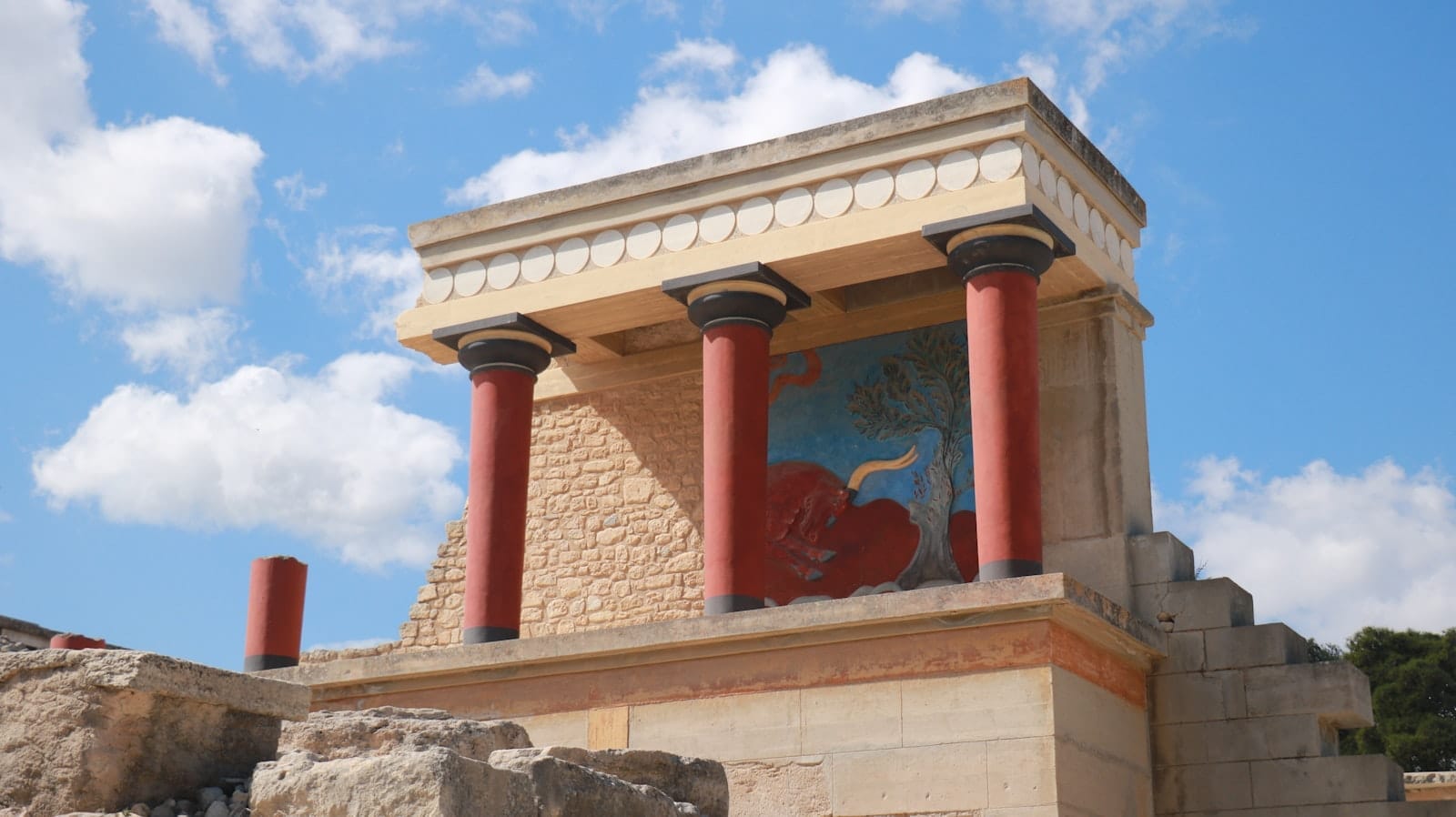
Knossos divides visitors sharply. Some find it overwhelming and revelatory in equal measure. Others, expecting pristine ancient ruins, are surprised by the colourful concrete reconstructions. Both reactions are valid. British archaeologist Arthur Evans, who excavated the site from 1900 onwards, made a controversial decision to physically rebuild parts of the palace using reinforced concrete, restoring columns (painted deep Minoan red), reinstalling replica frescoes, and reconstructing upper-storey walls. The originals of most frescoes are now in the Heraklion Archaeological Museum.
The result is a site that reads as part ruin, part interpretation. The Throne Room, with its gypsum throne still in situ and its flanking griffin fresco, is genuinely striking. The grand staircase descending into the residential quarter is one of the most dramatic pieces of ancient architecture in the Mediterranean. The storage magazines, lined with enormous clay pithoi jars that once held olive oil, wine, and grain, give a visceral sense of the palace's economic scale. And the Central Court, the large open rectangle around which the entire palace is organized, anchors everything spatially.
For deeper archaeological context before or after your visit, the Heraklion Archaeological Museum houses the original Knossos frescoes, the bull-leaping fresco, the Snake Goddess figurines, and Linear A and B tablets found on site. Pairing the two visits in a single day gives the clearest picture of Minoan civilization available anywhere.
Tickets & tours
Hand-picked options from our booking partner. Prices are indicative; availability and final rates are confirmed when you complete your booking.
Private guided tour of Crete with Knossos Palace and Lassithi Plateau
From 650 €Instant confirmationFree cancellationKnossos Archaeological Site Entrance Tickets and Heraklion Audio Guide
From 10 €Instant confirmationVisit a Family-Run Olive Mill with Food Tasting in Heraklion
From 19 €Instant confirmationFree cancellationSnorkeling experience in Crete
From 45 €Instant confirmationFree cancellation
The Site at Different Times of Day
Knossos opens in the morning, and the difference between arriving at opening time versus mid-morning is substantial. Early visitors move through the Central Court and Throne Room area with breathing room. The light at that hour is also softer and more directional, better for photography and for reading the relief of the stone surfaces. By late morning, tour groups from Heraklion and the northern coast resorts arrive in numbers. The Throne Room vestibule becomes a bottleneck, and the restored areas fill with audio guide commentary in six languages.
By early afternoon in summer, the site bakes. Knossos is not heavily shaded. The olive groves along the entrance path provide some cover, but once inside the main palace complex, shade is limited to the lower-level corridors and the reconstructed colonnades. Wearing a hat, carrying water, and using sunscreen is not optional advice in July and August — it is essential. The site terrain is also genuinely uneven: ancient stone floors, irregular steps, and packed-earth pathways mean that walking shoes with grip are far more practical than sandals.
⚠️ What to skip
Knossos is a multi-level site with significant changes in elevation, narrow ancient staircases, and no systematic ramp infrastructure. Visitors with mobility limitations should check current accessibility conditions directly with the site before visiting, as accommodations are limited.
The History Underneath the Reconstructions
The hill at Kephala was inhabited continuously from the seventh millennium BC, making Knossos one of the longest-occupied sites in the Aegean. The first palace was built around 1900 BC and destroyed around 1720 BC, probably by earthquake. The second and more elaborate palace rose from those ruins and reached its peak between 1700 and 1450 BC. It was destroyed again, its causes debated: earthquake, internal rebellion, the Theran volcanic eruption, or Mycenaean invasion all appear in the academic literature. A reduced settlement persisted until around 1350 BC when the palace was definitively abandoned.
The palace's mythology is inseparable from its archaeology. Knossos is the site associated with King Minos, the Labyrinth, the Minotaur, Daedalus, and Ariadne — stories that Homer referenced and that predate classical Greece by centuries. Whether those myths encode actual historical memory or were invented later is still argued. What is clear is that the palace's floor plan, with its branching corridors and confusing spatial logic, almost certainly inspired the labyrinth legend. For a broader grounding in Minoan history across Crete, the Minoan history guide for Crete covers the full arc of the civilization, from Knossos through the later palace sites.
Navigating the Site: A Practical Walkthrough
The main entrance is from the west, off the Heraklion–Knossos road. After passing through the ticket gate and the introductory signage area, the first major space is the West Court, a large paved area with circular storage pits (kouloures) that may have held grain or ceremonial deposits. From here, the standard path moves into the west wing through the Processional Corridor, where replica frescoes of gift-bearers line the walls.
The Throne Room complex sits just off the Central Court on the west side. It is the most evocative space in the palace: a small, low-ceilinged anteroom leading to the throne itself, flanked by benches for officials or priests and backed by a painted screen of griffins. The room feels ceremonially charged even in its current state. From the Central Court, the east wing descends via the Grand Staircase into the Domestic Quarter, where the Queen's Megaron (complete with a replica dolphin fresco) and the Hall of the Double Axes occupy the lower levels. Budget at least 30 minutes just for this section.
Photography inside the Throne Room is permitted but the space is small and fills quickly. The Grand Staircase photographs best from below, looking upward. The storage magazines on the west side, with their rows of intact pithoi, are undervisited and worth extra time.
Is Knossos Worth It? An Honest Assessment
Knossos is the most visited archaeological site in Crete, and that popularity creates real challenges. Peak-season crowds are heavy, the reconstructions divide opinion, and without some prior knowledge of Minoan civilization, the site can feel confusing. Arriving without a guide or audio tour and expecting the ruins to explain themselves is the most common disappointment. The site labelling has improved in recent years, but Knossos rewards preparation.
For visitors who have done even an hour of background reading, or who spend time in the Heraklion Archaeological Museum first, Knossos shifts from impressive to genuinely moving. The scale, the sophistication, the frescoes, and the sheer age of the place accumulate into something that stays with you. Travellers who are short on time and want to see one place that explains why Crete is historically important should come here. Those primarily interested in beaches and resort life can skip it without regret — but they will be missing the deepest layer of what makes this island worth visiting. If you're planning a broader archaeological route across the island, day trips from Crete's main towns can be structured around the southern palace sites as well.
ℹ️ Good to know
A licensed guide hired at the entrance or pre-booked online transforms the experience. Guided tours typically run 1.5–2 hours and provide mythological, architectural, and archaeological context that site signage alone cannot deliver.
Insider Tips
- Visit the Heraklion Archaeological Museum before Knossos, not after. Seeing the original frescoes, Linear B tablets, and Minoan artifacts first makes the site's blank walls and reconstructed rooms far more legible when you arrive.
- The lower levels of the Domestic Quarter, including the Queen's Megaron and the Hall of the Double Axes, are cooler, less crowded, and more architecturally impressive than the upper west wing areas. Many visitors skim these sections. Don't.
- The storage magazines on the western edge of the site are almost always quiet, even when the Throne Room has queues. The rows of original pithoi jars, some over a metre tall, are among the most intact and underappreciated features of the palace.
- Bus 2 from Heraklion runs directly to Knossos and is cheap and reliable. The stop is close to the main entrance. Taxis are faster but cost considerably more, and parking near the site in summer is limited and sometimes chaotic.
- Afternoon light (around 4–5 pm) creates better shadow and texture for photography of the stonework, and crowds thin noticeably in the final two hours before closing. If early morning is not possible, late afternoon is the next best window.
Who Is Palace of Knossos For?
- First-time visitors to Crete who want to understand the island's historical significance
- History and archaeology enthusiasts, particularly those with interest in Bronze Age Mediterranean cultures
- Families with children aged 10 and over who are engaged by myth and ancient history
- Travellers pairing the site with the Heraklion Archaeological Museum for a full-day deep dive
- Anyone on a Crete itinerary structured around the island's Minoan palace circuit
Nearby Attractions
Other things to see while in Heraklion:
- CretAquarium
Located 15 km east of Heraklion on a former American military base, CretAquarium is one of Europe's largest modern aquariums. Run by the Hellenic Centre for Marine Research, it showcases around 2,000 animals from 200 Mediterranean species across 1,800,000 liters of seawater. It is a serious scientific institution that doubles as a compelling day out.
- Heraklion Archaeological Museum
The Archaeological Museum of Heraklion holds the most complete collection of Minoan artifacts on earth, spanning 5,500 years from the Neolithic period through Roman times. For anyone serious about ancient Mediterranean civilizations, this is the definitive stop in Crete.
- 1866 Street Market (Heraklion)
Running from Meidani Square to Kornarou Square in the heart of Heraklion, the 1866 Street Market is the most concentrated expression of Cretan food culture in the city. Free to enter, alive with vendors and locals, and framed by layers of Ottoman and Venetian history, it rewards anyone willing to slow down and look closely.
- Heraklion Venetian Walls & Koules Fortress
Rising from the breakwater of Heraklion's old harbor, the Koules Fortress is one of the best-preserved Venetian sea fortresses in the eastern Mediterranean. Combined with the city's sweeping land walls, this is Heraklion's most visually commanding historical site.