Heraklion Venetian Walls & Koules Fortress: The Sea Bastion That Defined a City
Rising from the breakwater of Heraklion's old harbor, the Koules Fortress is one of the best-preserved Venetian sea fortresses in the eastern Mediterranean. Combined with the city's sweeping land walls, this is Heraklion's most visually commanding historical site.
Quick Facts
- Location
- Western breakwater of Heraklion's old Venetian harbor, Heraklion, Crete
- Getting There
- 5-10 minute walk from central Heraklion along the waterfront; reachable by local bus or taxi to the port area
- Time Needed
- 1-2 hours for the fortress; add 1-2 hours if walking a section of the land walls
- Cost
- Admission fee applies for the fortress interior; verify current pricing locally before visiting
- Best for
- History enthusiasts, architecture lovers, sunset photographers, and travelers who want Heraklion beyond the Archaeological Museum
What You're Actually Looking At
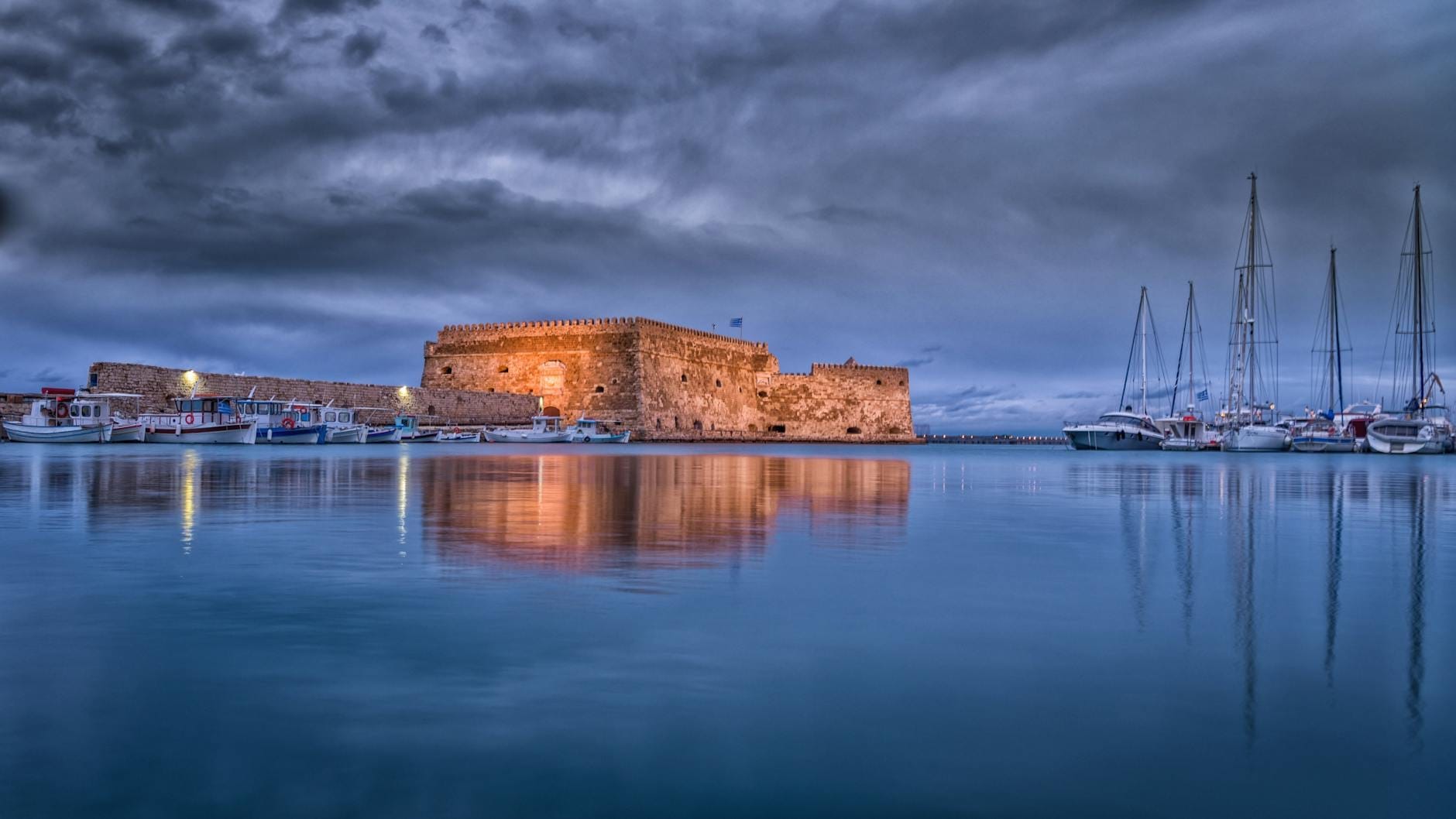
The Heraklion Venetian Walls and Koules Fortress represent one of the most complete examples of Venetian military engineering surviving in the eastern Mediterranean. Koules, officially known as the Rocca a Mare (and also called Castello a Mare), guards the mouth of Heraklion's old harbor from the western breakwater. You can see it from a considerable distance: a squat, sand-colored cube of a building sitting directly on the water, its walls visually continuous with the sea itself.
The fortress is not just decorative backdrop. Walking out along the narrow harbor breakwater toward it gives you an immediate sense of scale. The walls reach up to 8.7 meters thick in places, and three carved Venetian lions of Saint Mark are visible on the exterior, marking the structure's Venetian origin before the Ottoman conquest. The land walls, which encircle the old city, operate as a separate but connected experience: a long, grassy-topped circuit of earthwork bastions that you can walk and look down over both the city and the sea.
💡 Local tip
Arrive at the fortress early morning on a weekday if you want the breakwater walk largely to yourself. By 10am in peak summer, the approach fills with tour groups. The walk out to Koules takes about five minutes from the harbor entrance.
History: From Byzantine Ruins to Venetian Stronghold
The site has layers going back well before Venice. An earlier Byzantine and Arab tower stood here, damaged significantly by an earthquake in 1303. Venice, which controlled Crete (calling the island Candia and its capital city Candia as well) from 1204 onward, recognized the harbor entrance as the critical point in the city's naval defenses. Construction of the current fortress was approved in 1462, a prior structure on the same site was demolished in 1523, and the fortress we see today was completed around 1540.
For over a century it served its intended purpose: protecting the harbor from Ottoman naval raids and piracy that plagued Venetian Crete. The fortress held out even as the Ottomans eventually besieged and captured Heraklion in 1669 after a 21-year siege, one of the longest in recorded military history. After the conquest, the Ottomans modified the structure, using it as a prison and barracks, and the Greek name Koules derives from the Ottoman term Su Kulesi, meaning Water Castle.
The land walls that circle old Heraklion are equally impressive in scope. They were continuously upgraded throughout the 16th century as Venice grappled with the growing power of the Ottoman Empire. The same ambition for fortification drove Venetian construction across Crete, visible at the Fortezza in Rethymno and the old harbor walls in Chania. Heraklion's walls, however, are the most extensive, enclosing the entire old city with a series of bastions, moats, and gates.
Tickets & tours
Hand-picked options from our booking partner. Prices are indicative; availability and final rates are confirmed when you complete your booking.
Visit a Family-Run Olive Mill with Food Tasting in Heraklion
From 19 €Instant confirmationFree cancellationHeraklion Snorkelling Tour with Sea Scooter
From 70 €Instant confirmationFree cancellationEcobike wine ride tour of Heraklion
From 79 €Instant confirmationFree cancellationEcobike food ride tour of Heraklion
From 99 €Instant confirmationFree cancellation
Inside the Fortress: Two Floors and 26 Rooms
The interior of Koules is more spacious than it appears from outside. The fortress has two main floors containing 26 rooms that served as barracks, storage areas, and a prison during different periods of its history. There is also a lighthouse tower. The architecture is functional rather than ornate: thick stone walls, narrow openings, and arched ceilings that create a cool interior even in July heat.
The upper level opens to the roof terrace, which is where most visitors spend their time. The views from here are the payoff: the full arc of the harbor below, fishing boats and ferries, the city skyline, and on clear days the White Mountains to the west. In the late afternoon, the light turns the stone a deep ochre and the water takes on a particular flat, dark blue that makes photographs look almost unreal. This is genuinely the best elevated vantage point in Heraklion.
ℹ️ Good to know
The fortress interior hosts cultural events and temporary exhibitions during summer, which can add interest but may also limit access to certain rooms. Check locally before visiting if you want guaranteed access to all floors.
Walking the Land Walls: A Different Experience Entirely
The Venetian land walls deserve more attention than most visitors give them. They stretch for roughly three kilometers around the old city, punctuated by massive bastion projections. You can walk sections of the wall on top, where the earthworks have been grassed over and in some places converted into public parks. The views here are internal, looking down into the city rather than out to sea, and the contrast is interesting: one moment you are above the rooftops, the next descending into narrow streets with a kafeneion on the corner.
The most visited point on the land walls is the Martinengo Bastion, where the tomb of Nikos Kazantzakis, the Cretan author of Zorba the Greek, is located. The epitaph on his grave reads: I hope for nothing. I fear nothing. I am free. Early mornings here are quiet; there is usually just the wind and a few locals walking dogs along the top of the wall.
If exploring Heraklion more broadly, pairing the walls with a visit to the Heraklion Archaeological Museum nearby makes for a full day of historical depth. The museum provides the Minoan and pre-Venetian context that the walls themselves cannot. For a broader sense of Crete's layered history, the guide to Minoan history in Crete is worth reading before your visit.
How the Experience Changes Through the Day
Early morning is the quietest and most atmospheric time at Koules. The fishing boats are still going out or coming back, the harbor smells of salt and diesel, and the light is low and sideways across the stone. By mid-morning, tour groups arrive in steady rotation. By noon in summer the breakwater becomes genuinely hot underfoot, the sun reflecting off both the stone and the water, so bring water and sun protection if you are visiting between June and September.
Late afternoon, from about 5pm onward, is the second-best window. The heat drops, the light improves for photography, and the harbor comes alive with the aperitivo hour in the cafes along the waterfront. The fortress itself may close before sunset depending on the season, so check current hours locally. The breakwater remains accessible in the evenings and attracts Heraklionites for evening walks, which makes it feel like a genuinely local place rather than a sealed tourist attraction.
⚠️ What to skip
The breakwater surface is uneven and can be slippery when wet. Wear shoes with grip rather than sandals if you plan to walk the full length. There are no guardrails on the sea-facing side.
Practical Information and Getting There
The fortress sits at the end of the old harbor breakwater, roughly a 5-10 minute walk from the city center along the waterfront promenade. There is no complicated navigation involved: follow the seafront, and the fortress is visible from most of the harbor approach. Local buses serve the port area, and taxis are easy to find anywhere in central Heraklion.
Opening hours and ticket prices for the fortress interior change seasonally and are worth verifying locally or through the official Greek Ministry of Culture portal before visiting. The exterior breakwater and the land walls are accessible without a ticket at any time. Photography is permitted throughout the site.
Heraklion itself rewards more than a half-day. The old city has the 1866 Street market for food and local produce, and the broader context of what to do in the city is covered in detail in this Heraklion guide. If you are weighing how to split time across Crete's two main cities, the Chania vs Heraklion comparison lays out the trade-offs clearly.
Who This Is Right For — and Who Should Reconsider
Travelers drawn to military history, Venetian architecture, or the political history of the eastern Mediterranean will find Koules genuinely rewarding rather than just impressive to look at. The combination of the fortress and the land walls gives a complete picture of how Venice tried, for over four centuries, to hold this island against Ottoman expansion. That is a story with real weight.
Beach-focused travelers who are in Heraklion primarily as a transit point may find the fortress sufficient as a 45-minute stop before or after the Archaeological Museum, but not worth reorganizing a day around. The interior, while historically interesting, is not extensive, and the site does not have the narrative curation of a well-funded modern museum. Travelers with limited mobility should be aware that the breakwater surface is uneven and the fortress involves stairs between floors with no lift access.
Insider Tips
- Walk the breakwater in both directions: going out you focus on the fortress, coming back you get the full harbor panorama and the city behind it, which is actually the better photograph.
- The Martinengo Bastion on the land walls is almost always quiet compared to the harbor. Visit in the early morning for a peaceful experience at Kazantzakis' tomb with almost no other visitors.
- If the fortress is hosting a temporary exhibition or evening concert, ticket prices may be higher than the standard admission. Conversely, some events are included in the regular price. Ask at the entrance before paying.
- The cafe on the waterfront directly opposite the fortress entrance has outdoor tables with a direct view of Koules. It is a good spot to sit for 20 minutes before entering and get your bearings on the structure.
- For the best light on the fortress exterior, position yourself on the harbor waterfront with the sun behind you in the mid-morning. The carved Lion of Saint Mark reliefs are most legible in this light.
Who Is Heraklion Venetian Walls & Koules Fortress For?
- History and architecture enthusiasts interested in Venetian Mediterranean heritage
- Photographers looking for Heraklion's most dramatic sunset and harbor views
- Travelers wanting cultural depth beyond the Archaeological Museum
- Walkers who enjoy combining historical monuments with waterfront and urban walking routes
- Those interested in Cretan literary history, particularly the legacy of Nikos Kazantzakis
Nearby Attractions
Other things to see while in Heraklion:
- CretAquarium
Located 15 km east of Heraklion on a former American military base, CretAquarium is one of Europe's largest modern aquariums. Run by the Hellenic Centre for Marine Research, it showcases around 2,000 animals from 200 Mediterranean species across 1,800,000 liters of seawater. It is a serious scientific institution that doubles as a compelling day out.
- Heraklion Archaeological Museum
The Archaeological Museum of Heraklion holds the most complete collection of Minoan artifacts on earth, spanning 5,500 years from the Neolithic period through Roman times. For anyone serious about ancient Mediterranean civilizations, this is the definitive stop in Crete.
- 1866 Street Market (Heraklion)
Running from Meidani Square to Kornarou Square in the heart of Heraklion, the 1866 Street Market is the most concentrated expression of Cretan food culture in the city. Free to enter, alive with vendors and locals, and framed by layers of Ottoman and Venetian history, it rewards anyone willing to slow down and look closely.
- Natural History Museum of Crete
Housed in a restored industrial power plant on Heraklion's waterfront, the Natural History Museum of Crete covers 3,500 square metres of Eastern Mediterranean biodiversity, geology, and paleontology. The star exhibit is a 4.5-metre Deinotherium skeleton — the largest land mammal ever found on Crete. It is a serious research institution that also works well as a family afternoon.