CretAquarium (Thalassocosmos): Heraklion's Mediterranean Sea World
Located 15 km east of Heraklion on a former American military base, CretAquarium is one of Europe's largest modern aquariums. Run by the Hellenic Centre for Marine Research, it showcases around 2,000 animals from 200 Mediterranean species across 1,800,000 liters of seawater. It is a serious scientific institution that doubles as a compelling day out.
Quick Facts
- Location
- Former American Base of Gournes, Chersonissos, 15 km east of Heraklion city center
- Getting There
- Car or taxi recommended; approximately 20 minutes from central Heraklion. Limited public bus options along the coastal road.
- Time Needed
- 1 to 1.5 hours for a comfortable visit
- Cost
- Adults €12 (April–October). Check official site for winter rates and concessions.
- Best for
- Families with children, marine biology enthusiasts, rainy-day visitors, and anyone seeking a break from archaeological sites
- Official website
- cretaquarium.gr
What Is CretAquarium and Why Does It Exist Here?
CretAquarium, officially known as Thalassocosmos (Greek: Θαλασσόκοσμος, meaning 'sea world'), sits inside a repurposed hangar on a former American military base at Gournes, between Heraklion and Chersonissos. The location is slightly surreal at first: you pull into a vast parking lot, 10,000 square meters of it, and the building looks more like an industrial facility than a cultural attraction. Step inside, and the contrast is immediate.
Opened in December 2005 and significantly expanded in 2008-2009, the facility is operated by the Hellenic Centre for Marine Research (HCMR), a public scientific institution funded jointly by the European Investment Bank and the Greek state. This is not a commercial entertainment aquarium. It is a research institution that opens its findings to the public, which gives the exhibits a depth that most tourist aquariums lack. The species on display are Mediterranean-specific, many of them native to the very waters visible from Crete's coastline.
ℹ️ Good to know
CretAquarium is one of the largest aquariums in Europe dedicated exclusively to Mediterranean marine life. Its 61 tanks hold a combined 1,800,000 liters of seawater and approximately 2,000 animals from 200 species.
What You Actually See Inside
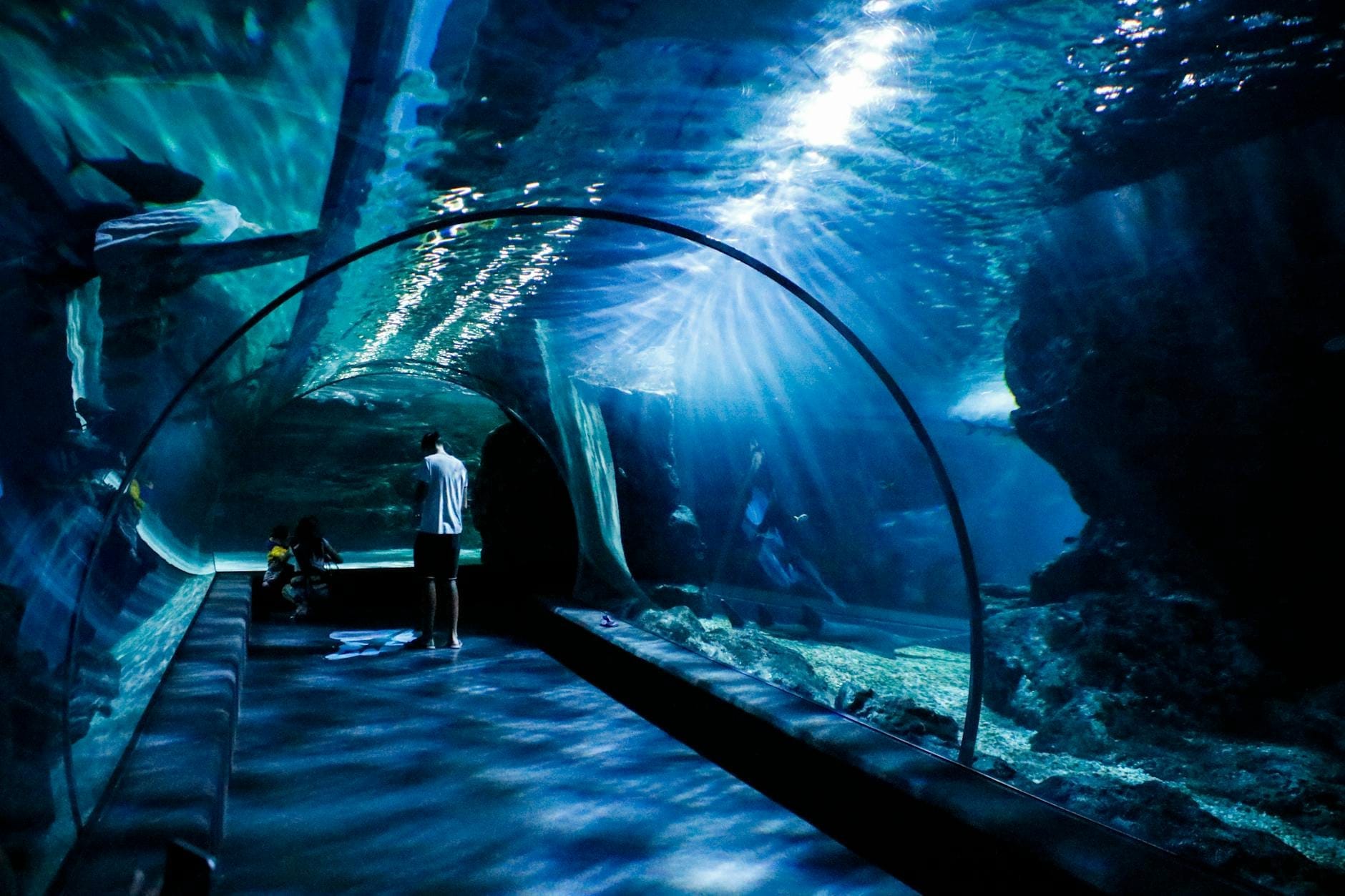
The exhibition covers 1,600 square meters and is organized around 61 tanks, 32 of which are arranged with 50 individual viewing points. Tank sizes range from 0.5 cubic meters to 600 cubic meters, so you move between intimate close-up encounters with small reef species and large floor-to-ceiling panels where sharks, rays, and schools of pelagic fish move in slow, looping circles.
The large tanks are the centerpiece. Standing in front of the biggest panels, you get the particular stillness that only an aquarium can produce, low light, muffled sound, and the sensation that time runs at a different speed on the other side of the glass. The collection includes species most visitors have eaten on a Greek island but never seen alive: large groupers, octopuses wedged into rock crevices, triggerfish, sea bream, and various species of ray. There are also jellyfish tanks, which are popular with children and adults equally, lit to make the animals glow against a dark background.
The labeling throughout is in both Greek and English, and the scientific context is clear without being dry. Because HCMR operates the facility, some tanks also serve an active research function, meaning the animals and conditions you observe are genuinely connected to ongoing marine science.
Tickets & tours
Hand-picked options from our booking partner. Prices are indicative; availability and final rates are confirmed when you complete your booking.
Visit a Family-Run Olive Mill with Food Tasting in Heraklion
From 19 €Instant confirmationFree cancellationSnorkeling experience in Crete
From 45 €Instant confirmationFree cancellationSpinalonga self-guided audio tour on your phone
From 12 €Instant confirmationFree cancellationMalia to Sissi private tuk-tuk journey with tastings
From 45 €Instant confirmationFree cancellation
Visiting by Time of Day and Season
CretAquarium is open daily year-round. From 1 April to 31 October, hours run from 9:30 to 19:00. From 1 November to 31 March, the facility closes earlier at 16:00. The experience inside changes very little based on time of day, since the interior is fully climate-controlled and artificially lit. This makes it one of the few attractions in Crete that is equally comfortable at midday in August as it is on a grey January morning.
In summer, the aquarium fills noticeably between 10:30 and 13:00, when families from the nearby resort strip of Chersonissos make it a morning activity. Arriving at opening time means near-empty tanks and the ability to linger at the large viewing panels without crowds pressing in behind you. By mid-afternoon in peak season, the building can feel congested in the narrow corridors between smaller tanks. Late afternoon, after 16:00 in summer, sees a second lull as groups depart.
💡 Local tip
If you are visiting in July or August, aim to arrive at 9:30 when doors open. You will have the large shark and ray tanks almost entirely to yourself for the first 30 to 45 minutes.
In winter and shoulder months, the aquarium is often very quiet, and the staff are noticeably more available to answer questions. October and April are arguably the sweet spot: comfortable temperatures, reasonable crowds, and the full summer hours still in effect.
Getting There and Practical Logistics
The aquarium is at the former American Base of Gournes, Chersonissos, 71500, approximately 15 km east of Heraklion city center. By car, the drive from central Heraklion takes around 20 minutes along the coastal E75 road heading toward Agios Nikolaos. The parking area is large and free, which is a genuine convenience in a region where summer parking is often a problem.
If you are staying in Heraklion and do not have a car, a taxi is the most practical option. Public buses along the northern coastal road do pass the general area, but stops and frequency are not designed with the aquarium as a destination in mind. For those planning broader movement around eastern Crete, the aquarium works well as an eastbound stop before continuing toward Agios Nikolaos or the Lassithi plateau. Check the getting around Crete guide for transport options across the island.
Admission is €12 for adults during the April to October period. Winter rates and concessions for children, students, and seniors should be confirmed directly via the official website or by calling +30 281 033 7788 before visiting, as these figures are subject to change. The average visit runs about one hour, though families with children who want to linger at specific tanks often take longer.
Who Will Get the Most From This Place
CretAquarium is particularly well-suited to families traveling with children, not just because of obvious child appeal, but because the exhibits are genuinely educational without being condescending. Children who have been swimming in the sea around Crete will likely recognize species from the water, which creates a satisfying connection. If you are visiting Crete with kids, pair this with a family-focused itinerary to make the most of the day.
Adults with an interest in marine ecology will find the Mediterranean-specific focus genuinely interesting. Most European aquariums include tropical or global collections. Thalassocosmos focuses entirely on what lives in the sea immediately around you, which makes the ecological context more immediate and coherent.
It is also a legitimate rainy-day alternative in a region where bad weather can make beach plans collapse. If you arrive on Crete expecting sunshine and encounter an unseasonal grey stretch, this is one of the more satisfying indoor options near Heraklion.
⚠️ What to skip
Travelers who prioritize outdoor scenery or archaeological depth may find the aquarium underwhelming for its ticket price. If your time in Heraklion is limited, prioritize the Heraklion Archaeological Museum or Knossos first.
Fitting CretAquarium Into a Broader Heraklion Day
CretAquarium works well as a half-morning activity combined with an afternoon at one of Heraklion's more significant historical sites. The Heraklion Archaeological Museum is widely considered one of the finest collections of Minoan artifacts in the world and sits in the city center, roughly 20 minutes back along the coast road. If you are interested in the ancient civilizations that built Crete's reputation, that museum is a more demanding but more rewarding stop.
For those combining the aquarium with a coastal drive, the Palace of Knossos is also accessible from Heraklion and makes for a full day covering both ancient history and Mediterranean marine biology, an unusual but genuinely varied combination. The one-week Crete itinerary covers how to balance these different attraction types across a longer trip.
Photography inside the aquarium is generally permitted without flash, since flash photography stresses the animals and is typically restricted. The low-light conditions and moving subjects make phone cameras less effective than you might expect. A camera with a wide aperture and good low-light performance produces better results. The jellyfish tanks are consistently the most photogenic, with their backlighting providing the contrast that phones struggle to create in the larger, dimmer panels.
Insider Tips
- Arrive at 9:30 on the dot in summer. The first 30 to 45 minutes before tour groups arrive give you the large tanks entirely to yourself, and the difference in atmosphere is significant.
- The jellyfish tanks are positioned midway through the route. Slow down here. The backlit displays are the most photogenic spot in the building, and children often spend more time here than anywhere else.
- If you are driving east toward Agios Nikolaos or the Lassithi plateau, the aquarium sits almost exactly on the route. It adds about 90 minutes to a driving day without requiring any meaningful detour.
- Check the official HCMR website before visiting for any seasonal educational events. The Hellenic Centre for Marine Research occasionally hosts public programs tied to ongoing research, which are not widely advertised.
- Bring a light layer. The interior is air-conditioned to protect the animals and equipment, and after an hour in an August heat of 35°C outside, the interior can feel noticeably cold.
Who Is CretAquarium For?
- Families with children aged 4 to 14 who want an interactive break from beach days
- Marine biology enthusiasts or anyone curious about Mediterranean underwater ecosystems
- Visitors dealing with a rainy or unexpectedly overcast day near Heraklion
- Travelers combining an eastbound coastal drive with a structured stop
- Groups that include members who cannot manage the walking demands of archaeological sites
Nearby Attractions
Other things to see while in Heraklion:
- Heraklion Archaeological Museum
The Archaeological Museum of Heraklion holds the most complete collection of Minoan artifacts on earth, spanning 5,500 years from the Neolithic period through Roman times. For anyone serious about ancient Mediterranean civilizations, this is the definitive stop in Crete.
- 1866 Street Market (Heraklion)
Running from Meidani Square to Kornarou Square in the heart of Heraklion, the 1866 Street Market is the most concentrated expression of Cretan food culture in the city. Free to enter, alive with vendors and locals, and framed by layers of Ottoman and Venetian history, it rewards anyone willing to slow down and look closely.
- Heraklion Venetian Walls & Koules Fortress
Rising from the breakwater of Heraklion's old harbor, the Koules Fortress is one of the best-preserved Venetian sea fortresses in the eastern Mediterranean. Combined with the city's sweeping land walls, this is Heraklion's most visually commanding historical site.
- Natural History Museum of Crete
Housed in a restored industrial power plant on Heraklion's waterfront, the Natural History Museum of Crete covers 3,500 square metres of Eastern Mediterranean biodiversity, geology, and paleontology. The star exhibit is a 4.5-metre Deinotherium skeleton — the largest land mammal ever found on Crete. It is a serious research institution that also works well as a family afternoon.