Fortezza of Rethymno: Inside Crete's Greatest Venetian Fortress
Perched on Paleokastro hill above Rethymno's old harbor, the Fortezza is one of the best-preserved Venetian fortifications in the Mediterranean. Built between 1573 and 1580, it offers sweeping sea views, Ottoman-era monuments, and a walk through 400 years of Cretan history.
Quick Facts
- Location
- Paleokastro Hill, northwest of Rethymno Old Town, Crete
- Getting There
- 10–15 min uphill walk from the Venetian Harbor; taxis available from town center
- Time Needed
- 1.5–2.5 hours
- Cost
- Approx. €4–6 (verify current price at the gate)
- Best for
- History lovers, architecture enthusiasts, sunset seekers, photographers
- Official website
- visit-rethymno.gr/rethymno/1_339
What the Fortezza Actually Is
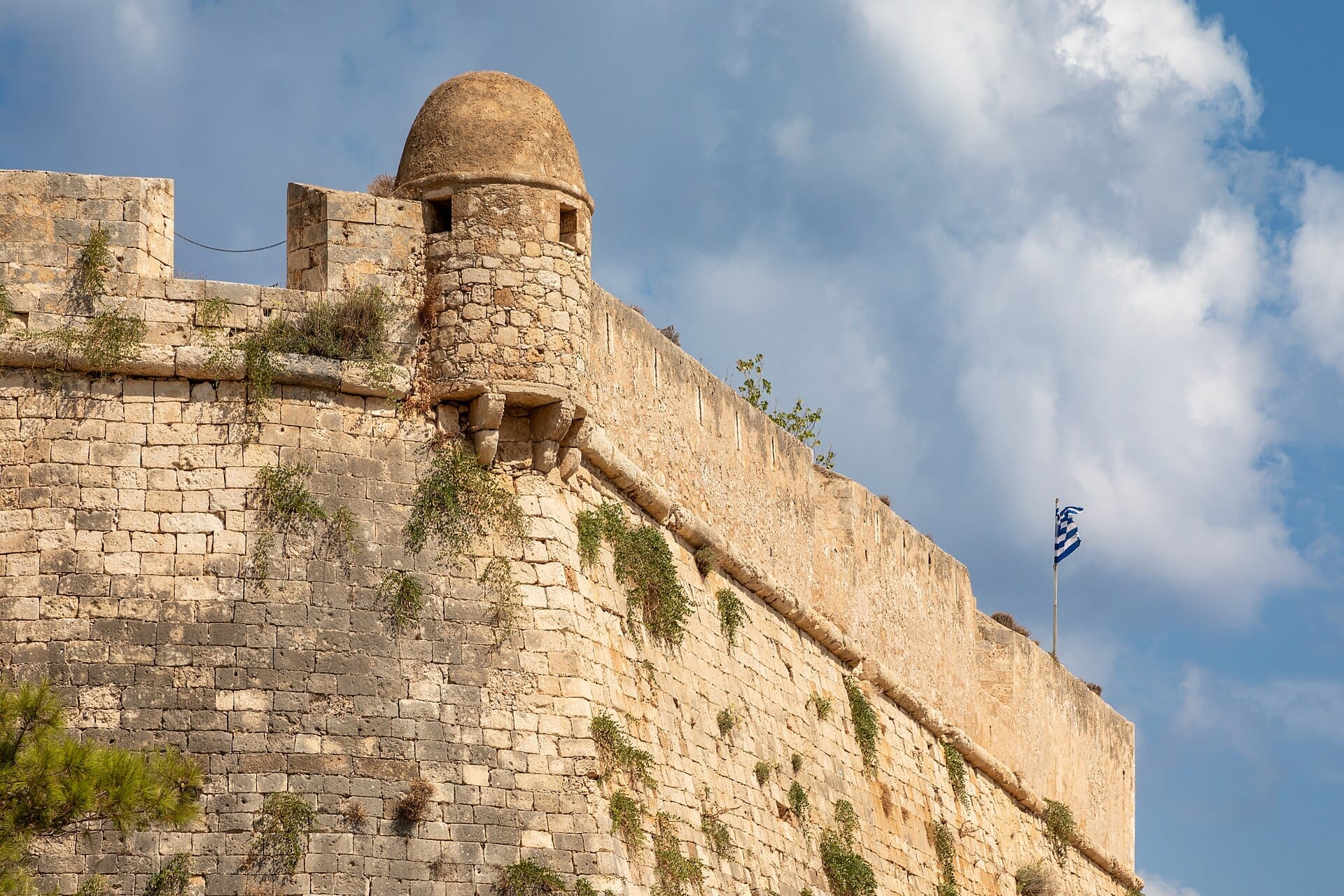
The Fortezza of Rethymno is the largest Venetian-era fortress ever constructed in Crete, and one of the most complete examples of Renaissance military architecture still standing in the eastern Mediterranean. It sits on Paleokastro hill at a significantly higher elevation than 15 meters, commanding an uninterrupted view over the Cretan Sea to the north and the rooftops of Rethymno's old town below. From almost anywhere in the lower town, you can look up and see its thick limestone bastions cutting a clean silhouette against the sky.
Construction began in 1573 under the direction of Venetian engineer Sforza Pallavicini, responding to the Ottoman threat that had already claimed Cyprus. The work was extraordinary in scale: historical records indicate that 107,142 Cretans were conscripted into its construction over the seven-year build period ending in 1580. Despite those efforts, the fortress fell to the Ottomans in 1646 after a fierce siege, and much of its internal layout was subsequently adapted for Ottoman use. Today, the site preserves both layers of its history, sometimes in the same stone.
ℹ️ Good to know
The Fortezza was built on the site of ancient Rithymna's acropolis, meaning the hill has been a defensive position for well over two thousand years before the Venetians arrived.
The Walk Up and First Impressions
The approach on foot from the old harbor takes about 10 to 15 minutes along a path that winds uphill through the edge of the old town. The climb is moderate but consistent. By the time the main gate comes into view, the ambient sound of the town has dropped away and you are left with wind, birdsong, and the occasional crunch of gravel underfoot. Sensory contrast is part of the experience here: the transition from the narrow, cafe-lined streets below to the open, sun-bleached plateau inside the walls feels abrupt in the best way.
The outer walls are massive up close. You genuinely cannot appreciate their thickness from below. At the main entrance, the stone is worn smooth where centuries of hands have touched it, and the wooden gate structure, though clearly restored, still creates a sense of threshold. Step through, and you are on an open plateau roughly the size of several football pitches, with ruins, monuments, and open sky in every direction.
💡 Local tip
Wear closed shoes with grip. The paths inside are uneven and some sections involve stepping over low rubble. Sandals are workable but not ideal, especially if you want to walk the perimeter walls.
Tickets & tours
Hand-picked options from our booking partner. Prices are indicative; availability and final rates are confirmed when you complete your booking.
Falassarna full-day tour from Rethymno
From 23 €Instant confirmationFree cancellationVisit a Family-Run Olive Mill with Food Tasting in Heraklion
From 19 €Instant confirmationFree cancellationSnorkeling experience in Crete
From 45 €Instant confirmationFree cancellationSpinalonga self-guided audio tour on your phone
From 12 €Instant confirmationFree cancellation
Inside the Walls: What You Will See
The interior of the Fortezza is not a manicured museum. It is a partially ruined plateau that rewards slow exploration. The most prominent surviving structure is the Sultan Ibrahim Mosque, a large domed building that was originally constructed as the Cathedral of Saint Nicholas by the Venetians and converted to a mosque after the Ottoman conquest. The interior is now largely empty, but the transition of the building from Christian to Islamic use, visible in the architecture itself, is a compact lesson in the island's turbulent history.
Scattered across the plateau are the remains of barracks, cisterns, gunpowder stores, and residential quarters. Most exist only as foundations and low walls, but informational signage placed throughout explains what each section was. The scale of what was once a self-contained fortified city becomes clearer as you move around. At its peak, the Fortezza was designed to shelter the entire population of Rethymno within its walls.
The perimeter walkway along the bastions is the architectural highlight. The walls are thick enough in places to walk two abreast, and the views change dramatically as you circle the fortress. The north-facing bastions look straight out over open Cretan Sea, while the south and east sides reveal the old town's domes, minarets, and the long arc of Rethymno Beach stretching east. In the late afternoon, the light hits the limestone at a shallow angle and the whole plateau turns a warm amber. This is when photographers do their best work here.
The Fortezza sits at the western end of Rethymno's historic core. Combining it with a walk through the Rethymno Old Town and a stop at the Venetian harbor makes for a coherent half-day of architectural history without needing a car.
Timing Your Visit
The Fortezza is open to visitors seasonally, with extended hours typically in effect during summer. Arriving early, around 9 to 10 in the morning, means you will have large sections almost entirely to yourself. The plateau can feel genuinely solitary at that hour, with the town noise still minimal below and the light soft and angled. By midday in July and August, the site is significantly busier and, more importantly, there is almost no shade on the plateau. Temperatures inside the walls can feel several degrees hotter than street level because the limestone absorbs and radiates heat.
Late afternoon, roughly two hours before closing, is the other sweet spot. Groups tend to have moved on, the light is ideal for photography, and the sea breeze from the north bastion is noticeably cooler. The fortress does not offer a sunset view in the strict sense since the sun sets behind the hill, not over the water, but the golden-hour quality of the light across the old town is worth the timing.
⚠️ What to skip
There is no shade and no food or water available inside the Fortezza. Bring at least 500ml of water per person, especially from June through September. The exposed plateau becomes genuinely harsh between noon and 3pm in summer.
Historical and Cultural Context
Understanding why the Fortezza exists requires a brief look at the geopolitical anxiety of 16th-century Venice. The Ottoman Empire had taken Constantinople in 1453, and Venice's eastern Mediterranean trade routes were under sustained pressure. Crete, known then as Candia, was Venice's most important overseas possession and had been since 1204. When the Ottomans took Cyprus in 1570 and sacked Rethymno in 1571, the Venetians responded by committing enormous resources to fortifying the island. The Fortezza was the centerpiece of that effort on the western side of the island.
The irony embedded in the site is that despite the scale and cost of construction, the Fortezza held for only a short time during the 1646 siege before surrendering. The Ottomans then occupied Rethymno, and the fortress, for the next 250 years. Their modifications, particularly the mosque conversion and the addition of a small hammam, are still legible in the ruins. When Crete united with Greece in 1913, the fortress became an archaeological and cultural monument, though it went through periods of neglect before systematic restoration work began.
For visitors interested in the broader arc of Cretan history, the Fortezza pairs well with the Rethymno Archaeological Museum, which covers the pre-Venetian layers of the region including Minoan and Classical-era finds. And if your interest extends to the island's ancient civilizations, the Minoan history of Crete provides essential context for just how deep the island's historical record runs.
Practical Details and Accessibility
Ticket prices have historically been in the range of 4 to 6 euros, making this one of the better-value major historical sites in Crete. Always verify the current price at the gate, as fees can be adjusted seasonally. There is no dedicated parking area at the top of the hill, so most visitors either walk up or take a taxi to the entrance and descend on foot afterward through the old town.
The site presents real challenges for visitors with limited mobility. The hill approach is steep, the paths inside are cobbled and uneven, and some of the more interesting bastion sections involve steps with no handrails. The central plateau is accessible once inside, but the full perimeter walk is not suitable for wheelchairs. For visitors who cannot manage the walk, the views from the base of the hill and from the harbor still give a strong sense of the fortress's scale from the exterior.
Rethymno itself is an excellent base for exploring the central region of Crete. The city offers easy day-trip access to sites including Arkadi Monastery and the gorges of the interior. See the Crete road trip guide for route planning that combines these sites efficiently.
Honest Assessment: Is It Worth Your Time?
For visitors with a serious interest in history or architecture, the Fortezza is one of the more satisfying sites in Crete. It is not polished or heavily curated, which is precisely why it works. Walking the bastions with nothing between you and the sea feels like the fortress is still performing its original function in some quiet way.
For visitors primarily interested in beaches, nightlife, or food, the Fortezza is an easy skip. There are no cafes, no gift shop worth mentioning, no interactive exhibits, and no air conditioning. If your time in Rethymno is limited to a single afternoon, you might find more sensory reward in a slow walk through the old town and harbor. But if you have a morning free and even a passing interest in what shaped this part of the Mediterranean, two hours here will hold your attention.
Insider Tips
- The north bastion, facing the sea, is the quietest and most photogenic section. Most visitors do a quick circuit and leave from the main entrance, so the far bastions see far less foot traffic. Take the full perimeter walk.
- The Sultan Ibrahim Mosque opens selectively and sometimes hosts temporary exhibitions. Check at the entrance gate on arrival whether it is accessible that day.
- If you visit in summer, bring a hat with a brim rather than a cap. The sun comes from multiple angles when you are on the open walls, and the reflected glare from the pale limestone is intense.
- For the best light for photography, arrive in the last two hours before closing. The limestone glows amber and the shadows across the ruins become long and defined.
- The descent back into town through the old quarter, heading toward the lighthouse and the Venetian harbor, takes about 10 minutes on foot and passes several good spots for lunch. Plan your visit so you finish with a meal in the old town.
Who Is Fortezza of Rethymno For?
- History and architecture enthusiasts who appreciate context over comfort
- Photographers looking for elevated views of the old town and the Cretan Sea
- Travelers combining a morning of culture with an afternoon at Rethymno Beach
- Anyone seeking a quiet, uncrowded experience during the early morning hours
- Couples and solo travelers who want to walk an entire historical monument at their own pace
Nearby Attractions
Other things to see while in Rethymno:
- Arkadi Monastery
Perched on a fertile plateau 500 meters above sea level, 23 kilometers from Rethymno, Arkadi Monastery carries the weight of one of the most dramatic episodes in Cretan history. The 1866 explosion that killed hundreds of refugees rather than allow Ottoman capture transformed this working monastery into a national symbol. Today it remains an active religious site, a sobering museum, and one of the most architecturally striking complexes on the island.
- Lake Kournas
Tucked inland from the north coast between Chania and Rethymno, Lake Kournas is Crete's sole freshwater lake — a striking contrast to the island's rugged, sun-scorched landscape. Terrapins bask on rocky outcrops, water birds drift across the surface, and the surrounding hills reflect in the still water with an almost mirror-like quality that explains the lake's name.
- Rethymno Archaeological Museum
The Rethymno Archaeological Museum traces Cretan civilization from the Paleolithic era through Roman occupation, displayed inside the 16th-century Church of Saint Francis. For a small admission fee, visitors access one of the most coherent regional collections in Crete, covering Minoan palace culture, burial customs, and everyday life across the centuries.
- Rethymno Beach
Rethymno Beach is a 13 to 15 kilometre arc of golden sand that begins at the eastern edge of Rethymno's Old Town and stretches east toward Skaleta. Free to access, gently shelving, and backed by hotels and tavernas, it works equally well for a quick morning swim or a full beach day.