Rethymno Beach: What to Expect Along Crete's Longest Urban Shoreline
Rethymno Beach is a 13 to 15 kilometre arc of golden sand that begins at the eastern edge of Rethymno's Old Town and stretches east toward Skaleta. Free to access, gently shelving, and backed by hotels and tavernas, it works equally well for a quick morning swim or a full beach day.
Quick Facts
- Location
- Eastern edge of Rethymno city center, extending ~14km east to Skaleta, Crete
- Getting There
- 10-min walk from Venetian Harbor; buses along EO94 coast road; parking near organized sections
- Time Needed
- 2–5 hours depending on how far east you walk or drive
- Cost
- Free entry; sunbed and parasol rental ~€10–15/pair (high season, subject to change)
- Best for
- Families, swimmers, travelers staying in Rethymno who want easy beach access
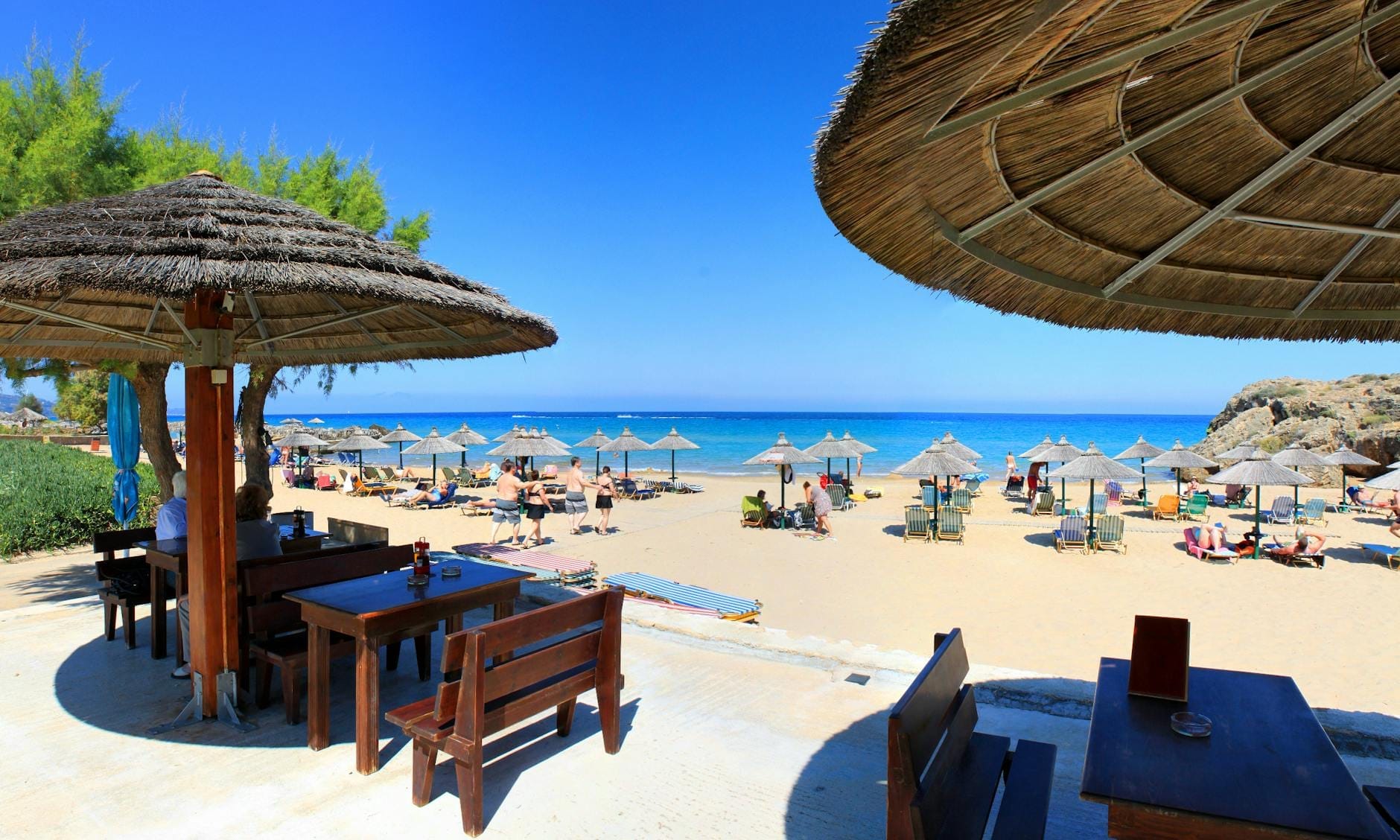
The Beach at a Glance: Scale and Setting
Rethymno Beach is one of the longest urban beaches in Crete, a nearly unbroken ribbon of fine golden sand that starts where the town's historic core gives way to the shoreline and continues eastward for 13 to 15 kilometres. Unlike the island's more remote coves, this beach is woven into everyday town life. On any given summer morning, you will find local families arriving early with folding chairs, joggers using the promenade path, and the first tourists negotiating sunbed rentals before 9am.
The proximity to Rethymno's compact city center is the beach's defining advantage. From the Venetian Harbor, the sand is roughly a ten-minute walk. You can spend a morning in the Old Town, have lunch at a harbourside taverna, and be lying on the beach before mid-afternoon without needing a car or bus.
💡 Local tip
The stretch directly in front of the city is fully organised with sunbeds, watersports, and beach bars. If you walk or drive eastward even a kilometre or two, the density drops noticeably and you can often find free sand without renting a sunbed.
How the Beach Changes Along Its Length
The city-facing section near the start of the beach is the most developed. Rows of orange and blue sunbed sets are managed by different operators, beach volleyball nets appear in high season, and pedalo and kayak rentals are clustered near the main access points. The water here is calm, the seabed is sandy and slopes gradually, and there are public showers and changing facilities nearby. Lifeguards are stationed in the organized sections during peak season, and coloured weather flags indicate safe swimming conditions.
Moving along the EO94 coastal road, the density of sunbeds and beach bars thins out. Hotel-backed stretches give way to quieter patches of sand where you can lay down a towel without any fee. By the time you reach the villages of Platanes, Missiria, or further toward Scaleta, the beach feels entirely different: fewer vendors, more local families, and the mountains of western Crete visible on the horizon. The sand quality remains consistent throughout, fine and pale gold, though the shallow gradient of the seabed means the water stays shallow for several metres in some sections, which suits children well.
Travelers exploring the wider region can combine a beach morning here with an afternoon visit to the Rethymno Old Town, one of the best-preserved Venetian and Ottoman streetscapes in Crete.
Tickets & tours
Hand-picked options from our booking partner. Prices are indicative; availability and final rates are confirmed when you complete your booking.
Falassarna full-day tour from Rethymno
From 23 €Instant confirmationFree cancellationVisit a Family-Run Olive Mill with Food Tasting in Heraklion
From 19 €Instant confirmationFree cancellationSnorkeling experience in Crete
From 45 €Instant confirmationFree cancellationSpinalonga self-guided audio tour on your phone
From 12 €Instant confirmationFree cancellation
Time of Day: How Light and Crowds Shift
Early morning, before 8am, is the most atmospheric time to be on Rethymno Beach. The air smells of salt and the overnight cool, the light is low and golden, and the organised sections are empty enough that you can hear the waves. This window is particularly good for photography, since the Venetian lighthouse and the Fortezza hill are visible along the shore and catch the warm morning light.
By 10am in July and August, the city-side section becomes crowded. The sunbed operators are fully set up, beach bars begin taking orders, and the promenade behind the beach fills with foot traffic. The peak heat between noon and 3pm pushes some visitors off the sand and into nearby cafes, which briefly reduces the crowd. Late afternoon, from around 5pm, the light becomes softer and the crowds thin as people return to hotels to prepare for dinner. Evening walks along the beach promenade are genuinely pleasant, particularly in June and September when temperatures are comfortable after dark.
⚠️ What to skip
In July and August, the organized section near the town centre gets very crowded by mid-morning. Arrive before 9am to secure a sunbed without waiting, or head 2–3 km east for uncrowded free sand.
Historical Context: Sand Beside an Ancient Town
The coastline here has been inhabited since antiquity. The site of ancient Rhithymna, which has Mycenaean-era origins, lies adjacent to the modern town. The Venetians, who controlled Rethymno from the 13th to the late 17th century, built the Fortezza fortress on the promontory overlooking the western end of the beach, a structure that still dominates the skyline today. The beach itself was not developed for tourism until the mid-twentieth century; before that, it was primarily a fishing shoreline.
The fortress looming above the town near the beach is the Fortezza of Rethymno, built by the Venetians in the 1570s and one of the best-preserved Renaissance fortifications in the Mediterranean. Seeing it from the beach, especially in the late afternoon when the stone takes on an orange cast, gives a strong sense of how long this coastline has been inhabited and contested.
The broader Rethymno regional unit has a population of around 84,000 according to recent census data, and the town itself has long been the cultural and educational centre of western Crete, home to a university campus that keeps the city noticeably younger and livelier than comparable Cretan towns.
Practical Walkthrough: Getting There and Getting Set Up
On foot from the Old Town, follow the main promenade road from the Venetian Harbor. The beach begins within the first few hundred metres and continues as far as you care to walk. By car, the EO94 coast road runs alongside much of the beach with parking bays at intervals, though spaces fill quickly after 9am in peak season. Local buses also run along this route.
Beach entry is free. Sunbed and parasol pairs in the organized sections cost approximately €10 to €15 in high season, though prices vary by operator and can change year to year. Some beachfront hotels have reserved sections for guests, marked with signs. Public shower and changing facilities are available near the main organized areas. In peak season, lifeguards are present, and weather flags are displayed. If red flags are flying, the sea conditions are unsafe for swimming regardless of how calm the surface looks.
For a full day at the beach, bring cash for sunbed rental and beach bar tabs, as some operators do not accept cards. Reef-safe sunscreen is worth packing: the water is clear enough that you can see the seabed, and it is worth keeping it that way. The promenade behind the beach has several cafes and convenience shops where you can buy water and snacks.
ℹ️ Good to know
The beach is open year-round, but the organized sections with sunbeds and watersports operate seasonally, typically from May through October. Outside this window, the beach is quiet and free, and the water is swimmable from late May through early November for most visitors.
Photography, Accessibility, and Who Should Skip It
For photography, the best compositions involve the Fortezza in the background with beach umbrellas and the sea in the foreground, captured from the western end of the main organized section. The light is best in the hour after sunrise and the hour before sunset. Midday light in summer is harsh and flat.
Accessibility is reasonable in the organized sections near the city. The beach slope is gentle, the sand is compact enough near the waterline for easier movement, and sunbed operators in the main sections generally accommodate guests with mobility needs. The promenade path behind the beach is paved and mostly flat.
Travelers who find large, hotel-backed urban beaches uninspiring should look further afield. Preveli Beach to the south and Falassarna Beach to the northwest offer far more dramatic settings, though both require a drive. If you are specifically seeking isolation, Rethymno Beach's city section will disappoint in July and August.
For context on how Rethymno compares to other beach towns in Crete, the guide on the best beaches in Crete covers the island's full range, from easily accessible urban stretches to remote lagoons.
Insider Tips
- The stretches furthest from the city, around 2–3 km east of the centre, are used mainly by locals and rarely appear in hotel recommendations. Drive or cycle out in the morning for sand with almost no tourist infrastructure.
- If you are visiting in September or October, Rethymno Beach is at its most relaxed. The sea is warmer than it looks, crowds are thin, and sunbed operators sometimes negotiate on price to fill their sets.
- The promenade path that runs behind the beach from the city centre eastward is excellent for an early evening walk or run. It is wide, mostly flat, and lined with places to stop for a drink as the sun drops toward the White Mountains.
- Beach bars near the city section play music throughout the day in summer. If you want quiet, even 500 metres eastward makes a significant difference to the noise level.
- The Venetian Harbor lighthouse is clearly visible from the eastern end of the beach just after sunrise. This is the best time to photograph both the architectural landmark and the shoreline in the same frame without crowds.
Who Is Rethymno Beach For?
- Families with young children: the gradual seabed slope, lifeguards in season, and calm water make this one of the safest swimming beaches in the region
- Travelers staying in Rethymno who want beach access without renting a car
- Visitors who want to combine a morning at a Venetian Old Town with an afternoon swim
- Early risers and photographers looking for dramatic morning light with historic architecture in the background
- Off-season visitors in May, September, and October who want a full beach experience without summer crowds
Nearby Attractions
Other things to see while in Rethymno:
- Arkadi Monastery
Perched on a fertile plateau 500 meters above sea level, 23 kilometers from Rethymno, Arkadi Monastery carries the weight of one of the most dramatic episodes in Cretan history. The 1866 explosion that killed hundreds of refugees rather than allow Ottoman capture transformed this working monastery into a national symbol. Today it remains an active religious site, a sobering museum, and one of the most architecturally striking complexes on the island.
- Fortezza of Rethymno
Perched on Paleokastro hill above Rethymno's old harbor, the Fortezza is one of the best-preserved Venetian fortifications in the Mediterranean. Built between 1573 and 1580, it offers sweeping sea views, Ottoman-era monuments, and a walk through 400 years of Cretan history.
- Lake Kournas
Tucked inland from the north coast between Chania and Rethymno, Lake Kournas is Crete's sole freshwater lake — a striking contrast to the island's rugged, sun-scorched landscape. Terrapins bask on rocky outcrops, water birds drift across the surface, and the surrounding hills reflect in the still water with an almost mirror-like quality that explains the lake's name.
- Rethymno Archaeological Museum
The Rethymno Archaeological Museum traces Cretan civilization from the Paleolithic era through Roman occupation, displayed inside the 16th-century Church of Saint Francis. For a small admission fee, visitors access one of the most coherent regional collections in Crete, covering Minoan palace culture, burial customs, and everyday life across the centuries.