Arkadi Monastery: Crete's Symbol of Resistance and Sacrifice
Perched on a fertile plateau 500 meters above sea level, 23 kilometers from Rethymno, Arkadi Monastery carries the weight of one of the most dramatic episodes in Cretan history. The 1866 explosion that killed hundreds of refugees rather than allow Ottoman capture transformed this working monastery into a national symbol. Today it remains an active religious site, a sobering museum, and one of the most architecturally striking complexes on the island.
Quick Facts
- Location
- Near Amnatos village, 23 km southeast of Rethymno, Crete
- Getting There
- Approx. 20 min by car from Rethymno; local KTEL buses serve the route seasonally
- Time Needed
- 1.5 to 2.5 hours, including the museum and grounds
- Cost
- Small admission fee (verify on arrival; subject to change)
- Best for
- History lovers, architecture enthusiasts, cultural travelers
Why Arkadi Matters: The Weight of the Visit
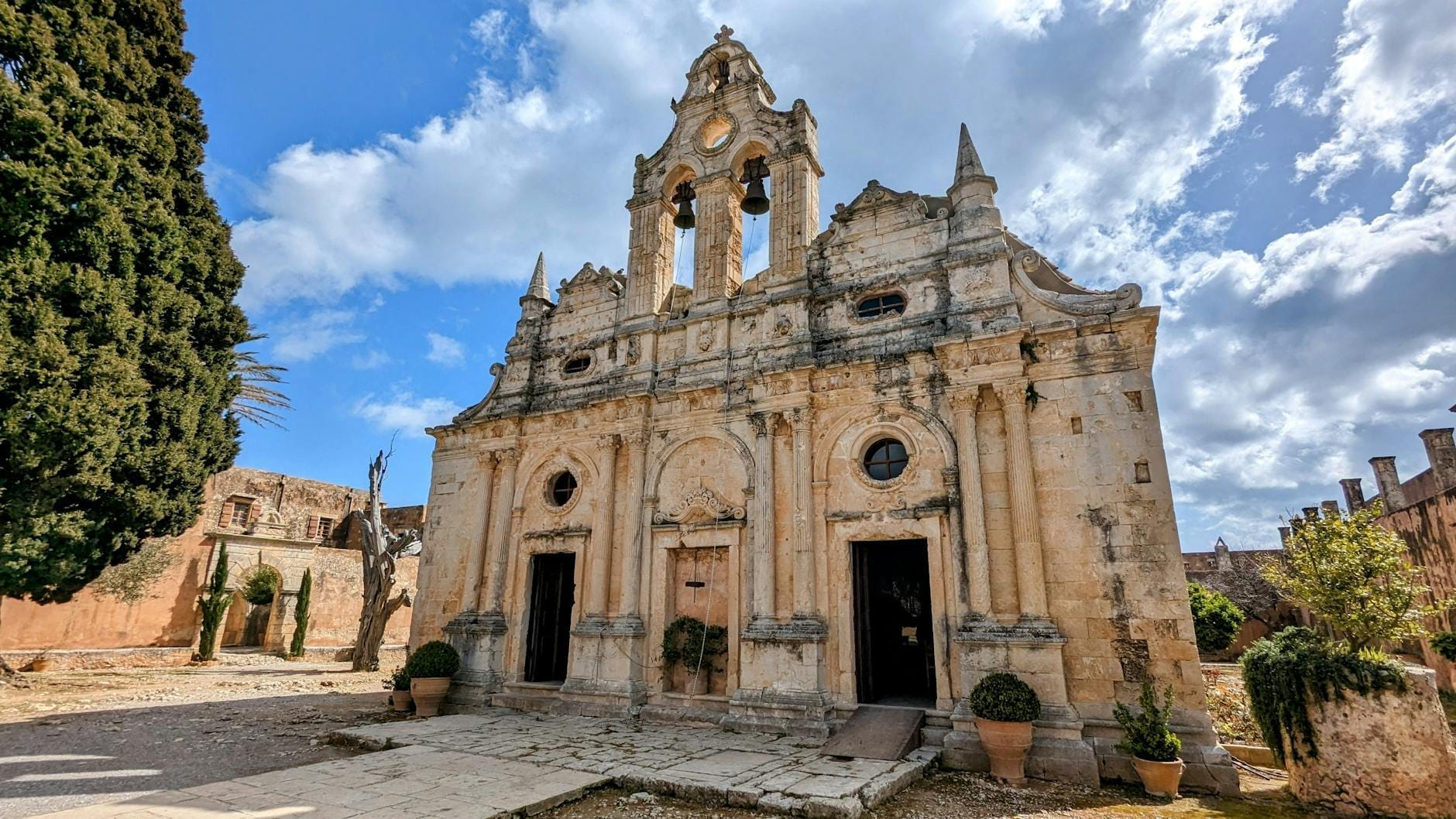
Arkadi Monastery is not a conventional tourist attraction. It is a site of profound historical trauma that has been reframed as a monument to dignity and resistance. When you walk through its arched gatehouse and into the central courtyard, the physical beauty of the place, the warm honey-colored stone, the ornate Venetian-Renaissance church facade, the scent of cypress and wild herbs on the plateau breeze, sits in deliberate contrast with what happened here in November 1866.
During the Cretan uprising against Ottoman rule, some 943 people, the majority of them women and children who had sought shelter inside the monastery walls, faced the decision to surrender or resist. Under the direction of Abbot Gabriel Marinakis, the gunpowder stores were ignited. The explosion killed most of those sheltering inside, along with hundreds of Ottoman soldiers. The event reverberated across Europe, drawing sympathy from figures including Victor Hugo and Giuseppe Garibaldi, and accelerated international pressure on the Ottoman Empire regarding Crete. November 8 is still commemorated annually as a day of remembrance.
ℹ️ Good to know
This is an active monastery with three resident monks. Dress modestly: covered shoulders and knees are required. A wrap or shawl is sometimes available at the entrance for those who need one, but it is safer to come prepared.
The Architecture: Renaissance on a Cretan Hilltop
The church at the center of the complex, known as the Katholikon, was built in 1587 by the abbot Klimis Hortatsis. It is a two-naved basilica: the northern nave is dedicated to the Transfiguration of Christ, the southern to Saints Constantine and Helen. The facade is the monastery's visual centerpiece, a two-story composition that blends Venetian baroque and Renaissance columns with Corinthian capitals, round arches, and a decorative cornice. The style is unusual for a Greek Orthodox religious building and reflects the Venetian dominance over Crete during the 16th century.
The monastery's outer walls are thick, high, and fortified, built with defensive intent against Ottoman raids long before 1866. Walking along the interior perimeter gives a clear sense of how this was a place designed to be held under siege. The courtyard itself is relatively modest in size, which makes the imagined scale of 943 people sheltering here feel viscerally impossible and deeply affecting.
The overall complex sits at 500 meters above sea level on a plateau surrounded by olive groves, vineyards, cypress trees, and pine. The drive up from Rethymno through the interior landscape is itself worth noting. This is the kind of countryside that makes sense of Crete's mountain village culture, a productive, self-contained world far from the coast.
Tickets & tours
Hand-picked options from our booking partner. Prices are indicative; availability and final rates are confirmed when you complete your booking.
Visit a Family-Run Olive Mill with Food Tasting in Heraklion
From 19 €Instant confirmationFree cancellationSnorkeling experience in Crete
From 45 €Instant confirmationFree cancellationSpinalonga self-guided audio tour on your phone
From 12 €Instant confirmationFree cancellationMalia to Sissi private tuk-tuk journey with tastings
From 45 €Instant confirmationFree cancellation
What to See Inside the Complex
The Katholikon is the first place most visitors head. Inside, the iconostasis (icon screen) is elaborately carved and gilded, and the space is lit by hanging oil lamps that cast a warm, slightly smoky light. The contrast between the interior atmosphere and the bright Cretan sun outside is jarring in the best sense. Take a moment to let your eyes adjust.
The monastery museum houses relics spanning the foundation period through the 20th century: icons, manuscripts, vestments, and objects related to the 1866 events. It is a small but carefully curated collection that adds important context to what the church and courtyard alone cannot fully communicate. The on-site art gallery is a quieter space, often skipped by visitors in a rush, but worth ten minutes.
Do not overlook the old refectory. This communal dining hall retains its original wooden door, which still bears the pockmarks of Ottoman bullets from the 1866 siege. It is one of the most tangible artifacts at the site: a scarred surface that connects the present visit to the specific violence of that morning in November 1866.
💡 Local tip
The refectory's bullet-marked door is easy to walk past without realizing what it is. Ask at the entrance or look for the information panel nearby. It tends to stop visitors in their tracks more than any display case.
Visiting by Time of Day: How the Experience Shifts
Morning visits, particularly before 10am, offer the most reflective experience. Coach groups typically arrive mid-morning, and by late morning the courtyard can feel crowded enough to dilute the quiet the site deserves. Earlier in the day, the light hits the church facade at a low angle that emphasizes the depth of the carved columns and arches. It is also the best time for photography without competing with other visitors in frame.
Afternoon light turns the stone a deeper amber, and by mid-afternoon the tour buses have largely departed. The late afternoon window, roughly 3pm to closing, is therefore another good option: fewer people, softer light, and the monks more visibly present going about their routines. The plateau's elevation means that even in July and August, temperatures here are noticeably cooler than on the Rethymno coast.
If you are visiting Crete in the shoulder season, October in particular offers ideal conditions for this kind of inland cultural site. For more on timing a Crete trip around atmosphere rather than just weather, see the guide to visiting Crete in October.
Practical Walkthrough: Getting There and Around
Arkadi Monastery is located 23 kilometers from Rethymno, approximately 20 minutes by car via a well-maintained road through the Cretan interior. The drive is scenic and straightforward. Parking is available outside the monastery entrance. Renting a car is by far the most flexible option for this excursion, and it pairs naturally with other inland stops.
KTEL buses do serve the route between Rethymno and Arkadi, though schedules are limited and should be confirmed locally before relying on them. For visitors based in Rethymno without a vehicle, a taxi round trip is a reasonable option that allows you to set your own pace. If you are planning a broader road trip through central Crete, see the Crete road trip guide for suggested routes that include Arkadi alongside other inland attractions.
The monastery grounds are largely flat once inside, making the interior accessible for most visitors. The approach path from the car park is paved. Uneven stone in parts of the courtyard could be challenging for those with significant mobility limitations, but the main church, museum, and refectory are all reachable without climbing steps.
⚠️ What to skip
Opening hours and admission prices are not fixed year-round and have historically varied by season. Verify current hours before making a dedicated trip, particularly if visiting outside the peak June to September window.
Honest Assessment: Is It Worth the Trip?
For visitors primarily interested in beaches and coastal scenery, Arkadi may feel like a detour that demands more emotional engagement than a holiday afternoon allows. That is not a criticism of those visitors. It is a site that rewards people who arrive with some background knowledge of the 1866 events, and it can feel like a quiet walled courtyard without that context.
For anyone with a genuine interest in Cretan history, Greek Orthodox architecture, or the island's long trajectory from Byzantine through Venetian to Ottoman rule and eventual union with Greece, Arkadi is one of the most concentrated and affecting sites on the island. It belongs in the same conversation as the Palace of Knossos and the Heraklion Archaeological Museum as a site that changes how you understand Crete as a place rather than just a destination.
It also pairs well with time in Rethymno itself. The city's own Venetian-Ottoman layered history, visible in its Rethymno Old Town and the Fortezza of Rethymno, provides context that makes an afternoon at Arkadi considerably richer.
Insider Tips
- Read at least a short summary of the 1866 revolt before you arrive. The physical site communicates atmosphere, but the history is what gives it meaning. Without it, the bullet-scarred refectory door is just old wood.
- The ossuary outside the main walls contains the skulls of some of those who died in 1866. It is sobering and not prominently signed. Walk around the exterior perimeter before leaving.
- A small shop near the entrance sells locally produced products including honey and wine from the monastery's own surrounding land. Both are worth buying as a genuinely local product rather than a tourist souvenir.
- If you want to combine the visit with a short walk, the Arkadi Gorge runs adjacent to the monastery property. It is a much less demanding route than Samaria and takes roughly an hour each way, passing through dense scrub and rock terrain.
- November 8 sees a formal commemoration ceremony at the monastery. The event draws crowds from across Crete and is a meaningful way to experience the site if your travel dates align, though logistics require advance planning.
Who Is Arkadi Monastery For?
- History-focused travelers who want to understand Crete beyond its coastline
- Architecture enthusiasts interested in Venetian-Renaissance influence on Orthodox religious buildings
- Cultural travelers combining an inland half-day with time in Rethymno
- Photographers looking for dramatic stone architecture with minimal commercial clutter
- Families with older children who have an interest in or school context for Greek or Ottoman history
Nearby Attractions
Other things to see while in Rethymno:
- Fortezza of Rethymno
Perched on Paleokastro hill above Rethymno's old harbor, the Fortezza is one of the best-preserved Venetian fortifications in the Mediterranean. Built between 1573 and 1580, it offers sweeping sea views, Ottoman-era monuments, and a walk through 400 years of Cretan history.
- Lake Kournas
Tucked inland from the north coast between Chania and Rethymno, Lake Kournas is Crete's sole freshwater lake — a striking contrast to the island's rugged, sun-scorched landscape. Terrapins bask on rocky outcrops, water birds drift across the surface, and the surrounding hills reflect in the still water with an almost mirror-like quality that explains the lake's name.
- Rethymno Archaeological Museum
The Rethymno Archaeological Museum traces Cretan civilization from the Paleolithic era through Roman occupation, displayed inside the 16th-century Church of Saint Francis. For a small admission fee, visitors access one of the most coherent regional collections in Crete, covering Minoan palace culture, burial customs, and everyday life across the centuries.
- Rethymno Beach
Rethymno Beach is a 13 to 15 kilometre arc of golden sand that begins at the eastern edge of Rethymno's Old Town and stretches east toward Skaleta. Free to access, gently shelving, and backed by hotels and tavernas, it works equally well for a quick morning swim or a full beach day.