Palace of Zakros: Crete's Most Remote Minoan Palace
The Palace of Zakros sits at the far eastern edge of Crete, half a kilometer from the sea, where a Minoan trade empire once operated 3,500 years ago. It is one of Crete's four largest Minoan palace complexes, and the one fewest visitors bother to reach — which is precisely what makes it worth the effort.
Quick Facts
- Location
- Kato Zakros, Lasithi, eastern Crete — approx. 45 km from Sitia
- Getting There
- By car from Sitia (~1 hr) or seasonal bus to Kato Zakros village; site is walkable from the village beach
- Time Needed
- 1.5 to 2.5 hours for the ruins; longer if combining with the Gorge of the Dead or the beach
- Cost
- Verify current admission with the Greek Ministry of Culture before visiting — fees and hours are subject to seasonal change
- Best for
- History enthusiasts, independent travelers, those combining archaeology with coastal scenery
What the Palace of Zakros Actually Is
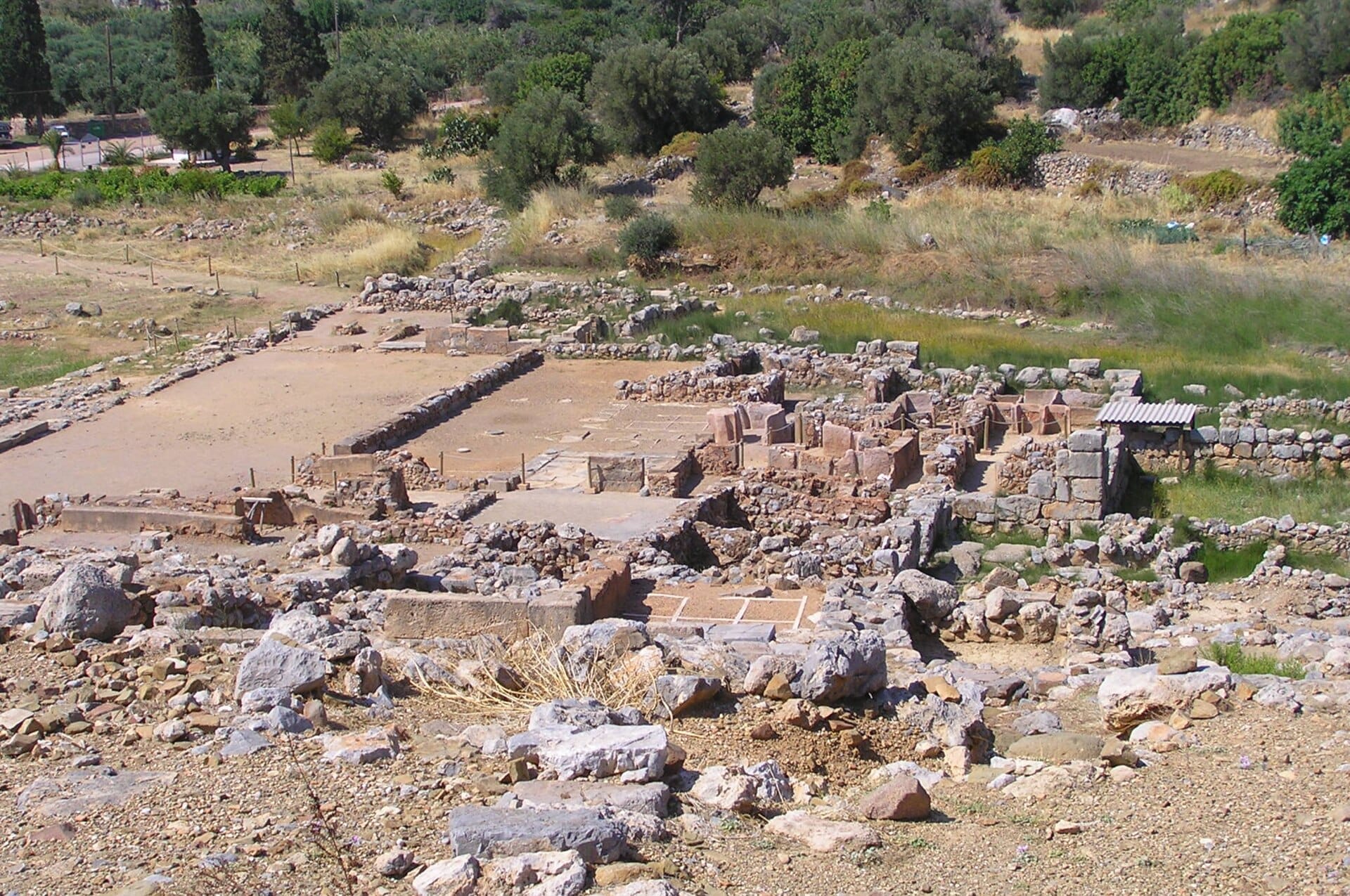
The Palace of Zakros, known in Greek as Ανάκτορο Ζάκρου (Anáktoron Zakrou), is the fourth largest of the Minoan palace complexes on Crete, after Knossos, Phaistos, and Malia. It covers roughly 8,000 square meters and once comprised between 150 and 300 rooms arranged across four wings around a central rectangular courtyard measuring approximately 30 by 12 meters. Zakros forms part of the broader Minoan archaeological landscape of Crete, recognized for its global significance.
What sets Zakros apart from the other palaces is its position and purpose. Tucked into a valley between two low hills, just 500 meters from the Cretan coastline, it functioned as a major maritime trade hub connecting the Minoans with Egypt, Cyprus, and the broader eastern Mediterranean. Goods flowed in and out through its sheltered natural harbor. The palace complex you see today is the New Palace, built around 1600 BC and destroyed by fire around 1450 BC. Unlike Knossos, it was never rebuilt after that destruction, which means the layers you walk through represent a single, clearly defined moment in Minoan history.
ℹ️ Good to know
Because the site was abandoned and not built over in later periods, excavations here have yielded exceptionally intact finds: storage vessels still containing olive oil and wine residue, ritual objects in near-perfect condition, and bronze ingots that had never been moved since the day the palace burned. Most of these artifacts are now housed in the Heraklion Archaeological Museum.
The Archaeology: Two Excavations, Centuries Apart
The site was first probed by British archaeologist D.G. Hogarth in 1901, who identified significant remains but did not pursue a full excavation. It was Greek archaeologist Nikolaos Platon who undertook the systematic excavation beginning in 1961, uncovering the full palace complex over several decades. Platon's work was transformative: he found the palace largely undisturbed, the sudden destruction having sealed its contents like a time capsule.
The Old Palace phase dates to approximately 1900 BC, placing the site firmly within the Protopalatial period. The more impressive New Palace (Neopalatial period, Late Minoan IB) was constructed around 1600 BC and represents the building whose foundations are visible today. Unlike at Knossos, where Sir Arthur Evans controversially reconstructed walls and painted columns in the early 20th century, Zakros presents its ruins in a more honest, unrestored state. You see what the archaeology actually left behind.
For deeper context on how Zakros fits into the broader arc of Minoan civilization, the Minoan history guide for Crete covers the rise and collapse of palace society across the island — essential reading before visiting any of the major sites.
Tickets & tours
Hand-picked options from our booking partner. Prices are indicative; availability and final rates are confirmed when you complete your booking.
Visit a Family-Run Olive Mill with Food Tasting in Heraklion
From 19 €Instant confirmationFree cancellationSnorkeling experience in Crete
From 45 €Instant confirmationFree cancellationSpinalonga self-guided audio tour on your phone
From 12 €Instant confirmationFree cancellationMalia to Sissi private tuk-tuk journey with tastings
From 45 €Instant confirmationFree cancellation
Walking the Site: What You Will Actually See
Enter from the northeast, where a paved track leads from the protected harbor side. The layout becomes clearer once you reach the central court, which remains the organizational anchor of the entire complex. From here you can identify the four wings: the west wing contained the ceremonial and religious spaces, including a treasury room where cult objects were found; the east wing held the royal apartments; the north and south wings contained workshops, storage magazines, and administrative areas.
The storage rooms along the west wing still show the bases of large ceramic pithoi, the giant storage jars used for oil, grain, and wine. Some of the stone-paved floors in the royal apartments survive with surprising completeness. A spring-fed cistern or lustral basin in the west wing has drawn particular archaeological attention, as its placement suggests both ritual and practical functions. The stonework throughout uses the characteristic Minoan ashlar masonry: carefully cut limestone blocks fitted without mortar.
The scale here is smaller and less theatrical than Knossos, and the absence of reconstruction means you need some imagination and, ideally, a good site plan or guidebook to orient yourself. That said, the ground-level intimacy is genuinely different from what you experience at the more famous palaces. You can crouch next to the foundations, look across the courtyard, and feel the proportions of the space without crowds pressing behind you.
💡 Local tip
Pick up a printed plan of the palace before you arrive — the on-site signage, while present, is sparse. The Heraklion Archaeological Museum sells a guidebook to the Zakros excavations, and several good site plans are available online to download and print.
How the Experience Changes Through the Day
Morning visits, particularly in the two hours after the site opens, offer the clearest light and the lowest crowds. The ruins face roughly east, and morning sun illuminates the stonework at an angle that brings out texture and depth in the masonry. By midday in July and August, the valley becomes a heat sink. There is almost no shade at the ruins themselves, and temperatures at the site can feel significantly higher than in nearby Sitia. Bring more water than you think you need.
Late afternoon, from around 4pm onward, the light shifts to a warmer tone and the heat relents. If the site is still open, this is arguably the best photography window. The low hills to the east begin to cast long shadows across the courtyard stones, and the sea glints in the distance beyond the valley entrance. Unlike Knossos, where afternoon tour buses keep the site consistently crowded, Zakros in the late afternoon often has only a handful of visitors.
In spring and early autumn, the surrounding valley is green and fragrant with wild thyme and sage. The walk from the village beach to the ruins takes about five minutes along a flat path. In October and November, after the main tourist season ends, the site can feel almost solitary.
If you are planning an autumn visit, the guide to Crete in October explains what's open, what the weather is like, and why the far east of the island suits off-season travelers particularly well.
Getting There and Practical Logistics
The Palace of Zakros sits 45 kilometers southeast of Sitia, the nearest town of any size, and about 9 kilometers below Pano Zakros village along a winding but fully paved road. A car is the most practical way to get here. The drive from Sitia takes roughly an hour and passes through dramatic limestone gorge scenery before descending to the coast. There is parking near the Kato Zakros village beach, and the site is a short, flat walk from there.
Seasonal bus service connects Sitia with Kato Zakros, but the schedule is limited and changes year to year. Confirm current timetables with KTEL Lasithi before relying on public transport. Hiring a car from Sitia for a full day gives you far more flexibility and allows you to combine the palace with the Gorge of the Dead hike and a swim at the Kato Zakros beach.
Zakros fits naturally into a road trip across eastern Crete. The Crete road trip guide maps out a logical route that takes in the far east of the island, including Sitia and the Lasithi region, without backtracking unnecessarily.
⚠️ What to skip
Facilities at the site are extremely limited. As of research time, the only water source near the ruins is a tap intended for plant irrigation, not drinking. Bring sufficient water from the village or from Sitia. There are a couple of tavernas in Kato Zakros for a post-visit meal, but do not count on a café or shop at the ruins themselves.
Combining Zakros with the Gorge of the Dead
The Gorge of the Dead, also known as the Zakros Gorge, runs directly above and north of the palace site, connecting Pano Zakros to Kato Zakros over roughly 8 kilometers. The gorge gets its name from the Minoan rock-cut tombs discovered in its cliff faces, making it an extension of the same archaeological landscape as the palace below. Hiking it takes two to three hours one way and ends near the palace entrance.
If you choose to hike down the gorge and then tour the palace, plan for a half-day minimum. Arrange for someone to drop your car at Kato Zakros before you start, or use the seasonal shuttle service if available. The gorge path is generally straightforward but uneven underfoot, with some scrambling near the upper section. Closed-toe shoes are necessary. This combination of wild landscape, Minoan tombs in the cliff faces, and a fully excavated palace at the end is one of the more distinctive archaeological experiences in Greece.
Is Zakros Worth It Compared to the Other Minoan Palaces?
This is the honest question most travelers are weighing. Knossos is more visually dramatic and its reconstructed sections give non-specialists a clearer sense of Minoan architectural ambition. Phaistos has a spectacular hilltop setting overlooking the Mesara Plain. Malia is easier to reach from the north coast resorts.
Zakros offers something different: remoteness, authenticity, and context. The surrounding valley, the proximity to the sea, and the lack of reconstruction together create an impression of discovery that the more accessible palaces no longer provide. If archaeology is genuinely why you are visiting Crete, Zakros deserves your time. If you have one palace visit available, the Palace of Knossos remains the more immediately legible experience. But Zakros rewards the effort in a way that Knossos, surrounded by tour groups, no longer can.
The artifacts recovered from Zakros — particularly the carved rock crystal rhyton, the bull's head rhyton, and the bronze ingots — are displayed at the Heraklion Archaeological Museum. Visiting the museum before or after Zakros transforms what you see at the site; without it, the stripped ruins lose much of their meaning.
Travelers who find unrestored ruins hard to interpret without assistance, those without a car, or anyone visiting during peak summer heat without adequate preparation may find the journey disproportionate to the payoff. It is not a site that meets you halfway.
Insider Tips
- Visit the Heraklion Archaeological Museum's Zakros collection before you go, not after. Seeing the rock crystal rhyton and the bronze ingots in person makes the empty storage magazines and treasury rooms at the site far more vivid.
- The tavernas in Kato Zakros village serve fresh fish caught from the same cove the Minoans once used as a harbor. Sitting there after the ruins is one of those rare cases where the meal and the setting genuinely complement what you just experienced.
- The gorge hike from Pano Zakros ends near the northern entrance of the palace. If you arrange your transport so your car is waiting at Kato Zakros beach, you can hike down, tour the ruins, swim, and eat lunch all without backtracking.
- Bring a physical site plan downloaded in advance. Mobile signal in the valley is unreliable, and the on-site interpretation panels, while informative, do not substitute for a floor plan when you are trying to navigate 150-plus rooms.
- Spring visits (April to early June) offer the best combination of comfortable temperatures, wildflowers in the valley, and thinner crowds. The site's isolation means it never gets truly packed, but shoulder season gives you the ruins essentially to yourself.
Who Is Palace of Zakros For?
- Archaeology enthusiasts who want to see a Minoan palace in its unrestored, honest state
- Independent travelers building an eastern Crete itinerary around Sitia or the Lasithi region
- Hikers combining the Gorge of the Dead trail with a coastal and archaeological finish
- History-focused couples or solo travelers who prefer quiet, context-rich sites over theatrical reconstructions
- Visitors returning to Crete who have already seen Knossos and want the full picture of Minoan palace civilization
Nearby Attractions
Combine your visit with:
- Ancient Gortyna
Ancient Gortyna, set across the sun-baked Mesara plain in south-central Crete, was once the Roman capital of an entire Mediterranean province. From the world's longest surviving ancient Greek inscription to a Byzantine basilica built over a Greek temple, Gortyna rewards patient visitors with layers of history that few other sites on the island can match.
- Palace of Phaistos
The Palace of Phaistos sits on a low hill above the Mesara plain in south-central Crete, offering a rare chance to walk through a Minoan palace complex without the crowds that overwhelm Knossos. Dating to around 2000 BCE, it is the second-largest Minoan palace on the island and the site where the famous, still-undeciphered Phaistos Disc was found. The views alone justify the drive.
- Richtis Gorge
Richtis Gorge cuts through Lasithi Prefecture in eastern Crete, following a 4 km trail from Exo Mouliana village down to a 20-metre waterfall and the Aegean coast. With ancient bridges, lush riparian forest, and relatively manageable terrain, it ranks among the island's most rewarding gorge hikes outside of the famous Samaria route.
- Sitia
Sitia sits at the far eastern edge of Crete, where the tourist trail quietly fades and daily Greek life takes over. With Minoan origins, a hilltop Venetian fortress, a serious archaeological museum, and easy access to Vai Beach and the Minoan palace at Zakros, this unhurried port town rewards travelers who make the journey.