Sitia: Eastern Crete's Most Authentic Port Town
Sitia sits at the far eastern edge of Crete, where the tourist trail quietly fades and daily Greek life takes over. With Minoan origins, a hilltop Venetian fortress, a serious archaeological museum, and easy access to Vai Beach and the Minoan palace at Zakros, this unhurried port town rewards travelers who make the journey.
Quick Facts
- Location
- Lasithi region, eastern Crete — 130 km east of Heraklion, 70 km east of Agios Nikolaos
- Getting There
- By car via the E75 highway (approx. 2 hrs from Heraklion); KTEL buses connect Heraklion and Agios Nikolaos; Sitia Airport (JSH) serves domestic routes; ferry connections from the port
- Time Needed
- Half a day for the town itself; allow 2 full days if combining with Vai Beach, Zakros, and Toplou Monastery
- Cost
- Free to walk and explore; Sitia Archaeological Museum charges a small entry fee (verify current price on arrival); most beaches free
- Best for
- Slow travelers, history enthusiasts, road trippers, couples, anyone exhausted by Crete's western tourist crowds
What Kind of Place Is Sitia?
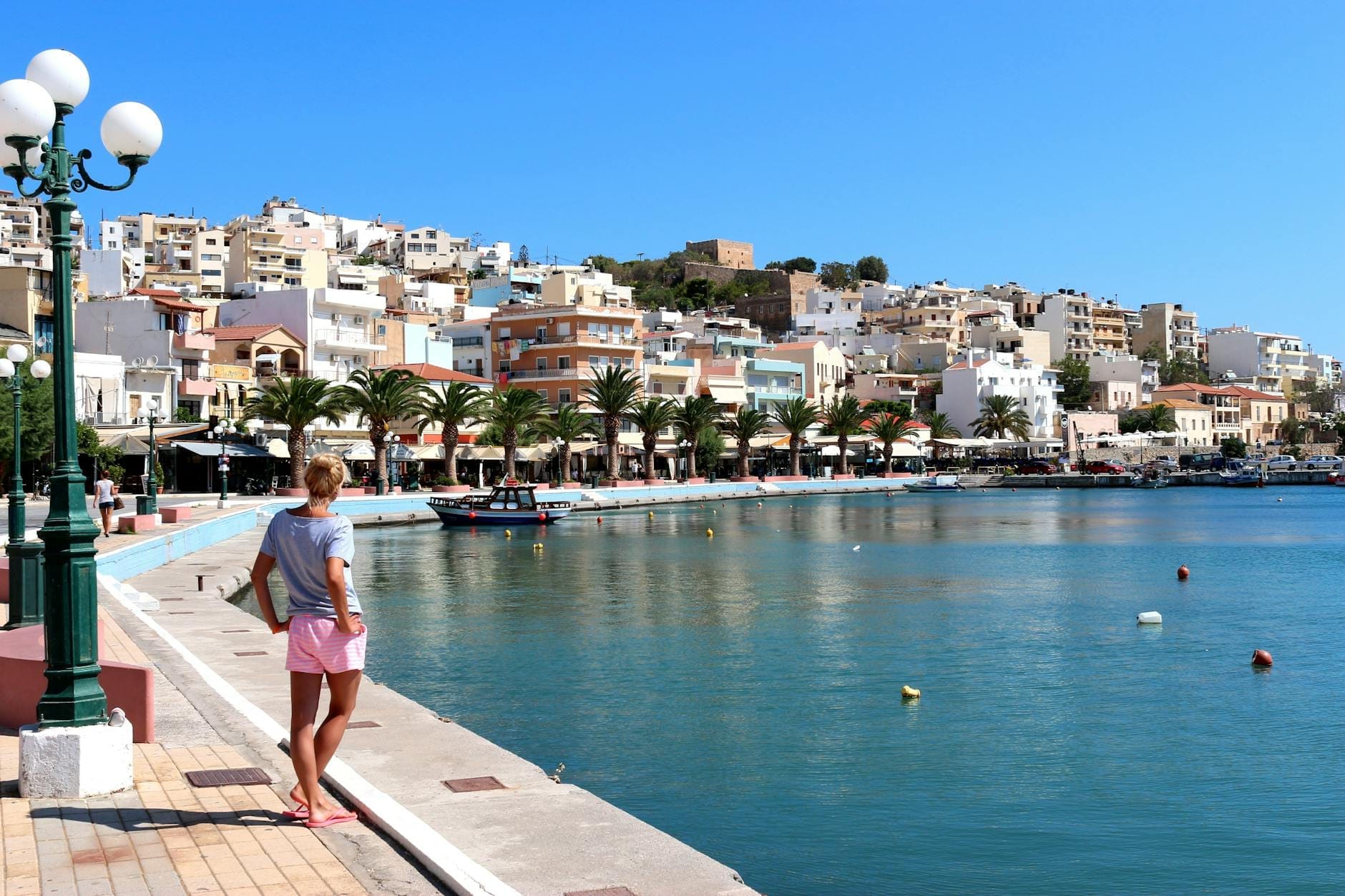
Sitia is a working Cretan port town that has not been refashioned for mass tourism. The waterfront promenade is lined with tavernas and kafeneions where locals still outnumber visitors well into summer. Fishing boats dock alongside the quay. The surrounding hills are terraced with vineyards producing Sitia's well-regarded PDO wines, and the air carries the particular combination of salt, diesel, and coffee that defines Greek harbor towns. It is not polished, and that is precisely its appeal.
The town has a population of around 11,000, making it the third-largest settlement in the Lasithi regional unit after Agios Nikolaos and Ierapetra. Its modest scale means the center is walkable in under twenty minutes — from the Kazarma fortress on the hill down through the market streets to the harbor. There are no grand resort complexes here, no beach clubs with imported DJs. What you get instead is a functioning Cretan town where a traveler can sit at a waterfront table, order grilled octopus and a carafe of local white wine, and watch the afternoon light shift over the bay without any particular agenda.
ℹ️ Good to know
Sitia is part of the UNESCO Global Geopark network, recognized for the geological and natural heritage of the eastern Crete landscape it sits within. This status covers the broader region, not just the town.
A History Shaped by Destruction and Resilience
The site of Sitia has been inhabited since Minoan times, when it was known as ancient Itia — a coastal refuge settlement that grew in importance as larger Minoan centers declined. Through the Classical, Hellenistic, Roman, and Byzantine periods the town functioned as a reliable eastern Aegean port, trading in olive oil, wine, and goods moving between the Levant and mainland Greece. Its position at the eastern end of Crete gave it strategic value that successive rulers recognized.
The Venetian period brought prosperity and architecture — the Kazarma fortress being the most visible legacy — but also catastrophe. The town was devastated by an earthquake in 1508, attacked and burned by the Ottoman corsair Hayreddin Barbarossa in 1538, and then destroyed again by the Venetians themselves in 1651 as a defensive measure against Ottoman advance. What stands today is largely a product of reconstruction that began in 1870, under Ottoman rule, when the settlement was rebuilt on the same harbourside site it had occupied for millennia. This layered history of loss and rebuilding gives Sitia a particular character: there is no single dramatic monument, but a slow accumulation of historical presence in the streets, the fortress walls, and the museum's collections.
Tickets & tours
Hand-picked options from our booking partner. Prices are indicative; availability and final rates are confirmed when you complete your booking.
Visit a Family-Run Olive Mill with Food Tasting in Heraklion
From 19 €Instant confirmationFree cancellationSnorkeling experience in Crete
From 45 €Instant confirmationFree cancellationSpinalonga self-guided audio tour on your phone
From 12 €Instant confirmationFree cancellationMalia to Sissi private tuk-tuk journey with tastings
From 45 €Instant confirmationFree cancellation
The Kazarma Fortress and the Town Center
The Kazarma is the defining landmark of Sitia's skyline, a Venetian fortification perched above the town on a low hill. The name derives from the Italian 'casa di arma' — house of arms — and the structure dates from the Venetian occupation of Crete. After the successive destructions of the town, much of the original fortification was lost, and what remains is substantially reconstructed. It functions today as an open-air venue for cultural events and theatre performances in summer, which is actually the most atmospheric way to experience it: sitting in the restored space at dusk with the bay visible below.
From the fortress area, the walk down into the town center passes through streets that have the ordinary texture of a Cretan market town: small grocery shops, a bakery or two, the occasional butcher. The central plateia near the waterfront is where the evening volta — the traditional Greek promenade walk — still happens with real local participation rather than as performance for visitors. If you arrive on a weekday morning, the covered market area sees local farmers trading produce, including the region's distinctive Sitia olive oil and raisins, for which the town has a centuries-old reputation.
Sitia Archaeological Museum: Underrated and Worth Your Time
Founded in 1984, the Sitia Archaeological Museum holds collections from excavations across eastern Crete, including artifacts from the sites of Palekastro and the island of Pseira. For anyone traveling east toward the Minoan palace at Zakros, stopping here first provides essential context. The museum is small enough to cover in 60 to 90 minutes without fatigue, and the crowds are a fraction of what you'd encounter at the Heraklion Archaeological Museum.
Among the standout pieces is the Palekastro Kouros, an extraordinarily detailed Minoan ivory figurine dating to around 1500 BCE, considered one of the finest examples of Minoan craftsmanship ever found. If you want deeper background on Minoan civilization before visiting, the guide to Minoan history in Crete covers the broader picture across the island's four newly UNESCO-listed palace sites.
💡 Local tip
Visit the museum in the middle of the day when heat makes outdoor exploration uncomfortable. Morning and late afternoon are better reserved for the waterfront and fortress walk, when the light is cooler and more photogenic.
Day Trips from Sitia: The Real Reason to Come This Far East
Sitia's greatest practical value is as a base for the cluster of extraordinary sites in eastern Crete that are genuinely difficult to reach efficiently from Heraklion or Agios Nikolaos in a single day. The town's position makes it the logical overnight stop for anyone committed to seeing this part of the island properly.
Vai Beach, approximately 24 km northeast of Sitia, holds Europe's largest natural palm forest — a disorienting pocket of the Levant that appears without warning above a sandy bay. It draws significant numbers in July and August, so arrive before 9am or after 5pm to see it without the crowds. See the full Vai Palm Beach guide for timing and logistics.
The Minoan palace at Zakros lies about 40 km south of Sitia and is the least visited of Crete's major Minoan palace sites, meaning you can sometimes walk its rooms in near-solitude. The palace was discovered intact in 1961 with a treasury of artifacts still in place, suggesting it was abandoned suddenly. Just above the site, the Gorge of the Dead — named for the ancient burials in its cliff caves — makes for a rewarding short hike.
Toplou Monastery, mid-way between Sitia and Vai, is a functioning monastic community that has stood since the 15th century. Its church contains an important 18th-century icon, 'Lord Thou Art Great,' featuring 61 individual scenes. The monastery also produces its own olive oil and wine commercially. For those interested in Crete's network of historic monasteries, Arkadi Monastery in the Rethymno region offers a striking point of comparison.
For hikers, the Richtis Gorge north of Sitia leads to a waterfall and a beach accessible only on foot — one of the quieter natural rewards in an area better known for its archaeology.
When to Go and What to Expect
Sitia sits in the driest, sunniest corner of Crete. Summers are long and hot, with July and August temperatures regularly above 30°C, but the town's north-facing harbor position means afternoon sea breezes make the waterfront tolerable even in peak heat. The surrounding landscape, which is semi-arid with rocky hillsides and vineyards, looks its most photogenic in May and early June, when whatever spring green remains before the dry season sets in. October is an excellent time to visit: the harvest season is underway, the sea is still warm enough to swim, and the town is quiet.
Winter brings cooler temperatures and intermittent rain, and some smaller tavernas close for several months, but the town does not fully shut down the way more tourist-dependent resorts do. If your Crete trip is timed around weather rather than crowds, the guide to the best time to visit Crete covers regional variations in detail. Sitia's eastern microclimate typically receives less rainfall than western Crete and sees slightly warmer winters.
⚠️ What to skip
The road between Agios Nikolaos and Sitia is mostly a single-lane coastal highway with some sharp bends and limited overtaking opportunities. It is not particularly dangerous, but the 70 km takes longer than maps suggest — allow at least 1 hour 20 minutes and more if driving cautiously. Do not plan tight connections.
Who Should Skip Sitia
Sitia is not the right stop for travelers whose priority is beach infrastructure. The town beach is pleasant but not spectacular, and the water sports, beach bar, and sunbed scenes are minimal compared to what you'd find around Elounda or further west. It is also a significant detour: coming from Chania or Rethymno, you are looking at a 3 to 4 hour drive each way. If you have only a week in Crete and are based in the west, Sitia probably does not justify the time unless the Zakros palace or Vai Beach is genuinely on your priority list.
Travelers who find Greek provincial towns slow or monotonous will also find little here to hold their attention beyond the museum. The town's appeal is precisely its lack of spectacle. For a comparison of how to structure a Crete trip across different pace preferences, the one-week Crete itinerary offers a useful framework for deciding how far east to push.
Insider Tips
- The Sitia Raisin Festival (Sultana Festival) takes place in late August and is a genuinely local celebration centered on the harvest of the region's famous Zante currant-type raisins. It includes music, wine, and food stalls, and draws very few non-Greek visitors — worth timing your trip around if you are in the region.
- Sitia's local wine, made primarily from the Vilana and Thrapsathiri grape varieties, is worth seeking out. Several tavernas on the waterfront carry unlabeled house wine from nearby producers that rarely leaves the region. Ask specifically for local wine rather than accepting the standard Greek house options.
- If you plan to visit Zakros palace on the same day as Vai Beach, do Zakros in the morning (it opens early) and head to Vai after 4pm when the day-trippers leave. The loop from Sitia covers roughly 120 km of driving, which is manageable in a day with an early start.
- The waterfront promenade at Sitia is best at 7am, before the kafeneions fill and while fishermen are still sorting their catch on the quay. The light is excellent for photography, and the quiet gives you a sense of the town's daily rhythms that disappears by mid-morning.
- Parking in the town center is mostly free and easy outside August. The lot near the harbor fills by late morning in summer, but streets one block back from the waterfront almost always have space.
Who Is Sitia For?
- Road trippers using Sitia as an eastern Crete base to reach Zakros, Vai, and Toplou Monastery
- History and archaeology travelers who want Minoan context without the Knossos crowds
- Slow travelers and couples seeking authentic Cretan town life with no performance for tourists
- Wine and food travelers interested in eastern Crete's PDO wine and raisin production
- Photographers who value documentary-style images of working Greek harbor towns over staged scenery
Nearby Attractions
Combine your visit with:
- Ancient Gortyna
Ancient Gortyna, set across the sun-baked Mesara plain in south-central Crete, was once the Roman capital of an entire Mediterranean province. From the world's longest surviving ancient Greek inscription to a Byzantine basilica built over a Greek temple, Gortyna rewards patient visitors with layers of history that few other sites on the island can match.
- Palace of Phaistos
The Palace of Phaistos sits on a low hill above the Mesara plain in south-central Crete, offering a rare chance to walk through a Minoan palace complex without the crowds that overwhelm Knossos. Dating to around 2000 BCE, it is the second-largest Minoan palace on the island and the site where the famous, still-undeciphered Phaistos Disc was found. The views alone justify the drive.
- Palace of Zakros
The Palace of Zakros sits at the far eastern edge of Crete, half a kilometer from the sea, where a Minoan trade empire once operated 3,500 years ago. It is one of Crete's four largest Minoan palace complexes, and the one fewest visitors bother to reach — which is precisely what makes it worth the effort.
- Richtis Gorge
Richtis Gorge cuts through Lasithi Prefecture in eastern Crete, following a 4 km trail from Exo Mouliana village down to a 20-metre waterfall and the Aegean coast. With ancient bridges, lush riparian forest, and relatively manageable terrain, it ranks among the island's most rewarding gorge hikes outside of the famous Samaria route.