Palace of Phaistos: Crete's Quieter Minoan Marvel
The Palace of Phaistos sits on a low hill above the Mesara plain in south-central Crete, offering a rare chance to walk through a Minoan palace complex without the crowds that overwhelm Knossos. Dating to around 2000 BCE, it is the second-largest Minoan palace on the island and the site where the famous, still-undeciphered Phaistos Disc was found. The views alone justify the drive.
Quick Facts
- Location
- Faistos municipality, south-central Crete, ~62 km from Heraklion
- Getting There
- By car: ~1 hr 20 min from Heraklion or Rethymno. KTEL buses run from Heraklion's long-distance bus station (check current schedules locally)
- Time Needed
- 1.5 to 2.5 hours on site
- Cost
- Check current admission prices with the Greek Ministry of Culture (odysseus.culture.gr); EU student and senior concessions typically apply
- Best for
- History lovers, archaeology enthusiasts, photography, anyone who found Knossos too crowded
- Official website
- http://odysseus.culture.gr/h/3/eh355.jsp?obj_id=2363
What Phaistos Actually Is (and Why It Matters)
The Palace of Phaistos is the second-largest Minoan palace ever excavated, built around 2000 BCE on a low ridge above the broad Mesara plain in the heart of Crete. It was a major administrative and ceremonial center of Minoan civilization, almost certainly governing the rich agricultural land spread out below it. Human settlement here stretches back even further, to the Neolithic period around 4000 BCE, making Phaistos one of the longest-continuously occupied sites in all of Greece. For context on what the Minoans built and why it matters, the Minoan history guide for Crete gives useful background before you visit.
The palace you walk through today is largely the Second Palace, rebuilt after a major earthquake destroyed the First Palace around 1700 BCE. A second catastrophic destruction, around 1450 BCE, ended the palace's function permanently. Italian archaeologists Frederick Halbherr and Antonio Taramelli first excavated the site in 1884, with major campaigns running from 1900 to 1904 and again from 1950 to 1971. The Italian Archaeological School at Athens still oversees research here, which partly explains why Phaistos feels less reconstructed and more raw than Knossos.
ℹ️ Good to know
Phaistos is not currently listed on the UNESCO World Heritage List. Verify current admission fees and seasonal hours directly with the Greek Ministry of Culture before visiting, as these details change.
The Site: What You See on the Ground
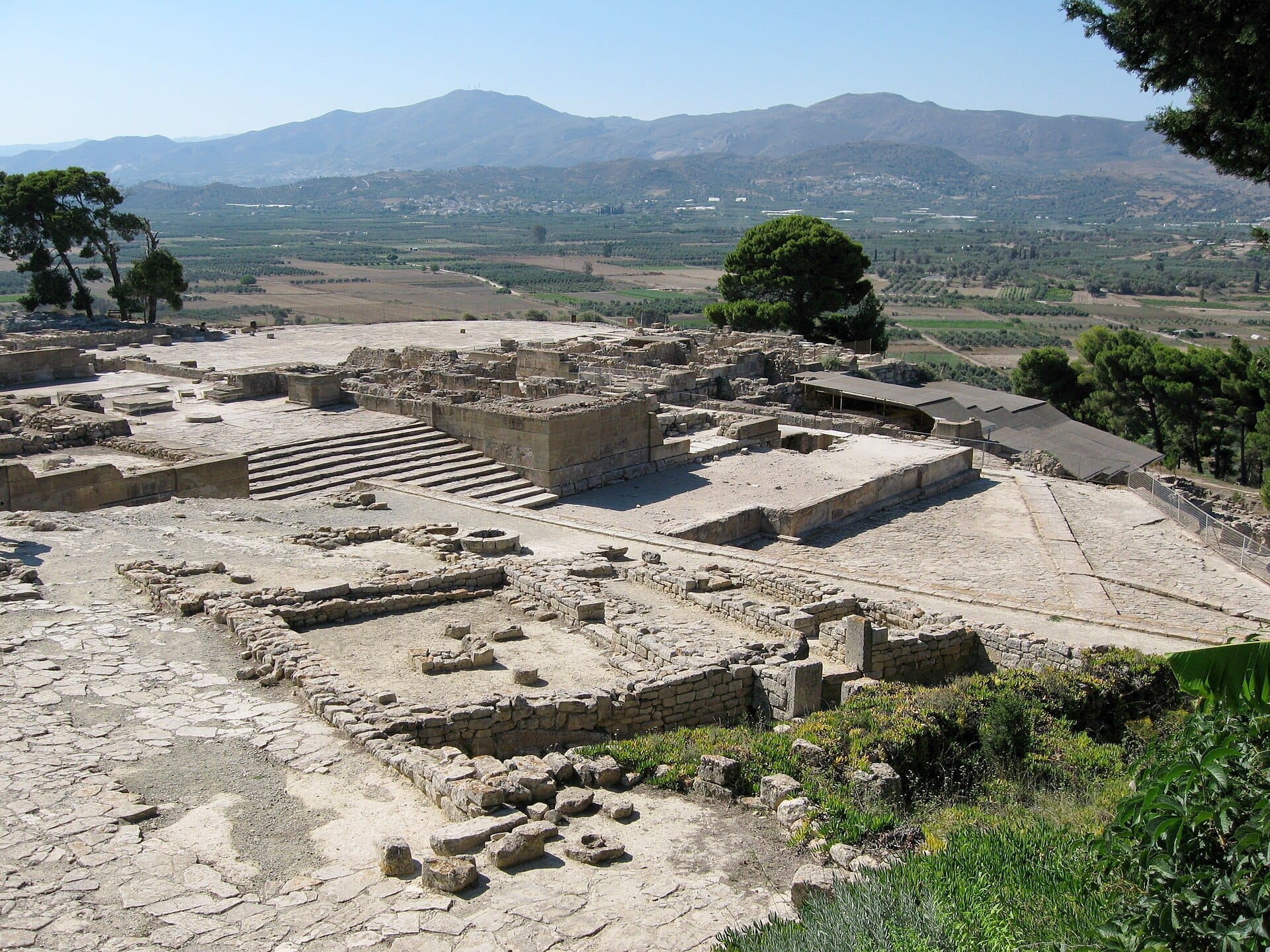
Entering from the main visitor path, the first thing that stops you is the Grand Staircase: a 14-metre-wide ceremonial entrance with a dozen broad steps carved from stone. Even in their eroded state, these stairs convey scale and intention. This was a place designed to impress. The staircase leads to the Central Court, a large open-air rectangular space that was the heart of Minoan palace life, used for ceremonies, possibly bull-leaping events, and the day-to-day business of running a Bronze Age palace-state.
Moving through the site, you encounter storerooms lined with enormous pithoi (ceramic storage jars), some still in place. The palace's north-south orientation, shared with nearly all major Minoan palaces except Zakros, seems deliberate, and standing in the court you understand why: the view axis frames the surrounding mountains almost perfectly. The site is unroofed and largely unrecovered, meaning you see stones roughly as archaeologists found them, with signage explaining what each section was used for.
The area where the Phaistos Disc was discovered in 1908, in the northeast section of the palace complex, is marked. The disc itself, a fired clay tablet about 16 centimetres in diameter, bears 241 symbols arranged in a spiral on both sides. Dating to around 1600 BCE, it remains one of archaeology's most discussed unsolved puzzles. The original is displayed at the Heraklion Archaeological Museum, so do not expect to see it here.
Tickets & tours
Hand-picked options from our booking partner. Prices are indicative; availability and final rates are confirmed when you complete your booking.
Visit a Family-Run Olive Mill with Food Tasting in Heraklion
From 19 €Instant confirmationFree cancellationSnorkeling experience in Crete
From 45 €Instant confirmationFree cancellationSpinalonga self-guided audio tour on your phone
From 12 €Instant confirmationFree cancellationMalia to Sissi private tuk-tuk journey with tastings
From 45 €Instant confirmationFree cancellation
The View and the Landscape Context
It is worth stating plainly: the panoramic view from Phaistos is exceptional. The Mesara plain, the largest fertile plain in Crete, stretches out to the south and east. The Asterousia Mountains close the southern horizon, and on clear days you can see north toward the Psiloritis (Ida) massif as well. The Minoans were deliberate about this position, the palace overseeing productive farmland and sitting at a crossroads of routes across the island.
In the early morning, the light falls at a low angle across the stone terraces, sharpening every texture. The plain below is tinged green or gold depending on the season. By midday in July or August, the site is fully exposed with almost no shade, and the pale limestone reflects heat aggressively. Late afternoon, roughly two hours before closing in summer, brings softer light and a noticeable drop in visitor numbers. If you are combining Phaistos with a drive along the south coast, the nearby Minoan villa of Agia Triada, just 3 kilometres away, is worth the short detour.
How Phaistos Compares to Knossos
Most visitors to Crete who have any interest in Minoan history will already be planning a stop at the Palace of Knossos near Heraklion. Knossos is larger, better explained with on-site reconstructions, and supported by an extensive visitor infrastructure. It is also significantly more crowded, particularly from June through August, when tour buses begin arriving before 9 a.m. Phaistos offers the inverse experience: fewer visitors, no concrete reconstructions, and a site that asks a little more of your imagination but rewards it with greater authenticity.
Archaeologists and those with a genuine interest in Bronze Age architecture tend to prefer Phaistos precisely because it has not been rebuilt. What you are standing in is closer to the actual excavated remains. The tradeoff is that signage, while present, is less comprehensive than at Knossos, and without prior reading, the site can feel like a field of unmarked stones. Spending 20 minutes reading about Minoan palace structure before arrival makes an enormous difference.
💡 Local tip
Download or purchase a site guide in advance. The on-site bookshop stocks printed guides in several languages, but quality varies by stock. A good guidebook transforms what looks like rubble into a readable plan.
Getting There and When to Go
Phaistos sits about 62 kilometres south of Heraklion, reached by driving south through the Messara plain via Mires. The drive takes roughly 1 hour 20 minutes in normal traffic, though the mountain roads require attention. A car is by far the most practical option, and Phaistos fits naturally into a south-coast loop that could include Matala or the Libyan Sea beaches. For route planning across the island, the Crete road trip guide covers the main circuits in detail.
KTEL buses connect Heraklion to the Phaistos area, stopping at Mires with connections onward. Check current schedules locally, as service frequency changes seasonally and is limited on Sundays. This is not an attraction easily reached by public transport on a tight timeline.
The site is open year-round. In winter hours run 08:30-15:30. In summer hours run 08:00-20:00. These hours are subject to change, so verify with the official Ministry of Culture page before travel. The best time to visit Crete is broadly April to early June and September to October, and this holds for Phaistos: the light is softer, temperatures are comfortable, and the site is quiet.
Practical Notes: What to Wear, Bring, and Expect
The site is almost entirely outdoors and unshaded. In summer, a hat and sunscreen are not optional. Sturdy shoes with grip matter more than most visitors expect: the stone surfaces are uneven, some paths slope, and surfaces can be slippery after rain. There is a small cafe and a bookshop near the entrance. Toilets are available at the site.
Accessibility is limited. The terrain is archaeological, meaning uneven ground, steps, and no lifts or paved accessible paths through the main ruins. Visitors with significant mobility limitations will find the site difficult beyond the entrance terrace and viewpoint area.
Photography is unrestricted across the open site. Early morning gives the cleanest light for the stonework. The southward view of the Mesara plain photographs well almost any time the sky is clear, and the Grand Staircase, shot from below looking up, gives a strong sense of the original scale.
Who Should Consider Skipping Phaistos
Phaistos is not the right choice for visitors who want a fully interpreted, walkthrough experience with clear reconstructions and dense explanatory material. Knossos does that job better. It is also not a good choice for families with very young children expecting interactive or engaging displays: the site is an open-air ruin, and children without an existing interest in archaeology may find it slow. Travelers with limited time who are already planning Knossos and the Heraklion Archaeological Museum may need to choose, since Phaistos adds a 140-kilometre round trip from Heraklion. That said, the museum houses the Phaistos Disc itself, which adds relevant context whether or not you make it to the palace.
Insider Tips
- Visit Agia Triada, a smaller Minoan villa just 3 kilometres from Phaistos, on the same ticket or with a combined ticket option. It is significantly less visited and its frescoes and storerooms complement the palace well.
- Arrive at opening time in summer (08:00). By 10:30, the site receives tour groups, and the Central Court becomes noticeably noisier. The first 90 minutes are by far the most peaceful.
- The Phaistos Disc is not at Phaistos. It is displayed at the Heraklion Archaeological Museum. If seeing the disc is your main objective, go to Heraklion first and use the palace visit to understand the context of where it was found.
- The view from the northern terrace, looking out over the Mesara plain toward the Asteroussia Mountains, is arguably the site's best photograph. Most visitors walk straight to the ruins and miss the terrace vantage point near the entrance.
- In spring (April to May), the Mesara plain below is green and punctuated with wildflowers. This is visually the most striking time to be standing on the palace ridge.
Who Is Palace of Phaistos For?
- Archaeology and Minoan history enthusiasts who want an unrestored, authentic Bronze Age site
- Photographers seeking dramatic landscape backdrops combined with ancient stonework
- Travelers who visited Knossos and want to see a contrasting, quieter Minoan palace
- Road-trippers exploring south-central Crete who can pair Phaistos with the Matala coast
- Visitors interested in the Phaistos Disc and its archaeological context
Nearby Attractions
Combine your visit with:
- Ancient Gortyna
Ancient Gortyna, set across the sun-baked Mesara plain in south-central Crete, was once the Roman capital of an entire Mediterranean province. From the world's longest surviving ancient Greek inscription to a Byzantine basilica built over a Greek temple, Gortyna rewards patient visitors with layers of history that few other sites on the island can match.
- Palace of Zakros
The Palace of Zakros sits at the far eastern edge of Crete, half a kilometer from the sea, where a Minoan trade empire once operated 3,500 years ago. It is one of Crete's four largest Minoan palace complexes, and the one fewest visitors bother to reach — which is precisely what makes it worth the effort.
- Richtis Gorge
Richtis Gorge cuts through Lasithi Prefecture in eastern Crete, following a 4 km trail from Exo Mouliana village down to a 20-metre waterfall and the Aegean coast. With ancient bridges, lush riparian forest, and relatively manageable terrain, it ranks among the island's most rewarding gorge hikes outside of the famous Samaria route.
- Sitia
Sitia sits at the far eastern edge of Crete, where the tourist trail quietly fades and daily Greek life takes over. With Minoan origins, a hilltop Venetian fortress, a serious archaeological museum, and easy access to Vai Beach and the Minoan palace at Zakros, this unhurried port town rewards travelers who make the journey.