Imbros Gorge: Crete's Best Gorge Hike Without the Crowds
Imbros Gorge cuts through the White Mountains of southern Crete, offering an 8-kilometre walk through some of the island's most dramatic limestone scenery. With a narrowest point of just 1.6 metres wide, a compelling WWII backstory, and a gentler trail than neighbouring Samaria, it suits a wide range of hikers without the exhausting long-distance commitment.
Quick Facts
- Location
- Imbros village to Komitades, Sfakia, Chania prefecture, southern Crete
- Getting There
- Public bus from Chania to Imbros (Chania–Hora Sfakion route); also accessible by car with parking at Imbros village
- Time Needed
- 2–3 hours for the gorge; half-day with travel from Chania
- Cost
- Small entrance fee (approx. €2; verify current rate at the gorge booth)
- Best for
- Families, casual hikers, history enthusiasts, and those who want gorge scenery without the Samaria crowds
What Imbros Gorge Actually Is
Imbros Gorge (Φαράγγι Ίμπρου in Greek) is an 8-kilometre gorge walk in the Sfakia region of Chania prefecture, cutting through the southern foothills of the White Mountains. The trail starts near Imbros village at around 780 metres altitude and descends to near sea level at Komitades village, close to the coast at Hora Sfakion. The gorge runs roughly parallel to the far more famous Samaria Gorge but takes about half the time and carries a fraction of the foot traffic, especially outside July and August.
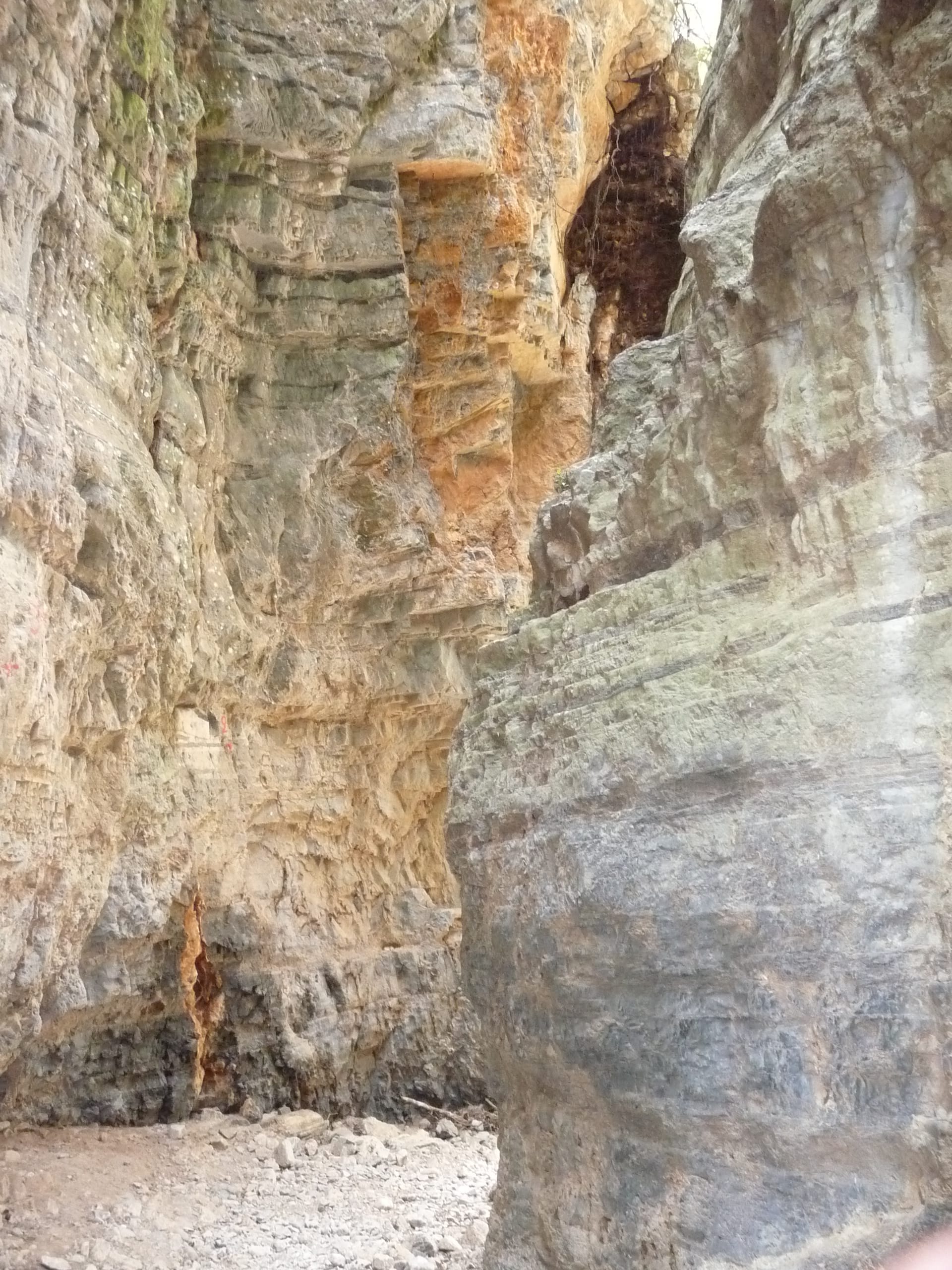
The geology here is the main character. The gorge was carved through Cretan limestone over millennia, and in several sections the canyon walls press in to just 1.6 metres apart. Standing in those narrows, the light drops to a thin strip overhead and the stone walls carry horizontal banding where ancient seabeds were compressed and lifted. It is genuinely dramatic, and unlike Samaria you experience those narrow passages without a crowd of 2,000 people doing the same thing at the same time.
💡 Local tip
The gorge is described as moderate difficulty, not easy. The terrain is rocky and uneven throughout, with large loose stones in many sections. Hiking boots with ankle support make a real difference; sandals or flat trainers will make the descent uncomfortable and slow.
The Walk: What You Encounter Section by Section
The Upper Stretch: Open Air and Olive Groves
The trail enters the gorge below Imbros village, where a small ticket booth collects the entrance fee. The first stretch is relatively open, with scrub oak and Cretan sage bordering the path. The altitude means mornings here are noticeably cooler than the coast, and in late spring the air carries the sharp green scent of wild herbs being warmed by the sun. If you start early, around 8am, you may have this section largely to yourself for the first 30–40 minutes.
The Narrow Passages: The Core of the Experience
After the first kilometre or two, the walls begin to converge. The gorge tightens progressively, and several passages force walkers through gaps barely wide enough for a person carrying a daypack. These sections are shaded almost entirely, and the temperature drops several degrees. The rock surface is damp in spring when water seeps through the limestone, and the smell shifts from dry herbs to something colder and mineral. In summer the streambed is dry; earlier in the season you may find water running between the rocks, which adds sound and a different character to the walk entirely.
Photographers should note that the narrow sections work best in the middle of the day when light filters down from directly above, creating a shaft effect through the stone corridor. Early morning in these sections can be very dark. A phone camera will struggle; a wide-angle lens and willingness to use slower shutter speeds pays off here.
The Lower Gorge: Opening Out Toward the Sea
In the final third, the walls pull back and the terrain shifts to a broader valley with views south toward the Libyan Sea. The light opens up, the path widens, and the village of Komitades comes into view. This is where walkers typically feel the accumulated descent in their knees, so take your time. The end point at Komitades has a small café where you can wait for a return bus or taxi to Hora Sfakion, which is a short drive away on the coast.
Tickets & tours
Hand-picked options from our booking partner. Prices are indicative; availability and final rates are confirmed when you complete your booking.
Excursion to Richtis Gorge from Agios Nikolaos
From 539 €Instant confirmationFree cancellationVisit a Family-Run Olive Mill with Food Tasting in Heraklion
From 19 €Instant confirmationFree cancellationSnorkeling experience in Crete
From 45 €Instant confirmationFree cancellationSpinalonga self-guided audio tour on your phone
From 12 €Instant confirmationFree cancellation
The History Behind the Trail
Imbros Gorge carries a specific and sobering piece of World War II history that most visitors know nothing about. In late May 1941, following the Battle of Crete, several thousand Allied troops, primarily British, Australian, and New Zealand soldiers, retreated south through this gorge toward the coast at Hora Sfakion. They were attempting to reach evacuation ships that would carry them to Egypt. Around 13,000 soldiers made it out; thousands more were captured or killed.
Walking the gorge with this context changes how the landscape reads. The narrow passages, which feel thrilling for a recreational hiker, would have been claustrophobic and terrifying for exhausted soldiers moving at night under fire. The descent that takes a fit walker two to three hours took those soldiers many more, often in darkness, carrying equipment, and under aerial attack. It is worth pausing at the narrows and sitting with that for a moment.
For those building a deeper understanding of Crete's wartime and ancient past, the gorge pairs well with a visit to the broader White Mountains region, which shaped so much of Cretan resistance culture during the occupation.
How Imbros Compares to Samaria
The comparison is inevitable. Samaria Gorge is 16 kilometres long, takes 5–7 hours, and during peak season is one of the most heavily trafficked trails in Greece. Imbros is 8 kilometres, takes 2–3 hours, and on a busy day sees a fraction of Samaria's numbers. Neither is better in an absolute sense. Samaria is a more sustained physical challenge and the scenery has greater variety. Imbros is more accessible, less physically punishing, and gives you the essential gorge experience, the tight narrows, the limestone walls, the scrub vegetation, without a full-day commitment.
Families with children who are confident walkers, older travellers without experience of long mountain hikes, and anyone with limited time but genuine curiosity about Crete's interior landscape will get more from Imbros than from attempting Samaria under pressure.
⚠️ What to skip
The gorge is a one-way walk from Imbros village down to Komitades. You cannot easily walk back up. Plan your return transport in advance: arrange a taxi to pick you up at Komitades, or check current bus timetables on the Chania–Hora Sfakion route. Morning buses from Chania fill up quickly in summer.
When to Visit and What to Expect by Season
The gorge is officially open year-round and there are no strict operating hours recorded at the entrance. In practical terms, the best hiking months are April through June and September through October. Spring brings flowing water in the gorge bed, cooler temperatures, and wildflowers on the upper slopes. October offers golden light, very manageable heat, and noticeably thinner crowds.
July and August are the most demanding months. The streambed is completely dry, the sun is high, and while the gorge is shaded in the narrower sections, the upper and lower stretches are fully exposed. Carry at least 1.5 litres of water per person; there are no reliable water sources inside the gorge in summer. For a broader picture of what Crete offers in different seasons, the guide on the best time to visit Crete covers the trade-offs in detail.
Winter visits are possible but the gorge can be wet underfoot and the path slippery in places. The remoteness of the Sfakia region means help is not immediately at hand if something goes wrong. Lone walkers in winter should inform someone of their plans.
Practical Information for Planning Your Visit
Getting There
By public bus, take the KTEL Chania line toward Hora Sfakion, which passes through Imbros village. In summer, morning buses fill up quickly, so book or arrive at the station early. By car, the drive from Chania takes roughly 1.5 hours via the main north-south road through the White Mountains. Parking is available near the cafés at Imbros village. Organised day tours from Chania and other north-coast resorts include return transport and are worth considering if you are not renting a car.
What to Bring
- Sturdy hiking boots with ankle support — this is the single most important preparation
- At least 1.5 litres of water per person (more in summer)
- Sun protection for the open upper and lower sections
- A light layer for the shaded narrows, which stay cool even in July
- Cash for the entrance fee at the gorge booth
- A charged phone for navigation and emergency contact
Accessibility
The gorge is not accessible for wheelchair users or pushchairs. The rocky, uneven path with large loose stones throughout makes it unsuitable for anyone with significant mobility limitations. It is, however, comfortably within reach for children aged around 7 and above who are used to walking, and for adults of most fitness levels who take the descent steadily and at their own pace.
If you are planning a broader hiking trip across Crete's interior, the hiking in Crete guide maps out trails across difficulty levels and regions.
Insider Tips
- Start the walk by 8am in summer. The narrow sections stay cool regardless, but the exposed upper and lower sections become uncomfortable in full midday heat. An early start also means the upper trail to yourself for the first hour.
- Arrange your return transport before you start walking, not after. At Komitades there is a café but limited mobile signal in the gorge itself. A pre-booked taxi to Hora Sfakion costs a few euros and saves significant frustration.
- The gorge is one-way, but Hora Sfakion on the coast is worth factoring into your day. The small seafront town has excellent fresh fish, and after a two-hour hike downhill, lunch by the water is a logical and satisfying continuation of the day.
- If you want the narrowest sections genuinely to yourself, visit on a weekday in late September or early October. The tourist season has wound down but the weather is still reliably good and the light in the afternoon is excellent for photography.
- The WWII evacuation history is not marked with any formal signage inside the gorge. Doing a small amount of reading about the Battle of Crete before the walk transforms the experience considerably, particularly in the tight passages where you can understand exactly what retreating soldiers would have faced.
Who Is Imbros Gorge For?
- Families with children aged 7 and above who want a manageable but genuinely scenic hike
- Travellers who want the gorge experience without committing a full day to Samaria
- History enthusiasts interested in the Battle of Crete and the WWII Allied evacuation
- Photographers looking for dramatic limestone canyon light and tight-corridor compositions
- Visitors based in Chania looking for a half-day excursion into the island's rugged interior
Nearby Attractions
Other things to see while in Chania:
- Archaeological Museum of Chania
Opened in 2022 in a purpose-built 6,000 m² building in the Chalepa suburb, the Archaeological Museum of Chania traces western Crete's story from the Palaeolithic era through the 4th century AD. With over 4,100 finds, tactile exhibits, and a location just outside the Old Town, it rewards anyone who wants more than a beach holiday.
- Balos Lagoon
Balos Lagoon sits at the northwestern tip of Crete, where a shallow, turquoise-green pool forms between the Gramvousa Peninsula and the rocky spur of Cape Tigani. The sand is faintly pink from crushed shells and coral. The crowds in July and August are real. Here is what the experience actually involves.
- Chania Old Town
Chania Old Town is a living archive of civilizations stacked on top of one another, from Neolithic Kydonia to Venetian merchant palaces to Ottoman minarets. Free to enter and open at all hours, it rewards slow exploration more than rushed sightseeing.
- Elafonissi Beach
Elafonissi Beach sits on Crete's remote southwestern tip, where crushed shells from microscopic foraminifera tint the sand pink and a shallow lagoon connects the shore to a small protected island. Free to enter and genuinely striking, it draws large summer crowds that reward early arrivals and discourage afternoon visits.