Kourtaliotiko Gorge: Where Sound, Stone, and Water Converge
Kourtaliotiko Gorge cuts through the Rethymno highlands for roughly 3 kilometres, its limestone walls rising up to 600 metres above a river that eventually spills into Preveli Beach. The gorge takes its name from the Cretan word for applause, a reference to the wind-carried echo that rings through the canyon walls. This is one of southern Crete's most rewarding short excursions, combining geology, legend, rare wildlife, and river scenery in a compact, accessible package.
Quick Facts
- Location
- Between Koxare and Asomatos, leading to Preveli Beach, Rethymno Prefecture, Crete
- Getting There
- By car via the Koxare–Asomatos road; no regular public bus to gorge entrance
- Time Needed
- 1.5–3 hours depending on route chosen
- Cost
- Entry ticket required during high season (May–October); price varies — book via NECCA ticket portal if applicable
- Best for
- Nature lovers, photographers, geology enthusiasts, families with older children
- Official website
- kourtaliotis-tickets.necca.gov.gr/checkout
What Is Kourtaliotiko Gorge?
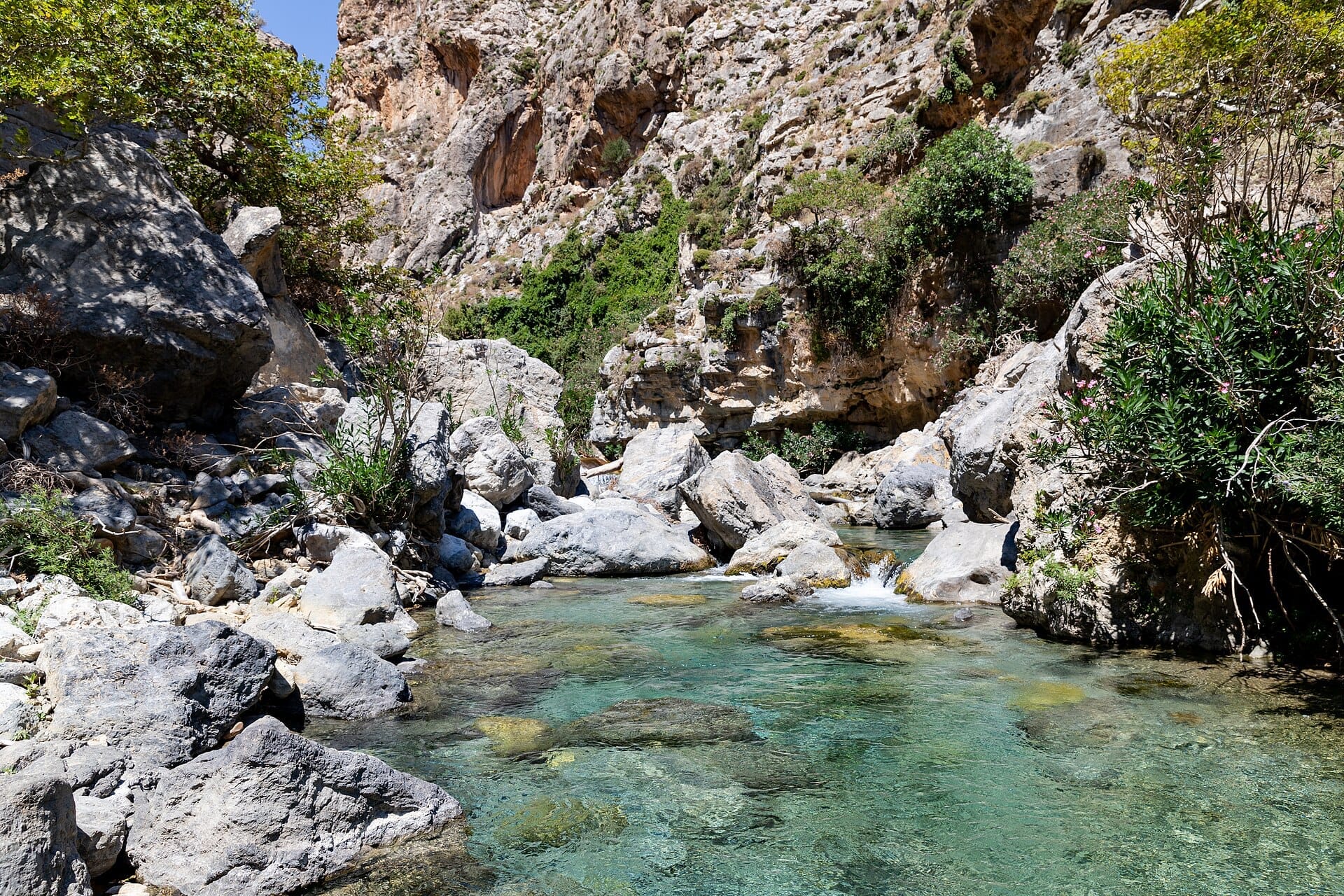
Kourtaliotiko Gorge, known in Greek as Κουρταλιώτικο φαράγγι, is a protected natural canyon carved between two mountains, Kouroupa and Xiro (Xiro Oros), in the Rethymno regional unit of Crete. The gorge runs for approximately 3 kilometres, beginning near the village of Koxare in the north and opening onto the coastal lowlands near Preveli Beach in the south. At its most dramatic points, the vertical limestone walls reach 600 metres in height, channelling the Kourtaliotis River, which is called Megalos River (Big River) closer to its mouth, through a series of pools, cascades, and narrow passages fringed by Cretan wild palms.
The name itself is telling. In Cretan dialect, 'kurtala' means applause or clapping, and anyone who visits on a windy day will immediately understand why. Sound reverberates between the stone faces in a way that genuinely resembles a crowd mid-clap. It is one of those natural acoustic phenomena that no photograph can capture and that first-time visitors remember long after they leave.
The gorge sits within a designated Natura 2000 protected zone, which has important practical consequences for visitors. Swimming in the waterfall pool and cave area is restricted, river bed access is discouraged, and a formal ticketing system managed by NECCA and local municipalities is in place during high season to control visitor numbers during high season. If you are also planning to spend time at Preveli Beach, which sits at the gorge's southern exit, combining both in a single day makes excellent logistical sense.
💡 Local tip
Book your entry ticket online in advance via the NECCA portal (kourtaliotis-tickets.necca.gov.gr). During peak season (May–October), on-site availability can be limited and pre-booking avoids queuing at the entrance.
The Descent: What the Walk Actually Looks Like
The main visitor experience begins at the official car park, from which it is a short walk of 115 to 140 metres to a stone archway marking the entrance. From there, a stone-paved path descends into the gorge in roughly 15 minutes. The path is well-maintained but involves an uneven, moderately steep descent on natural rock surfaces, so footwear with grip is genuinely important. Sandals are a bad idea here regardless of how warm the day feels.
The path leads to the small Church of Saint Nicholas (Agios Nikolaos), which sits against the rock face beside a series of springs. According to local legend, the saint caused five springs to emerge from the stone here, and the water is still regarded with reverence. The church itself is built directly into the cliff, making it feel organic to the landscape rather than imposed upon it. Below the church, a waterfall feeds a shallow pool in a cave-like alcove. This is the visual centrepiece most visitors come for: fractured limestone, hanging vegetation, the sound of falling water, and the smell of damp rock and wild herbs coming down from the slope above.
Beyond this point, the gorge continues toward Preveli and the coast, but the lower sections are not formally maintained as a walking trail and the terrain becomes significantly more demanding. Most casual visitors turn back at or near the church. Those with experience in technical gorge walking can continue, but this should be planned separately and not attempted without local knowledge.
⚠️ What to skip
Swimming in the waterfall pool and cave is prohibited. The area is a protected Natura 2000 site. Rangers are present during peak season and fines can be issued.
Tickets & tours
Hand-picked options from our booking partner. Prices are indicative; availability and final rates are confirmed when you complete your booking.
Excursion to Richtis Gorge from Agios Nikolaos
From 539 €Instant confirmationFree cancellationVisit a Family-Run Olive Mill with Food Tasting in Heraklion
From 19 €Instant confirmationFree cancellationSnorkeling experience in Crete
From 45 €Instant confirmationFree cancellationSpinalonga self-guided audio tour on your phone
From 12 €Instant confirmationFree cancellation
Time of Day and Seasonal Differences
The gorge faces roughly north-south, which means the interior remains in shadow for much of the morning. In summer, this makes an early start far more comfortable than arriving at midday when the surrounding plateau bakes and the descent into the gorge feels like entering a slightly cooler but humid pocket of air. By mid-afternoon in July and August, the car park fills and the path to the church becomes congested enough that the experience loses some of its quiet.
Spring, particularly April through early June, is the period when the gorge is at its most alive. The Kourtaliotis River runs higher and faster after winter rains, the waterfall is substantially more powerful, and the walls are threaded with seasonal wildflowers. The temperature in the gorge itself rarely feels oppressive, and the sound of the water is loud enough to be heard before you see it. Autumn visitors get similar benefits: reduced crowds and a river still carrying reasonable volume.
For those visiting Crete between October and March, the gorge remains open year-round and the mandatory ticketing scheme does not apply outside the May–October window. This makes it one of the more rewarding off-season destinations in the region. For broader guidance on travelling at that time of year, see the guide to visiting Crete in October.
Wildlife and Ecology
Kourtaliotiko Gorge is one of the most significant nesting sites in Crete for the Griffon vulture (Gyps fulvus), a massive raptor with a wingspan that can exceed 2.8 metres. Thermal currents along the cliff faces make this habitat ideal, and sightings of vultures circling above the gorge walls are common, particularly in the morning hours when thermals begin to develop. If you look up and see what appears to be a very large, slow-moving bird riding the air without effort, it is almost certainly a Griffon.
The river corridor supports Egyptian vultures, kestrels, and various migratory species passing through the south of the island. The vegetation along the watercourse includes Cretan date palms (Phoenix theophrasti), oleander, and plane trees, along with patches of lush undergrowth that would feel surprising to anyone who has only seen the dry plateau above. The contrast between the arid landscape at road level and the moisture-rich interior of the gorge is one of the most striking physical features of the visit.
Getting There and Practical Logistics
The gorge is accessible by car from Rethymno town in approximately 30 to 40 minutes, heading south via the E75 and then turning onto the local road through Koxare. There is no regular public bus service that stops at the gorge entrance, which makes a rental car or organised tour the only realistic options for most visitors. The official car park is clearly signposted from the main road and is the correct place to leave your vehicle, particularly during the May–October season when roadside parking along the gorge road is prohibited as part of the visitor management scheme.
If you are basing yourself on the southern coast, the gorge sits roughly between Plakias and the Rethymno plateau, making it a natural stop on any route between the two. Combining a gorge visit in the morning with an afternoon at Preveli Beach, a short drive south of the gorge exit, is a very common and logical itinerary.
If you are planning to explore this part of the island more thoroughly, the Crete road trip guide covers the southern Rethymno coast in detail, including road quality, fuel stops, and alternative routes.
ℹ️ Good to know
Wear sturdy closed-toe shoes with grip. The path to the church involves uneven stone steps and damp surfaces near the waterfall. Light layers are advisable even in summer, as the gorge interior is noticeably cooler than the surrounding landscape.
Photography Notes
The gorge is at its most photogenic from late morning onward, when indirect light filters down between the walls without the harsh contrast of direct midday sun. The church-and-waterfall combination photographs best from the path approaching it, before you descend to the pool level, as you get the full context of cliff, structure, and water in a single frame. Wide-angle lenses work well for capturing the scale of the walls; a longer lens is useful for photographing vultures without disturbing them.
Moisture from the waterfall and the generally humid air near the pool will affect lenses and camera bodies. Bring a microfibre cloth and keep gear in a bag until you are ready to shoot. On overcast days, the diffused light actually improves colour saturation in the vegetation, making it one of the rare natural sites that can photograph better under cloud cover than under direct sunshine.
Who Should Consider Skipping This
The Kourtaliotiko Gorge is genuinely not suitable for visitors with significant mobility limitations. The descent involves uneven stone, a moderate gradient, and surfaces that are wet near the waterfall regardless of season. There is no alternative route to the main viewpoints, and the return uphill, though short, requires reasonable fitness. If walking on irregular terrain is a concern, this is one to consider carefully.
Those who have already visited the Samaria Gorge and are hoping for a similar scale of experience may find Kourtaliotiko feels compact by comparison. It is not a full-day trekking gorge. It is a 1.5 to 3 hour nature excursion with a strong visual payoff. Adjusting expectations accordingly leads to a far better experience than treating it as an alternative to Samaria.
Insider Tips
- Arrive before 9:30 am in summer to have the path to the church almost entirely to yourself. The light is softer, the bird activity is higher, and you can hear the waterfall from further away without crowd noise.
- Look up regularly as you descend. Griffon vultures often circle directly overhead and are easy to miss if you are focused on the path. The best sightings happen when thermals start to build, typically 45 minutes to an hour after sunrise.
- The spring water near the Church of Saint Nicholas is cold and clean. Locals fill bottles here. Bring an empty one.
- If you want to walk the full gorge to the coast, plan a separate day and research conditions beforehand. The lower section requires route-finding experience and is not a maintained trail.
- The gorge road between Koxare and Asomatos is narrow in places. If you meet an oncoming vehicle on a blind bend, the passing points are infrequent. Drive slowly and use your horn before sharp corners.
Who Is Kourtaliotiko Gorge For?
- Nature and wildlife observers, especially those interested in raptor sightings
- Photographers looking for dramatic geological scenery and waterfall subjects
- Travellers combining a half-day gorge visit with Preveli Beach in the afternoon
- Families with children aged 8 and above who are comfortable on uneven paths
- Off-season visitors wanting a rewarding outdoor experience without summer crowds
Nearby Attractions
Other things to see while in Plakias & South Coast:
- Agia Galini
Perched amphitheatrically above Messara Bay on Crete's southern coast, Agia Galini is a small fishing village with steep lanes, a sheltered harbor, and a beach within 100 meters of the center. Its name means 'Holy Peace' in Greek, and for most of the year, that description holds.
- Matala Beach
Matala Beach on Crete's south coast is unlike any other stretch of sand on the island. A 250-metre Blue Flag bay backed by cliff caves that served as Roman tombs, then 1960s hippie dens, it rewards curious travelers who want history and a good swim in the same afternoon.
- Matala Caves
Cut into sandstone cliffs above one of southern Crete's most atmospheric beaches, the Matala Caves are an open-air archaeological site with a layered past: Roman burial chambers, a Minoan port connection, and a 1960s countercultural chapter that gave this quiet village an unlikely legendary status. The views from the cliff face alone justify the small entrance fee.
- Plakias Beach
Plakias Beach stretches 1.3 kilometres along the south coast of Crete's Rethymno Prefecture, backed by mountains and facing the Libyan Sea. Free to enter, Blue Flag certified, and far quieter than the north coast resorts, it rewards travellers who make the drive south.