Dikteon Cave: Inside the Legendary Birthplace of Zeus
Carved into the northern slopes of Mount Dikti at 1,025 metres, the Dikteon Cave is one of the most mythologically charged sites in Greece. Used from the Neolithic period through Roman times, this ancient sanctuary is where legend says Rhea gave birth to Zeus — and the cave's dripping stalactites and cold, cathedral-like chambers make that story feel entirely plausible.
Quick Facts
- Location
- Psychro village, Lassithi Plateau, Lasithi Prefecture — elevation 1,025 m
- Getting There
- Car or rental vehicle required; no public bus to cave. ~2 hrs from Heraklion by road. Park at the tourist kiosk, then 20-min uphill hike (~200 steps, 100 m ascent) or hire a donkey at the trailhead.
- Time Needed
- 2–3 hours including the hike up, cave visit, and descent
- Cost
- Admission fee charged (verify current rate on-site or via official source before visiting)
- Best for
- Mythology enthusiasts, history lovers, families with older children, cave explorers
- Official website
- http://odysseus.culture.gr/h/2/eh251.jsp?obj_id=1628
What the Dikteon Cave Actually Is
The Dikteon Cave, officially known as Diktaion Antron (Δικταῖον Ἄντρον) and sometimes called Psychro Cave after the nearby village, sits on the northern flank of Mount Dikti at 1,025 metres above sea level. It is one of the most archaeologically significant sacred caves in the Aegean world, with evidence of religious use stretching from the Neolithic period through the Roman era — a span of roughly five thousand years.
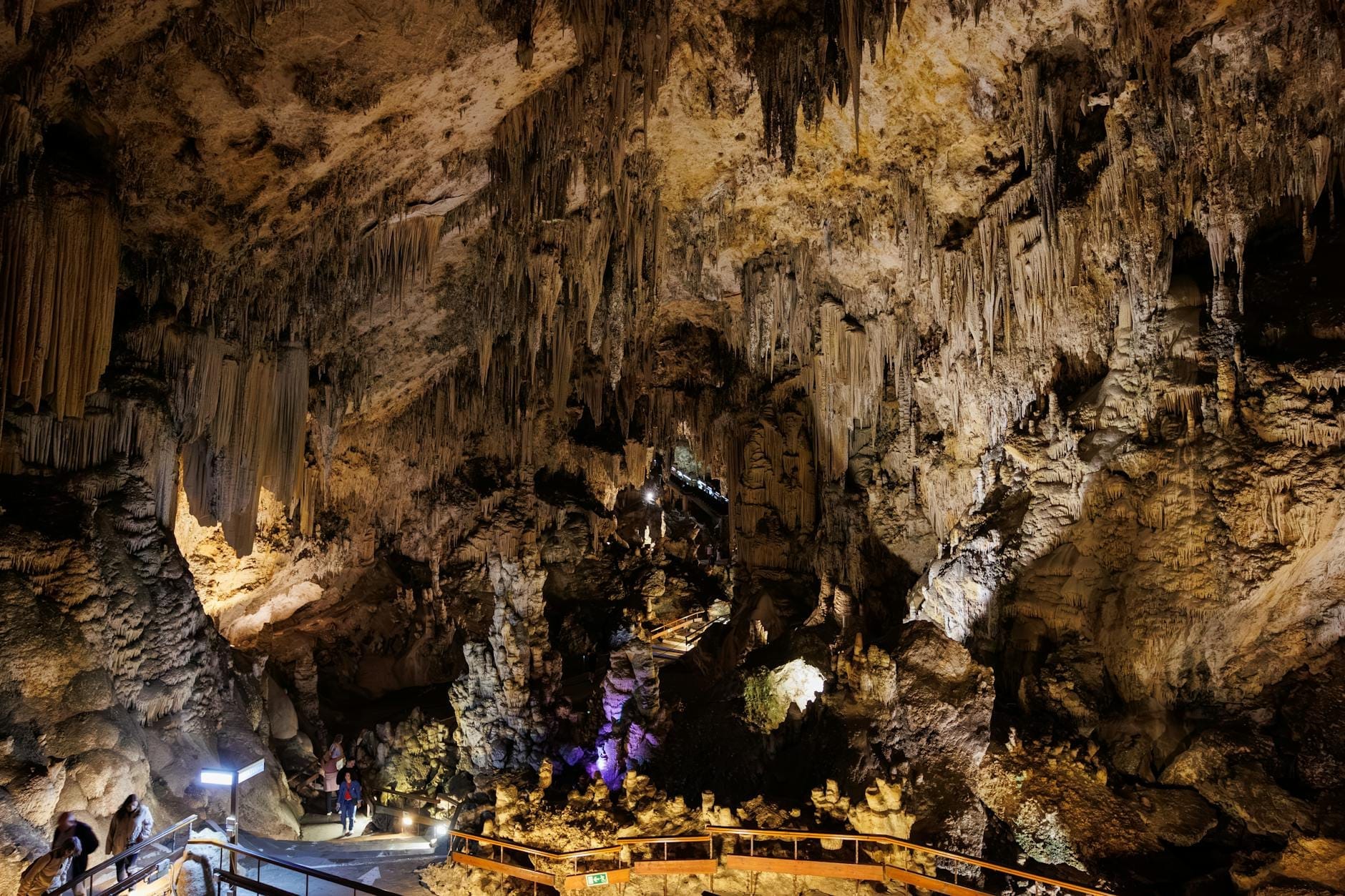
The cave covers approximately 2,200 square metres and descends through five distinct chambers. The lower chambers contain a shallow subterranean lake, and the walls and ceiling are thick with stalactites and stalagmites formed over millions of years. Minoan votive offerings — including bronze figurines, double axes, and pottery — were deposited here in enormous quantities, pointing to a sanctuary of island-wide importance rather than a local cult site.
ℹ️ Good to know
The cave interior maintains a constant cool temperature year-round. Even in August, when the plateau above bakes, you will want a light jacket or layer inside. The stone steps are slick from moisture, so wear closed-toe shoes with grip.
The Myth and Why It Matters Here
According to the most widely cited version of the Greek creation myth, Rhea hid the infant Zeus in this cave to protect him from his father Kronos, who had been swallowing his children to prevent any son from overthrowing him. The Kouretes — divine attendants — beat their shields together to drown out the baby's cries. Zeus would eventually return the favor by defeating Kronos and establishing the Olympian order.
Standing in the lower chamber, where the air is cold, the stone is perpetually damp, and the formations press in from every angle, the myth doesn't feel arbitrary. The cave has a genuinely primal quality: dark, enclosed, acoustically strange. Sound travels oddly here. Dripping water amplifies. It is easy to understand why ancient Greeks chose this specific place to anchor such a foundational story.
It is worth noting that an alternative tradition places Zeus's birthplace at the Ideon Cave, on Mount Ida (Psiloritis) in central Crete. Scholars debate which site holds the stronger archaeological claim. The Dikteon Cave's Minoan finds are extensive and well-documented, and the site is listed under the Greek Ministry of Culture. Visitors interested in the broader Minoan world should also consider the Palace of Knossos and the Heraklion Archaeological Museum, where many objects excavated from sacred caves are on display.
Tickets & tours
Hand-picked options from our booking partner. Prices are indicative; availability and final rates are confirmed when you complete your booking.
Melidoni Cave, Margarites, and more guided tour in Crete
From 116 €Instant confirmationFree cancellationCrete highlights day-tour with Cave of Zeus
From 540 €Instant confirmationCave of Zeus & mountainous East Crete adventure private tour
From 590 €Instant confirmationFree cancellationCave of Zeus & mountainous East Crete private tour from Chania
From 730 €Instant confirmationFree cancellation
The Hike Up: What to Expect Before You Enter
The approach to the cave is part of the experience, and it requires honest preparation. After parking at the tourist kiosk roughly halfway up the hillside, you face a 20-minute climb of about 100 vertical metres on a well-worn stone path. The ascent involves approximately 200 steps in total, some steep and uneven. The surrounding landscape is open scrubland and rock, with views across the Lassithi Plateau widening as you climb.
At the base of the trail, operators offer donkey rides for visitors who cannot or prefer not to walk. This is a practical option for children or those with mobility concerns on the way up, though the interior of the cave itself is not accessible by wheelchair or mobility aid — the steps inside are steep and the passages narrow in places.
💡 Local tip
Start your visit before 10:00 to avoid the tour bus crowds. The Lassithi Plateau is a popular day-trip destination from Heraklion and Agios Nikolaos, and the cave entrance queue can grow significantly by late morning in peak season (July–August).
The hike down is faster but harder on the knees — take the descent slowly, especially after rain, when the stone surface becomes genuinely slippery. Morning light illuminates the plateau below most flatteringly for photography, so the pre-10:00 timing serves double duty.
Inside the Cave: Chamber by Chamber
At the cave entrance, you step from bright Mediterranean daylight into near-darkness within a few metres. The temperature drops noticeably. The cave is lit artificially along the main path, which helps orient visitors, though the lighting is subdued enough to preserve atmosphere rather than turning the interior into a fairground attraction.
The upper chamber is large and open, giving a false impression of a modest space. But the path descends steeply into the lower chambers, where the scale expands dramatically. Stalactites hang in dense clusters from ceilings several metres high, and stalagmites rise from the floor in formations that resemble draped fabric or frozen waterfalls. The subterranean lake sits at the lowest accessible point — shallow, still, and reflecting the formations above it.
During Minoan times, worshippers would have descended into these lower spaces to leave offerings. The experience of going deeper into the cave corresponds, symbolically, to moving closer to the divine. Archaeologists excavating the site recovered an extraordinary range of artifacts now distributed between the Heraklion Archaeological Museum and other collections. What you see today is the raw geological setting of that worship, stripped of its offerings but retaining its full atmospheric power.
⚠️ What to skip
The cave has been closed periodically for conservation works and may close again for restoration. Verify current opening status directly with the site (tel: +30 28410 22462) or via the official Ministry of Culture page before making a long drive to the plateau.
How the Experience Changes by Time of Day and Season
Early morning is unambiguously the best time. The plateau is quiet, the air still cool, and the light on the hillside path clean and directional. The cave itself stays the same temperature regardless of the hour, but the walk up and the views are measurably better before the midday haze settles over the plateau.
By 11:00 in high summer, the path fills with guided tour groups moving in single file. The cave's narrow sections create natural bottlenecks, and the acoustic effect of multiple groups speaking simultaneously inside a cave is not pleasant. If you arrive mid-morning without a reserved slot, you may find yourself shuffling rather than exploring.
Late spring (May to early June) and September are arguably the most rewarding windows. The plateau is green rather than sun-bleached, temperatures on the hike are comfortable, and visitor numbers are substantially lower. October visits are also feasible and increasingly popular — see the guide to visiting Crete in October for broader seasonal context.
Winter visits are theoretically possible on open days, but road conditions on the mountain road approaching the Lassithi Plateau can be difficult after snowfall, and the site operates on reduced hours. The 6th of January sees limited hours (08:30–15:00), and the 1st of January the site is closed entirely. Always confirm hours before traveling in the off-season.
Pairing the Cave with the Lassithi Plateau
The Dikteon Cave sits at the edge of the Lassithi Plateau, one of the most distinctive landscapes in Crete: a flat, fertile highland basin ringed by the Dikti mountains at roughly 840 metres elevation. The drive around the plateau before or after the cave visit adds real depth to the day. The plateau is known historically for its thousands of white-sailed windmills used for irrigation, though most are no longer operational. A few restored examples remain near the Lassithi windmills area and make a worthwhile short stop.
The village of Psychro itself, directly below the cave parking area, has tavernas serving straightforward Cretan food: grilled meats, dakos, local cheese, and honey from plateau hives. It is a reasonable place for lunch after the visit without any expectation of culinary sophistication, and portions are generous.
For visitors building a broader itinerary, the Lassithi region also contains the Minoan Palace of Zakros further east, and the nearby town of Agios Nikolaos serves as a practical base for exploring the region without committing to the more remote plateau accommodation.
Who Will Get the Most From This Visit, and Who Won't
The Dikteon Cave rewards visitors who come with some background in Minoan history or Greek mythology. Without that context, the cave is geologically impressive but lacks the layer of meaning that makes it genuinely affecting. If mythology and ancient religion interest you even moderately, the experience of standing where the ancient Greeks believed a god was born — in a cave that really was used for sacred ritual for thousands of years — is remarkable.
Visitors who struggle with steep, uneven terrain or enclosed spaces should approach cautiously. The path inside is not extreme, but it is physically demanding relative to a standard museum or archaeological site. Young children who are comfortable with short hikes and not prone to claustrophobia generally find the cave exciting rather than frightening, especially the stalactites and the underground lake.
Travelers whose primary interest is beaches, nightlife, or Venetian architecture may find the journey to the plateau — especially the long, winding mountain road — a poor use of a limited day. The cave is not the kind of attraction that works as a casual detour. It requires commitment: a full morning or afternoon, appropriate footwear, and a genuine interest in what you are going to see.
Insider Tips
- Arrive at the trailhead parking area by 08:30–09:00 in July and August. Tour buses begin arriving around 10:30, and the narrow cave interior becomes genuinely congested. The first hour of opening is qualitatively different from midday.
- Bring a small torch or phone flashlight. The official lighting illuminates the main path adequately, but side formations and detail in the upper chambers are much easier to appreciate with your own light source pointed at specific features.
- The donkey operators at the trailhead base are legitimate, licensed services and a reasonable option for the ascent if you have children under seven or any knee issues. Negotiate the price clearly before setting off, and note that the donkeys only cover the hike up, not the cave interior.
- The cave temperature hovers around 10–14°C regardless of season. A light fleece or packable jacket makes a real difference, especially after the warm walk up when your body is cooling down rapidly upon entry.
- If you are combining the cave with a full Lassithi Plateau loop, drive the plateau circuit counterclockwise from Psychro (toward Tzermiadou and the plateau windmill area) to avoid the worst of the tourist traffic and to catch the best afternoon light on the mountains.
Who Is Dikteon Cave (Cave of Zeus) For?
- Mythology and ancient religion enthusiasts who want to stand inside a genuinely sacred ancient space
- Minoan history travelers building a broader itinerary across Crete's archaeological sites
- Families with older children (8+) who can manage a 20-minute uphill hike and are comfortable in cave environments
- Visitors seeking a full day combining mountain scenery, a distinctive landscape, and cultural depth away from coastal crowds
- Photographers interested in geological formations and dramatic interior cave lighting
Nearby Attractions
Other things to see while in Lassithi Plateau:
- Lassithi Plateau Windmills
The windmills of the Lassithi Plateau are among Crete's most distinctive landmarks, ranging from the ancient stone mills at Seli Ambelou Pass to the remnants of thousands of white-sailed irrigation pumps that once dotted the plateau floor. Free to visit and open around the clock, they reward curious travelers who take the mountain road into eastern Crete.