Lassithi Plateau Windmills: History, Access, and What You Actually See
The windmills of the Lassithi Plateau are among Crete's most distinctive landmarks, ranging from the ancient stone mills at Seli Ambelou Pass to the remnants of thousands of white-sailed irrigation pumps that once dotted the plateau floor. Free to visit and open around the clock, they reward curious travelers who take the mountain road into eastern Crete.
Quick Facts
- Location
- Lasithi Plateau, Lasithi regional unit, eastern Crete (approx. 35°11′N 25°28′E)
- Getting There
- By car from Heraklion (~1 hr) via the Agios Nikolaos road; seasonal buses serve plateau villages from Heraklion and Agios Nikolaos
- Time Needed
- 30–60 min at Seli Ambelou; half a day if exploring the wider plateau
- Cost
- Free. Open access at all hours, no gates or entry fees
- Best for
- Landscape photography, history enthusiasts, road-trippers, and travelers combining with a visit to the Dikteon Cave
What the Lassithi Plateau Windmills Actually Are
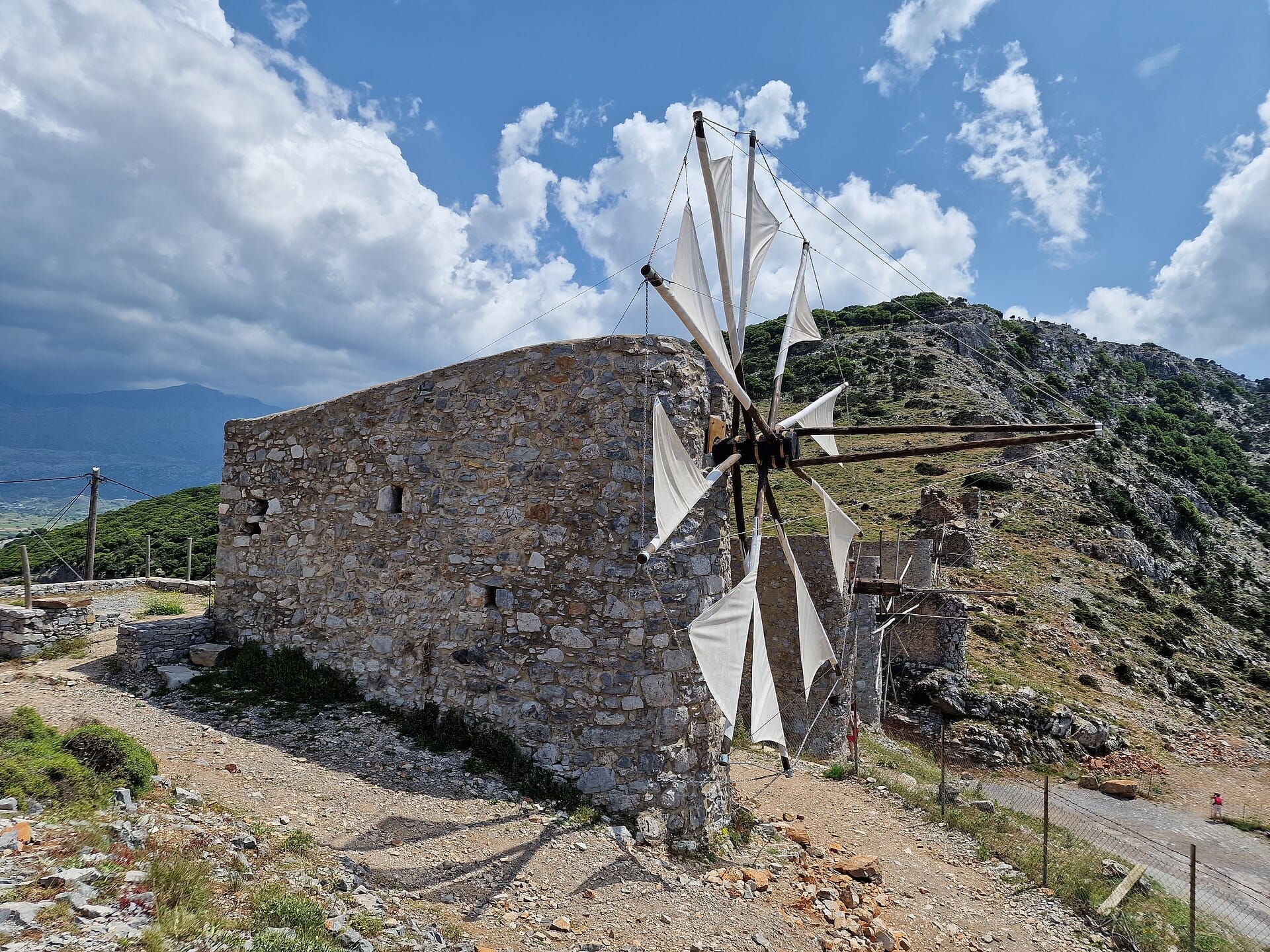
The phrase 'Lassithi windmills' refers to two distinct things that visitors often conflate. The first is the cluster of stone windmills at Seli Ambelou (also written Seli Ambelos), a mountain pass at the northern entrance to the plateau. These are ancient grinding mills, sturdy rectangular structures of the Axetrocharis type, built with fixed sails oriented to face the prevailing northwest wind. Twenty-four of the original 26 to 27 mills survive. They were relocated here in the late 19th century from the nearby villages of Zaroma and Potami, and in 1986 they were officially designated as works of exceptional folk art.
The second windmill story belongs to the plateau floor itself. From the 1920s onward, farmers installed somewhere between 10,000 and 15,000 white-sailed wind-pumps across the fertile basin to irrigate their apple orchards, potato fields, and vegetable plots. At their peak, the sight of thousands of spinning white triangles against the high mountain walls was reportedly extraordinary. Today, most have been abandoned in favor of diesel and electric pumps. A handful of restored examples remain, mainly near the village of Tzermiado, but visitors expecting a sea of spinning sails will be disappointed. What remains is more archaeology than spectacle.
ℹ️ Good to know
Practical note: The stone windmills at Seli Ambelou Pass are the most photogenic and historically significant stop. Set your GPS for Seli Ambelou (or Ambelos Pass) rather than simply 'Lassithi windmills' to avoid driving to the wrong part of the plateau.
The Drive Up: Approaching the Plateau
The road to Lassithi is part of the experience. Coming from Heraklion, the route climbs through the foothills of the Dikti mountain range, passing through villages where the air gradually cools and the olive groves thin out. The final kilometers before the pass involve switchbacks that open onto long views south across the Aegean on clear days. The stone windmills of Seli Ambelou appear at the crest of the pass, lined up along a low ridge at roughly 900 meters elevation, before you descend into the plateau.
The plateau itself sits at around 840 meters above sea level, a broad, nearly flat agricultural basin ringed by peaks that reach above 2,000 meters. In spring, the fields are intensely green and apple trees are in blossom. In summer, the heat of coastal Crete is almost entirely absent here, making the plateau noticeably cooler than the resorts below. In October and November, mist settles in the bowl in the mornings and the harvested fields take on a bleached, quiet character.
The plateau is also one of the more accessible mountain destinations on the island. For context on planning a longer route through eastern Crete, the Crete road trip guide covers the Lasithi region as part of a broader eastern circuit.
Tickets & tours
Hand-picked options from our booking partner. Prices are indicative; availability and final rates are confirmed when you complete your booking.
Private guided tour of Crete with Knossos Palace and Lassithi Plateau
From 650 €Instant confirmationFree cancellationVisit a Family-Run Olive Mill with Food Tasting in Heraklion
From 19 €Instant confirmationFree cancellationSnorkeling experience in Crete
From 45 €Instant confirmationFree cancellationSpinalonga self-guided audio tour on your phone
From 12 €Instant confirmationFree cancellation
The Seli Ambelou Windmills Up Close
The mills at the pass are more austere than romantic. They are roughly built from local stone, with low rectangular bases and short towers. Most are roofless or partially collapsed, but the form is clear, and a few have been partially restored. The sails, where they exist at all, are fixed wooden frameworks rather than the fabric sails that once turned in the wind. The row of mills stretches for perhaps 200 meters along the ridge, and you can walk the full length in ten minutes on a well-maintained footpath.
What makes the site worthwhile is the combination of the mills with the landscape framing them. To the north, the road descends toward the coast. To the south, the plateau opens up in a wide green ellipse with the Dikti peaks behind it. On a clear morning, the light hits the stone from the east and the mills cast long shadows across the dry grass. By midday the whole site is exposed and flat-lit, which is less interesting for photography but fine for a quick stop. Late afternoon brings warm light again from the west.
💡 Local tip
Photography tip: Arrive at Seli Ambelou within the first two hours after sunrise or in the 90 minutes before sunset. The directional light picks out the texture of the stone and the mountains behind the mills become more three-dimensional. Midday shots tend to look flat.
There are no facilities at the pass itself. No ticket booth, no café, no toilets. A small roadside area allows parking for several cars, and during the summer months tour buses occasionally stop here as part of organized excursions to the Dikteon Cave. On those days, you may have 15 to 20 minutes of relative solitude before a group arrives. If you time it for early morning or late afternoon, you will often have the site to yourself entirely.
Historical and Agricultural Context
Windmills for grain grinding have been in use on the Lassithi Plateau since at least the Byzantine period, and the technology was refined under Venetian rule from the 13th century onward. The Venetians recognized the plateau's agricultural potential but also used it strategically: at one point they banned settlement there to deny mountain rebels a supply base, a period that lasted roughly two centuries before cultivation resumed.
The large-scale irrigation windmills that transformed the plateau floor came much later, mostly from the 1920s through the mid-20th century. The white canvas-sailed pumps pulled water from underground sources to irrigate what became one of the most productive agricultural zones in Crete. Potatoes from Lassithi developed a reputation for quality across Greece. The shift to motorized pumps from the 1970s onward made the wind-pumps economically unviable, and they were abandoned gradually rather than all at once. What survives today is scattered and mostly in poor repair.
The broader agricultural and cultural heritage of the region connects naturally to the Minoan sites in the area. The Dikteon Cave near Psychro, one of the most significant Minoan religious sites in Crete, is a 20-minute drive from the Seli Ambelou pass and makes a logical pairing on the same day.
Exploring the Plateau Floor
Once you descend from the pass, the plateau road loops through a series of small villages including Tzermiado, Agios Georgios, and Psychro. The villages are working agricultural communities, not tourist resorts, and they have a quieter, more ordinary character than the coastal towns. A few tavernas serve traditional Cretan food, and small folk museums in Agios Georgios and elsewhere document the history of the wind-pumps and local life.
The irrigation wind-pumps that remain on the plateau floor are scattered across fields and not concentrated in any single viewpoint. You will see them from the road, often standing alone in a plowed field or beside an orchard, their white-painted frames weathered and the canvas long gone. They are evocative in the way that ruined industrial equipment often is, but they require a certain patience. If you are expecting a landscape full of spinning sails, this is not that place anymore.
The Lassithi Plateau itself is detailed as a destination in its own right. For a broader overview of what to do in the area beyond the windmills, see the Lassithi Plateau destination guide.
⚠️ What to skip
Weather note: The plateau sits at high elevation and weather can change quickly, especially in spring and autumn. Bring a layer even in summer, and note that the access road can be affected by snow or ice in winter months, sometimes making it impassable.
Who This Attraction Suits and Who It Doesn't
Travelers who respond well to landscape combined with vernacular history will find the windmill stop genuinely satisfying. The Seli Ambelou mills are an honest piece of Cretan rural heritage, and the setting is dramatic without being manicured. The plateau itself rewards slower travel: people who enjoy driving through agricultural countryside, stopping at village kafeneions, and piecing together a picture of how Crete has functioned outside of tourism.
Travelers who need clear spectacle, a guided narrative, or visible scale of grandeur may leave underwhelmed. The mills are not tall or imposing. Many are partially ruined. There are no information panels explaining their history in depth, and no staff to provide context. If you are visiting Crete for beaches and coastline and have only a few days, the windmills alone probably do not justify the mountain detour. The calculation changes if you pair the visit with the Dikteon Cave or build it into a full-day plateau circuit.
For travelers planning their time carefully across the island, the one-week Crete itinerary suggests how the Lassithi region fits into a broader schedule without feeling rushed.
Insider Tips
- The mills at Seli Ambelou are best photographed from the south side of the road, where you can frame them against the plateau backdrop rather than against the parking area. Walk 50 meters past the main stopping point for the cleaner angle.
- Spring (April to May) is the best time to visit the plateau. The fields are at their greenest, apple trees are flowering, and the snow on the Dikti peaks behind the plateau is still visible, making for a striking combination that summer dries out entirely.
- Most tour groups visit between 10 am and 1 pm en route to the Dikteon Cave. Arriving before 9 am or after 3 pm gives you the pass almost entirely to yourself.
- The village of Tzermiado has the best concentration of working tavernas on the plateau. If you want to eat locally rather than driving back to the coast, stop there for lunch rather than at the more tourist-oriented spots near Psychro.
- The Seli Ambelou site is listed as accessible for visitors with mobility needs, and the footpath along the mills is relatively flat and compact, making it one of the more wheelchair-friendly rural heritage sites in the Lasithi region.
Who Is Lassithi Plateau Windmills For?
- Road-trippers crossing eastern Crete who want a worthwhile mountain detour with historical depth
- Photographers looking for dramatic landscape compositions combining stone architecture with high-altitude scenery
- History and archaeology travelers pairing the windmills with the nearby Dikteon Cave or Minoan sites
- Visitors seeking cooler temperatures during summer, when the plateau sits well below the coastal heat
- Travelers interested in traditional Cretan agriculture and rural life away from resort areas
Nearby Attractions
Other things to see while in Lassithi Plateau:
- Dikteon Cave (Cave of Zeus)
Carved into the northern slopes of Mount Dikti at 1,025 metres, the Dikteon Cave is one of the most mythologically charged sites in Greece. Used from the Neolithic period through Roman times, this ancient sanctuary is where legend says Rhea gave birth to Zeus — and the cave's dripping stalactites and cold, cathedral-like chambers make that story feel entirely plausible.