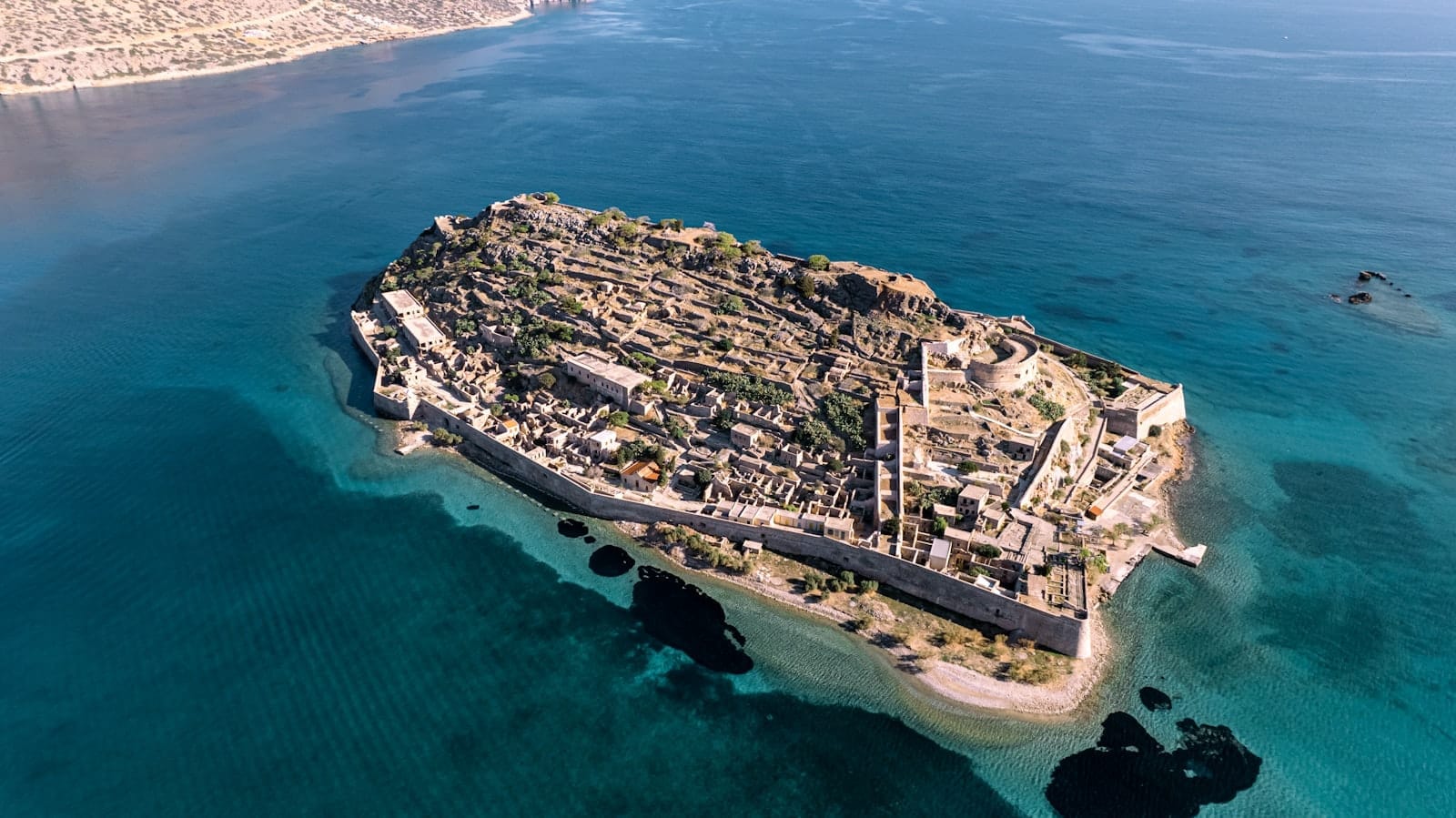
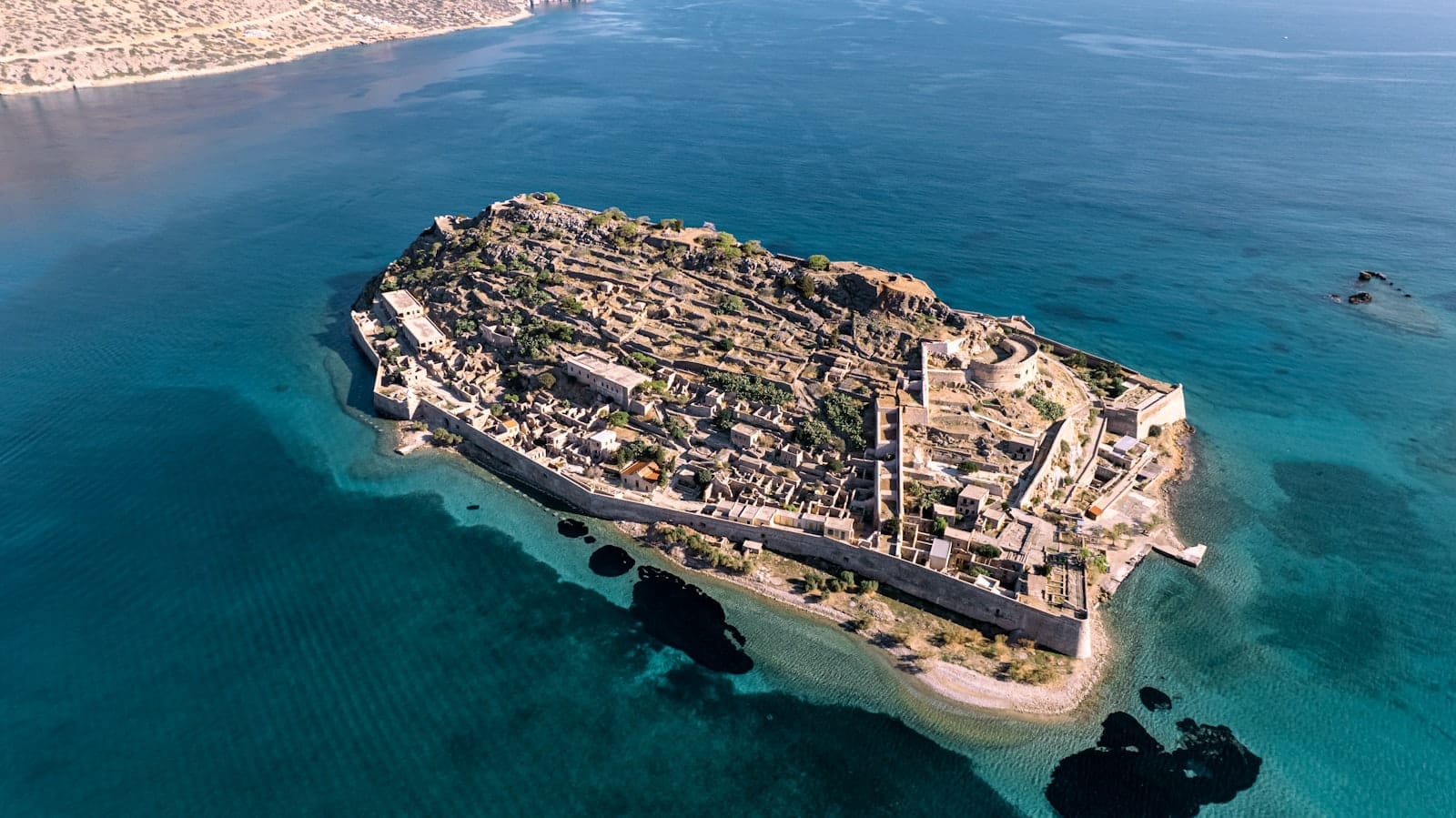
Elounda sits on the northern coast of Crete's Lasithi region, facing the cerulean waters of Mirabello Bay. It is best known as the address of choice for high-end resort holidays and as the departure point for boat trips to the haunting Venetian fortress of Spinalonga Island. Small, unhurried, and positioned between dramatic coastal scenery and deep history, it is the kind of place that rewards those who come prepared.
Elounda is Crete's most prestigious coastal address: a quiet town of around 2,250 people that somehow hosts some of the Mediterranean's most acclaimed luxury resorts. Its real draw runs deeper than five-star pools, though. The Venetian salt flats, the boat-trip to Spinalonga's leper-colony fortress, and the long curve of Mirabello Bay give the area a layered, unhurried character that lingers long after you've checked out.
Orientation: Where Elounda Sits on the Map
Elounda occupies the western shore of Mirabello Bay, roughly 68 km east of Heraklion and 11 km north of Agios Nikolaos. The road from Agios Nikolaos winds uphill along the shoreline before dropping into the coastal plain where Schisma, the town's most populated and central village, sits beside a small fishing harbor. That ~12 km stretch of road is one of the more scenic drives in the Lasithi region, with the bay opening out below and the island of Spinalonga visible from certain viewpoints.
Administratively, Elounda is a community within the Agios Nikolaos municipality, comprising seven distinct settlements: Schisma (the main hub), Epano Elounda, Mavrikiano, Kato Chorio, Epano Chorio, Kato Pines, and Plaka, a smaller coastal village to the north. The uninhabited peninsula and island area that includes the ancient ruins of Olous sits just south of the town center, connected to it by a narrow causeway with a concrete pedestrian bridge.
The surrounding geography divides the area into two distinct coastal sub-zones. The bay of Korfos, a sheltered inlet to the south of the channel, is calmer and shallower, historically used for the Venetian salt works. Mirabello Bay itself, broader and open to the north, is where most of the resort coastline lies. Understanding this split helps orient you when navigating between the town's different beaches and attractions.
ℹ️ Good to know
Elounda sits at approximately 35°16′N, 25°43′E. The central square in Schisma is the practical anchor for the whole area: it is where buses stop, boats depart, and most cafés and tavernas are concentrated.
Character and Atmosphere: How Elounda Actually Feels
Early mornings in Elounda belong almost entirely to locals. The fishing harbor in Schisma is quiet before 8am, with a few boats heading out and the kafeneions serving strong Greek coffee to a clientele that has been coming here for decades. The light across Mirabello Bay in the morning is flat and silver, the water barely moving. Walk south along the shoreline path toward the salt flats at this hour and you will likely have the path to yourself.
By mid-morning the character shifts. The boat departure points near the harbor become the focal point for day visitors taking trips to Spinalonga Island. Tour groups from Agios Nikolaos and resort guests converge on the harbor front, and the central square fills with the familiar choreography of a popular tourist destination: menus in multiple languages, sunscreen-slicked visitors waiting for tickets, and water taxis idling. This is not a bad thing, but it is honest. Elounda in July and August is unambiguously a high-season tourist town.
Afternoons settle into a slower rhythm dictated by the heat. Most visitors retreat to resort pools or the shaded terraces of seafront cafés. The streets around the harbor square are warmest and most crowded at midday; if you want the salt flats or the channel ruins to yourself, this is actually a good window. The light in the late afternoon turns golden across the bay and the views back toward the Lasithi hills become properly cinematic.
After dark, Elounda is genuinely relaxed. This is not a nightlife destination. The waterfront restaurants fill up for dinner, there are a few bars around the central square, and the promenade gets its evening walkers, but things wind down well before midnight in the town center itself. The luxury resort strip along the coast toward Katevati operates in its own contained universe: private beaches, pool bars, and resort restaurants that rarely intersect with the village at night.
⚠️ What to skip
Elounda is at its most crowded between late June and early September, when the Spinalonga boats run at full capacity and the harbor front becomes genuinely packed by 10am. Visiting the island earlier in the season, or arriving at the harbor before 9am, makes a significant difference to the experience.
What to See and Do
The defining experience in Elounda is the boat trip to Spinalonga Island. The small island sits less than a kilometer offshore and carries one of the most layered histories in the Aegean. Its Venetian fortress dates to 1579 and was never taken by the Ottomans during their conquest of Crete in the 17th century; it remained a Venetian outpost until 1715, long after the rest of the island had fallen. The Ottomans then used it as a garrison and settlement until Crete gained autonomy in 1898, and from 1903 to 1957 it served as Greece's last active leper colony. Victoria Hislop's novel 'The Island' and the subsequent Greek TV series brought a new wave of visitors, and the site draws enormous crowds in summer. The ruins are extensive and the atmosphere, particularly toward the far end of the island away from the main boat landing, is genuinely affecting.
South of the town, the Venetian salt flats reward a quiet hour of walking. The shallow pans, most no longer in active use, still hold color and birdlife, and the area has an understated, almost melancholy quality that feels very different from the resort coast. A 1.5 km seafront path links the central harbor to this area.
At the southern end of the narrow isthmus, a French-built channel constructed in 1897 connects Mirabello Bay to the inner bay of Korfos. A concrete pedestrian bridge crosses it, and on the isthmus itself lie the partially submerged ruins of Olous, an ancient Minoan and later Roman settlement. Some of the ruins are visible just below the waterline on calm days, and there are mosaic fragments from an early Christian basilica visible on the causeway. It is an unusual site: no entrance gate, no signage, just history at ankle level.
For those who want more physical activity, the Mount Oxia circular hike covers approximately 10.5 km and climbs to 540 meters above sea level. It starts near the Schisma area and offers panoramic views across the full arc of Mirabello Bay. The trail is not marked to international standards, so a detailed map or GPS track is useful. Go early in summer; the upper sections are fully exposed.
Boat trips to Spinalonga Island, departing from the central harbor in Schisma (multiple operators, typically 30-minute crossing)
Walking the Venetian salt flats path south of the town center
Crossing the 1897 channel bridge to view the submerged ruins of ancient Olous
Mount Oxia circular hike (10.5 km, 540 m elevation, allow 4-5 hours)
Swimming at the sheltered bay beaches near Schisma and along the Katevati coast
Day trip north to the smaller coastal village of Plaka, departure point for the shorter Spinalonga crossing
💡 Local tip
Boat trips to Spinalonga also depart from Plaka, about 4 km north of Schisma. The crossing from Plaka is shorter and often less crowded than the main Elounda harbor departures. Plaka itself is quieter and worth a visit in its own right.
Eating and Drinking
The eating scene in Elounda runs across a wide price spectrum, roughly divided between the village tavernas around the harbor square and the high-end dining inside the resort properties. For most independent travelers, the harbor-front restaurants in Schisma are the practical focus. Expect fresh fish, standard Cretan meze, grilled meat, and the usual mezedopolia staples. Quality varies, as it does in any tourist-facing strip, but the tavernas that face slightly away from the main promenade and toward the harbor rather than the road tend to have better food and less theatrical service.
Cretan cuisine here follows the same fundamentals you will find elsewhere on the island: dakos (barley rusk with tomato and mizithra), local olive oil, fresh horta (wild greens), lamb prepared simply, and seafood that was in the water the previous night. For a deeper understanding of what is on your plate, the Cretan food guide provides useful context on the island's culinary traditions before you sit down to order.
Coffee in the morning is best taken at one of the kafeneions on or just off the central square rather than at the resort cafés. The difference in price is significant and the experience of sitting with a Greek coffee while the town wakes up is one of the more genuinely local moments available in a place that has, otherwise, been fairly thoroughly organized for international visitors.
For an evening drink with a view, the waterfront in the harbor area is the obvious choice, though the sunset view is actually better looking east across the bay toward Spinalonga and the far Lasithi hills than looking west. A few bars along the main promenade stay open until late but Elounda is not a destination for nightlife in the conventional sense. If bars and clubs are a priority, Agios Nikolaos 11 km south has more variety.
Getting There and Around
Most visitors arrive by road. From Heraklion, the drive is approximately 68 km along the A90/VOAK highway to Agios Nikolaos, then 11 km north on a well-signposted coastal road. Journey time is typically one hour in light traffic, longer in peak summer. From Heraklion's Nikos Kazantzakis Airport, a rental car is the most practical option for reaching Elounda directly. For route planning across the island, the guide to getting around Crete covers all transport options in detail.
KTEL buses connect Elounda to Agios Nikolaos several times daily, and from Agios Nikolaos there are regular connections to Heraklion. The bus stop in Elounda is in the central square in Schisma. Journey time from Agios Nikolaos is roughly 20-25 minutes; from Heraklion allow at least 90 minutes including the change. Timetables shift seasonally and the last bus back to Agios Nikolaos can be early, so check the current schedule before planning an evening in the village.
Within Elounda, most of the town center and harbor area is walkable within 15-20 minutes on foot. The resort properties along the Katevati coast are spread out and some are not realistically walkable from the center; taxis or resort shuttles are the practical options for reaching these. For the Plaka village to the north, a car or taxi is the easiest approach, though the road is well paved and manageable on a bicycle for fit cyclists.
Boat taxis between Elounda harbor, Plaka, and Spinalonga run regularly through the summer season. There is no regular public ferry; the boats are tourist-oriented and priced accordingly, but the routes are reliable and multiple operators compete for business at the harbor, keeping prices broadly consistent.
Where to Stay
Elounda's international reputation rests almost entirely on its luxury resort properties, several of which consistently rank among the top hotel experiences in the Mediterranean. The stretch of coast south of Schisma toward Katevati and beyond contains a concentration of five-star resorts with private beaches, multiple pools, and villa-style accommodation that has attracted high-profile guests for decades. If this category of travel interests you, the luxury Crete guide covers the island's premium options in fuller context.
For travelers who want to stay in Elounda without the resort price tag, there are smaller hotels, studio apartments, and family-run guesthouses in and around Schisma and the neighboring village of Mavrikiano. These properties tend to be much better value, put you within walking distance of the harbor and boats, and give a more grounded sense of the town. The trade-off is that you won't have a private beach or pool garden, though the town's public beach areas are reasonably accessible.
Budget-conscious travelers might also consider basing themselves in Agios Nikolaos and making Elounda a day trip. The 11 km road is quick and the bus connection is manageable. Agios Nikolaos has a much wider range of mid-range accommodation and a more genuinely local atmosphere, while Elounda remains easily accessible for the Spinalonga crossing and the salt flats walk.
💡 Local tip
If you are considering a honeymoon or a special occasion stay in Elounda, book far in advance. The top resort properties fill quickly for summer and their villa accommodation, in particular, has waiting lists. The shoulder months of May and October offer better availability, lower prices, and far more pleasant temperatures for exploring outside the resort grounds.
Elounda in Context: Day Trips and the Wider Region
Elounda's location in the Lasithi region puts it within reach of some of eastern Crete's most compelling attractions. The drive south and then east leads to the archaeological site of Minoan Palace of Zakros and the extraordinary Vai Palm Beach near the island's eastern tip. Both require a full day with an early start.
The famous Lake Voulismeni in Agios Nikolaos is 11 km south and worth an evening visit when the lakeside restaurants and cafés are at their liveliest. The lake, set in a deep circular depression connected to the sea by a narrow channel, is one of the more unusual natural features in this part of Crete.
Further afield, the Dikteon Cave on the Lassithi Plateau is around 45 minutes by car from Elounda and pairs well with a drive through the plateau's famous windmill-dotted landscape. For anyone planning a wider circuit of eastern Crete, the best day trips in Crete guide maps out logical routes from this part of the island.
TL;DR
Elounda is the right base for travelers who want a high-end, low-key coastal holiday with easy access to one of Crete's most historically significant sites: Spinalonga Island.
The town center (Schisma) is compact, walkable, and genuinely pleasant, but it is oriented toward tourism and lacks the everyday local texture of Agios Nikolaos or Rethymno.
The luxury resort strip along the Katevati coast operates almost independently from the village; guests who stay there and guests who stay in the center have quite different experiences of the same destination.
Avoid peak July-August if the Spinalonga crowds concern you; May, June, September, and October all offer calmer conditions and the full range of boat trips and hiking.
Budget travelers are better served basing themselves in Agios Nikolaos and treating Elounda as a day trip rather than a base.
Crete has over 1,000 beaches, ranging from famous pink-sand lagoons to wild river-mouth coves. This guide ranks the best by region so you can plan your base and your days on the water without the guesswork.
Crete is large enough that each of its main towns sits within reach of completely different landscapes, ruins, and coastlines. This guide organizes the best day trips by base town, so whether you're staying in Chania, Heraklion, Rethymno, or Agios Nikolaos, you'll know exactly where to go and how to get there.
Crete holds one of the richest concentrations of museums in the Mediterranean, from world-class Minoan collections to maritime heritage and Byzantine icons. This guide covers the essential museums and historically significant sites across the island, organized by theme and region.
Crete rewards visitors year-round, but the right time depends entirely on what you want. This guide breaks down every month by weather, crowds, prices, and activities so you can plan with confidence.
Choosing between Chania and Heraklion shapes your entire Crete experience. This guide breaks down both cities honestly, covering location, culture, beaches, day trips, and who each one actually suits.
Cretan cuisine is one of the most distinctive and well-studied food traditions in the world, rooted in 4,000 years of agricultural practice and the foundational principles of the Mediterranean diet. This guide covers the essential dishes, local ingredients, seasonal patterns, and practical tips for eating well across the island.
Crete's coastline is best explored from the water. From the tidal lagoon at Balos to the haunting island of Spinalonga, these are the boat trips worth planning your days around.
Crete delivers more romance than most Greek islands dare to promise. From the pink-sand shores of Elafonissi to candlelit dinners in Chania's Venetian harbour and private yacht trips around hidden sea caves, this guide covers every romantic experience worth planning, plus honest advice on where the crowds go and where couples actually find peace.
October is one of the most underrated months to visit Crete. The summer crowds have thinned, sea temperatures stay around 23°C, and the island shifts into a slower, more authentic rhythm. This guide covers what the weather actually looks like, which attractions stay open, where crowds still linger, and how to plan a genuinely rewarding trip.
July and August are Crete's most popular months, and for good reason. The sea hits 26°C, the days stretch to 12 hours of sunshine, and almost every beach, taverna, and archaeological site is fully operational. But peak season on Greece's largest island comes with real trade-offs. This guide breaks down exactly what to expect and how to handle it.
Crete's interior is a world apart from its famous coastline. This guide covers the island's most compelling mountain villages, the gorges and caves surrounding them, and the ancient sites tucked into its high plateaus and rugged massifs.
Crete after dark ranges from cocktails beside a Venetian harbour to all-night club marathons in Malia. This guide breaks down the best nightlife in Crete by city, venue type, and season, so you know exactly where to go and what to expect before you arrive.
Crete produces some of the world's finest olive oil and a range of wines from indigenous grapes found nowhere else on earth. This guide covers where to taste, what to look for, how to book tours, and what's actually worth bringing home.
Crete is one of the Mediterranean's most rewarding destinations, and it doesn't have to be expensive. This guide breaks down real daily costs, the cheapest ways to get around, where to eat well for under €10, and which experiences are completely free — so you can spend more time enjoying the island and less time worrying about your wallet.
Crete rewards self-drivers like few Mediterranean islands can. From the white-pebble coves of the south coast to the gorge-carved mountains of the interior, this guide covers every route, practical detail, and honest warning you need to drive Crete with confidence.
The ferry from Crete to Santorini is faster, cheaper, and more scenic than flying via Athens. This guide covers every option: high-speed ferries, slow overnight boats, the flight reality, day trip logistics, and what to book first in summer.
Two of Greece's most iconic islands, but they deliver very different experiences. This guide breaks down beaches, budget, activities, and logistics so you can decide which island actually suits your trip.
From pink-sand beaches with toddler-safe shallows to underwater aquariums and myth-soaked caves, Crete delivers a remarkable range of family experiences. This guide breaks down the best activities by age group, the seasonal realities parents need to know, and the honest warnings that travel brochures skip.
Crete rewards travelers who know where to look, and the best experiences here rarely require a ticket. From pink-sand beaches and mythological caves to Venetian harbors and ancient ruins, here are 20 genuinely free things to do across the island.
Crete is 260 km long and divided into four distinct regions. Getting around efficiently requires planning. This guide breaks down every transport option — from KTEL buses to car rental pricing — so you can move around Greece's largest island without wasting a day.
Crete rewards travelers who look beyond Knossos and Elafonissi. This guide uncovers the island's lesser-known beaches, gorges, ancient sites, and villages that most visitors drive straight past.
Crete is one of Europe's finest hiking destinations, with towering gorges, mountain plateaus, coastal paths, and ancient landscapes to explore. This guide covers the best trails across the island, from iconic gorge walks to quieter routes that reward those willing to go further.
Crete delivers a caliber of luxury that rivals anywhere in the Mediterranean. This guide cuts through the noise to identify the best high-end hotels, private villas, and exclusive experiences across the island's four regions, with honest advice on where to splurge and where to save.
The Matala Beach Festival is one of Europe's largest free-entry music events, held annually on the south coast of Crete. Running across four stages for three days each July, it draws thousands of visitors to a beach that has its own remarkable counterculture history. Here is everything you need to plan your visit.
The Minoans built Europe's first advanced civilization on Crete over 4,000 years ago, leaving behind palaces, frescoes, and artifacts that still astonish. This guide covers the essential sites, museums, and landscapes connected to their remarkable world.
Seven days is enough to cover Crete's four regional units, its best beaches, and its most significant ancient sites — if you plan it right. This guide gives you a day-by-day route built around a rental car, honest crowd warnings, and practical details on costs and timing.
Crete is Greece's largest island and one of its most rewarding destinations, with Minoan ruins, dramatic gorges, world-class beaches, and a food culture that puts most of Europe to shame. This guide covers the best things to do in Crete across every category, with honest advice on what's worth your time and what to skip.
Crete is 260 km long, and choosing the wrong base can cost you hours of driving each day. This guide breaks down the best areas to stay in Crete by location, travel style, and budget, with honest advice on which towns to avoid and which hotels are worth booking early.