Trinity College and College Green occupy the geographic and cultural centre of Dublin, where a 16th-century university campus sits behind stone walls just steps from major shopping streets, Georgian squares, and the River Liffey. This is where Dublin's academic history, civic architecture, and tourist activity converge in one compact, walkable area.
Trinity College Dublin is one of the great university campuses of Europe, and the area surrounding it, anchored by College Green to the west and Nassau Street to the south, forms the beating heart of central Dublin. Few places in the city carry the same weight of history, architectural drama, and sheer foot traffic as this block, and fewer still manage to feel genuinely worth the crowds.
Orientation
Trinity College Dublin sits on a roughly 47-acre walled campus in the very centre of the city, bordered on the west by College Green, on the south by Nassau Street, on the east by Pearse Street, and with the main pedestrian entrance opening directly onto the intersection where Grafton Street begins. If you are standing at the base of Grafton Street looking north, Trinity's front facade is directly in front of you. That puts it about an 8–10-minute walk south from the River Liffey and O'Connell Bridge, and less than ten minutes south of St. Stephen's Green.
College Green itself is less a park and more a wide civic plaza, flanked by the former Irish Parliament building (now the Bank of Ireland headquarters) and the Bank of Ireland Arts Centre. It functions as one of Dublin's primary traffic interchanges, which means it is almost always noisy and busy. The streets immediately surrounding the campus, particularly Nassau Street to the south and Pearse Street to the east, are where the campus transitions into ordinary city life: shops, cafes, bus stops, and the kind of everyday Dublin that tourists rarely notice because they are already inside the gates.
The area connects naturally to the Grafton Street and St. Stephen's Green neighbourhood to the south and to Temple Bar to the northwest. Walking north through College Green leads you across Dame Street and into Temple Bar within two or three minutes on foot. This central position makes the Trinity area a natural base point for navigating almost anywhere in Dublin's south city centre.
Character and Atmosphere
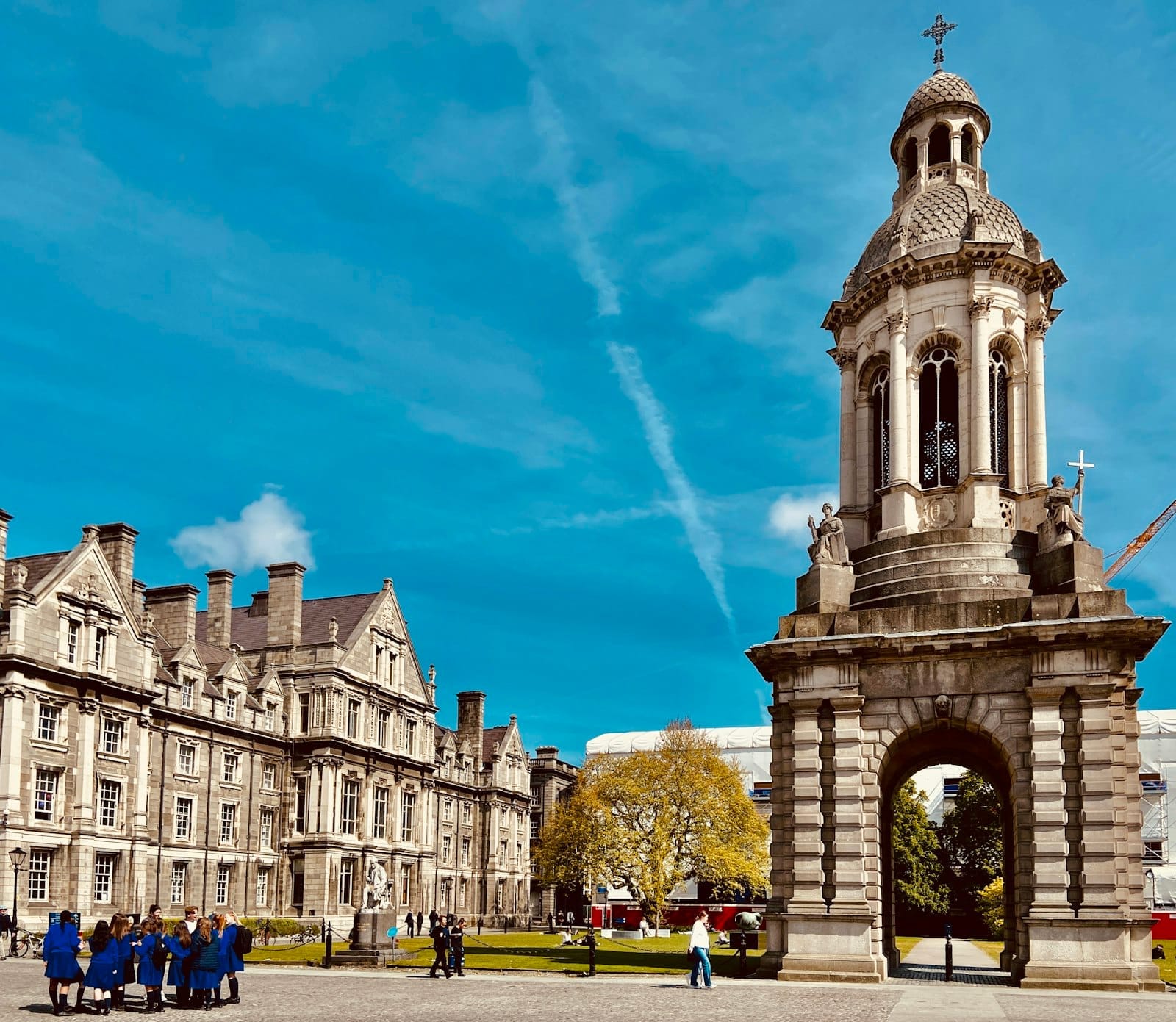
The rhythms of this neighbourhood are tied closely to the academic calendar and the tourist season, which means it rarely feels quiet. Early on a weekday morning, the cobbled Front Square inside the college gates has a particular stillness: pigeons, the grey stone of the Campanile, the smell of cut grass from the cricket grounds further in, and a handful of early-risers crossing on their way to lectures. By 9am, that changes. Tour groups queue at the main entrance, delivery vans idle on Nassau Street, and commuters pour out of Pearse DART station a few hundred metres east.
Midday in summer is the neighbourhood's most intense moment. College Green becomes a tangle of city buses, cyclists, tourists photographing the Bank of Ireland, and Dubliners cutting through on their lunch breaks. The queue for the Book of Kells can stretch along the front of the college by mid-morning, and the cobbled squares inside the campus fill with guided tour groups moving in slow orbits. The acoustic quality changes too: there is a constant hum of voices in multiple languages, traffic from every direction, and occasional buskers carrying up from Grafton Street.
By evening, the character shifts. The tour groups clear out, the campus gates close to casual visitors, and the surrounding streets take on the feel of a city neighbourhood rather than a visitor attraction. The pubs along Nassau Street and on the side streets near College Green fill with a mix of students, office workers, and people who have wandered up from Temple Bar. The facade of Trinity, lit at night, is one of the better pieces of architectural drama in the city, especially when College Green is less clogged with buses.
💡 Local tip
If you want to experience the campus without crowds, arrive before 9am on a weekday. The grounds are generally open to the public during the day and the Front Square is genuinely peaceful before the tour groups arrive.
What to See and Do
The anchor attraction is the Book of Kells, housed in the Old Library on campus. The manuscript itself, an illuminated gospel book created around 800 AD of extraordinary delicacy, is genuinely worth the ticket price, though the Long Room upstairs, with its 200,000 ancient texts and barrel-vaulted ceiling, arguably makes the stronger impression. Book tickets in advance online: walk-up queues in summer can mean a wait of over an hour, and the experience is far more comfortable with a timed entry.
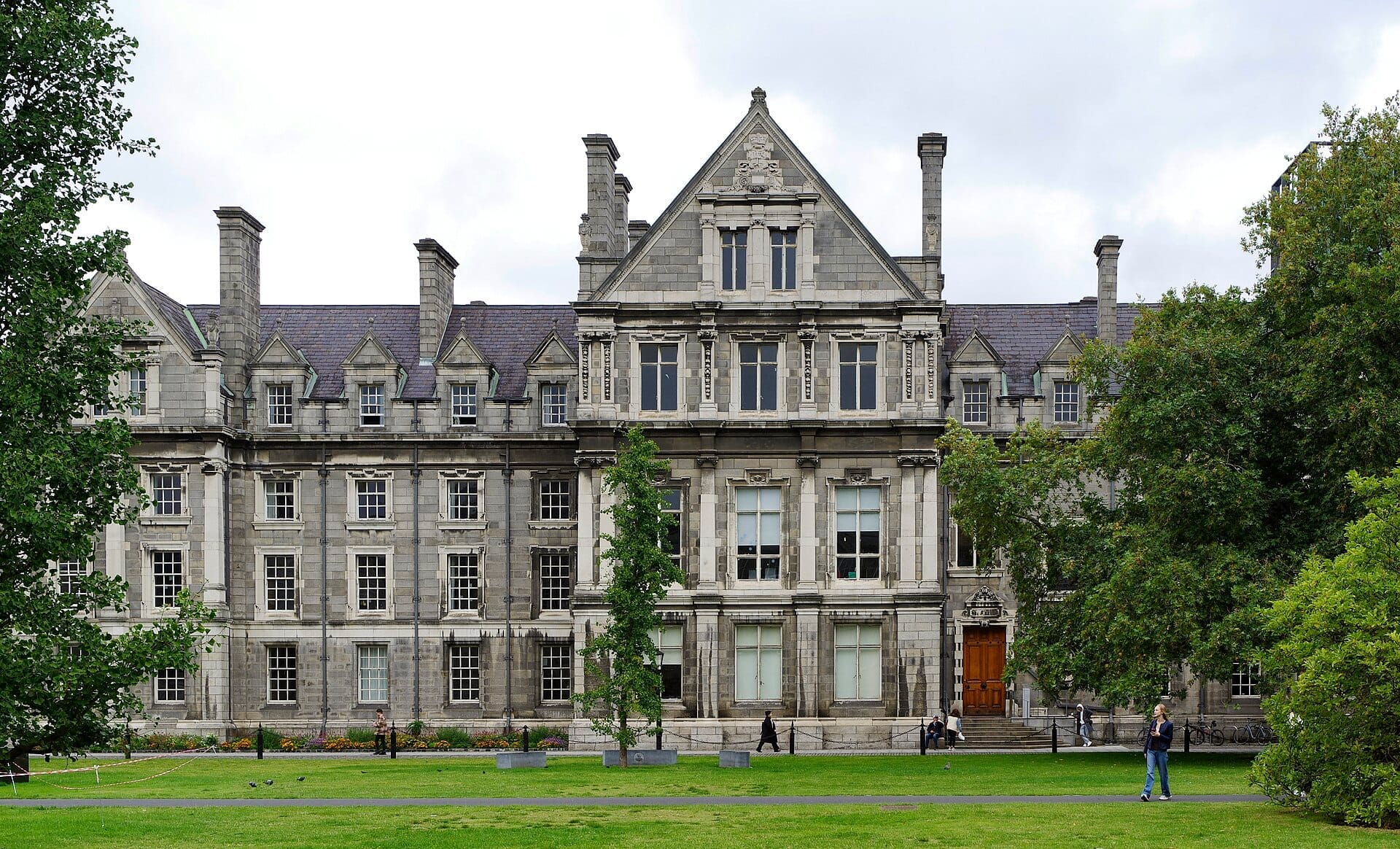
Beyond the Old Library, Trinity College Dublin itself is worth treating as an attraction in its own right. Walking through the campus, past the Campanile and the Rubrics (one of Dublin's oldest surviving brick buildings, dating to around 1700), through the Science Gallery on Pearse Street, and out toward the sports grounds gives a sense of how this institution, founded in 1592, has accumulated layer upon layer of architecture across four centuries. Free walking tours of the campus run regularly from Front Square; the student-led versions are particularly good.
College Green itself deserves a few minutes of attention. The Bank of Ireland building, the neoclassical former home of the Irish Parliament, is a significant piece of civic architecture, and the interior can be visited during banking hours. The building has a complicated history tied to the Acts of Union in 1800, when the Irish Parliament voted itself out of existence. That context adds weight to what is otherwise a handsome but easy-to-walk-past facade.
Book of Kells and Long Room, Trinity College Old Library (book timed entry online)
Free walking tours of Trinity College campus from Front Square
Bank of Ireland building (former Irish Parliament) on College Green
Science Gallery on Pearse Street (space currently closed; check for any updated uses before visiting)
Nassau Street for browsing Irish craft and bookshops
The surrounding area also puts you within easy walking distance of several major Dublin attractions. The National Museum of Archaeology on Kildare Street is a five-minute walk along Nassau Street and is free to enter. The National Gallery of Ireland is just around the corner on Merrion Square West. Both are world-class institutions and chronically underrated compared to the queue lengths at Trinity.
ℹ️ Good to know
Trinity College is a working university, not a theme park. Some areas, including certain libraries, research buildings, and the college's sports facilities, are not open to the general public. Stick to the publicly accessible quadrangles and the Old Library complex unless you are on a guided tour.
Eating and Drinking
The immediate vicinity of College Green and the college gates is not Dublin's strongest food neighbourhood. The streets closest to the main tourist flow, particularly the stretch directly facing the college on College Green and the corner of Grafton Street, are dominated by chain cafes, tourist-oriented pubs, and fast food, with prices reflecting the location. That is not a criticism of any particular establishment, it is simply what happens to the streetscape in any major city when foot traffic is this high and this tourist-heavy.
The better options are a short walk in either direction. Nassau Street, running along the south edge of the campus, has a handful of independent cafes and delis that cater more to university staff and the professional crowd from the surrounding offices. Walking a few minutes south on Dawson Street or Kildare Street takes you into better restaurant territory, with a range of price points and cuisines that reflects a more local clientele. Grafton Street itself is largely for shopping, but the streets immediately east of it, including Duke Street and Anne Street South, have long-established pubs and restaurants worth investigating.
For something quick and good near the college, the food hall inside the college itself (accessible when the grounds are open) serves students and staff and tends to be well-priced and decent quality. The Pav, the student bar near the college sports grounds, is a good place for an unpretentious pint in summer when the outdoor terrace is open, if you can get in. Nearby on Lincoln Place, there are a few smaller cafes that see less tourist traffic than the spots facing College Green.
⚠️ What to skip
The pubs directly on College Green and at the top of Grafton Street can charge significantly more than elsewhere in the city. They are not necessarily bad, but if you are watching your budget, walking two streets in any direction will give you better value.
Getting There and Around
The Trinity College area is exceptionally well connected by public transport. Pearse Street DART station, on the coastal rail line, sits a short walk east of the college along Pearse Street and gives direct rail connections south to Dun Laoghaire, Dalkey, and Bray, and north to Connolly Station and coastal suburbs such as Howth and Malahide. This is one of the most useful transit connections in the area for day trips.
The Luas Green Line stops at Trinity, with the tram stop directly serving the college on the line that runs south through St. Stephen's Green, Ranelagh, Dundrum and out to Sandyford and Brides Glen. This gives easy access to the southside suburbs and links into the broader Luas network via central interchanges. For the full picture of getting around Dublin, the guide to getting around Dublin covers all the main transport options in detail.
Multiple Dublin Bus routes stop along College Green and on the surrounding streets. College Green is one of the city's primary bus interchanges, meaning almost any cross-city route will pass through or very close to here. The flip side of that is that College Green can be heavily congested during morning and evening rush hours, and bus journey times can vary considerably depending on traffic.
From Dublin Airport, the most direct public transport option is the Aircoach or Dublin Bus service direct to the city centre, with stops near College Green and O'Connell Street. Journey times vary by traffic but the airport is roughly 10–11 km north of the college. Taxis from the airport to the College Green area are metered; fares and any applicable surcharges should be verified with the National Transport Authority before travel as these are subject to change.
On foot, the college area is central enough that you can reach most of Dublin's major south city-centre attractions without any public transport at all. Temple Bar is under five minutes on foot going northwest from College Green. St. Stephen's Green is around an eight-minute walk south on Grafton Street. The National Museum and National Gallery are both within about a ten-minute walk along Nassau Street and Kildare Street respectively.
Where to Stay
Staying in or immediately around the Trinity College and College Green area puts you at the geographic centre of Dublin's south city, which is an excellent position for first-time visitors who want to walk to most of the major attractions. For a broader comparison of Dublin neighbourhoods for accommodation, the Dublin neighbourhood guide for accommodation is a useful starting point.
The streets directly around College Green and the top of Grafton Street have a cluster of mid-range to luxury hotels. These are convenient but they carry city-centre pricing, and the immediate surroundings, particularly College Green with its bus traffic and the top of Grafton Street with its weekend crowd density, can be noisy well into the evening. Rooms facing the street in this area will experience significant ambient noise, so a rear-facing room is worth requesting.
A short walk south onto Dawson Street or into the streets between Grafton Street and Kildare Street puts you in a slightly calmer pocket of the same neighbourhood, with the same walkability but less of the concentrated tourist activity immediately outside your door. The area around Merrion Square and Fitzwilliam Square, five to ten minutes east, has some of Dublin's more characterful Georgian guesthouses and smaller hotels and tends to be quieter at night.
Budget travellers will find the Trinity area expensive relative to some other Dublin neighbourhoods. Hostels and more affordable guesthouses tend to cluster slightly further north toward Temple Bar or south toward the Portobello and Rathmines area, both of which are still within comfortable walking distance of the college.
Practical Considerations
The Trinity College and College Green area is one of the safest parts of Dublin city for visitors. The neighbourhood is well-lit, heavily trafficked by pedestrians at most hours, and has a strong institutional presence in the form of the college itself. The main practical issue is not safety but congestion: the streets immediately around College Green carry an enormous volume of foot traffic, particularly in summer and on weekends, and the combination of tourists, commuters, city buses, and cyclists can make crossing the road at College Green feel genuinely chaotic.
One thing worth knowing before you visit: the campus walls that enclose Trinity have historically made this part of Dublin feel more closed off than it could be, given its central position. The debate around the relationship between the college and the surrounding city is an ongoing one in Dublin. But from a visitor's perspective, the gates are open during the day, the grounds are publicly accessible, and the campus provides a rare piece of green, relatively quiet space in the middle of an otherwise dense urban core. For context on Dublin's wider literary and cultural history, which Trinity looms large in, the Dublin literary trail guide connects many of the surrounding sites.
TL;DR
Trinity College and College Green occupy the geographic centre of Dublin's south city, within walking distance of virtually all major attractions.
The Book of Kells and Long Room are the headline draw; book timed entry in advance to avoid long queues.
Best experienced early in the morning or in the evening, when the campus is quieter and the surrounding streets feel less tourist-heavy.
Transit connections are excellent: Pearse DART station, the Luas Green Line stop at Trinity, and multiple bus routes all serve the area.
Well suited to first-time visitors and those who want to be central; less suited to travellers looking for a neighbourhood with a strong local identity or quiet evenings.
Top Attractions in Trinity College & College Green
Three days is the sweet spot for Dublin. Long enough to cover the iconic historic sites, dig into the food and pub culture, and fit in a coastal or countryside excursion. This itinerary is built around real logistics, honest crowd warnings, and the kind of sequencing that makes a short trip feel unhurried.
Dublin punches well above its weight as a museum city. Several of its finest institutions are completely free, and the range spans Celtic gold, Viking archaeology, Irish revolutionary history, world literature, and contemporary art. This guide covers the best museums in Dublin, grouped by theme, with practical advice on when to go and what to expect.
Dublin rewards visitors year-round, but the timing of your trip shapes everything from hotel prices to what you can actually do outdoors. This guide breaks down every month, season, and key trade-off so you can plan with confidence.
Dublin sits at the centre of an exceptional day trip network. Within two hours you can reach glacial mountain valleys, medieval castles, dramatic coastal headlands, and one of Europe's great prehistoric monuments. This guide covers the best escapes, how to get there, and what to expect.
Dublin Bay is a UNESCO Biosphere Reserve with more beaches than most visitors expect. This guide covers the best strands, swimming spots, and coastal walks within easy reach of the city, from the vast sands of Dollymount to the dramatic cliffs of Howth and the sheltered coves of Dún Laoghaire.
Bloomsday is Dublin's most distinctive literary celebration, held every 16 June to honour the date James Joyce set Ulysses. This guide covers the key locations, walking routes, festival events, food traditions, and everything you need to join the festivities — whether you've read the book or not.
Dublin rewards couples who look beyond the obvious. This guide covers scenic walks, intimate cultural experiences, evening entertainment, and coastal day trips — with honest advice on what's worth it and what to skip.
Attending a Gaelic Games match at Croke Park is one of the most authentic experiences Dublin offers. This guide covers everything from buying tickets and navigating the stadium to understanding the sport, the season, and what separates a regular league game from an All-Ireland final.
Dublin rewards the curious traveller who ventures beyond the Guinness Storehouse and Temple Bar. From a mummified Crusader beneath a Northside church to a Victorian reservoir turned secret garden, these are the places Dubliners love and visitors rarely find.
Dublin transforms in winter, with Christmas markets running from late November through early January, citywide light trails, cathedral concerts, and festive fairgrounds. This guide covers every major event, what things actually cost, and what to watch out for before you visit.
Dublin is one of the few cities in the world to have produced three Nobel Prize-winning writers of literature. This guide maps the key sites connected to George Bernard Shaw, W.B. Yeats, and Samuel Beckett, plus James Joyce, Oscar Wilde, and others, covers the best guided tours with practical pricing, and gives you the detail to do it properly.
Dublin has around 772 pubs, dozens of late-night bars, and several distinct club districts. This guide breaks down where to drink, when to go, what it costs, and which neighbourhoods to skip if you want to avoid tourist pricing.
Dublin has a reputation for being expensive, but that reputation is only half true. The city's best museums are free, the centre is walkable, public transport is cheap with the right pass, and the finest pub sessions cost nothing beyond the price of a pint. This guide breaks down every major cost category so you can plan a genuinely great trip without watching every euro.
Seven days is enough to see Dublin's best and reach the wild west coast of Ireland, but only if you plan smart. This itinerary balances city time with coastal scenery, covers realistic driving and transit times, and flags the planning mistakes that turn a great trip into an exhausting one.
Dublin, Ireland offers a surprisingly varied shopping scene, from the flagship stores lining Grafton Street to independent boutiques on South William Street, weekend food markets in Temple Bar, and Ireland's largest mall in Dundrum. This guide covers where to go, what to expect, and how to avoid wasting time.
Dublin rewards walkers like few cities in Europe. Compact enough to cover on foot, layered enough to take weeks to unpack, the city reveals itself best at street level. This guide covers the stops, routes, and landmarks that make Dublin's walking tours so compelling.
Dublin punches well above its weight as a family destination. Between a world-class zoo, free city parks, Viking history museums, coastal castles, and indoor waterparks, there is genuinely enough to fill a week without repeating yourself. This guide covers the best things to do in Dublin with kids, organised by type, age range, and weather — so you can plan around Irish reality rather than tourist brochure optimism.
Dublin punches well above its weight for free attractions. National museums, modern art galleries, coastal walks, and grand public parks all cost nothing to enter. This guide covers 22 of the best free things to do across the city, organised by type so you can plan your days without watching your budget.
Dublin's Georgian streets and squares represent one of Europe's most intact examples of 18th-century urban planning. This guide covers the key buildings, the best self-guided walking route, what's actually open to visitors, and how to avoid the common traps that waste your time.
Dublin's public transport network covers the city and coast through buses, DART rail, Luas trams, and airport coaches. This guide breaks down fares, Leap Card options, airport transfer routes, and the practical details that save you time and money when navigating Ireland's capital.
Dublin sits at the doorstep of some of Ireland's finest walking country. Whether you want cliff-top sea views, ancient monastic valleys, or proper mountain terrain, these are the best hikes and trails within easy reach of the city.
Dublin's St Patrick's Festival is a multi-day national celebration centred on 17 March, with a free city-centre parade, ticketed concerts, street theatre, and events across the city. This guide covers the full programme, booking essentials, crowd logistics, and what to realistically expect from Ireland's biggest annual celebration.
Dublin packs centuries of history, world-class museums, legendary pubs, and coastal scenery into a compact, walkable city. This guide covers the best things to do in Dublin across every interest and budget, with honest advice on what's worth your time and what to skip.
Dublin's food scene has transformed well beyond stew and soda bread. This guide covers the essential Irish dishes, where to find them, what to pay, and which areas give you the best value — including a frank look at where not to waste your money.
Choosing where to stay in Dublin, Ireland shapes your entire trip. This guide breaks down every major neighbourhood by location, vibe, price range, and transport links, so you can book with confidence rather than guesswork.