National Museum of Ireland – Archaeology: Ireland's Greatest Treasures, Free to See
On Kildare Street in the heart of Dublin, the National Museum of Ireland – Archaeology holds some of the most significant prehistoric and early medieval artefacts ever discovered on the island. From the gold masterworks of the Bronze Age to eerily preserved Iron Age bog bodies, the collections here span thousands of years of Irish history. Admission is free, and a visit typically takes two to three hours.
Quick Facts
- Location
- 35A Kildare Street, Dublin 2 (St. Stephen's Green / Grafton Street area)
- Getting There
- Luas Green Line – Dawson stop (5-min walk); Dublin Bus stops on Kildare Street; Pearse DART station (10-min walk)
- Time Needed
- 2–3 hours for a thorough visit; 90 minutes if focused on highlights
- Cost
- Free admission (currently free; check before visiting)
- Best for
- History lovers, families, anyone curious about prehistoric Ireland
- Official website
- www.museum.ie/en-ie/museums/archaeology
What the National Museum of Ireland – Archaeology Actually Is
The National Museum of Ireland – Archaeology is Ireland's primary repository for prehistoric and early historic material culture. The collections cover roughly 700,000 years of human activity on the island, from the earliest stone tools to medieval Christian metalwork. This is not a dusty provincial museum with a few labelled fragments. The artefacts here include the Ardagh Chalice, the Tara Brooch, and the Broighter Gold hoard, objects that regularly appear in art history textbooks worldwide. The fact that you can stand two feet from all of them for free is genuinely remarkable.
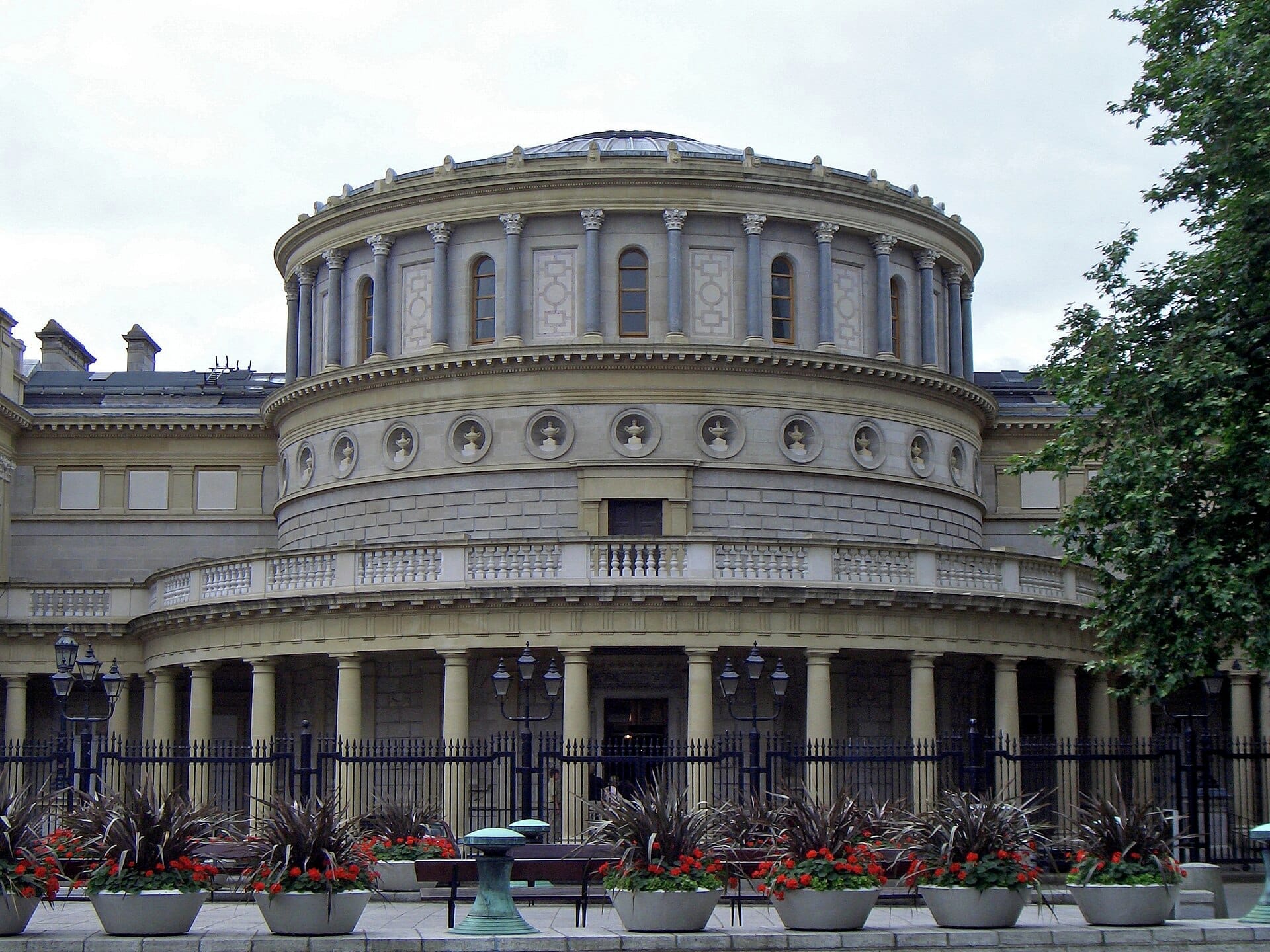
The building itself is worth arriving early to appreciate. Designed in a Classical style and opened in 1890, the original structure was conceived as the Museum of Science and Art. The entrance rotunda is modelled loosely on the Roman Pantheon, with a coffered ceiling, mosaic floor featuring zodiac symbols, and ornate colonnades that open onto the main hall. The architecture signals seriousness of purpose before you've seen a single exhibit.
ℹ️ Good to know
Opening hours: Tuesday–Saturday 10:00–17:00; Monday and Sunday 13:00–17:00. Hours can vary on public holidays or for special events, so check the official site before visiting.
The Collections: What You'll Actually See
Or, Naofa – Prehistoric Ireland and the Treasury
The ground floor is where most visitors spend the majority of their time. The Treasury gallery contains the museum's most famous pieces. The Ardagh Chalice, crafted in the early 8th century from silver, gold, bronze, brass, and enamel, is a technical achievement that still impresses metallurgists today. The Tara Brooch, made around the same period, is covered in interlaced gold filigree so fine it was once thought impossible to replicate with medieval tools. Both objects were found in the 19th century and their discovery significantly shaped scholarly understanding of early Christian Ireland.
The Or (Gold) gallery presents Bronze Age goldwork spanning roughly 2200 to 600 BCE. The Broighter Gold hoard from County Derry is perhaps the centrepiece: a collection of gold torcs, chains, and a miniature boat so detailed it has oars and a mast, interpreted as a ritual deposit to a sea deity. The sheer quantity of gold on display conveys just how sophisticated Bronze Age Irish society was, and how active its trade networks must have been.
Kingship and Sacrifice: The Bog Bodies
The Kingship and Sacrifice exhibition on the ground floor contains the museum's most viscerally affecting material: preserved human remains recovered from Irish peatlands. Clonycavan Man and Old Croghan Man, both dating to the Iron Age (roughly 400–200 BCE), are displayed with careful contextual interpretation. The preservation achieved by the anaerobic, acidic bog environment is extraordinary. Fingernails, skin texture, and stomach contents are still legible after more than two millennia.
The exhibition handles the material with appropriate gravity. The academic consensus, discussed in the display panels, is that these individuals were ritual sacrifices, possibly connected to kingship inauguration ceremonies. The tone is scholarly rather than sensationalist, which is the right call given what is being shown.
⚠️ What to skip
The bog body exhibition involves viewing human remains. Parents should decide in advance whether this is suitable for young children. The displays are respectful but do not shy away from the physical reality of what is shown.
Viking Ireland and the Medieval Period
The first floor holds exhibitions on Viking Ireland, medieval Dublin, and ancient Egypt (a smaller but genuinely interesting collection of mummies and funerary objects). The Viking material connects directly to what visitors may have already seen at the nearby Dublinia attraction, which covers Viking-age Dublin in more interactive terms. The museum's approach is more scholarly: carved game pieces, weaponry, amber beads, and combs made from antler are labelled with site references that allow anyone who wants to follow up the archaeology to do so.
For visitors who want to trace Dublin's full archaeological story above ground, Dublinia on High Street offers an immersive complement to the more object-focused approach here.
Tickets & tours
Hand-picked options from our booking partner. Prices are indicative; availability and final rates are confirmed when you complete your booking.
Giant's Causeway, Dark Hedges, and Belfast Tour from Dublin
From 85 €Instant confirmationFree cancellationDublin self-guided audio tour
From 10 €Instant confirmationBird of Prey, Cliffs of Moher and Aillwee Cave from Dublin
From 201 €Instant confirmationFree cancellationGame of Thrones Studio tour with return transfer from Dublin
From 63 €Instant confirmationFree cancellation
How the Experience Changes by Time of Day
Tuesday to Saturday mornings between 10:00 and 11:30 are consistently the quietest window. School groups typically arrive from around 11:00, and by early afternoon the main galleries, particularly the Treasury, become noticeably crowded. If you want to spend time studying individual pieces without people moving around you, an early start on a weekday is the practical choice.
On Monday and Sunday, the museum does not open until 13:00. The light inside the rotunda shifts noticeably across the day: morning casts a cooler tone through the upper windows, while afternoon light warms the mosaic floor. Neither time is objectively better for photography, but afternoon openings mean you'll share the early hours with other visitors who arrived at exactly 13:00, so the Treasury gallery can feel crowded for the first 30 to 45 minutes.
💡 Local tip
For photography of the Treasury pieces, come on a weekday morning. Cases are positioned with overhead lighting, and the glass can catch reflections in busy periods. Early visits minimise both crowds and glare from other visitors' phones.
The Building and Its Place on Kildare Street
The museum sits on Kildare Street in one of Dublin's most architecturally concentrated stretches. The Leinster House government buildings are directly adjacent, separated from the museum by a shared forecourt. The Natural History Museum, another branch of the National Museum of Ireland, is a short walk away on Merrion Street. The National Library of Ireland is on the opposite side of Leinster House. The cumulative effect is a cultural campus that developed across the 19th century, each building signalling the ambitions of the Irish state (and its British predecessor) through monumental Classical design.
This area forms the eastern boundary of the St. Stephen's Green and Grafton Street district, meaning that a visit to the museum integrates naturally with a half-day walk that takes in the green itself, Grafton Street, and nearby Merrion Square.
The rotunda entrance hall is one of the better pieces of Victorian public architecture in the city. The floor is an original mosaic with interlocking geometric patterns and zodiac symbols, intact since the building's 1890 opening. Looking up at the dome from the centre of the room is one of those moments that briefly stops most visitors mid-stride. It costs nothing extra and most people hurry past it toward the galleries.
Practical Information for Your Visit
Getting to the museum is straightforward from anywhere in the city centre. The Luas Green Line stops at Dawson Street, roughly a five-minute walk across the corner of St. Stephen's Green. Multiple Dublin Bus routes serve Kildare Street directly. If you are arriving by DART, Pearse Station on Westland Row is about ten minutes on foot. There is no dedicated car park attached to the museum; street parking in this area is limited and metered.
The museum is a two-storey building. The ground floor and first floor both have exhibits, and lifts are available. Detailed accessibility information, including step-free routes and facilities, is available on the official museum website or by contacting the museum directly before your visit.
There is a café and a museum shop on the ground floor. The shop carries well-produced books on Irish archaeology, replicas of significant artefacts, and gifts with genuine connection to the collections, which distinguishes it from the average tourist shop. The café is a reasonable option for a mid-visit break, though it becomes congested during the lunchtime peak.
The museum sits close to several other major institutions. The National Gallery of Ireland on Merrion Square West is a 10-minute walk and is also free. Planning both in one day is feasible, though ambitions should be realistic: trying to do justice to both collections in a single afternoon will leave most visitors feeling saturated rather than enriched.
Who Should Reconsider This Visit
The museum presents information at an academic level. Display panels are detailed and well-written, but they assume a baseline level of interest in the subject matter. Visitors looking for high-interactivity, touchscreens, or gamified experiences will find the approach fairly traditional. Children under eight or nine may enjoy the scale of the building and certain tactile stations, but the core collection rewards focused reading rather than fast movement through galleries.
If you have one afternoon in Dublin and are choosing between this museum and a more immediately engaging experience, be honest about your own interests. The bog bodies are genuinely arresting and the gold is extraordinary, but the collections speak most clearly to people who are willing to slow down and read.
Insider Tips
- The mosaic floor in the entrance rotunda is original to 1890. Stand at the centre and look straight up at the coffered dome before you do anything else. Most visitors miss it entirely.
- The Broighter Gold hoard is displayed in the Or gallery rather than the Treasury. Many first-time visitors focus only on the Treasury and walk past it. It deserves equal attention.
- Audio guides are available at the information desk and add significant context to the Treasury pieces, particularly for the craftsmanship techniques used in the Ardagh Chalice.
- The museum café becomes very busy between 12:30 and 14:00. If you plan to eat there, either arrive before noon or wait until mid-afternoon.
- The ground floor exhibition layout is not entirely linear. Pick up a free floor plan at the entrance desk to avoid accidentally doubling back through galleries you have already seen.
Who Is National Museum of Ireland – Archaeology For?
- History and archaeology enthusiasts who want serious collections with scholarly context
- Travellers looking for free cultural experiences without compromising on quality
- Families with older children (10+) who are comfortable reading exhibit panels
- Architecture admirers drawn to Victorian Classical civic buildings
- Visitors on a Dublin literary or heritage trail who want to ground the city's past in physical objects
Nearby Attractions
Other things to see while in St Stephen's Green & Grafton Street:
- George's Street Arcade
Built in 1881 as Ireland's first purpose-built shopping centre (later rebuilt after an 1892 fire), George's Street Arcade is a red-brick Victorian market hall on South Great George's Street, Dublin 2. Free to enter and open daily, it houses a mix of vintage clothing, records, antiques, food stalls, and independent retailers beneath a soaring glazed roof.
- Grafton Street
Grafton Street is Dublin's most recognisable shopping street, running 500 metres through the heart of the city from St Stephen's Green to College Green. Pedestrianised in the early 1980s, it draws everyone from commuters and coffee-seekers to tourists and street musicians. Entry is free and the street is open daily.
- Iveagh Gardens
Tucked behind the National Concert Hall on Clonmel Street, Iveagh Gardens is a free, formally designed Victorian park covering around 5 acres in the heart of Dublin 2. Opened to the public after years of restoration, it offers fountains, a rosarium, a cascade waterfall, and woodland walks with a fraction of the foot traffic you'll find at nearby St. Stephen's Green.
- Little Museum of Dublin
Housed in a Georgian townhouse at 15 St. Stephen's Green, the Little Museum of Dublin distills over a century of city life into a compact series of rooms and thousands of donated artefacts. Entry is by guided tour only, making this one of Dublin's most intimate and unexpectedly absorbing cultural experiences.