Grafton Street: Dublin's Premier Pedestrian Thoroughfare
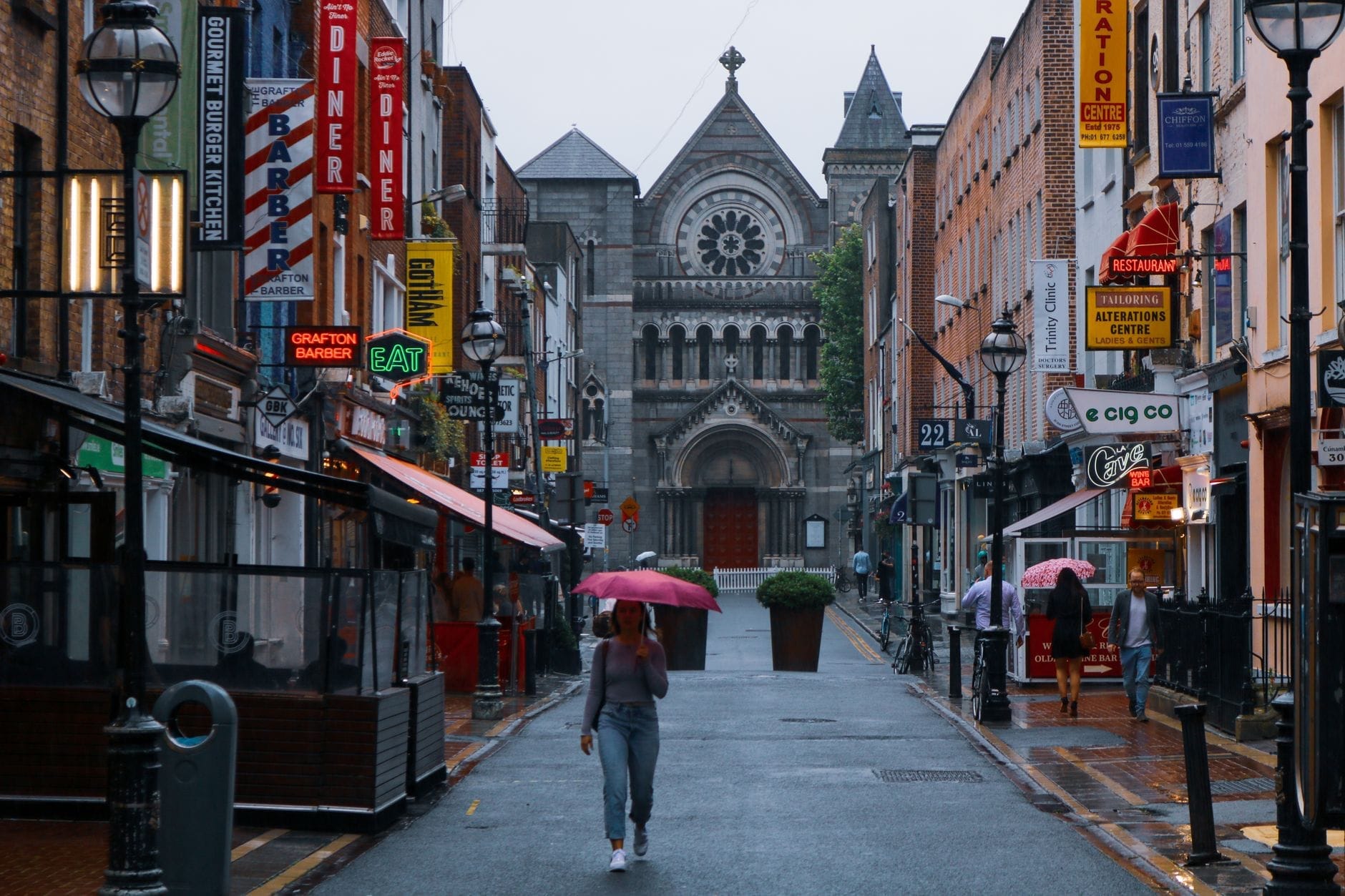
Grafton Street is Dublin's most recognisable shopping street, running 500 metres through the heart of the city from St Stephen's Green to College Green. Pedestrianised in the early 1980s, it draws everyone from commuters and coffee-seekers to tourists and street musicians. Entry is free and the street is open daily.
Quick Facts
- Location
- City centre, Dublin — from St Stephen's Green (south) to College Green (north)
- Getting There
- Luas Green Line: St Stephen's Green stop; multiple Dublin Bus routes to College Green and Nassau Street
- Time Needed
- 30 minutes to walk through; 2–3 hours if shopping or stopping for coffee
- Cost
- Free to walk; shops and cafés at your own expense
- Best for
- Shoppers, people-watchers, street music fans, first-time visitors to Dublin
- Official website
- www.graftonstreet.ie
What Grafton Street Actually Is
Grafton Street is a 500-metre pedestrianised street in central Dublin, running from the top gates of St Stephen's Green northward to College Green, where it meets Dame Street and the front of Trinity College. It is roughly 12 metres wide, which gives it a proportionate, walkable feel rather than the canyon-like scale of some European shopping streets. The lower section was first trialed for pedestrianisation in 1971 and made permanent in 1983, after a trial experiment began in 1971, and the change gradually transformed the street from a congested traffic corridor into the city's primary promenade.
The street's origins date to the early 18th century. Developed by the Dawson family around 1708 from what had been a laneway, it gradually became the fashionable spine of Dublin's southside, connecting the civic centre near the old parliament to the Georgian residential squares further south. That north-south alignment still holds today: the street anchors one of the most walkable sequences in any European capital, connecting Trinity College, the old parliament building at College Green, the shopping corridors of the Grafton quarter, and St Stephen's Green park within a ten-minute walk.
ℹ️ Good to know
Grafton Street is a public street with no admission charge. Individual shops, restaurants, and cafés set their own hours. The street itself is accessible around the clock, though the official Grafton Street FAQ notes pedestrianisation from 11:00 AM to 6:00 AM.
How the Street Changes Through the Day
Grafton Street has a distinct rhythm that shifts several times between morning and night. Before 9:00 AM, it belongs to commuters: office workers cutting through from St Stephen's Green Luas stop, delivery trolleys being loaded into stores, baristas setting up pavement boards outside the coffee shops near the Bewley's end. The granite cobblestones are damp and quiet, and you can actually read the facades of the buildings without a crowd in the way.
From mid-morning onward, the street fills steadily. By 11:00 AM on any weekday, the first street performers have claimed their pitches — busking spots on Grafton Street are well known, and on a good day you might hear a classical guitarist near the top, a folk duo in the middle stretch, and a solo vocalist with a backing track closer to College Green. The acoustic quality of the street, shaped by its width and the relatively uniform building line, amplifies sound in a way that makes some performances worth pausing for.
Saturdays in summer are the most crowded. The full length of the street compresses into a slow shuffle between roughly noon and 4:00 PM, which suits window-shopping but makes a purposeful walk frustrating. If you want to move freely, a weekday morning in spring or autumn is considerably more comfortable. Rain, common in Dublin, clears the street quickly — which is actually useful if you want photographs without crowds, though the cobblestones become slippery underfoot.
💡 Local tip
For the best combination of atmosphere and manageable crowds, aim for a weekday morning between 9:30 and 11:00. You'll have clear sightlines, active but not overcrowded street-level action, and a better chance of finding seats in Bewley's without waiting.
Tickets & tours
Hand-picked options from our booking partner. Prices are indicative; availability and final rates are confirmed when you complete your booking.
Giant's Causeway, Dark Hedges, and Belfast Tour from Dublin
From 85 €Instant confirmationFree cancellationDublin self-guided audio tour
From 10 €Instant confirmationBird of Prey, Cliffs of Moher and Aillwee Cave from Dublin
From 201 €Instant confirmationFree cancellationGame of Thrones Studio tour with return transfer from Dublin
From 63 €Instant confirmationFree cancellation
What You'll Find Along the Street
The retail mix on Grafton Street leans toward international mid-range and premium brands. Brown Thomas, the Irish department store occupying a large footprint on the west side of the street, is the most notable anchor. Its ground-floor perfume and accessories hall has the cool, hushed atmosphere of a London or Paris equivalent, and it remains a genuine draw for those interested in international fashion. Beyond that, the street hosts a predictable array of chain retailers.
If independent shopping is the priority, Grafton Street is not where you'll find it. The more interesting retail options are on the side streets: Powerscourt Centre on William Street South houses independent designers and antique dealers in a converted Georgian townhouse, and George's Street Arcade a block west offers vintage clothing, secondhand books, and food stalls in a Victorian covered market. Neither is far from Grafton Street itself.
Bewley's Oriental Café at 78 Grafton Street deserves specific mention. The café has occupied this site since 1927, and the building's interior features stained glass windows by Harry Clarke, one of Ireland's most significant early 20th-century artists. The recent renovation maintained the original mosaic floor and dark timber panelling. A coffee here costs more than average Dublin café prices, but the interior is architecturally significant and the upstairs rooms are far less hectic than the ground floor.
Historical and Cultural Context
Grafton Street sits at the heart of a part of Dublin that came to define the city's southside identity during the Georgian period. The surrounding streets — Dawson Street, Kildare Street, Merrion Square — were developed in the 18th century as the city's professional and administrative class moved south of the Liffey. The St Stephen's Green and Grafton Street area retains much of that architectural scale today, with the street itself bookended by two landmarks: Trinity College Dublin at the northern end, and St Stephen's Green park at the southern end.
The street has appeared in Irish literary history. James Joyce referenced the area in his work, and the general southside district around Grafton Street features in the imaginative geography of Ulysses. A small bronze sculpture of Molly Malone — the fictional fishmonger of the famous Dublin song — stood at the junction with Nassau Street for decades before being relocated. It now stands on Suffolk Street, a short walk away.
Pedestrianisation in 1983 was not an uncontested decision: it required significant changes to traffic routing across the city centre and faced opposition from businesses that feared reduced access would hurt trade. The opposite proved true. The pedestrianised street became a more attractive destination, and the model influenced later changes to other Dublin streets. Today it is one of the most commercially valuable stretches of retail real estate in Ireland, which explains why independent retailers have largely been priced out.
Getting There and Getting Around
The easiest approach from the city's northern side is to walk south from the DART stations at Pearse Street or Tara Street, through College Green and Nassau Street to Grafton Street's northern entrance. This ten-minute walk from the river is straightforward and passes some of the city's more interesting civic architecture.
From the south, the Luas Green Line stops at St Stephen's Green, and the Grafton Street entrance is a short walk north of the park. This is the most convenient option if arriving from the suburbs along the Luas corridor. Multiple Dublin Bus routes serve Nassau Street and Dawson Street, which run parallel to Grafton Street on either side.
The street itself is flat, fully pedestrianised, and has no steps or major gradient changes. Wheelchair access along the main thoroughfare is straightforward, though the cobblestone surface can be uneven in places. Side streets and individual shop interiors vary in accessibility. There is no dedicated car access or parking on the street itself; the nearest multi-storey car parks are on Drury Street and Dawson Street.
Photography and What to Expect Visually
Grafton Street photographs best early in the morning or in the golden hour before dusk, when low-angle light catches the dressed stone of the building facades and the street is not yet obscured by crowds. The building line is relatively consistent in height, which gives photographs a cohesive frame.
The Bewley's facade is the most photogenic single element on the street: its historic frontage and café name in period lettering stand out against the more generic retail signage on either side. At the St Stephen's Green end, the gates and tree canopy of the park provide natural depth. For wider urban photography, the view from the top of Grafton Street looking south toward the park on a clear day shows the contrast between the retail corridor and the green beyond.
⚠️ What to skip
Grafton Street is frequently used for temporary road closures and event setups, particularly around Christmas, St Patrick's Day, and major sporting events. On these days, crowd density significantly increases and the street can feel uncomfortable for anyone with limited mobility or crowds sensitivity. Check local event calendars before visiting if this is a concern.
Honest Assessment: Is Grafton Street Worth Your Time?
For most international visitors, Grafton Street is worth a single deliberate walk rather than a destination in its own right. The retail offering is largely replicable in any mid-sized European city, and if your goal is to understand Dublin's character, you will find more of it one street over in either direction.
That said, the street functions well as a connector. Walking the full length from St Stephen's Green to College Green gives you a clear spatial understanding of central Dublin's southside layout and deposits you at the doorstep of the Book of Kells exhibition at Trinity College. It is also genuinely enjoyable on a dry midweek morning with good busking and a coffee from Bewley's in hand.
Visitors who expect a locally distinctive shopping street are likely to be disappointed. Those who treat it as a pleasant walk through Dublin's most polished commercial corridor, combined with a stop at Bewley's and a detour into the Georgian lanes on either side, will find it a satisfying hour.
Insider Tips
- Bewley's Oriental Café is the one stop on Grafton Street with genuine architectural value. The Harry Clarke stained glass windows on the upper floors are rarely mentioned in passing, but they are among the finest examples of his work accessible to the public without booking. Ask for a seat in the James Joyce room on the first floor.
- The busking pitches are allocated and competitive. The performers you hear on Grafton Street are not random amateurs — many are experienced professional musicians who have auditioned for their slots. If you hear something you like, stopping for a full song is worth it; the acoustic conditions on the street are unusually good for outdoor performance.
- The side entrance to Powerscourt Centre on Clarendon Street is easy to miss from Grafton Street. It is one block west and worth the detour: the interior courtyard of the converted townhouse is one of the more unusual retail environments in Dublin, and the top-floor café has good natural light.
- If you are visiting in December, Grafton Street's Christmas lights are a genuine annual tradition rather than a commercial afterthought — the tree and lighting scheme at the St Stephen's Green end has been a familiar fixture for decades. But the crowds in the weeks before Christmas are extreme; evenings after 7:00 PM are calmer than afternoons.
- For a much quieter parallel route with independent shops and cafés, walk Drury Street or South William Street instead. They run one block west of Grafton Street and have a notably different atmosphere.
Who Is Grafton Street For?
- First-time visitors who want a spatial orientation of Dublin's southside city centre
- Shoppers looking for mid-range and premium international retail brands
- Coffee and café lovers, particularly those interested in historic interiors like Bewley's
- Those combining a walk with a visit to Trinity College or St Stephen's Green park
- People-watchers and street music enthusiasts on a dry midweek morning
Nearby Attractions
Other things to see while in St Stephen's Green & Grafton Street:
- George's Street Arcade
Built in 1881 as Ireland's first purpose-built shopping centre (later rebuilt after an 1892 fire), George's Street Arcade is a red-brick Victorian market hall on South Great George's Street, Dublin 2. Free to enter and open daily, it houses a mix of vintage clothing, records, antiques, food stalls, and independent retailers beneath a soaring glazed roof.
- Iveagh Gardens
Tucked behind the National Concert Hall on Clonmel Street, Iveagh Gardens is a free, formally designed Victorian park covering around 5 acres in the heart of Dublin 2. Opened to the public after years of restoration, it offers fountains, a rosarium, a cascade waterfall, and woodland walks with a fraction of the foot traffic you'll find at nearby St. Stephen's Green.
- Little Museum of Dublin
Housed in a Georgian townhouse at 15 St. Stephen's Green, the Little Museum of Dublin distills over a century of city life into a compact series of rooms and thousands of donated artefacts. Entry is by guided tour only, making this one of Dublin's most intimate and unexpectedly absorbing cultural experiences.
- Merrion Square Park
Merrion Square Park is a free public park at the heart of one of Dublin's best-preserved Georgian squares, dating to 1762. Surrounded by grand red-brick townhouses, it combines manicured gardens, public art, and literary history in a compact, walkable space close to the National Gallery and Government Buildings.