St Stephen's Green: Dublin's Central Park, Explained
St Stephen's Green is a 22-acre public park in the heart of Dublin 2, free to enter and open all year round. From its Georgian perimeter railings to its ornamental lake, it offers a genuine pause from the city — if you know when to go.
Quick Facts
- Location
- St Stephen's Green, Dublin 2 — top of Grafton Street
- Getting There
- Luas Green Line: St Stephen's Green stop. Multiple Dublin Bus routes on surrounding streets.
- Time Needed
- 30–60 minutes for a full circuit; longer if you sit or picnic
- Cost
- Free — no ticket required
- Best for
- Lunchtime breaks, morning walks, families, people-watching
- Official website
- ststephensgreenpark.ie
What St Stephen's Green Actually Is
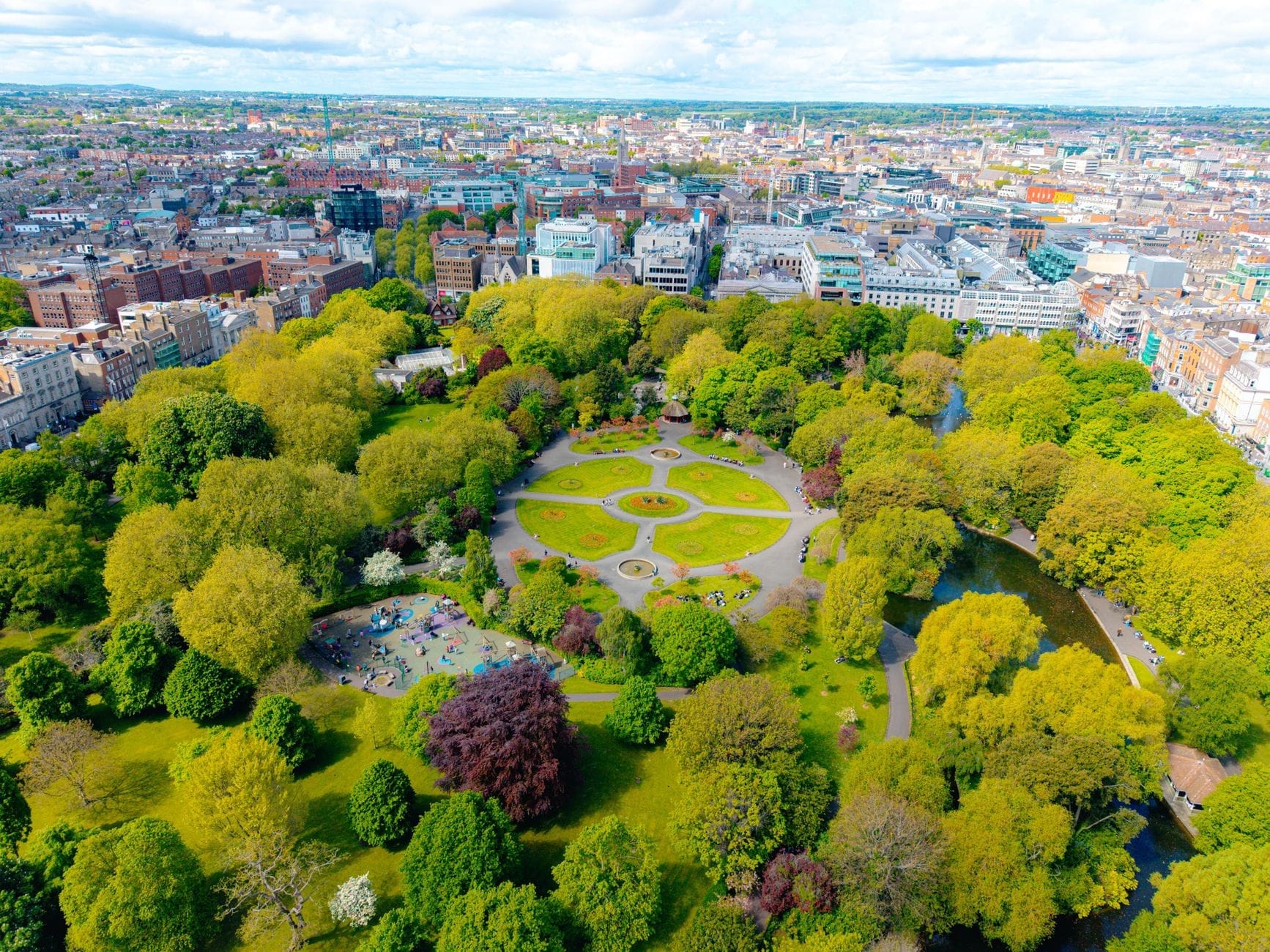
St Stephen's Green is a 22-acre public park managed by Ireland's Office of Public Works, sitting at the southern end of Grafton Street in Dublin 2. It is free to enter, open all year round, and surrounded on all four sides by Georgian terraces, hotels, and institutional buildings that frame it like an outdoor room. The park is roughly rectangular, with a central ornamental lake, formal garden beds, mature trees, and a network of paths that total over 3.5 kilometres.
The main entrance is through Fusiliers' Arch, a heavy stone triumphal arch at the Grafton Street corner that commemorates Royal Dublin Fusiliers who died in the Second Boer War. Walk through it and the noise level drops almost immediately. The city is still audible, but the park creates enough physical and acoustic distance to make it feel like a different place.
ℹ️ Good to know
Opening hours: Monday to Saturday from 07:30, Sunday and Bank Holidays from 09:30. Christmas Day 09:30–12:30. The park closes approximately 20 minutes before dusk — check ahead in winter when sunset comes early.
A Short History Worth Knowing
The green's history is long and contested. Dublin Corporation enclosed it with a wall in 1664 after surrounding land was sold for development following a 1663 decision, turning what had been common grazing land into a private enclosure bordered by prosperous terraced houses. For roughly two centuries it was accessible only to residents of those surrounding properties, who paid an annual fee for the privilege.
That changed in 1877, when an Act of Parliament passed to reopen the green to the public. The driving force behind its physical transformation was Sir Arthur Guinness, later Lord Ardilaun, who funded a comprehensive redevelopment of the park's interior. On 27 July 1880 the redesigned park opened to the public in the form largely recognisable today: the ornamental lake, the formal plantings, the Victorian-era bandstand, and the sweeping gravel paths.
The green sits at the geographic and symbolic centre of Georgian Dublin. The streets surrounding it — particularly the north side, known as the Beaux Walk — were once among the most fashionable addresses in the city. That architectural legacy is part of what makes the park worth visiting: the perimeter buildings provide the backdrop for the interior. For a broader look at that architectural context, the Georgian Dublin architecture guide covers the squares and streets that developed alongside the green.
Tickets & tours
Hand-picked options from our booking partner. Prices are indicative; availability and final rates are confirmed when you complete your booking.
Giant's Causeway, Dark Hedges, and Belfast Tour from Dublin
From 85 €Instant confirmationFree cancellationDublin self-guided audio tour
From 10 €Instant confirmationBird of Prey, Cliffs of Moher and Aillwee Cave from Dublin
From 201 €Instant confirmationFree cancellationGame of Thrones Studio tour with return transfer from Dublin
From 63 €Instant confirmationFree cancellation
How the Park Changes Through the Day
Early morning, from 07:30 on weekdays, the park is at its quietest. Dog walkers move along the outer perimeter paths; joggers cut across the central lawns. The ducks on the ornamental lake are audible before they are visible. There is a faint smell of damp grass in any season, and in autumn, fallen leaves gather along the path edges before the groundskeepers clear them. This is genuinely the best window for photography: flat northern light, few people, and the Georgian facades still in morning shadow.
By midday on a weekday the character shifts entirely. Office workers from the surrounding streets fill the benches; students from nearby university buildings spread across the lawns with takeaway coffee. The park becomes a lunch venue for large crowds on a mild day. The sound is layered: pigeons, conversation, the splash of the lake fountain, and the occasional Luas tram audible from the western edge. Seating can be hard to find near the centre of the park between roughly 12:30 and 14:00.
Late afternoon and early evening brings a slower rhythm. Families with pushchairs, older residents on benches, and tourists working their way from Grafton Street tend to drift through. In summer, when the park stays open well into the evening, the long western light catches the flower beds along the central axis and makes this the best time for colour photography of the formal gardens.
💡 Local tip
For the most peaceful experience, arrive within 30 minutes of opening. On summer mornings the light is good and the park nearly empty — a complete contrast to the midday crowds.
What to See Inside the Park
The ornamental lake at the centre of the park is the focal point. Waterfowl including mallard, moorhen, and tufted duck are year-round residents. The fountain at the centre of the lake operates in the warmer months. Surrounding the lake are some of the park's oldest trees, including limes and chestnuts that predate the 1880 redesign.
Sculptures are distributed throughout the park and reward a slow circuit. The most significant is a memorial to Wolfe Tone, the 18th-century republican figure, at the northeast corner. There is also a memorial to the Great Famine, a striking and deliberately uncomfortable group of bronze figures by Edward Delaney installed in 1967, positioned near the Grafton Street entrance. A garden for the visually impaired is located within the park, with plants selected for scent and texture and labelled in Braille.
The park is also close to several of Dublin's most significant cultural sites. The Little Museum of Dublin is on the north side of the green, in a Georgian townhouse. The National Gallery of Ireland is a 10-minute walk east, and the Iveagh Gardens — a quieter, less-visited formal garden — is accessible from the south side of the green and worth combining with a visit if you have the time.
Getting There and Getting Around
The Luas Green Line runs directly to a stop named St Stephen's Green, at the southwest corner of the park. This is the most straightforward public transport connection, linking the park to Ranelagh, Rathmines, and the southside suburbs in one direction, and to O'Connell Street and the north of the city centre via the St Stephen's Green cross-city interchange. Multiple Dublin Bus routes stop on the surrounding streets, including Harcourt Street and Leeson Street.
On foot from Grafton Street the main entrance through Fusiliers' Arch takes about 2 minutes from the foot of the street. From Trinity College Dublin it is a 5-minute walk southwest. Cycling is possible on the surrounding streets; there are bicycle parking facilities near the park entrances, and Dublin Bikes docking stations are located nearby.
The park's over 3.5 kilometres of accessible pathways mean that most of the main routes are suitable for pushchairs and wheelchair users. The surface on the main paths is compacted gravel, which is manageable in dry conditions. The grass areas and some of the narrower garden paths are less predictable after rain, when the ground can become soft.
⚠️ What to skip
The park closes near dusk. In December and January, that can be as early as 16:00. If you are planning a late-afternoon visit in winter, check the day's sunset time and arrive with enough margin.
Honest Assessment: What the Park Is and Is Not
St Stephen's Green is a well-maintained Victorian public park in a central location. It is not a wild or informal space, and it is not a landscape garden in the English country house sense. The formality of its layout, the regular maintenance of its beds, and the density of people at peak hours give it a civic character more than a natural one. Visitors expecting something contemplative and uncrowded at midday on a weekday in summer will be disappointed.
What it does well: it provides a genuine green pause in a dense urban environment, it is historically layered in ways that reward a little background reading, and it is free and central. For anyone spending several days in Dublin, it will likely be passed through rather than specifically visited. That is not a criticism. Parks of this kind earn their place precisely because they are part of the everyday life of a city, not sealed off as spectacle.
Travellers with limited time in Dublin who want to concentrate on indoor cultural attractions might prioritise the Chester Beatty Library or the National Museum of Archaeology over a park visit. Both are free and within walking distance. That said, if you are already on Grafton Street, adding 30 minutes in the green costs nothing.
Photography and Practical Preparation
The park is at its most photogenic in early morning or in the hour before dusk, when the light is low and the crowds have thinned. The Fusiliers' Arch frames a useful composition looking south from inside the park. The lake with the fountain running offers a foreground for the treeline behind it. In autumn, the avenue of limes along the central axis turns a clean yellow and is genuinely worth seeking out.
Bring a waterproof layer regardless of the forecast. Dublin's climate is oceanic: rain can arrive quickly and pass equally fast. In spring and autumn, mornings in the park can be considerably cooler than afternoon temperatures suggest. The park has no cafe of its own, but there are multiple options on the surrounding streets.
Insider Tips
- The Iveagh Gardens, accessible from Clonmel Street off Harcourt Street, is effectively the green's less-visited neighbour. It has a sunken lawn, a cascade fountain, and a hedge maze — and on a summer lunchtime it has a fraction of the crowds.
- The garden for the visually impaired, in the northeast section of the park, is one of the more unusual features. The planting is chosen for scent and texture rather than visual display, and even sighted visitors find it a different sensory experience from the rest of the park.
- The north side of the perimeter, facing onto St Stephen's Green North street, has some of the best-preserved Georgian facades in the city. Walk the outside of the park boundary as well as the inside to appreciate the architectural ensemble.
- Weekday lunch hours (12:30–14:00) are reliably the most crowded period. If your schedule allows, either arrive before noon or wait until mid-afternoon. The transformation in atmosphere is significant.
- Dogs are permitted on leads in most of the park but not in the playground or around the lake and fountain areas. If you are visiting with a dog, stick to the main paths and avoid these restricted zones.
Who Is St Stephen's Green For?
- Travellers who want a free, central pause between Grafton Street shopping and southside museum visits
- Families with young children, thanks to the playground and open lawn space
- Early-morning walkers who want the park nearly to themselves before the city wakes up
- History enthusiasts interested in Georgian Dublin and the 19th-century civic park movement
- Anyone combining it with a walk through the Iveagh Gardens for a longer, quieter green circuit
Nearby Attractions
Other things to see while in St Stephen's Green & Grafton Street:
- George's Street Arcade
Built in 1881 as Ireland's first purpose-built shopping centre (later rebuilt after an 1892 fire), George's Street Arcade is a red-brick Victorian market hall on South Great George's Street, Dublin 2. Free to enter and open daily, it houses a mix of vintage clothing, records, antiques, food stalls, and independent retailers beneath a soaring glazed roof.
- Grafton Street
Grafton Street is Dublin's most recognisable shopping street, running 500 metres through the heart of the city from St Stephen's Green to College Green. Pedestrianised in the early 1980s, it draws everyone from commuters and coffee-seekers to tourists and street musicians. Entry is free and the street is open daily.
- Iveagh Gardens
Tucked behind the National Concert Hall on Clonmel Street, Iveagh Gardens is a free, formally designed Victorian park covering around 5 acres in the heart of Dublin 2. Opened to the public after years of restoration, it offers fountains, a rosarium, a cascade waterfall, and woodland walks with a fraction of the foot traffic you'll find at nearby St. Stephen's Green.
- Little Museum of Dublin
Housed in a Georgian townhouse at 15 St. Stephen's Green, the Little Museum of Dublin distills over a century of city life into a compact series of rooms and thousands of donated artefacts. Entry is by guided tour only, making this one of Dublin's most intimate and unexpectedly absorbing cultural experiences.