Iveagh Gardens: Dublin's Quietly Magnificent Victorian Park
Tucked behind the National Concert Hall on Clonmel Street, Iveagh Gardens is a free, formally designed Victorian park covering around 5 acres in the heart of Dublin 2. Opened to the public after years of restoration, it offers fountains, a rosarium, a cascade waterfall, and woodland walks with a fraction of the foot traffic you'll find at nearby St. Stephen's Green.
Quick Facts
- Location
- Clonmel Street, Dublin 2 (behind the National Concert Hall)
- Getting There
- Luas Green Line: Harcourt (approx. 3 min walk); St. Stephen's Green stop (approx. 6 min walk)
- Time Needed
- Around 1 hour (typical visit)
- Cost
- Free entry
- Best for
- Quiet walks, picnics, garden photography, escaping city crowds
- Official website
- heritageireland.ie/places-to-visit/the-iveagh-gardens/
What the Iveagh Gardens Actually Are
The Iveagh Gardens (Irish: Gairdíní Uí Eachach) are a Victorian-era public park stretching across around 5 acres in Dublin 2, directly behind the National Concert Hall on Clonmel Street. The gardens were designed in 1865 by Ninian Niven, a Scottish-born horticulturalist and gardener to the Royal Dublin Society, and they remain one of the most complete examples of a formal Victorian pleasure garden in Ireland.
The word that keeps appearing in official descriptions is 'secret,' and while that label risks overpromising, there is real truth behind it. Most visitors to this part of Dublin walk straight to St. Stephen's Green, a five-minute detour away. The Iveagh Gardens draw a fraction of that footfall, which means you can actually hear the cascade waterfall instead of just seeing it above someone's shoulder. On a weekday morning, the main lawn is often occupied only by office workers eating lunch early and the occasional dog walker.
ℹ️ Good to know
The gardens are open all year and closed only on 25 December and 17 March (St. Patrick's Day). Opening hours vary by season: typically 08:00 Monday to Saturday and 10:00 on Sundays and Bank Holidays, with closing times earlier in winter. Check iveaghgardens.ie before visiting if your timing is tight.
The Design: What Niven Built and What Survives
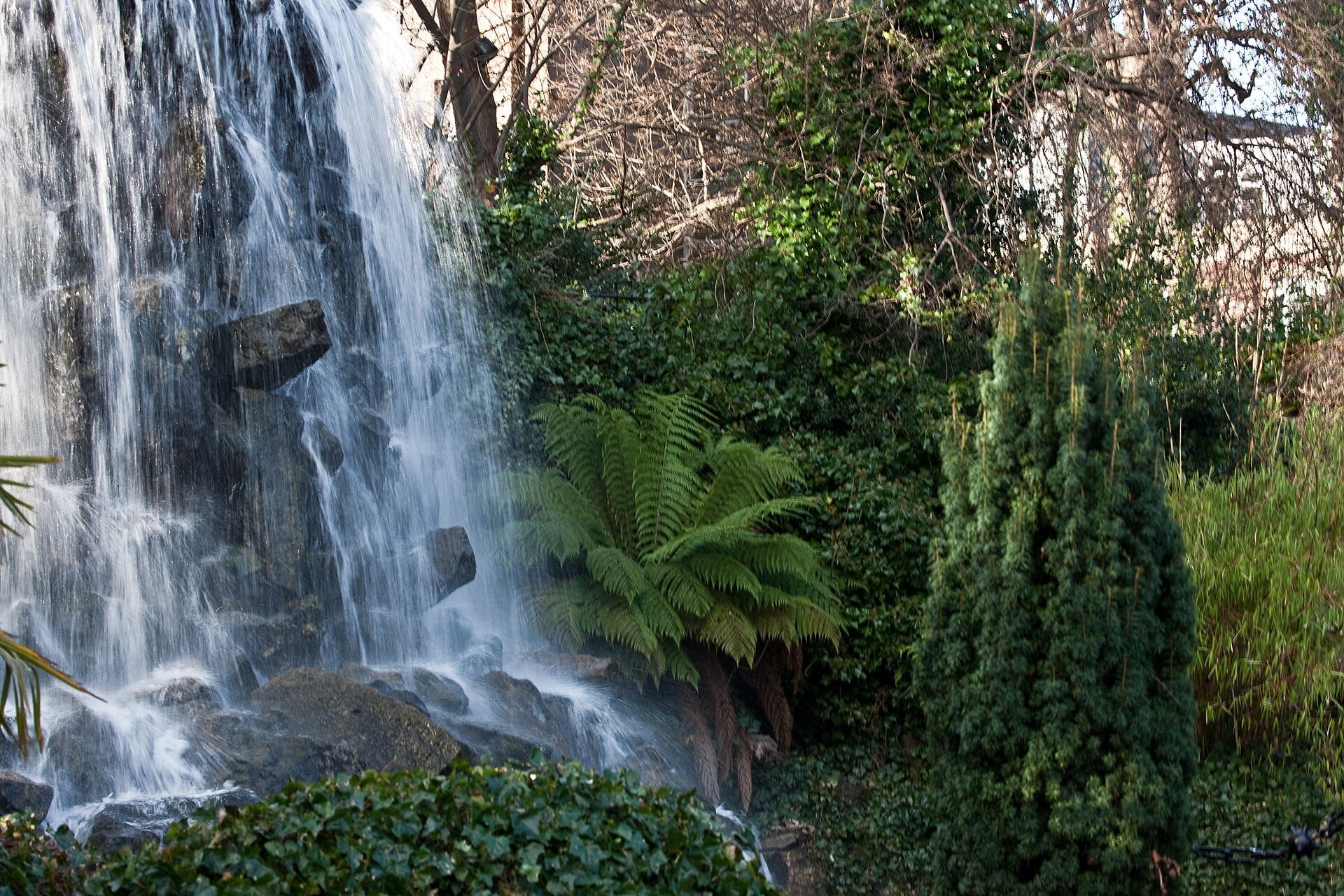
Niven laid out the gardens in a formal French-influenced style with a large central sunken lawn framed by terraces and tree-lined walks. The key features he installed, many of which survive in restored form, include a cascade waterfall at the southern end, a rosarium (rose garden), a wilderness area of mature trees, a maze, archery grounds, and a fountain that forms the centrepiece of the main lawn. Restoration work beginning in 1995 has steadily returned these features to functional condition.
The bones of the design are what make this place feel different from a typical municipal park. The sunken geometry of the main lawn means that as you descend from the perimeter path, the noise of the surrounding city drops noticeably. The high boundary walls, the canopy of mature trees around the edges, and the elevation change create something that functions almost like an acoustic enclosure. It is genuinely quieter inside than outside.
If you want to understand the broader architectural and landscape tradition this park belongs to, the Georgian Dublin architecture guide provides useful context for the period in which the gardens were commissioned and the estates that once surrounded them.
Tickets & tours
Hand-picked options from our booking partner. Prices are indicative; availability and final rates are confirmed when you complete your booking.
Wicklow and Glendalough day trip from Dublin with Powerscourt Gardens
From 65 €Instant confirmationFree cancellationGiant's Causeway, Dark Hedges, and Belfast Tour from Dublin
From 85 €Instant confirmationFree cancellationDublin self-guided audio tour
From 10 €Instant confirmationBird of Prey, Cliffs of Moher and Aillwee Cave from Dublin
From 201 €Instant confirmationFree cancellation
How the Gardens Change Through the Day
Early morning, particularly in summer when the gates open at 08:00, is when the gardens are at their most photogenic and their least crowded. The low-angle light catches the fountain spray and the mown lines of the lawn with particular clarity. The smell of the grass and the damp stone of the paths is strongest in this window, before foot traffic disturbs the dew.
The midday hour, roughly 12:30 to 14:00 on weekdays, brings the biggest crowds of the day: nearby office workers, students from University College Dublin's nearby Earlsfort Terrace campus, and tourists who've been redirected here from St. Stephen's Green. This is still a manageable number of people by any reasonable standard. The main lawn gets lively, benches fill up, and the rosarium path becomes a common route for through-traffic.
Late afternoon in summer, from around 16:00 onward, brings a softer light across the main lawn and the fountain. The cascade waterfall at the far end of the gardens is worth visiting specifically at this hour when the afternoon sun catches the water from the west-facing angle. On concert evenings at the National Concert Hall, the gardens sometimes fill briefly with pre-show visitors, creating an unusually well-dressed crowd for a public park.
A Practical Walkthrough: What to See and In What Order
Enter from Clonmel Street, which is the primary gate and the most direct route from the Harcourt Luas stop. The entry path brings you in at the northern end of the main lawn, giving you an immediate view down the full length of the gardens toward the cascade. This first moment, the long view down the sunken lawn with the fountain in the middle distance and the waterfall beyond, is the payoff the design intended.
Follow the left-hand (western) terrace path down toward the cascade. The waterfall is modest in scale but the stone rockwork around it is well-maintained and the sound of moving water in an otherwise enclosed space creates a disproportionate sense of seclusion. The area immediately around the cascade is the best spot in the gardens for close-up photography without other visitors in frame.
Loop back up through the rosarium, which is at its best between late May and July when the roses are in bloom. The woodland walk along the eastern perimeter follows the original wilderness planting and feels noticeably wilder than the manicured central sections. The maze is small and unchallenging for adults, but it works well if you're visiting with children.
💡 Local tip
The Hatch Street entrance (southern end) is the quieter access point and useful if you're approaching from Harcourt Street or connecting from the Luas. It also deposits you closer to the cascade and rosarium, which are the highlights of the design.
Iveagh Gardens vs. St. Stephen's Green: Making the Choice
The honest comparison is this: St. Stephen's Green is larger, more central, and has a duck pond, a bandstand, and strong historical associations with the 1916 Easter Rising. It is also significantly busier and, around the main paths on a summer weekend, it can feel more like a pedestrian thoroughfare than a garden. The Iveagh Gardens are smaller, harder to find, and offer less in terms of historical drama or landmark status. What they offer instead is a working Victorian pleasure garden that you can actually experience as a garden rather than a public space you happen to move through.
If you want historical significance and open space in one place, go to St. Stephen's Green. If you want to sit on a bench for twenty minutes without feeling you're in anyone's way, or if you want to photograph Victorian landscape design without crowds, come here.
Weather, Seasons, and When to Reconsider
Dublin's maritime climate means the Iveagh Gardens are best visited between late April and September, when average temperatures sit in the mid-teens Celsius and daylight hours are long. The gardens are genuinely pleasant in this window and the planting is at its fullest. In winter, the gardens remain open (excluding the two closure dates) and the bare tree canopy and emptier lawns have their own austere quality, but the short days and frequent rain narrow the useful visiting window considerably.
After heavy rain, the sunken lawn can become muddy around the perimeter and the stone paths near the cascade get slippery. Flat, closed footwear is advisable if there has been recent rainfall. The gardens offer very limited shelter from rain once inside; there are no cafes, covered structures, or refreshment kiosks within the grounds.
⚠️ What to skip
There are no food or drink facilities inside the Iveagh Gardens. If you plan to picnic, bring everything with you. The nearest cafes are on Harcourt Street or along the Grafton Street area, a short walk north.
For a well-planned day that combines the Iveagh Gardens with the broader area, the things to do in Dublin guide includes a range of options in this part of the city that pair naturally with a garden visit.
Photography and Accessibility
The Iveagh Gardens photograph well throughout the day but are at their best in morning light when the lawn is clear and the long axial view is uninterrupted. The fountain and cascade are the most compositionally satisfying subjects. The mature trees along the eastern walk provide canopy framing that works particularly well in autumn when the foliage turns.
Accessibility: both the Clonmel Street and Hatch Street entrances are described by Heritage Ireland as accessible. The main lawn and primary paths are surfaced and manageable for mobility aids, though some of the woodland walk paths are less even. Visitors with mobility requirements should note the slight elevation change between the perimeter terraces and the sunken central lawn.
The Iveagh Gardens sit at the core of the St. Stephen's Green and Grafton Street area, which concentrates a significant number of Dublin's cultural and commercial attractions within easy walking distance.
Insider Tips
- The Hatch Street entrance is less obvious than Clonmel Street but often has less foot traffic passing through, making it a quieter arrival point. It also puts you near the cascade immediately, which is the design highlight.
- On evenings when the National Concert Hall has a sold-out performance, the gardens sometimes fill briefly with well-dressed audience members in the hour before curtain. It creates an unusually atmospheric scene and is worth timing if you're in the area.
- The rosarium is at peak bloom roughly from late May through July. If you're visiting specifically to see the rose garden, this window is the only one that delivers on the promise.
- The sunken lawn is used for outdoor concerts during the summer, most notably the Forbidden Fruit festival period. During these events the gardens may be partially closed or have restricted public access; check the official site before visiting in late May or June.
- For the cleanest long-axis photographs of the main lawn and fountain, position yourself at the Clonmel Street entrance immediately after opening time on a weekday. The lawn is empty, the light is soft, and you'll have the full designed view to yourself.
Who Is Iveagh Gardens For?
- Travelers who want a genuine break from Dublin's busier parks and pedestrian streets
- Garden design and landscape architecture enthusiasts interested in Victorian formal planting
- Photographers looking for clean, crowd-free compositions in a designed setting
- Families with young children: the maze and open lawn work well, and the enclosed walls make supervision straightforward
- Anyone combining a visit to the National Concert Hall and wanting somewhere to decompress before or after
Nearby Attractions
Other things to see while in St Stephen's Green & Grafton Street:
- George's Street Arcade
Built in 1881 as Ireland's first purpose-built shopping centre (later rebuilt after an 1892 fire), George's Street Arcade is a red-brick Victorian market hall on South Great George's Street, Dublin 2. Free to enter and open daily, it houses a mix of vintage clothing, records, antiques, food stalls, and independent retailers beneath a soaring glazed roof.
- Grafton Street
Grafton Street is Dublin's most recognisable shopping street, running 500 metres through the heart of the city from St Stephen's Green to College Green. Pedestrianised in the early 1980s, it draws everyone from commuters and coffee-seekers to tourists and street musicians. Entry is free and the street is open daily.
- Little Museum of Dublin
Housed in a Georgian townhouse at 15 St. Stephen's Green, the Little Museum of Dublin distills over a century of city life into a compact series of rooms and thousands of donated artefacts. Entry is by guided tour only, making this one of Dublin's most intimate and unexpectedly absorbing cultural experiences.
- Merrion Square Park
Merrion Square Park is a free public park at the heart of one of Dublin's best-preserved Georgian squares, dating to 1762. Surrounded by grand red-brick townhouses, it combines manicured gardens, public art, and literary history in a compact, walkable space close to the National Gallery and Government Buildings.