Chester Beatty Library: Dublin's Most Underrated World-Class Museum
Housed within the grounds of Dublin Castle, the Chester Beatty Library holds one of the finest collections of manuscripts, rare books, and decorative arts in the world, spanning cultures from ancient Egypt to imperial Japan. Entry is normally free, but the museum is closed to the public from 15 June through December 2026 for Ireland's EU Council Presidency. Check chesterbeatty.ie before visiting.
Quick Facts
- Location
- Dublin Castle, Dublin 2 (city centre, near Temple Bar)
- Getting There
- Dublin Bus routes on Dame Street; short walk from city centre
- Time Needed
- 1.5 to 2.5 hours
- Cost
- Free admission when open; no advance booking required
- Best for
- History lovers, art enthusiasts, rainy-day escapes, solo visitors
- Official website
- chesterbeatty.ie
What Is the Chester Beatty Library?
The Chester Beatty Library is a museum and library in Dublin that holds one of the most significant collections of manuscripts, miniature paintings, prints, drawings, rare books, and decorative arts ever assembled by a private individual. The collection was built by Sir Alfred Chester Beatty, an American-born mining magnate who spent decades acquiring objects from across Asia, the Middle East, North Africa, and Europe. He bequeathed the entire collection to the Irish state on his death in 1968, and Ireland has been quietly custodying one of the world's great cultural treasures ever since.
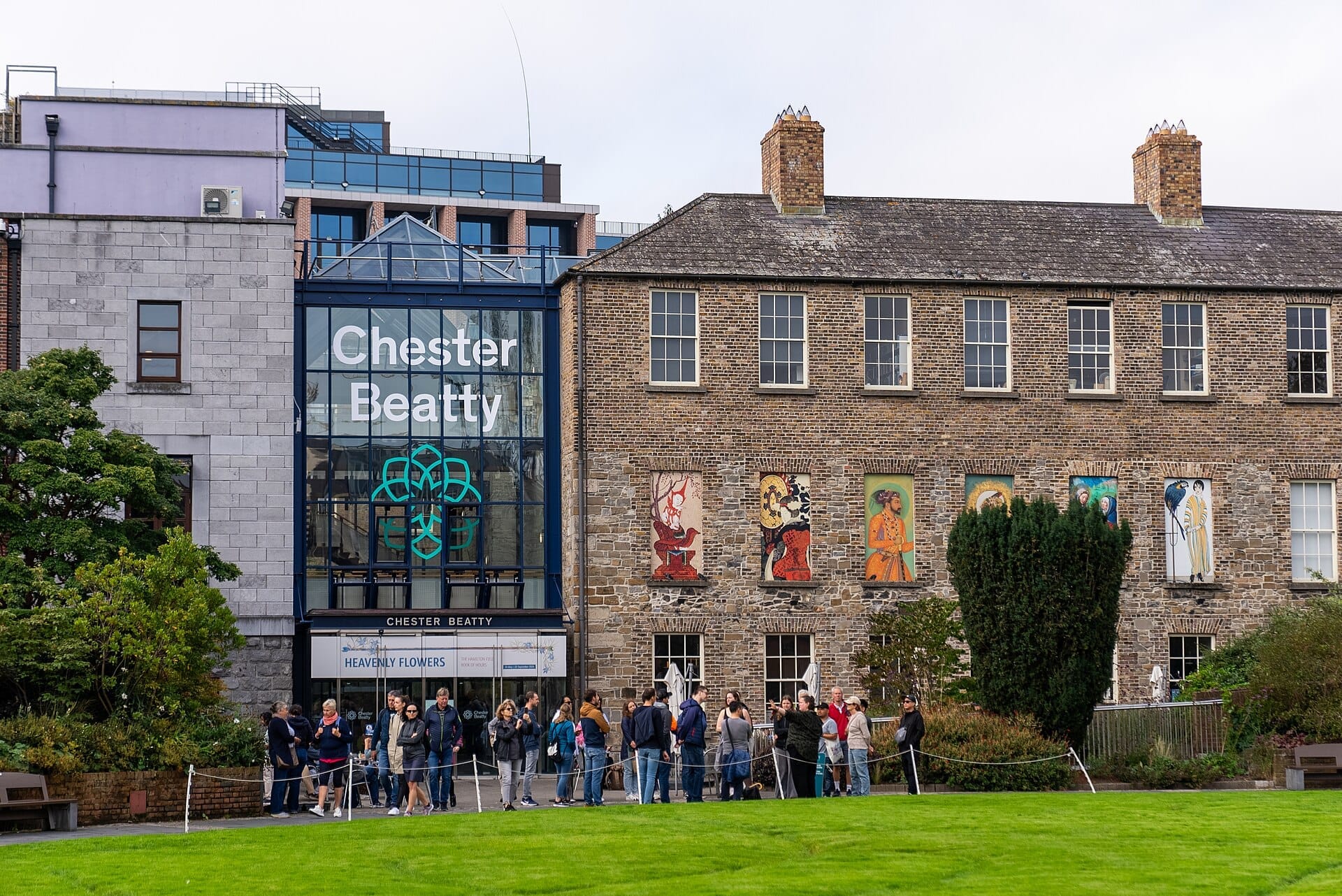
The library sits within the grounds of Dublin Castle, accessed from either Dame Street or Castle Street. From the outside, the building is understated: a late-19th-century Clock Tower building that was sensitively extended and refurbished in 2000. Step inside the glazed lobby, however, and the scale of what this institution holds becomes gradually apparent. The collections span roughly 4,700 years of human creative effort, from clay tablets dating to around 2700 BC to Quranic manuscripts of extraordinary precision, Japanese woodblock prints, illustrated European texts, and Chinese jade books commissioned for the imperial court.
💡 Local tip
Admission is free and no booking is required for general entry when the museum is open. Arrive within the first hour after opening on weekdays for the quietest experience. Sundays and school-holiday afternoons see the most visitors.
The Collection: What You Will Actually See
The permanent collection is spread across two main gallery floors. The ground floor focuses on what the library calls its Arts of the Book collection from the Islamic world and Asia. Here you will find Quranic manuscripts with geometric illumination so precise that it looks machine-made, Persian miniature paintings the size of a paperback page that reward close study with a magnifying glass (available on request), and decorative lacquerwork, textiles, and objects from the Mughal empire, Ottoman Turkey, and Safavid Persia.
The upper floor widens the scope to include Western and biblical material. Some of the library's most historically significant holdings are here: papyrus fragments of the New Testament that are among the oldest known, fragments of the Hebrew Bible, and a large collection of printed books from early European presses. There are also Japanese Noh theatre robes, Chinese rhinoceros horn cups, and a remarkable set of jade books created for the Qing dynasty emperor, each carved page as smooth and cool to the eye as polished stone.
The Reading Room on the first floor of the Clock Tower building is available to registered researchers. Its most surprising feature is a Chinese-style lacquered ceiling that was originally installed in Sir Alfred Chester Beatty's London home and relocated here after his death. It is not always visible to casual visitors, but worth asking about at reception.
The library also mounts temporary exhibitions throughout the year that often bring out items from storage not otherwise on public display. Check the schedule on the Dublin museum listings before you visit, as these exhibitions can significantly change what you see on any given day.
Tickets & tours
Hand-picked options from our booking partner. Prices are indicative; availability and final rates are confirmed when you complete your booking.
Giant's Causeway, Dark Hedges, and Belfast Tour from Dublin
From 85 €Instant confirmationFree cancellationDublin self-guided audio tour
From 10 €Instant confirmationBird of Prey, Cliffs of Moher and Aillwee Cave from Dublin
From 201 €Instant confirmationFree cancellationGame of Thrones Studio tour with return transfer from Dublin
From 63 €Instant confirmationFree cancellation
How the Visit Feels at Different Times of Day
The library opens at 9:45 on Tuesdays through Saturdays and at 12:00 on Sundays, and the first hour is reliably quiet. Gallery attendants are attentive without being intrusive, and the low ambient noise means you can take time with individual objects. The lighting throughout is calibrated to protect sensitive materials, which gives the galleries a calm, slightly dim quality that encourages slow looking rather than fast walking. This is not a museum you sprint through.
By midday on weekdays, small guided groups sometimes move through the galleries, and on summer Saturdays the lobby area can get crowded. The rooftop terrace, accessible from inside the building, is popular with lunch visitors from nearby offices. Arriving after 14:00 on a Tuesday or Wednesday tends to offer a middle ground: the morning rush has cleared and the late-afternoon school groups have not arrived.
Sunday hours start at 12:00, which makes a late-morning visit to Dublin Castle followed by the Chester Beatty a natural pairing. The castle grounds are usually at their liveliest at this time, and the contrast between the outdoor foot traffic and the interior quiet of the library is striking.
ℹ️ Good to know
The library is closed on Mondays. This catches a significant number of visitors off guard, particularly those combining it with a Dublin Castle tour on what is often a day off.
Getting There and Navigating the Castle Grounds
The Chester Beatty Library is located within the Dublin Castle complex in Dublin 2, adjacent to the Temple Bar neighborhood on its northern edge. The most straightforward approach is through the main castle gates on Dame Street. Walk through the Upper Castle Yard and continue toward the rear of the complex; the library is signposted and sits alongside a landscaped garden.
An alternative entrance comes from Castle Street, down steps into the lower grounds, from which the Garda Síochána Memorial Garden and the library building are visible to the right. This route is slightly less obvious but deposits you directly at the garden terrace level, which is useful if you plan to start outside. The Dublin Castle grounds themselves are worth walking through regardless of your entry point.
Multiple Dublin Bus routes serve Dame Street, which runs directly past the castle gates. The walk from Trinity College takes roughly eight minutes on foot. There is no dedicated parking at the castle for visitors, and driving is not recommended given the central location and limited drop-off access. Cyclists will find bike parking near the Dame Street entrance.
The Rooftop Garden: Often Missed, Worth Seeking
One of the features visitors most consistently overlook is the rooftop garden above the library building. It offers a view across the Dublin Castle roofscape and toward the dome of City Hall, and it is one of the quieter outdoor spots in central Dublin. In warm weather, it functions as a genuine refuge from the noise of Dame Street below. There are benches, planted areas, and on clear days, a useful orientation point for getting your bearings in the old city.
The garden is free to access and open during museum hours. It is also a practical stop if you are visiting with children who need a break between gallery floors. The café on the ground floor serves light food and coffee and opens onto a lower courtyard garden, which catches afternoon sun on clear days.
Practical Notes: Weather, Photography, and Accessibility
Because the Chester Beatty Library is an indoor attraction, it works well on Dublin's frequent overcast or rainy days. The climate-controlled galleries are comfortable year-round. There is no need to plan around seasons, though temporary exhibition schedules are worth checking in advance for those with specific interests.
Photography policy allows non-flash photography of permanent collection items in most galleries, but restrictions apply to some temporary exhibitions. Gallery staff will clarify on request. Phone photography works well given the gallery lighting; tripods are not permitted. Some of the most visually compelling items for photography are the Persian miniatures and the Quranic manuscripts, where the geometry of the illumination reproduces well even in limited light.
The building is accessible by level or ramped paths from the castle grounds. The main galleries are on different floors, and the building has lifts. For detailed current information on step-free access, hearing loops, or other accessibility requirements, it is worth contacting the library directly before your visit, as these facilities can change.
⚠️ What to skip
The Chester Beatty is closed to the public from 15 June through December 2026 for Ireland's EU Council Presidency. The museum expects to reopen in early 2027. Check chesterbeatty.ie for updates, and explore the Google Arts & Culture digital collection in the meantime.
Who Should Think Twice
Visitors seeking large-scale dramatic exhibits, interactive installations, or anything kinetic will find the Chester Beatty slow-paced. The experience is overwhelmingly about small, intricate, beautiful objects behind glass, and it rewards patient looking rather than quick scanning. Visitors with children under the age of eight may find the gallery format limiting, though the outdoor gardens and café provide useful breaks. The library is also not the right choice if you have only 30 minutes: the collection genuinely benefits from unhurried time.
If you are primarily interested in Irish history, there are more focused options nearby: Dublinia covers Viking and medieval Dublin, while the National Museum of Archaeology on Kildare Street contains the national collection of Irish prehistoric and early Christian objects. The Chester Beatty complements both but should not be substituted for them if Irish heritage is your priority.
Insider Tips
- The library's online viewer at viewer.cbl.ie allows you to browse digitized manuscripts in detail before your visit. Identifying two or three objects in advance makes the physical experience significantly richer, as you can seek out the originals and see them in their actual scale.
- The rear entrance from Castle Street is almost always less congested than the Dame Street approach and puts you directly level with the garden terrace. Use it on busy weekend afternoons.
- Free guided tours of the permanent collection are offered on certain weekdays and Sundays. Times vary seasonally, so check the website or ask at reception on arrival. These tours provide context that wall labels alone cannot convey.
- The café courtyard on the ground floor is a genuinely pleasant lunch stop and is open to non-museum visitors. On a dry afternoon it is one of the more civilized outdoor spaces in the old city.
- The temporary exhibition program often features material from the reserve collection that is not normally on display. A visit timed around a temporary exhibition can make the Chester Beatty feel like a different museum entirely compared to a standard permanent-collection visit.
Who Is Chester Beatty Library For?
- Travelers with an interest in world history, religion, or the history of books and writing
- Art lovers drawn to Islamic, Asian, or pre-modern European decorative arts
- Visitors caught by bad weather who want a serious alternative to the city's busier paid attractions
- Solo travelers who prefer quiet, self-paced cultural experiences
- Anyone who has already seen the main Dublin attractions and wants something with genuine depth
Nearby Attractions
Other things to see while in Temple Bar:
- Dublin Castle
Dublin Castle stood at the centre of British rule in Ireland from 1204 until 1922, when Michael Collins accepted the handover of power in its courtyard. The State Apartments, Gothic Chapel Royal, and underground Viking excavations are normally open to visitors off Dame Street, but the entire campus is closed to the public from 15 June through December 2026 for Ireland's EU Council Presidency. Check dublincastle.ie before planning a visit.
- Ha'penny Bridge
Standing since 1816, the Ha'penny Bridge is a slender cast-iron arch over the River Liffey that connects Temple Bar on the south bank to Liffey Street on the north. Free to cross at any hour, it offers one of Dublin's most photographed vantage points and a genuine sense of the city's history underfoot.
- The Temple Bar Pub
With its crimson facade, wall-to-wall whiskey bottles, and live Irish music running through the day and into the early hours, The Temple Bar Pub is the pub most visitors picture when they think of Dublin. Whether that's a reason to go or a reason to look elsewhere depends on what you want from a night out.