Dublin Castle: 700 Years of Irish History in One Courtyard
Dublin Castle stood at the centre of British rule in Ireland from 1204 until 1922, when Michael Collins accepted the handover of power in its courtyard. The State Apartments, Gothic Chapel Royal, and underground Viking excavations are normally open to visitors off Dame Street, but the entire campus is closed to the public from 15 June through December 2026 for Ireland's EU Council Presidency. Check dublincastle.ie before planning a visit.
Quick Facts
- Location
- Dame Street, Dublin 2 — off Dame Street behind City Hall, just south of Temple Bar
- Getting There
- 5–10-minute walk from Trinity College; buses along Dame Street stop nearby. Main pedestrian entrance via Palace Street.
- Time Needed
- 1 to 1.5 hours (typical visit); up to around 2 hours with guided tour
- Cost
- Self-guided: Adult €8, Child (12–17) €4, Under 12 free. Guided: Adult €12. Family tickets available.
- Best for
- Irish history, architecture, school groups, first-time Dublin visitors
- Official website
- dublincastle.ie
What Dublin Castle Actually Is
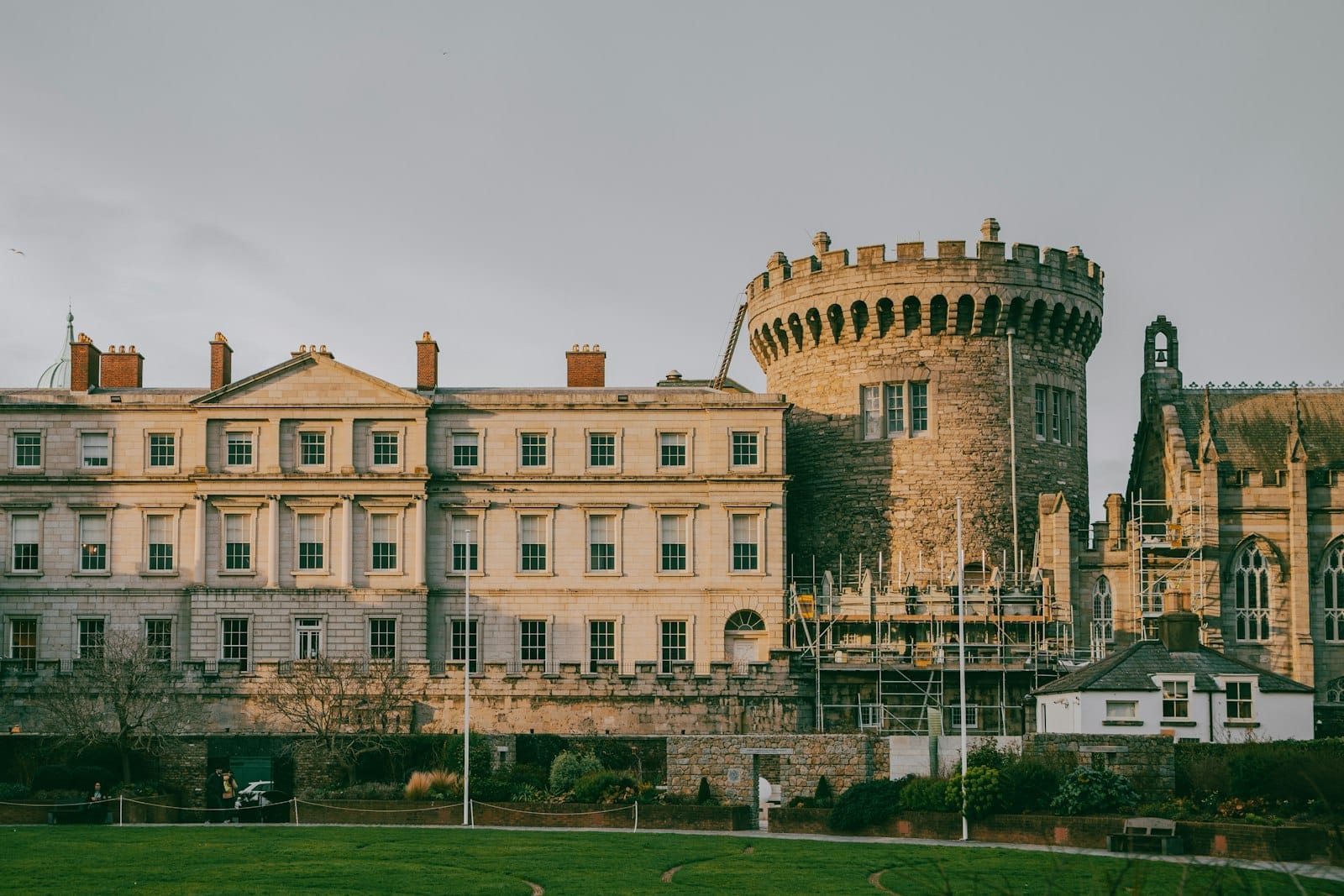
Dublin Castle is not a fairytale fortress. There are no towers to climb for dramatic views, no moat, no drawbridge. What it is, instead, is something more interesting: a layered complex of courtyards, state rooms, a Gothic chapel, and underground medieval excavations that together hold the administrative and symbolic core of Irish history for over 700 years.
Built on the orders of King John of England in 1204, the castle was constructed on the site of an earlier Viking settlement where the River Poddle met the Liffey. For the next eight centuries it functioned as the seat of English, and later British, administration in Ireland, housing the Viceroy's court, a prison, and the machinery of colonial government. On 16 January 1922, Michael Collins accepted the formal handover of the castle from the British authorities, ending that era. The castle has served as a venue for EU Council Presidencies, state banquets, and public exhibitions ever since.
⚠️ What to skip
Closure notice: Dublin Castle will be closed to the public from 5 May to 31 December 2026 to accommodate Ireland's EU Council Presidency. Check dublincastle.ie before visiting to confirm current access.
The State Apartments: Where Power Was Performed
The State Apartments occupy the south range of the Upper Yard and are the most elaborately decorated part of the complex. These rooms were the formal residence of the Lord Lieutenant of Ireland, and the furniture, portraiture, and ceiling plasterwork were all intended to project the authority of the British Crown. Today they read as a precise record of 18th-century power dressing in stone, silk, and gilding.
The Throne Room retains its original early 19th-century throne, said to be the oldest in the British Isles still in its original setting. St Patrick's Hall is the most photogenic space in the building: a long ceremonial room hung with the banners of the Knights of St Patrick, with a painted ceiling depicting the relationship between Britain and Ireland. Since Irish independence, it has been used for the inauguration of Irish presidents, and the Chapel Royal can currently only be visited on a guided tour.
Both the State Apartments and the Chapel Royal are wheelchair accessible with step-free routes, though the Chapel Royal is only accessible as part of a guided tour. Photography is generally permitted in the public areas, though flash photography is restricted around fragile textiles and portraits.
Tickets & tours
Hand-picked options from our booking partner. Prices are indicative; availability and final rates are confirmed when you complete your booking.
Blarney, Rock of Cashel and Cahir Castles Tour from Dublin
From 85 €Instant confirmationFree cancellationGiants Causeway, Dunluce castle, Dark Hedges tour from Dublin
From 71 €Instant confirmationFree cancellationGiant's Causeway, Dark Hedges, and Belfast Tour from Dublin
From 85 €Instant confirmationFree cancellationDublin self-guided audio tour
From 10 €Instant confirmation
The Chapel Royal: Gothic Detail Up Close
The Chapel Royal, completed in 1814 and designed by Francis Johnston, is the architectural showpiece of the castle grounds. From outside it is quietly impressive; inside, the fan-vaulted plaster ceiling and carved oak gallery are extraordinary for a building of this scale. Over 90 carved limestone heads line the exterior walls, representing Irish historical figures and British monarchs, carved by Edward Smyth and his son John.
The chapel sits at the lower end of the Lower Yard and is included in both the self-guided and guided tour routes. Morning light through its east-facing windows is particularly good for photography between roughly 10am and noon. The space is quiet, even when the rest of the castle is busy with school groups, which tend to focus on the State Apartments and the Viking excavation.
The Viking Excavation: Oldest Layer of the Site
Beneath the Upper Yard, accessible via stairs only, are the remains of the original Viking and Norman defenses uncovered during 20th-century construction work. This section includes the base of the Powder Tower, part of the medieval city wall, and the channel of the River Poddle, which originally filled the castle moat. The stonework here dates to the 13th century and represents the oldest visible fabric of the site; it is accessible only on a guided tour.
The underground area is cool year-round, which is welcome on warm days but worth noting in winter when the dampness is more pronounced. Wear shoes with grip, as some of the surfaces around the excavation are uneven. This section is not wheelchair accessible.
If Viking-era Dublin interests you specifically, the Dublinia museum on High Street, a short walk from the castle toward Christ Church, goes into considerably more depth on the Viking and medieval city.
How the Experience Changes by Time of Day
When open, Dublin Castle opens at 09:45 and the first hour is reliably the quietest. The courtyard fills quickly once school tours begin arriving, typically from around 10:30 onward. If you are visiting on a weekday during school terms, arriving at opening gives you the State Apartments and Chapel Royal with relatively few other visitors. By midday the Upper Yard can feel crowded, particularly in summer.
The courtyard itself, which is free to enter, is worth seeing at any time. The combination of the 18th-century Record Tower, the Victorian Bedford Tower, and the restored medieval architecture around the Lower Yard makes it one of the more architecturally varied public spaces in central Dublin. On dry afternoons, the benches near the Dubh Linn Garden on the castle's south side are a reasonable place to pause before or after the tour.
When the site is open, late afternoon visits in summer, in the hour before last admission at 17:15, tend to be quieter than midday. Weekends draw leisure visitors rather than school groups, but the overall volume can be similar. Rain does not significantly affect the indoor portions of the tour, though the courtyard and garden are less pleasant in heavy weather.
💡 Local tip
The courtyard and Dubh Linn Garden are free to enter without a ticket. If you are short on time, a walk through the grounds gives a strong sense of the castle's scale and architectural range at no cost.
Guided vs Self-Guided: Which to Choose
The self-guided option (€8 adult) includes access to the State Apartments with information panels throughout. It works well if you read as you go and are comfortable setting your own pace. The panels are informative, though they can feel dry in the State Apartments where the historical context is most complex.
The guided tour (€12 adult) adds a live guide and typically takes around 1 hour for the main circuit. Guides vary in style and depth, but the better ones give genuine texture to the 1922 handover, the architectural history of the State Apartments, and the Norse origins of the site. If Irish history is a primary interest rather than a secondary one, the guided option is worth the extra cost, and it is currently the only way to visit the Chapel Royal and Viking Excavation. Guided tours run at set times; confirm the schedule at the entrance on arrival.
For a broader walk through Dublin's historically significant buildings, the Georgian Dublin architecture guide covers the castle alongside Custom House, the Four Courts, and the key squares of the southside.
Practical Information for Your Visit
Dublin Castle is at Dame Street, Dublin 2, D02 XN27. The main pedestrian entrance is via Palace Street, a narrow lane off Dame Street leading to the Upper Yard. City Hall, which faces Dame Street directly, is a useful landmark: the castle entrance is immediately behind it. Multiple Dublin Bus routes serve Dame Street, and the castle is walkable from most central Dublin hotels in under 15 minutes.
The castle sits between two other significant religious buildings. Christ Church Cathedral is a 10-minute walk west along Dame Street, and St Patrick's Cathedral is a further 5 minutes south. Combining all three in a single half-day walk is practical and logistically straightforward.
- Opening hours: When open, Monday to Sunday and public holidays, 09:45–17:45 (last admission 17:15)
- Closed: 25–27 December and 1 January annually
- Closed to public: 5 May – 31 December 2026 (EU Presidency; otherwise open year-round)
- State Apartments and Chapel Royal: fully accessible (step-free; Chapel Royal only via guided tour)
- Viking Excavation: stairs only, not wheelchair accessible
- No cloakroom; travel light if possible
- Café and gift shop on site (when the castle is open)
Who Should Think Twice
Visitors expecting a dramatic medieval castle in the visual sense, with battlements, great halls, and period armour, will likely be underwhelmed. The majority of what is visible today is 18th and 19th-century building work. The Record Tower is the only substantial medieval structure still standing above ground, and it is not open to general visitors as an internal space.
Very young children may find the State Apartments difficult to engage with, given the emphasis on painted ceilings and ceremonial furniture. The Viking Excavation tends to hold children's attention better, but is inaccessible to pushchairs and prams. Families with very young children may find the nearby Dublinia a more interactive starting point.
Insider Tips
- The Dubh Linn Garden, on the south side of the castle behind the State Apartments, is one of the least-visited green spaces in central Dublin. The circular pattern in the lawn is inspired by the outline of the original Black Pool (Dubh Linn) from which Dublin takes its Irish name.
- If you want to see the State Apartments without queuing behind a school group, arrive at 09:45 on a Tuesday or Wednesday outside of Irish school holiday periods. Groups tend to book the mid-morning slot.
- The guided tour price difference (€4 over self-guided) is modest relative to the improvement in context for the 1922 handover story. Ask the guide specifically about the disputed account of Collins arriving late to the ceremony.
- City Hall, directly in front of the castle on Dame Street, has a free permanent exhibition on the history of Dublin in its rotunda. It takes 20–30 minutes and pairs well with a castle visit at no extra cost.
- Photography of the Chapel Royal exterior is best from the Lower Yard in the morning. By afternoon, the light falls on the west-facing side and the carved limestone heads lose detail in flat light.
Who Is Dublin Castle For?
- First-time visitors to Dublin who want a single site that covers the span of Irish political history
- Architecture enthusiasts interested in Georgian and Gothic Revival building in an Irish context
- Travellers following a Dublin literary or historical trail who want primary-source context for the 1922 handover
- School-age children and teenagers, particularly for the Viking Excavation
- Visitors who want a sheltered, indoor-focused morning during wet weather
Nearby Attractions
Other things to see while in Temple Bar:
- Chester Beatty Library
Housed within the grounds of Dublin Castle, the Chester Beatty Library holds one of the finest collections of manuscripts, rare books, and decorative arts in the world, spanning cultures from ancient Egypt to imperial Japan. Entry is normally free, but the museum is closed to the public from 15 June through December 2026 for Ireland's EU Council Presidency. Check chesterbeatty.ie before visiting.
- Ha'penny Bridge
Standing since 1816, the Ha'penny Bridge is a slender cast-iron arch over the River Liffey that connects Temple Bar on the south bank to Liffey Street on the north. Free to cross at any hour, it offers one of Dublin's most photographed vantage points and a genuine sense of the city's history underfoot.
- The Temple Bar Pub
With its crimson facade, wall-to-wall whiskey bottles, and live Irish music running through the day and into the early hours, The Temple Bar Pub is the pub most visitors picture when they think of Dublin. Whether that's a reason to go or a reason to look elsewhere depends on what you want from a night out.