St Patrick's Cathedral, Dublin: What to Know Before You Visit
Standing for over 800 years in the Liberties quarter, St Patrick's Cathedral is Ireland's largest cathedral and the national cathedral of the Church of Ireland. From Jonathan Swift's tomb to its soaring Gothic nave, it rewards visitors who take time to look closely.
Quick Facts
- Location
- St Patrick's Close, Dublin D08 H6X3 (Liberties/Smithfield area)
- Getting There
- Dublin Bus routes 49, 54A, 77A, and 150 stop nearby; 15-min walk from St Stephen's Green
- Time Needed
- 60–90 minutes for a thorough visit; 45 minutes if focused
- Cost
- Adult €11.50 | Student/Senior €10.00 | Child (6–12) €5.50 | Family €31.00 | Joint entry with Marsh's Library €17.00
- Best for
- History, architecture, literary heritage, quiet contemplation
- Official website
- www.stpatrickscathedral.ie
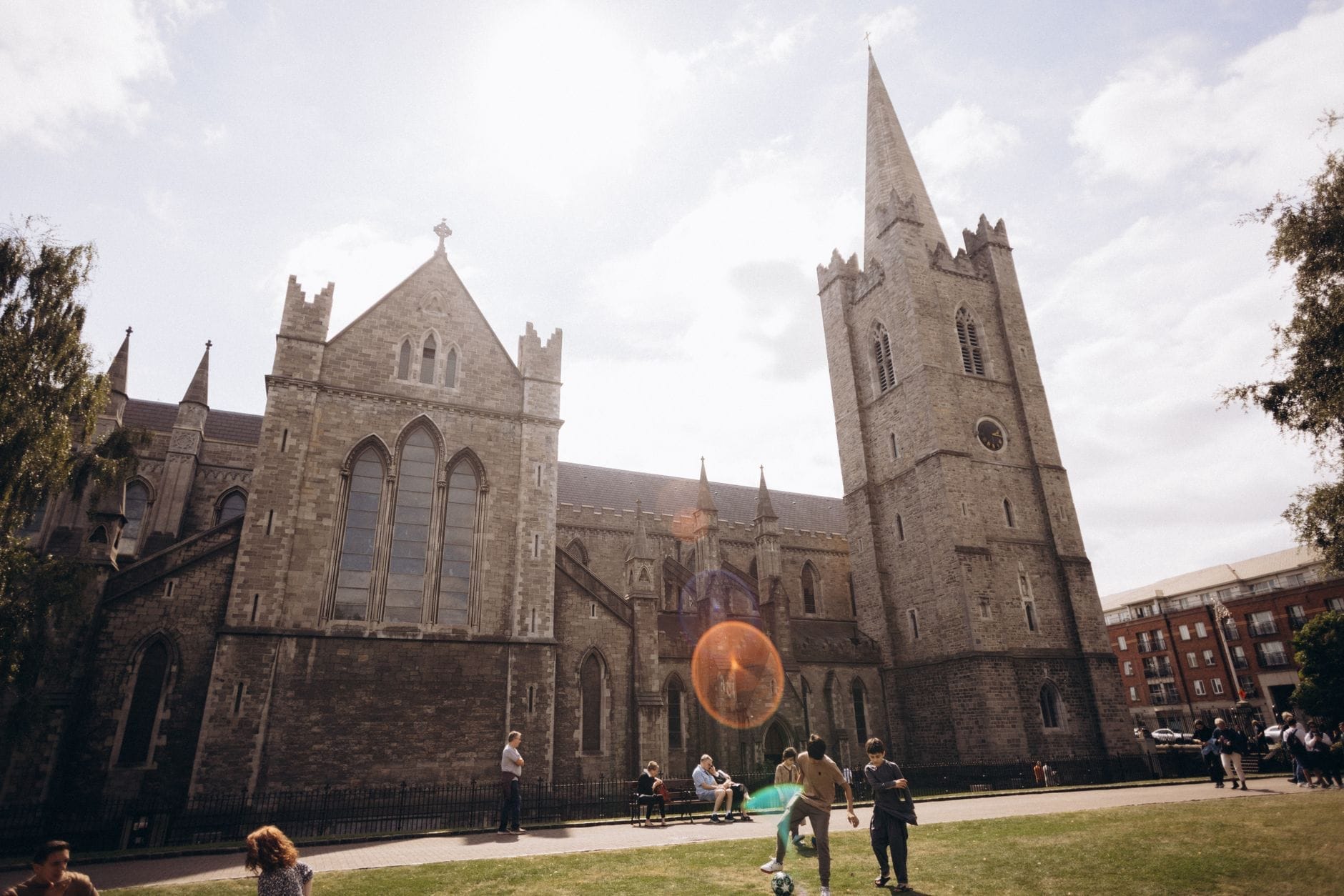
Why St Patrick's Cathedral Still Matters
Saint Patrick's Cathedral, Dublin is not merely old. It is the largest cathedral in Ireland, a building that has shaped the city's religious, literary, and civic life since 1220, and one of the few places in Dublin where 800 years of uninterrupted use becomes genuinely tangible. The walls carry memorials to figures who changed Irish history. The flagstones bear the weight of state funerals, royal visits, and ordinary Sunday services. Even on a busy tourist afternoon, the interior holds a quality of stillness that is hard to find in the city.
The cathedral sits in the Liberties, one of Dublin's oldest working-class neighborhoods, close to Smithfield and the Liberties quarter. That location matters. Unlike Trinity College or the Georgian squares, this corner of the city was never gentrified into a postcard. The streets around the cathedral retain a plainness that makes the building's scale feel even more unexpected when it rises into view.
💡 Local tip
Free guided tours run Monday to Saturday at 10:30 and 14:30. They last around 45 minutes and are included in the admission price. The 10:30 tour typically has fewer visitors and a better pace for questions.
History: From a Marshy Well to Ireland's Largest Cathedral
The site's religious significance predates the Norman construction by centuries. According to tradition, Saint Patrick himself used a well here to baptise converts around the 5th century, roughly 1,500 years before the present building took shape. A church presence is recorded from around 1191, when the Normans elevated the existing parish church to collegiate status. The current cathedral dates from around 1220.
The building has survived fire, flood, and radical repurposing. In the 17th century, Oliver Cromwell's forces stabled horses in the nave. By the 19th century, after centuries of neglect, the structure was in severe disrepair. It was the Guinness family, specifically Sir Benjamin Lee Guinness, who funded a substantial restoration in the 1860s that saved the building and largely determined the interior as visitors see it today. That restoration is worth keeping in mind as you walk around: what looks medieval is sometimes Victorian Gothic interpretation, though much original fabric survives.
The cathedral is the National Cathedral of the Church of Ireland. It still functions as an active place of worship alongside its role as a visitor attraction, which shapes the experience in practical ways, particularly on Sundays when access is restricted to service times.
Tickets & tours
Hand-picked options from our booking partner. Prices are indicative; availability and final rates are confirmed when you complete your booking.
Dublin Christ Church Cathedral entrance ticket and self-guided tour
From 12 €Instant confirmationFree cancellationGiant's Causeway, Dark Hedges, and Belfast Tour from Dublin
From 85 €Instant confirmationFree cancellationDublin self-guided audio tour
From 10 €Instant confirmationBird of Prey, Cliffs of Moher and Aillwee Cave from Dublin
From 201 €Instant confirmationFree cancellation
Jonathan Swift and the Literary Connection
Jonathan Swift served as Dean of St Patrick's Cathedral from 1713 until his death in 1745. His tomb is inside the cathedral, as is the tomb of Esther Johnson, the woman he called Stella, who is widely believed to have been his lifelong companion. Swift wrote his own epitaph in Latin, which W.B. Yeats later translated as: 'Swift has sailed into his rest; savage indignation there cannot lacerate his breast.' The original epitaph is set into the wall near his tomb.
Swift's connection to the Liberties was not ceremonial. He was deeply involved in the welfare of local workers, particularly the weavers of the area, and used his position to advocate publicly for the Irish poor under English rule. For visitors following Dublin's literary trail, the cathedral offers a more complex portrait of Swift than a simple gravestone: the pulpit from which he preached still stands in the nave, and the chapter house holds a display on his life and writing.
What You Actually See Inside
Walking through the main door on St Patrick's Close, the first impression is the sheer length of the nave. At around 91 metres from end to end, it is longer than most visitors expect. The ceiling height and the ranked stone columns create an effect of compressed perspective that makes the distance to the altar seem both far and manageable at the same time.
The medieval floor tiles near the crossing are worth stopping for. Many are worn to near-abstraction but retain their original pattern, and they sit undisturbed by ropes or barriers. The choir stalls along the nave date from the 14th century and carry the banners and helmets of the Knights of St Patrick, Ireland's now-dormant order of chivalry established in 1783. The combination of heraldic regalia and plain stone gives the interior a layered quality that rewards slow looking.
The stained glass windows vary widely in period and quality. Many are Victorian or later replacements. The north transept holds some of the more interesting memorial windows, with inscriptions that read as compressed social histories of the Anglo-Irish establishment. The Lady Chapel at the east end, which was used for centuries by the French Huguenot community in Dublin, is quieter and less visited than the main nave, and worth the short detour.
ℹ️ Good to know
The joint entry ticket with Marsh's Library (€17.00) is worth considering. Marsh's Library sits directly adjacent to the cathedral, dates from 1701, and is one of the oldest public libraries in Ireland. Its original oak bookcases and reading cages are extraordinary. The combined visit extends a natural route.
When to Visit and What to Expect at Different Times
The cathedral opens at 09:30 Monday to Friday and at 09:00 on Saturdays. The first 90 minutes of opening are consistently the quietest, particularly on weekday mornings when the only visitors tend to be early walkers and those who have planned specifically to avoid tour groups. By mid-morning, particularly between 11:00 and 13:00, tour groups from central Dublin begin arriving and the nave can become crowded around the Swift memorial and the main altar.
Afternoons between 14:00 and 15:30 see a secondary peak. After 16:00 on weekdays the numbers thin noticeably, and the cathedral takes on a different character: the light changes through the west windows, the tour groups have departed, and the space begins to feel more like the active church it remains.
Sunday visiting hours are limited to three windows: 09:00–10:30, 13:00–14:30, and 16:30–18:00. These restrictions exist because services take precedence. If you arrive outside those windows on a Sunday, you will not be admitted. It is worth checking the cathedral's official website before visiting on any day, as special services and events can affect access without much advance notice on third-party sites.
⚠️ What to skip
The cathedral is an active place of worship. Guided tours do not run on Sundays. Photography is generally permitted in the main body of the church but may be restricted during services. Dress is casual but understated; the interior is cool year-round, so a layer is advisable even in summer.
Practical Walkthrough: Getting There and Getting the Most From It
The cathedral is around a 15-minute walk from St Stephen's Green, heading southwest along Aungier Street and then Patrick Street. Several Dublin Bus routes (including 49, 54A, 77A, and 150) stop close to the cathedral on Patrick Street; check the Transport for Ireland journey planner for current timetables before travel.
Parking directly at the cathedral is limited to a small number of coach spaces on St Patrick's Close. For those arriving by car, street parking in the surrounding area is available but inconsistent. Most visitors arriving independently will find that walking from St Stephen's Green or from the Temple Bar area is more reliable than searching for nearby parking.
The cathedral is wheelchair accessible and has toilet facilities on site. The main entrance, nave, and choir area are all accessible without steps. Some of the side chapels and upper areas are not, though this does not affect the core visitor route.
Photography inside is largely unrestricted during visitor hours, though flash photography on the medieval floor tiles and aged memorial brasses is best avoided on basic grounds of preservation etiquette. The interior lighting is generally low, which makes wide-aperture lenses or higher ISO settings useful for anyone shooting without a tripod. The west end of the nave, when the morning light comes through the doors, offers the strongest natural illumination for photographs of the full length of the building.
An Honest Assessment: Is It Worth Your Time?
At €11.50 for an adult ticket, St Patrick's Cathedral is not cheap by comparison with some Dublin attractions, though the price is reasonable given the quality of what is preserved here. Visitors who approach it with some context, either from the free guided tour or from reading a little about Swift, the Knights of St Patrick, or the Guinness restoration, will find it considerably more rewarding than those who walk through without that framework.
Those who find ecclesiastical interiors unengaging, or who are visiting Dublin primarily for outdoor activities, food, or the pub culture of Temple Bar, may reasonably decide the cathedral does not warrant their limited time. It is not a building that performs for visitors who are not curious about what they are looking at. But for anyone with an interest in Irish history, Gothic architecture, or the literary legacy of Swift and the Anglo-Irish tradition, it is among the more substantial experiences Dublin offers.
If you are building a broader itinerary around this part of the city, the cathedral combines naturally with the Guinness Storehouse, which is a 10-minute walk west, and with Kilmainham Gaol, around 20 minutes on foot. Together they form a coherent afternoon or full-day route through the Liberties and Kilmainham.
Insider Tips
- The free guided tour at 10:30 on weekday mornings consistently attracts fewer people than the 14:30 slot. Guides vary in style; if you get one who lingers on Swift and the Knights of St Patrick, take your time in the choir stalls and ask about the door with the hole cut in it, a physical relic of a famous 1492 peace gesture between the Earls of Kildare and Ormond.
- The door with a cut hole that gave rise to the phrase 'chancing your arm' is displayed in the north transept. It is one of the more directly evocative objects in any Dublin building and tends to be glossed over quickly on busy tours.
- If you plan to visit Marsh's Library, buy the joint ticket at the cathedral entrance rather than paying separately at the library. The library opens at 09:30 Tuesday to Friday and 10:00 on Saturdays, and is closed Sundays and Mondays; plan accordingly.
- The cathedral's evensong services, held several times weekly, are open to the public and free to attend. They offer a completely different experience of the building: candlelit, acoustically rich, and attended mostly by locals. Check the cathedral's website for the current schedule.
- The garden on the south side of the cathedral, along the old city wall line, is small but quiet and rarely busy even during peak visitor hours. It is a useful spot to decompress before or after the interior.
Who Is St Patrick's Cathedral For?
- History enthusiasts drawn to medieval architecture and the Anglo-Irish narrative
- Literary travelers following the trail of Jonathan Swift and Dublin's literary past
- Families with older children (10+) interested in the Knights of St Patrick and the building's stories
- Photographers looking for Gothic interior shots with natural light and original detail
- Visitors combining a half-day circuit of the Liberties, Kilmainham, and Guinness Storehouse
Nearby Attractions
Other things to see while in Smithfield & The Liberties:
- Christ Church Cathedral
Christ Church Cathedral has anchored Dublin's skyline for nearly a thousand years, predating the city's most famous landmarks by centuries. This guide covers what you actually see inside, when to go, how to get there, and whether the admission fee is worth it.
- Dublinia Viking and Medieval Museum
Dublinia brings over a thousand years of Dublin's earliest history to life through immersive reconstructions of Viking longships, medieval streetscapes, and hands-on archaeology exhibits. Housed in the 19th-century Gothic Revival Synod Hall beside Christ Church Cathedral, it rewards curious visitors of almost any age.
- Guinness Open Gate Brewery
Tucked inside the St. James's Gate complex on James's Street, the Guinness Open Gate Brewery is a working experimental taproom where Guinness brewers test recipes that never make it to supermarket shelves. No queues, no theatrics, just serious beer in a real brewery setting.
- Guinness Storehouse
The Guinness Storehouse takes you through seven floors of brewing history at St James's Gate, the birthplace of one of the world's most recognisable drinks. The experience ends at the rooftop Gravity Bar with a complimentary pint and views across the Dublin skyline. It draws more visitors than any other paid attraction in Ireland, and whether that's a recommendation or a caution depends entirely on what you're after.