Guinness Storehouse: Dublin's Most-Visited Attraction, Honestly Assessed
The Guinness Storehouse takes you through seven floors of brewing history at St James's Gate, the birthplace of one of the world's most recognisable drinks. The experience ends at the rooftop Gravity Bar with a complimentary pint and views across the Dublin skyline. It draws more visitors than any other paid attraction in Ireland, and whether that's a recommendation or a caution depends entirely on what you're after.
Quick Facts
- Location
- St James's Gate, Dublin D08 VF8H (Liberties district, Dublin 8)
- Getting There
- Luas Red Line: James's stop (approx. 6-min walk) or Fatima stop (approx. 7-min walk). Also served by hop-on/hop-off bus tours.
- Time Needed
- 2 to 2.5 hours for the full self-guided experience; allow extra time at the Gravity Bar
- Cost
- Timed tickets required; prices vary by date and experience type. Check guinness-storehouse.com for current pricing. Standard ticket includes one complimentary drink.
- Best for
- First-time visitors to Dublin, beer enthusiasts, group outings, and anyone curious about Irish industrial and cultural history
- Official website
- www.guinness-storehouse.com/en
What the Guinness Storehouse Actually Is
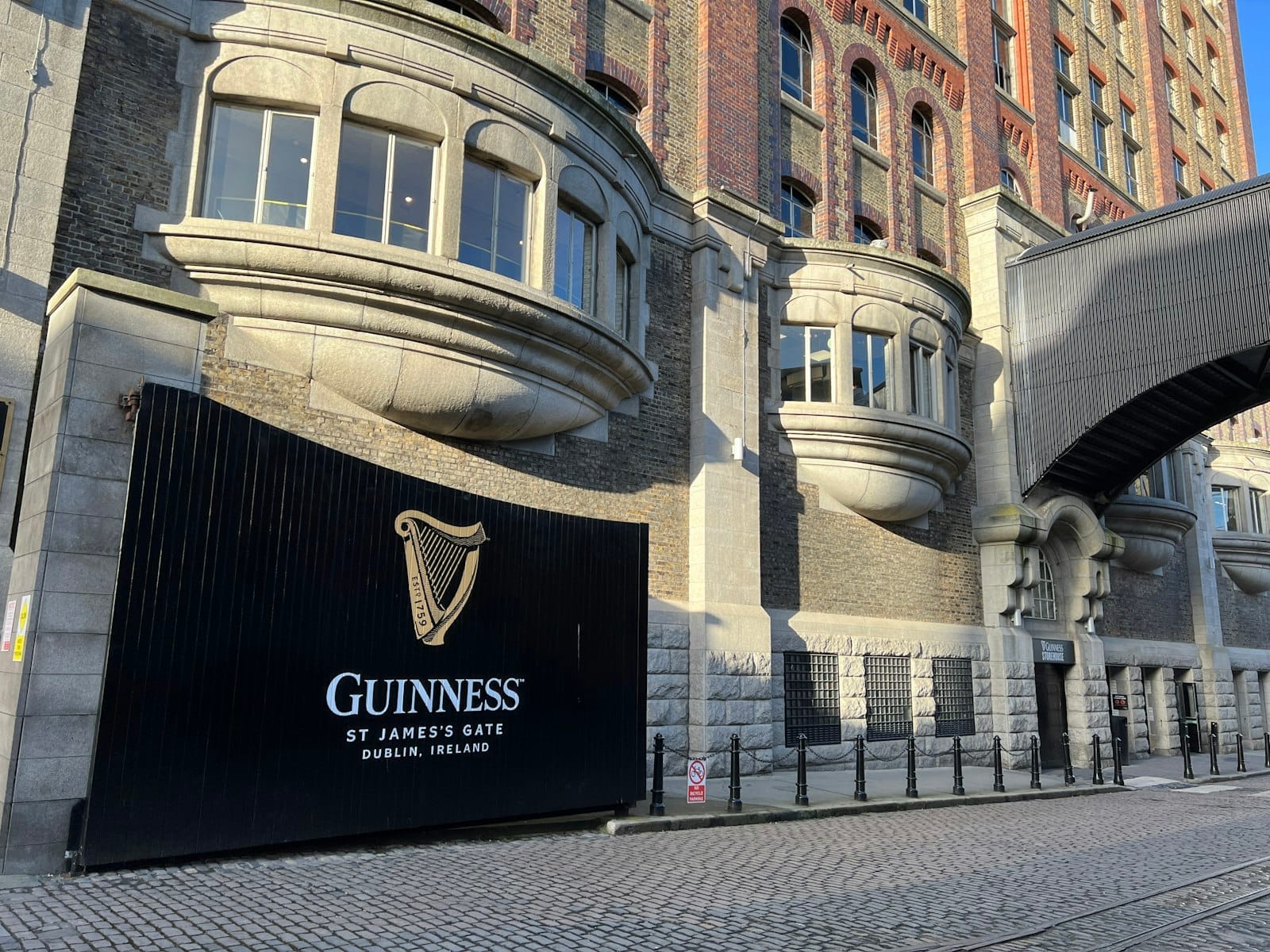
The Guinness Storehouse is a seven-floor visitor experience built inside the old fermentation plant at St James's Gate Brewery in Dublin's Liberties district. It opened in 2000 and has since become Ireland's single most visited paid attraction. That popularity is worth taking seriously: the building processes a vast number of visitors on any given day, and knowing this in advance shapes how you plan your visit.
The structure itself is a piece of industrial architecture worth noticing. The central atrium is designed in the shape of a giant pint glass, rising the full height of the building. Looking up from the ground floor, you see seven levels of galleries wrapping around that hollow core, with natural light filtering down from above. The scale alone is striking before you've read a single exhibit panel.
The surrounding neighbourhood is the Liberties, one of Dublin's oldest working-class areas, with a long history tied to trades and small industries. St James's Gate has been a brewery site since Arthur Guinness signed a 9,000-year lease there in 1759. The area has changed considerably since then, but walking up from Smithfield's Jameson Distillery or across from Kilmainham, you still pass streets of brick terracing and local pubs that predate any tourist infrastructure by generations.
💡 Local tip
Book timed-entry tickets online in advance. Walk-up queues at peak times can be substantial, and online booking typically offers better pricing than the door rate. Saturday mornings between 11:00 and 13:00 are among the busiest windows of the week.
The Brewing History: What You're Actually Learning
The ground floor opens with the 1759 lease itself, a physical document displayed under glass. It's a genuine historical artefact, and the storytelling around it is well-executed: brewing at St James's Gate predates Irish independence, predates the Act of Union, predates the American Declaration of Independence. Anchoring the story to that document gives the experience a credibility that more synthetic visitor attractions often lack.
Subsequent floors cover the four ingredients of Guinness: water, barley, hops, and yeast. The barley and roasting section involves an actual sensory element: you can smell the roasted grain through vented display units, and the difference in colour between malted barley at different roasting stages is presented clearly. It's a small thing, but it distinguishes this floor from a purely visual experience.
The brewing process floors are more technical and better suited to visitors with genuine curiosity about fermentation and production. For those less interested in the mechanics, the historical advertising archive on an upper floor tends to be more immediately engaging. Guinness has been producing illustrated advertising since the 1920s, and the posters on display here trace graphic design trends across a century. The toucan, introduced in 1935 by artist John Gilroy, has become so recognisable that many visitors know it without knowing its origin.
Tickets & tours
Hand-picked options from our booking partner. Prices are indicative; availability and final rates are confirmed when you complete your booking.
Go City | Dublin All-Inclusive Pass
From 79 €Instant confirmationFree cancellationGiant's Causeway, Dark Hedges, and Belfast Tour from Dublin
From 85 €Instant confirmationFree cancellationDublin self-guided audio tour
From 10 €Instant confirmationBird of Prey, Cliffs of Moher and Aillwee Cave from Dublin
From 201 €Instant confirmationFree cancellation
The Gravity Bar: Views, Pints, and the Reality of Crowds
The rooftop Gravity Bar is the payoff. Circular, glassed-in on all sides, it sits at the top of the building and offers an unobstructed 360-degree view across Dublin. On a clear day you can see the Dublin Mountains to the south, the spire of Christ Church Cathedral below, the docklands cranes to the east, and the green plateau of the Phoenix Park to the west. It's a genuinely useful orientation for anyone arriving in Dublin for the first time.
Your admission ticket includes one complimentary drink at the Gravity Bar. You can choose a pint of Guinness, a Guinness 0.0 (for those not drinking alcohol), or a soft drink. The pour, when the bar is not overwhelmed, takes about two minutes using the traditional two-part method. On peak days, the bar becomes congested, with visitors circling for window positions. If you want a clear view with your drink, arrive at opening time or in the last 90 minutes before closing, when crowds thin noticeably.
⚠️ What to skip
Weekend afternoons between roughly 13:00 and 17:00 are the busiest period. If you visit then, the Gravity Bar can feel more like a commuter platform than a rooftop bar. Going first thing on a weekday morning or in the final hour before last admission changes the experience substantially.
Floor by Floor: A Practical Walkthrough
The experience is self-guided, meaning you move at your own pace. Most visitors spend between 90 minutes and two and a half hours inside, though the building is designed so you can move quickly through sections that don't interest you without missing the core narrative.
- Floor 1 (The Origin): The 1759 lease, the founder's story, the site's geography and history
- Floor 2 (The Ingredients): Barley, water, hops, and yeast, with sensory displays
- Floor 3 (The Brewery): The brewing and fermentation process explained in detail
- Floor 4 (The Cooperage): The history of barrel-making and coopering, an often-overlooked section
- Floor 5 (The Transport and Global Story): How Guinness reached the world, shipping routes, export heritage
- Floor 6 (The Advertising Archive): Decades of Guinness advertising, poster art, and campaign history
- Floor 7 (Gravity Bar): Rooftop bar with 360-degree views and complimentary drink
There are also food and drink outlets on several floors, including a bar mid-building where you can purchase Guinness before reaching the top. Photography is permitted throughout. The most photographed spot inside the building, other than the Gravity Bar views, is the ground-floor atrium looking upward through the pint-glass structure. Arrive a few minutes before opening and you can get that shot without other visitors in frame.
Getting There and Practical Logistics
The Guinness Storehouse is located at St James's Gate, about two kilometres west of Temple Bar. The walk from the city centre takes about 25 minutes along Thomas Street, which passes through the heart of the Liberties. It's a flat walk, and the route itself passes some interesting streetscapes, including the Iveagh Trust housing blocks and several old pub facades.
By Luas Red Line, the James's stop is approximately a six-minute walk from the entrance. Trains run frequently from central stops including Jervis, Abbey Street, and Heuston Station. If you're combining the Storehouse with a visit to Kilmainham Gaol, both are accessible from the same Luas corridor. Several hop-on/hop-off bus routes also stop directly outside.
The building is equipped with lifts serving all seven floors, and the self-guided format means visitors can move at a pace that suits them. Detailed accessibility information, including provision for visitors with specific needs, is available through the official booking process on the Guinness Storehouse website.
Guinness Storehouse opening hours as of the time of writing are typically Monday to Friday 10:00 to 19:00 (last admission 17:00), Saturday 09:30 to 20:00 (last admission 18:00), and Sunday 10:00 to 19:00 (last admission 17:00). These hours are subject to seasonal and holiday variation, so check the official site before your visit.
An Honest Assessment: Is It Worth It?
The Guinness Storehouse is not the cheapest attraction in Dublin. Compared to the city's free museums and galleries, the ticket price is significant. What you're paying for is a well-produced narrative experience, a rooftop view that's among the best in the city, and a setting that connects genuinely to Irish social and industrial history. Whether that's worth it depends on your interests.
Visitors who have already spent time at the National Museum of Archaeology or the Chester Beatty Library sometimes find the Storehouse comparatively shallow as a cultural experience. The advertising and brand history floors, in particular, are openly promotional in tone. That's not hidden, but it's worth knowing going in.
For first-time visitors to Dublin who want a single attraction that combines Irish history, an atmospheric building, and a rooftop drink with city views, the Guinness Storehouse delivers reliably on all three. The key is managing expectations: this is a premium visitor experience built around a brand, and it's very good at what it is. It's not a history museum in the academic sense.
ℹ️ Good to know
Who might skip it: Repeat visitors to Dublin who have already done the tour, travellers who don't drink and find the beer focus less interesting, and anyone on a tight budget who would rather spend the same money across two or three of Dublin's free cultural institutions.
Combining the Storehouse with the Surrounding Area
The Liberties and Smithfield neighbourhoods around St James's Gate have enough to fill a half-day. After the Storehouse, the walk north toward Smithfield Square takes about 15 minutes and passes through streets that have changed relatively little in character. Smithfield has a weekend market and several bars with live traditional music.
To the east, Christ Church Cathedral is a 20-minute walk along Thomas Street and High Street, a route that traces Dublin's medieval core. The combination of the Storehouse in the morning and Christ Church or the nearby Dublinia museum in the early afternoon makes for a coherent half-day in this part of the city.
Insider Tips
- Visit on a weekday morning when the building opens. The Gravity Bar at 10:00 on a Tuesday has fewer than a dozen people in it; by 14:00 on a Saturday it can hold over a hundred.
- The mid-building bar on Floor 5 or 6 (the Arthur's Bar area) is often quieter than the Gravity Bar and serves the same Guinness. If the rooftop is packed, consider using your complimentary drink there instead.
- The ground-floor atrium viewed from directly underneath looking up through the full height of the pint-glass structure is the best interior photograph in the building. Get there before the first tour group arrives for a clean shot.
- The advertising floor is genuinely worth slowing down for. The original John Gilroy toucan artwork and the pre-war lithograph posters are rarely given the attention they deserve because most visitors are moving toward the Gravity Bar.
- If you want to pour your own pint, the Guinness Academy experience (available as an add-on or in some ticket tiers) teaches the two-part pour in a dedicated area. Check the official site for current availability and pricing, as the format has changed over time.
Who Is Guinness Storehouse For?
- First-time visitors to Dublin wanting a single landmark attraction that combines history, architecture, and a rooftop view
- Beer enthusiasts and anyone interested in brewing history, industrial heritage, or brand history
- Groups and families where members have mixed interests, as the multi-floor format allows people to move at different paces
- Travellers with limited time who want an efficient way to understand something of Dublin's industrial and cultural identity
- Those visiting Dublin in winter or wet weather, when the indoor, multi-floor format is a practical advantage
Nearby Attractions
Other things to see while in Smithfield & The Liberties:
- Christ Church Cathedral
Christ Church Cathedral has anchored Dublin's skyline for nearly a thousand years, predating the city's most famous landmarks by centuries. This guide covers what you actually see inside, when to go, how to get there, and whether the admission fee is worth it.
- Dublinia Viking and Medieval Museum
Dublinia brings over a thousand years of Dublin's earliest history to life through immersive reconstructions of Viking longships, medieval streetscapes, and hands-on archaeology exhibits. Housed in the 19th-century Gothic Revival Synod Hall beside Christ Church Cathedral, it rewards curious visitors of almost any age.
- Guinness Open Gate Brewery
Tucked inside the St. James's Gate complex on James's Street, the Guinness Open Gate Brewery is a working experimental taproom where Guinness brewers test recipes that never make it to supermarket shelves. No queues, no theatrics, just serious beer in a real brewery setting.
- Jameson Distillery Bow St
Set in the historic Bow Street distillery building that dates to 1780, Jameson Distillery Bow St in Smithfield is the original home of Irish whiskey's most recognised name. Guided tours combine genuine industrial history with hands-on tasting, finishing at a rooftop bar above the cobbled square.