Jameson Distillery Bow St: Dublin's Landmark Whiskey Experience
Set in the historic Bow Street distillery building that dates to 1780, Jameson Distillery Bow St in Smithfield is the original home of Irish whiskey's most recognised name. Guided tours combine genuine industrial history with hands-on tasting, finishing at a rooftop bar above the cobbled square.
Quick Facts
- Location
- Bow Street, Smithfield Village, Dublin 7
- Getting There
- Smithfield Luas stop (Red Line), 2-minute walk
- Time Needed
- 1.5 to 2.5 hours depending on tour type
- Cost
- Paid admission; check official site for current ticket prices
- Best for
- Whiskey enthusiasts, history lovers, social evenings
- Official website
- www.jamesonwhiskey.com/en/visit-us/jameson-distillery-bow-st
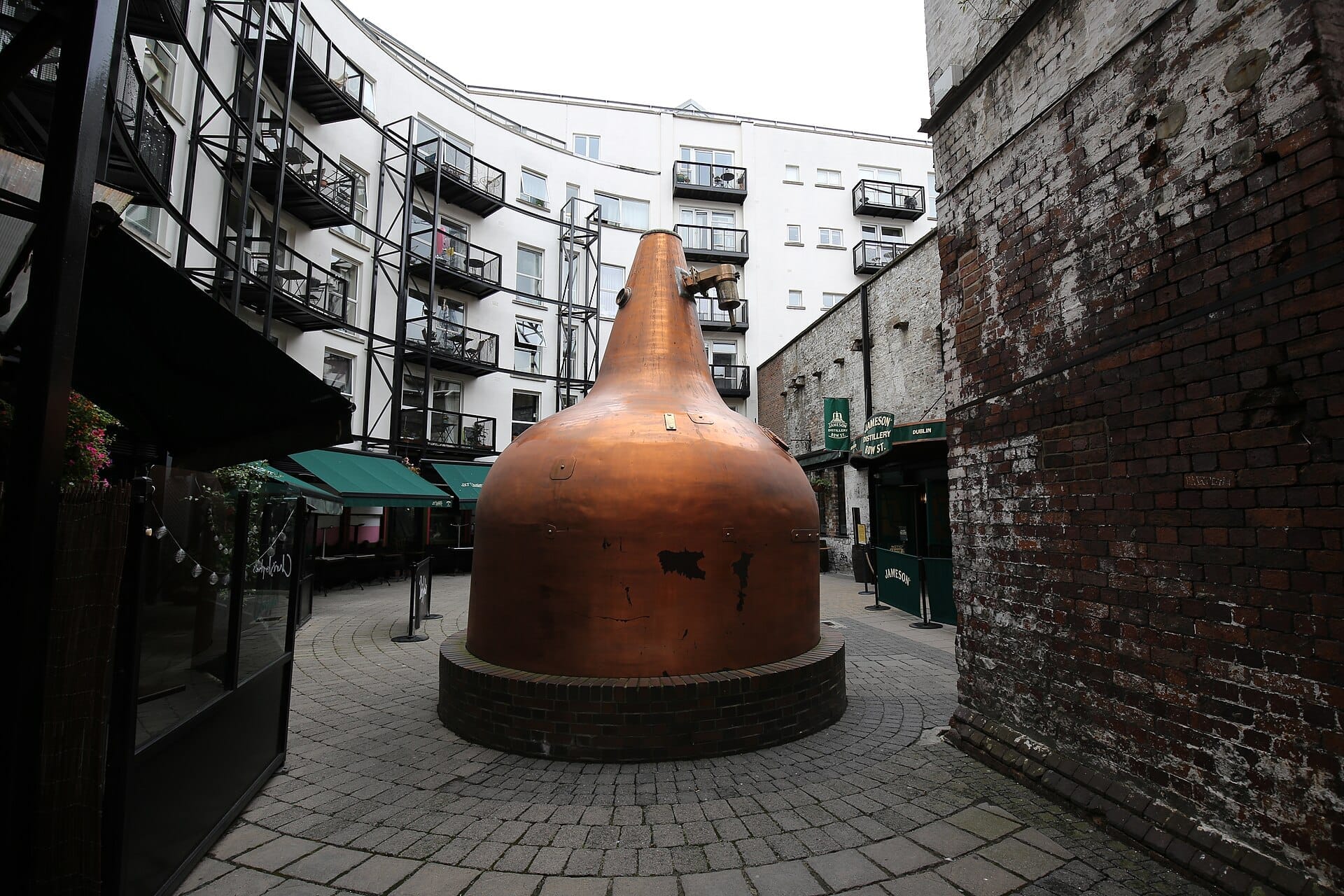
What Jameson Distillery Bow St Actually Is
Jameson Distillery Bow St is not a replica or theme park attraction. The building at Bow Street in Smithfield is the original site where John Jameson began distilling in 1780, and the masonry around you during a tour carries that age visibly. By the 19th century this complex had grown into the largest whiskey distillery in the world. Production shifted to the Midleton Distillery in County Cork in 1971, and the Dublin site reopened as a visitor experience, but the bones of the place are genuine: copper pot stills, stone warehouses, and industrial ironwork from centuries of whiskey making.
The experience is structured around guided tours of varying depth. The standard Bow St Experience walks you through the production process, covers the Triple Distillation method that defines Irish whiskey, and ends with a whiskey tasting. The Whiskey Makers Tour goes further, taking smaller groups into areas of the building not on the standard route, with a more detailed tasting flight. The Bar at the top of the building is accessible without booking a tour, which matters if you want a drink without the full programme.
💡 Local tip
Book your tour slot online before arriving. Walk-in availability is inconsistent, especially on weekends and during summer months. The official website is the only reliable place to check live pricing and availability.
The Smithfield Setting and How to Arrive
Bow Street sits on the edge of Smithfield Square, one of Dublin's largest public squares and a neighbourhood that has shifted considerably over the past two decades. The square itself hosts occasional markets and events, and the cobblestones around the distillery entrance give the approach a texture that feels appropriate for the building's age. To understand the wider area, the Smithfield and Liberties neighbourhood covers both the historic industrial quarter and the streets south toward the Guinness quarter.
The Smithfield Luas stop on the Red Line is a short walk from the entrance, making this one of the most straightforward major attractions in the city to reach by public transport. From the city centre, the Red Line runs through Jervis and Abbeys Street before reaching Smithfield. Buses serve Arran Quay on the nearby quays, and there is a Dublin Bikes station on Smithfield Square if you are cycling. Paid parking exists in the area but the Luas is the path of least resistance.
If you are walking from Temple Bar or the Ha'penny Bridge area, Smithfield is roughly a short walk across the river and north through the Liberties-adjacent streets. The walk itself passes through a part of Dublin that most tourists skip, which is worth the detour for context.
Tickets & tours
Hand-picked options from our booking partner. Prices are indicative; availability and final rates are confirmed when you complete your booking.
Private Dublin distillery trail
From 163 €Instant confirmationFree cancellationGiant's Causeway and Titanic Distillers Whiskey tasting from Dublin
From 75 €Instant confirmationFree cancellationGiant's Causeway, Dark Hedges, and Belfast Tour from Dublin
From 85 €Instant confirmationFree cancellationDublin self-guided audio tour
From 10 €Instant confirmation
Inside the Tour: What You See and Smell
The entry courtyard sets an immediate tone: stone walls, industrial proportions, and the faint sweetness of malt that clings to old distillery buildings long after production has moved elsewhere. It is not an overpowering smell, more a background note, but it tells you before a word is spoken that this is a real production site rather than a built set.
The tour moves through areas covering grain sourcing, mashing, fermentation, and distillation. The copper pot stills on display are full-scale pieces that help convey the industrial scale this operation reached in the 19th century. and standing next to them gives a physical sense of the industrial scale this operation reached in the 19th century. Guides typically explain the difference between Irish Triple Distillation and Scottish double distillation with enough clarity to satisfy people with no prior whiskey knowledge, while keeping enough detail to hold the interest of people who already know their single pot still from their blended.
The tasting at the end of the standard tour involves a comparative tasting, allowing a comparison that makes abstract descriptions of flavour profiles concrete. The Whiskey Makers Tour extends this with a more curated selection and a longer session in the tasting room. If whiskey tasting is your primary reason for visiting rather than the history, the upgraded tour is worth the additional cost.
ℹ️ Good to know
Opening hours vary by day and season, so verify current hours on the official website before planning your visit.
The Rooftop Bar and After the Tour
The bar at the top of the Bow St building is one of the more underused options in this part of the city. The view over Smithfield Square is not dramatic, but it is an elevated position that gives the square a different scale than street level.
Evening visits to the bar draw a mix of locals and tourists who have finished a tour and extended their stay. It is quieter than most options in Temple Bar and considerably less expensive per drink than the rooftop bars in hotel properties further south. That said, it is not a late-night destination and operates within the distillery's general opening window.
Historical Weight: From 1780 to Today
John Jameson was a Scottish-born distiller who established himself at Bow Street in 1780. Within a generation the business had grown into the dominant force in Irish whiskey, exporting heavily to Britain and beyond. The 19th century was the commercial apex: the Bow Street site employed hundreds and produced large volumes annually. Irish whiskey's decline in the 20th century, caused by a combination of trade disruptions, Prohibition closing the American market, and competition from Scotch whisky, nearly finished the industry entirely. That context is not incidental to visiting this building. The tour explains it, and understanding it makes the revival of Irish whiskey over the past 30 years feel earned.
The broader Dublin whiskey scene has expanded significantly since the Bow Street experience was established. If you want to compare production methods and styles, Teeling Whiskey Distillery in the nearby Liberties is a working craft distillery with its own visitor experience, offering a useful contrast to the heritage focus at Bow Street.
Photography, Lighting, and Practical Conditions
The interior of the distillery is atmospheric but low-light in several sections. Phone cameras handle most of it adequately, but the copper still room is the standout shot and benefits from a wider lens if you have one. The tour moves at a guide-determined pace, so there is not always time to linger for a considered composition. If photography is important to you, the Whiskey Makers Tour with its smaller group size gives more space and time.
The cobbled courtyard outside the entrance is the most photogenic exterior area. Morning light before 11:00 hits the stone facade well. By early afternoon on sunny days there is direct overhead light that flattens the texture of the stonework. Weather does not significantly affect the indoor experience, which makes this a reliable option on Dublin's frequent overcast or rainy days.
⚠️ What to skip
The distillery is wheelchair accessible according to official information, but the cobbled surfaces outside the entrance can be uneven. Check with the distillery directly if specific access requirements apply.
Who Will Get the Most From This Visit
People with a genuine interest in whiskey history or production will find the depth here satisfying. The same goes for anyone tracing Dublin's industrial and economic past: Bow Street is a physical document of the city's commercial history in a way that a conventional museum cannot replicate. If you are building a broader Dublin itinerary, the Dublin attractions overview and the Dublin on a budget guide both provide context for where Bow Street fits relative to other options on time and cost.
People who are not interested in whiskey at all will find the tour slow regardless of how well it is delivered. The history is strong, but it is narrated through the lens of whiskey production, and there is no way around that. The same applies to visitors with very limited time: the standard tour runs about 45 minutes before the tasting, which means committing a half-day slot including travel. It is not a 30-minute drop-in.
For visitors combining whiskey history with the wider Smithfield area, Smithfield Square directly outside the distillery is worth a few minutes of exploration, and the The Cobblestone pub on the northern edge of the square is one of Dublin's most respected traditional music venues, worth pairing with an evening tour.
Insider Tips
- The Whiskey Makers Tour runs with smaller groups and accesses areas closed to standard tours. If you are serious about whiskey, the price difference is justified by both access and the extended tasting.
- The Bar at the top of the building can be visited without booking a tour. It is a practical option for a pre-dinner drink in Smithfield with no distillery commitment required.
- If you are visiting early in the day, you may find the experience less crowded than at peak times. Weekend afternoon tours fill quickly, particularly in summer, and the experience degrades noticeably in large groups.
- If you are visiting both Jameson Bow St and Teeling Distillery, allow enough time to walk between them. The contrast in scale, age, and style between the two sites is instructive.
- The gift shop carries aged expressions and single pot still releases not always available at standard retail. It is worth a look after the tour even if shopping is not a priority.
Who Is Jameson Distillery Bow St For?
- Whiskey enthusiasts wanting historical context alongside tasting
- Visitors interested in Dublin's industrial and commercial heritage
- Couples or groups looking for a structured evening activity with drinks included
- Travellers with a half-day free who want indoor content on a rainy Dublin afternoon
- Anyone curious about Irish whiskey's near-collapse and revival as a category
Nearby Attractions
Other things to see while in Smithfield & The Liberties:
- Christ Church Cathedral
Christ Church Cathedral has anchored Dublin's skyline for nearly a thousand years, predating the city's most famous landmarks by centuries. This guide covers what you actually see inside, when to go, how to get there, and whether the admission fee is worth it.
- Dublinia Viking and Medieval Museum
Dublinia brings over a thousand years of Dublin's earliest history to life through immersive reconstructions of Viking longships, medieval streetscapes, and hands-on archaeology exhibits. Housed in the 19th-century Gothic Revival Synod Hall beside Christ Church Cathedral, it rewards curious visitors of almost any age.
- Guinness Open Gate Brewery
Tucked inside the St. James's Gate complex on James's Street, the Guinness Open Gate Brewery is a working experimental taproom where Guinness brewers test recipes that never make it to supermarket shelves. No queues, no theatrics, just serious beer in a real brewery setting.
- Guinness Storehouse
The Guinness Storehouse takes you through seven floors of brewing history at St James's Gate, the birthplace of one of the world's most recognisable drinks. The experience ends at the rooftop Gravity Bar with a complimentary pint and views across the Dublin skyline. It draws more visitors than any other paid attraction in Ireland, and whether that's a recommendation or a caution depends entirely on what you're after.