Kilmainham Gaol Museum: Dublin's Most Haunting Window into Irish History
Kilmainham Gaol is a former Victorian prison in western Dublin where the leaders of the 1916 Easter Rising were executed. Now a state-managed museum, it offers guided tours through cold stone cells, a skylit Victorian wing, and a courtyard where Irish history reached some of its darkest turning points. Pre-booking is essential.
Quick Facts
- Location
- Inchicore Road, Kilmainham, Dublin 8 — approx. 3.5 km west of Dublin city centre
- Getting There
- Dublin Bus routes serve the area; a taxi from the city centre takes around 10–15 minutes depending on traffic
- Time Needed
- 2 to 2.5 hours including the guided tour and exhibition
- Cost
- Adults €8, Seniors €6, Students €4, Children (12–17) €4, Under 12s free (ticket required). Exhibition entry is free.
- Best for
- History enthusiasts, those with Irish heritage, school groups, and visitors wanting context beyond surface-level tourism
- Official website
- www.kilmainhamgaolmuseum.ie
What Kilmainham Gaol Actually Is
Kilmainham Gaol Museum is not a reconstructed heritage experience. It is the actual building where Irish political prisoners were held, endured cold and isolation, and in several cases executed. Opened in 1796 as Dublin's County Gaol, it operated for over a century before finally closing as a civilian prison in 1924 and receiving an official closing order in 1929. Today it is managed by the Office of Public Works and stands as one of the largest unoccupied gaols in Europe.
The gaol held prisoners during the 1798 Rebellion, the Great Famine, the Fenian uprisings of the 1860s, and — most consequentially in Irish cultural memory — the aftermath of the 1916 Easter Rising. Fourteen leaders of the Rising were executed by firing squad in the prison's stone-breaking yard between May 3 and May 12, 1916. Those executions, carried out over ten days, transformed public opinion in Ireland and set in motion the chain of events that led to Irish independence. The weight of that history is still very much present when you stand in that yard.
⚠️ What to skip
Pre-booking is essential. Tours regularly sell out days or even weeks in advance, especially during summer and around significant Irish commemorations. Book only through the official site at kilmainhamgaolmuseum.ie — third-party resellers charge inflated prices.
The Guided Tour: What You Walk Through
Access to the gaol interior is exclusively by guided tour. There is no self-guided option for the main prison building. Tours typically last around one hour, led by knowledgeable guides employed directly by the museum. Group sizes are managed carefully, but during peak months the tour still moves at a steady pace, so it rewards attentive visitors who listen rather than simply photograph.
The tour begins in the older west wing, a section of the building dating to the late 18th century. The cells here are narrow, dark, and deliberately austere — conditions that were considered reform-minded at the time, with solitary confinement intended to encourage penitence. The dampness in the walls is not atmospheric staging; it is the genuine result of a stone structure that has never been climate-controlled. Bring a layer, even in summer, because the interior temperature is noticeably cool regardless of the weather outside.
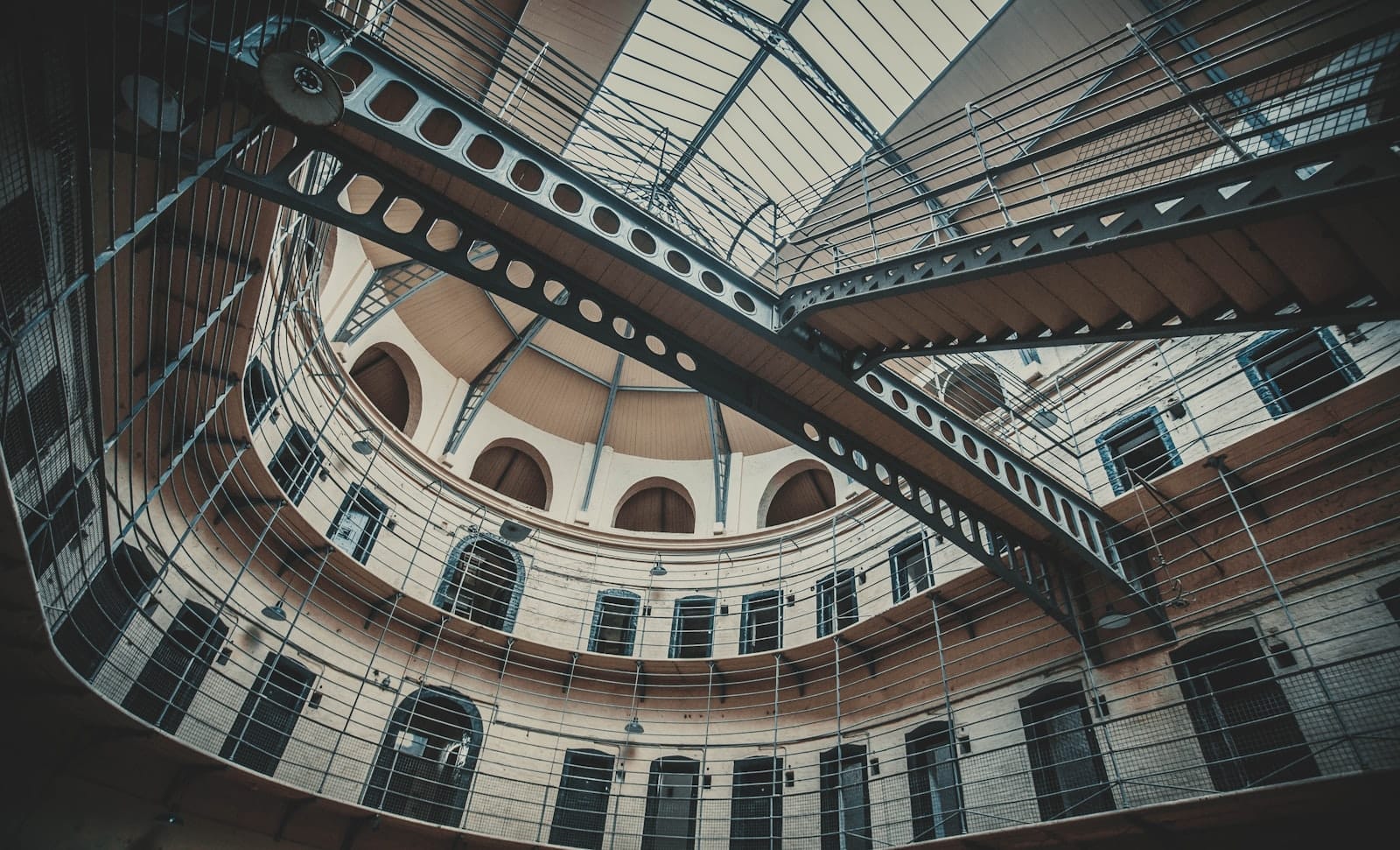
The centrepiece of the tour is the East Wing, built in 1862 in a panopticon-inspired design with three tiers of cells arranged around a skylit central hall. Natural light filters down through a large cast-iron and glass ceiling, giving the space an eerie beauty that sits in uncomfortable contrast with its function. Photographs reproduce the geometry well but fail to capture the scale or the silence. Standing on the ground floor and looking upward at the rows of identical cell doors is one of those moments that stays with visitors long after they leave.
Toward the end of the tour, guides take groups through the stone-breaking yard, where the 1916 executions took place. The storytelling at this point tends to be precise and unflinching, naming the individuals executed and describing the conditions. One of those executed, Joseph Plunkett, was married to Grace Gifford in the prison chapel hours before his death — a detail that has embedded itself in Irish ballads and is usually recounted on the tour.
Tickets & tours
Hand-picked options from our booking partner. Prices are indicative; availability and final rates are confirmed when you complete your booking.
Giant's Causeway, Dark Hedges, and Belfast Tour from Dublin
From 85 €Instant confirmationFree cancellationDublin self-guided audio tour
From 10 €Instant confirmationBird of Prey, Cliffs of Moher and Aillwee Cave from Dublin
From 201 €Instant confirmationFree cancellationGame of Thrones Studio tour with return transfer from Dublin
From 63 €Instant confirmationFree cancellation
The Exhibition: Before and After the Tour
Entry to the museum exhibition is free and separate from the paid guided tour. The exhibition traces the full span of Irish penal history from the late 18th century through independence, with particular depth around the 1916 Rising and the subsequent War of Independence. Display cases hold original documents, personal effects, and photographs. The interpretive text is unusually candid in places, acknowledging the brutality of the British administration without descending into polemic.
The exhibition is worth visiting even if you cannot secure a tour slot, though it functions better as a companion to the tour than as a standalone experience. Many visitors go through it twice: briefly before the tour to build context, then more slowly afterward when specific names and events from the tour make the displays more meaningful.
If you want to go deeper into this period of Irish history, the GPO Witness History museum in the city centre covers the Easter Rising from the other side — inside the building where the proclamation of the Republic was read. Together, the two sites give you a much fuller picture than either does alone.
Visiting by Time of Day and Season
The Visitor Centre opens daily at 09:00, with the earliest tour slots available shortly after. Morning visits — particularly on weekdays — offer the most manageable crowd sizes. By midday in summer, the building can feel considerably more crowded, and the experience in the courtyard and corridors shifts when you are surrounded by large tour groups rather than a single guided cohort.
The gaol is open year-round, and visiting outside summer has real advantages. In autumn and winter, tours tend to be smaller and the atmosphere in the stone corridors is, if anything, more affecting. The outdoor sections, including the execution yard, are exposed to Irish weather, which in November means a meaningful chance of cold rain. Waterproof footwear and a windproof outer layer are practical choices rather than precautions.
The museum is closed from 24 to 27 December. On Bank Holidays and during the week around Easter — a period of high symbolic significance in Irish history — visitor numbers increase sharply and tour slots fill weeks in advance.
💡 Local tip
Arrive 10–15 minutes before your tour slot. Latecomers may not be admitted to the guided group, and there are no refunds for missed tours. If you are travelling by bus, factor in that Dublin Bus schedules can run irregularly during peak hours.
Getting There and Practical Logistics
The gaol sits on Inchicore Road in Kilmainham, Dublin 8, roughly 3.5 kilometres west of the city centre. Several Dublin Bus routes connect the city centre to this part of Dublin; the most practical approach is to check the Transport for Ireland journey planner before you go, as specific route numbers and stops change over time. A taxi from central Dublin takes around 10 to 15 minutes in normal traffic and costs a moderate fare at metered rates.
Kilmainham is also within reasonable walking or cycling distance of the Irish Museum of Modern Art, which occupies the former Royal Hospital Kilmainham adjacent to the gaol. Combining the two sites makes for a full and varied half-day in the area.
Parking is available on-site, which is useful for visitors arriving by car from outside Dublin. The car park fills during busy periods, so arriving early is advisable if you are driving.
Accessibility at Kilmainham Gaol is limited by the building's historical fabric. The structure was not designed with modern accessibility in mind, and some sections of the tour involve uneven surfaces and narrow passages. Wheelchair users and visitors with mobility needs are strongly advised to contact the museum directly in advance at kilmainhamgaol@opw.ie to discuss arrangements. The staff are experienced in accommodating a range of needs where the building permits.
Photography, Children, and Who Might Not Enjoy This
Photography is generally permitted throughout the tour and exhibition without flash. The East Wing's vaulted light creates genuinely interesting architectural compositions, and the cell interiors reward a steady hand in low light. The execution yard, given its significance, is a place where many visitors instinctively lower their cameras — there is no rule requiring this, but the atmosphere tends to prompt it.
Children can visit, but the content is heavy. The tour covers executions, famine-era suffering, and the psychological deliberateness of solitary confinement. Children aged roughly 12 and older who have some context for Irish history tend to engage meaningfully. Younger children often find the tour confusing or distressing without that background. Parents should assess their child's readiness based on temperament and prior knowledge rather than age alone.
Visitors whose primary interest is lighter, more social Dublin experiences may find this attraction emotionally demanding rather than enjoyable. If you are looking for a broader range of activity, the things to do in Dublin guide offers a fuller picture of the city's different moods and attraction types.
Why This Place Still Matters
The restoration of Kilmainham Gaol is itself a remarkable piece of Irish history. After its closure in 1929, the building fell into serious disrepair and was considered for demolition. In 1960, a voluntary committee of citizens began a restoration project using largely unpaid labour, driven by the conviction that the building was too significant to lose. The Office of Public Works eventually took over management, but the original restoration was a grassroots act of historical preservation that reflects the depth of meaning the site holds for Irish people.
That significance extends well beyond political history. The gaol held ordinary prisoners too — men, women, and children convicted of crimes ranging from theft to vagrancy — and the exhibition engages with those lives as well as the famous ones. It is one of the reasons Kilmainham Gaol works as a museum in a way that many heritage sites do not: it does not simplify its story into a single narrative. For visitors who want to explore this era further on foot, the Glasnevin Cemetery Museum on the north side of the city offers another deeply researched window into Irish history across the same period.
Insider Tips
- Book your tour slot at least one week in advance in summer, and two to three weeks ahead around Easter and national commemoration events. The website releases new slots periodically, so checking back on a Tuesday morning often yields availability.
- The exhibition is free and does not require a tour ticket. If you are on a tight budget, you can spend 45 minutes in the exhibition and get meaningful value from the visit even without the tour.
- Wear shoes with grip. Parts of the tour route involve cobblestones and uneven stone flooring that can be slippery when the building is damp, which is frequently.
- The tour guides vary in style but are uniformly well-informed. If you get one who encourages questions, use that opportunity — the layered stories about individual prisoners are often more affecting than the headline history.
- The gift shop carries a range of books on Irish history that are considerably more substantive than typical tourist shop fare. The museum's own publications on the 1916 Rising are particularly well-regarded.
Who Is Kilmainham Gaol Museum For?
- Visitors with Irish heritage seeking to understand the independence period at its most direct source
- History enthusiasts who want primary-location storytelling rather than replicated exhibits
- School and university groups studying Irish nationalism, penal history, or colonial history
- Travellers making a deliberate effort to understand Ireland beyond its surface-level tourist image
- Film buffs: Kilmainham Gaol has appeared in several major films including In the Name of the Father and The Italian Job
Nearby Attractions
Other things to see while in Kilmainham:
- Irish Museum of Modern Art (IMMA)
The Irish Museum of Modern Art occupies the Royal Hospital Kilmainham, one of Ireland's finest 17th-century buildings, set across 48 acres in Dublin 8. Admission to most exhibitions is free, making it one of the city's most rewarding cultural visits. The combination of architecture, contemporary art, and formal gardens creates an experience that goes well beyond a typical gallery.
- War Memorial Gardens, Islandbridge
Designed by Edwin Lutyens and laid out between 1933 and 1939, the Irish National War Memorial Gardens at Islandbridge commemorate the 49,400 Irish soldiers who died in the First World War. Free to enter and open throughout the year (with daily opening times and closing at dusk), this is one of Dublin's most architecturally significant and emotionally affecting public spaces.