Irish Museum of Modern Art (IMMA): World-Class Art in a 17th-Century Masterpiece
The Irish Museum of Modern Art occupies the Royal Hospital Kilmainham, one of Ireland's finest 17th-century buildings, set across 48 acres in Dublin 8. Admission to most exhibitions is free, making it one of the city's most rewarding cultural visits. The combination of architecture, contemporary art, and formal gardens creates an experience that goes well beyond a typical gallery.
Quick Facts
- Location
- Royal Hospital Kilmainham, Military Road, Kilmainham, Dublin 8, D08 FW31
- Getting There
- 8-min walk from Heuston Luas (Red Line) stop; Dublin Bus routes serving the Heuston/Kilmainham area
- Time Needed
- 1.5 to 3 hours depending on exhibitions; add 30 min for the gardens
- Cost
- Free admission and free entry to most exhibitions; some individual exhibitions or special events ticketed — check imma.ie
- Best for
- Art lovers, architecture enthusiasts, quiet afternoons away from city-centre crowds
- Official website
- imma.ie
What Is IMMA and Why Does the Building Matter?
The Irish Museum of Modern Art, known almost universally as IMMA, is Ireland's national institution for modern and contemporary art. It was established by the Government of Ireland in 1990 and officially opened on 25 May 1991, making it a relatively young institution in a building that is anything but. The art is housed inside the Royal Hospital Kilmainham, a 17th-century complex restored by the Irish government in 1984 after years of disuse. The building predates most of Dublin's iconic landmarks and represents a bold architectural statement from a period when Ireland was reasserting its identity on the European stage.
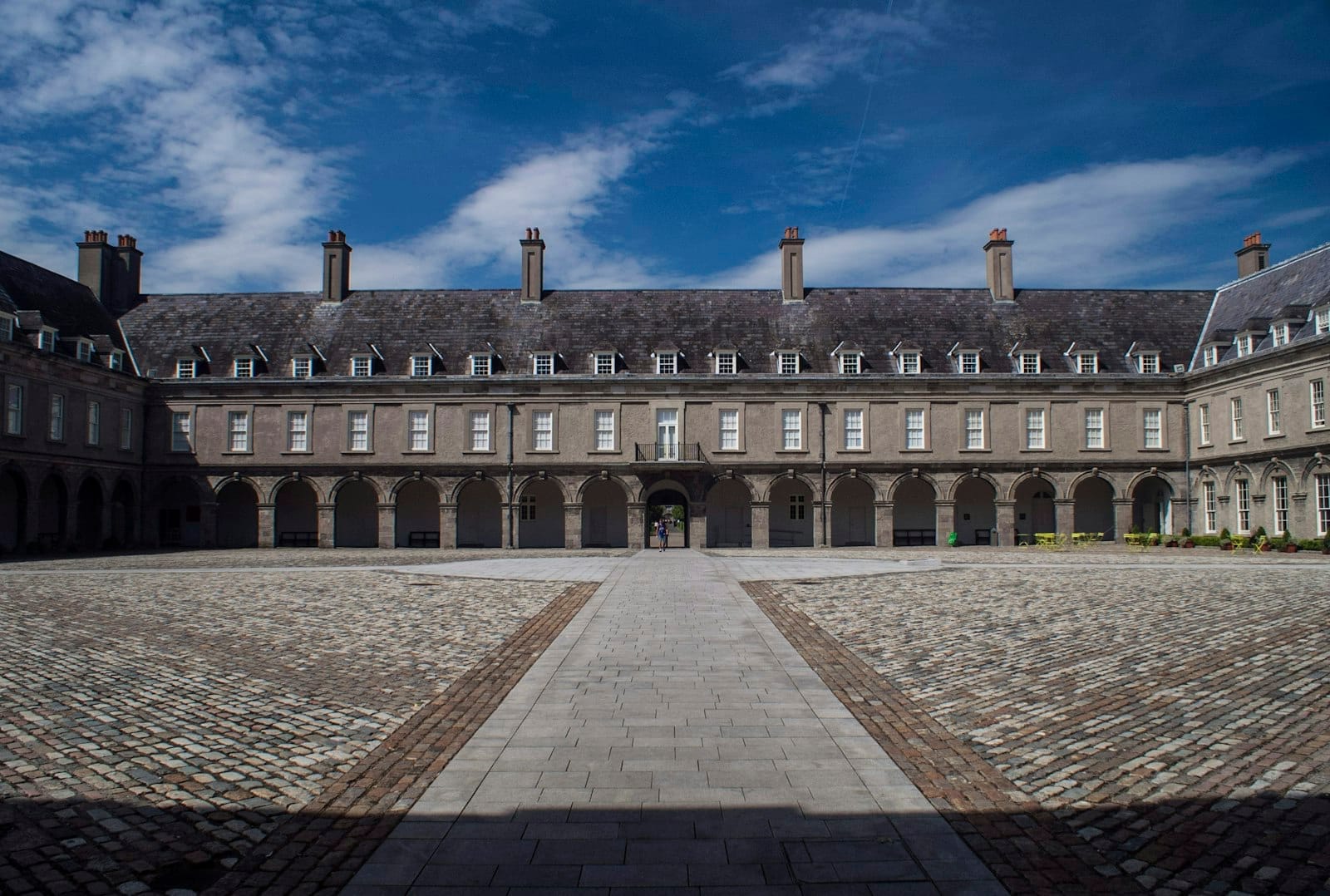
The Royal Hospital was completed in 1684 and modelled in part on Les Invalides in Paris. It was originally built as a home for retired soldiers, a function it served for over 200 years. The symmetry of the courtyard, the vaulted baroque chapel, and the long formal corridors give the building a grandeur that creates a productive tension with the contemporary and often provocative art installed within. Walking from a gallery showing video installation or abstract painting into a corridor of 17th-century stone arches is a genuinely unusual experience, and one that sets IMMA apart from purpose-built modern art spaces.
ℹ️ Good to know
IMMA is closed on Mondays, except Bank Holidays (open 12:00–17:30). On Tuesdays and Thursdays, the museum opens at 10:00, while on Wednesdays it opens later at 11:30. Last admission to galleries is 17:15 on all open days. Plan accordingly if you want the full run of the building.
Navigating the Galleries and Grounds
The museum spreads across approximately 48 acres, which catches many first-time visitors off guard. Most people arrive expecting a single building. What they find is a complex of interconnected wings arranged around a central cobbled courtyard, with formal gardens and open meadowland extending beyond the main structure. The result is that a thorough visit requires more time than typical gallery spaces of comparable reputation.
The permanent collection at IMMA spans over 3,500 works, with a focus on Irish and international art from the 1940s onward. The collection rotates regularly, so what is on display varies between visits. Alongside the permanent holdings, IMMA runs a year-round programme of temporary exhibitions, some of which attract international attention. These range from solo retrospectives of Irish artists to major touring shows from European institutions. The scale and ambition of programming is worth checking on imma.ie before your visit, since the mix of exhibitions significantly shapes what kind of afternoon you will have.
The formal gardens to the south of the main building are often overlooked. Laid out in 17th-century French style with geometric hedgerows and gravel paths, they offer a calm route between the main entrance and the meadow beyond. In summer, the gardens are bright and relatively quiet, particularly on weekday mornings. In winter, the stripped-back formality of the box hedging and bare stone becomes its own kind of austere beauty.
Tickets & tours
Hand-picked options from our booking partner. Prices are indicative; availability and final rates are confirmed when you complete your booking.
Giant's Causeway, Dark Hedges, and Belfast Tour from Dublin
From 85 €Instant confirmationFree cancellationDublin self-guided audio tour
From 10 €Instant confirmationBird of Prey, Cliffs of Moher and Aillwee Cave from Dublin
From 201 €Instant confirmationFree cancellationGame of Thrones Studio tour with return transfer from Dublin
From 63 €Instant confirmationFree cancellation
How the Experience Changes by Time of Day
Morning visits, particularly on Tuesdays and Thursdays when the museum opens at 10:00, offer the most tranquil experience inside the galleries. The cobbled courtyard catches early light from the east, and the interior corridors are largely empty until late morning. This is when you get the building at its best: footsteps echo on the stone floors, and the light through the tall windows changes slowly across the gallery walls.
By early afternoon, school groups and guided tours arrive, particularly on weekdays. The central courtyard becomes livelier, and the café fills up. If you are visiting specifically for quiet contemplation of the art, arriving at opening time and working through the galleries before noon gives you a noticeably different experience than arriving post-lunch. Sunday visits from 12:00 onward tend to attract a mix of families and couples exploring the grounds, with less concentration in the galleries themselves.
💡 Local tip
The formal gardens on the south side of the building are almost always quieter than the main galleries. If the interior feels busy, stepping outside into the parterre offers an immediate sense of space and calm — and the view back toward the building from the garden path is one of the most photogenic angles of the entire complex.
The Architecture Up Close: What to Look For
The Royal Hospital Kilmainham is considered one of the finest 17th-century buildings in Ireland, and the details reward close attention. The main courtyard is framed by arcaded walkways on three sides, with stone columns that show their age in the subtle unevenness of the masonry. The chapel, located in the north wing, features a baroque plasterwork ceiling and carved wooden reredos that are among the best examples of their type in the country. It is used today for concerts and events, and even when closed to casual visitors, you can often peer in through the glazed doors.
The east wing contains the great hall, which now functions as an events and reception space. Its proportions — long, high-ceilinged, with painted portraiture along the upper walls — recall the building's original ceremonial function. When an exhibition spills into this space, the contrast between the historic setting and contemporary work can be striking. The stone floors throughout the building are original, worn smooth in places where foot traffic has been consistent for over three centuries.
For anyone with a broader interest in Dublin's architectural history, IMMA sits within a neighbourhood with exceptional density of significant buildings. Kilmainham Gaol is less than ten minutes on foot, and the Georgian Dublin architecture guide provides useful context for reading the building within the wider story of Irish civic construction.
Getting There and Moving Around the Site
The most straightforward route from the city centre is the Luas Red Line to Heuston Station, followed by an eight-minute walk west toward the Royal Hospital gates. Dublin Bus also serves the Heuston and Kilmainham area; confirm current routes and stops via the Dublin Bus website or the Transport for Ireland Journey Planner, as routes can change.
On-site car parking is available at the Royal Hospital Kilmainham. The grounds are largely step-free outdoors, and IMMA states that the building is wheelchair accessible, though some historic interior spaces have limitations due to the age of the structure. Lockers are available inside for bags and coats. A café on site provides food and drinks, and given the size of the complex, factoring in a break is reasonable for longer visits.
If you are planning a wider day in this part of Dublin, IMMA pairs naturally with the area around Kilmainham and is a reasonable starting point for anyone following a Dublin walking tour that covers the western inner city.
Practical Notes: Photography, Weather, and What to Bring
Photography policies inside the galleries vary by exhibition, particularly when works by living artists are on show under specific licensing terms. As a general rule, IMMA permits personal photography in most areas, but tripods and commercial shoots require prior permission. The courtyard and gardens are freely photographable at all times, and the geometry of the parterre garden is particularly effective in morning light or on overcast days when contrast is even.
Dublin's maritime climate means that visiting the outdoor grounds in comfort depends somewhat on the season. Summer visits in May to August offer the longest daylight and the best conditions for walking the full 48-acre site. In autumn and winter, the gardens remain open but the meadow grass gets wet and the wind through the open grounds is noticeable. Wearing layers and waterproof footwear for any visit that includes the gardens is simply practical, regardless of the forecast.
⚠️ What to skip
IMMA’s main museum entrance is on the Military Road side of the Royal Hospital, with a secondary pedestrian entrance on South Circular Road opposite Kilmainham Gaol. First-time visitors arriving by bus or on foot sometimes spend a few minutes locating the correct entry point — check the map on imma.ie before you arrive.
Who Will Get the Most from IMMA
IMMA works best for visitors who want to combine a genuine art experience with architecture and outdoor space in a single location. The free admission model means there is no pressure to rush through the galleries, and the scale of the site encourages a slower pace than most city-centre attractions allow. For anyone building a broader cultural itinerary around Dublin, the museum sits comfortably alongside the city's other major collections.
If modern and contemporary art is your priority, it is worth pairing IMMA with the Dublin City Gallery: The Hugh Lane in Parnell Square, which holds an exceptional collection of Impressionist and 20th-century Irish work including Francis Bacon's reconstructed studio. Together, the two galleries cover Irish and international modern art with considerable depth. For broader context on Dublin's museum landscape, the best museums in Dublin guide maps out how IMMA fits alongside the national collections.
Visitors looking for a high-energy or highly interactive experience will find IMMA comparatively quiet and self-directed. The museum does not have large-scale multimedia installations as a permanent feature, and the programming, while ambitious, leans toward thoughtful engagement rather than spectacle. Families with young children can visit — the museum offers activity packs and periodic workshops — but the building and grounds are not designed around child-centred experiences in the way that some venues are.
Insider Tips
- The vaulted baroque chapel in the north wing is one of the finest rooms in Dublin and is easily missed if you follow only the gallery signage. Ask at the front desk whether it is open to visitors on the day you arrive.
- Wednesday's later opening (11:30) is less well known, so Tuesday and Thursday mornings, when the museum opens at 10:00, consistently have the fewest visitors in the galleries. If your schedule is flexible, Tuesday at opening is one of the quietest windows of the week.
- The meadow behind the formal gardens connects through to the south grounds and offers an unobstructed view of the rear facade of the Royal Hospital. Very few visitors walk this far, and it is worth the five minutes, particularly in spring when the grass is green and the building catches the afternoon light from the west.
- IMMA's free evening events and artist talks, often part of the IMMA Nights programme on Thursday and Friday evenings from May to September, attract a younger local crowd and a different atmosphere than daytime visits. Check the events calendar on imma.ie; these are often announced only a few weeks in advance.
- The on-site café is run separately from the museum and has its own opening schedule, which does not always align with gallery hours. If you are planning a lunch break as part of your visit, check the café hours on arrival or via the IMMA website before building your timing around it.
Who Is Irish Museum of Modern Art (IMMA) For?
- Art and architecture enthusiasts wanting depth without the pressure of paid admission
- Visitors looking for a slower-paced afternoon away from the tourist concentration in the city centre
- Photographers interested in historic courtyard and garden compositions
- Travellers combining IMMA with a half-day in Kilmainham that includes the Gaol
- Locals and repeat visitors who follow IMMA's rotating programme of temporary exhibitions
Nearby Attractions
Other things to see while in Kilmainham:
- Kilmainham Gaol Museum
Kilmainham Gaol is a former Victorian prison in western Dublin where the leaders of the 1916 Easter Rising were executed. Now a state-managed museum, it offers guided tours through cold stone cells, a skylit Victorian wing, and a courtyard where Irish history reached some of its darkest turning points. Pre-booking is essential.
- War Memorial Gardens, Islandbridge
Designed by Edwin Lutyens and laid out between 1933 and 1939, the Irish National War Memorial Gardens at Islandbridge commemorate the 49,400 Irish soldiers who died in the First World War. Free to enter and open throughout the year (with daily opening times and closing at dusk), this is one of Dublin's most architecturally significant and emotionally affecting public spaces.